

Optimizing subgroup selection in petrochemical industries: A robust data envelopment analysis approach for uncertainty management

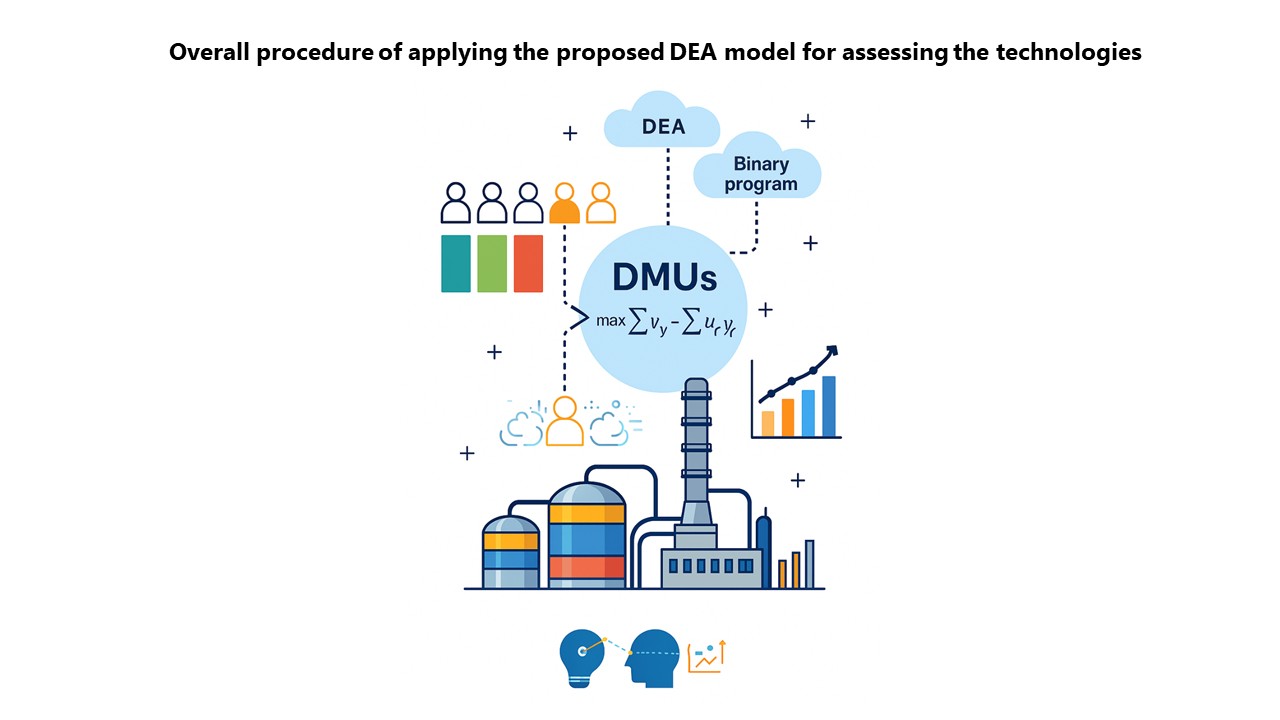
This study addresses the critical challenge faced by organizations in selecting an optimal subgroup of decision-making units (DMUs). Such a selection procedure can significantly influence efficiency, profitability, and strategic development. Recognizing the limitations of existing methods in handling inexact data and incorporating managerial preferences, this study proposes a novel framework that integrates data envelopment analysis (DEA) with binary linear programming models. The model applies belief-degree–based representations of uncertainty to capture imprecise inputs and outputs. For this model, two solution approaches—namely, chance-constrained programming and expected value approaches—were developed. These approaches are suitable for real world applications using standard optimization software. The effectiveness of the proposed method was validated through a case study in Iran’s petrochemical industry, where it successfully identified the optimal technology for a new refinery unit while balancing efficiency and profitability under uncertainty. This work is the first study in the literature to combine DEA and binary linear programming under belief-degree–based uncertainty for DMU selection, offering a systematic, practical, and computationally efficient solution, with recommendations for future research to explore alternative uncertainty modeling techniques and broader industrial applications.
- Modhej D, Sanei M, Shoja N, Hosseinzadeh LotfiF. Integrating inverse data envelopment analysis and neural network to preserve relative efficiency values. J Intell Fuzzy Syst. 2017;32(6):4047-4058. https://doi.org/10.3233/JIFS-162926
- Monzeli A, Daneshian B, Tohidi G, Sanei M, Razaveian S. Improving hospital efficiency and economic performance: a DEA approach with un- desirable factors in Tehran emergency wards. Int J Econ Sci. 2025;14(1):90-107. https://doi.org/10.31181/ijes1412025174
- Farrell MJ. The measurement of productive efficiency. J R Stat Soc A. 1957;120(3):253-281. https://doi.org/10.2307/2343100
- Charnes A, Cooper WW, Rhodes E. Measuring the efficiency of decision-making units. Eur J Oper Res. 1978;2(6):429-444. https://doi.org/10.1016/0377-2217(78)90138-8
- Banker RD, Charnes A, Cooper WW. Some mod- els for estimating technical and scale inefficiencies in data envelopment analysis. Manag Sci. 1982;28(9):1078-1092. https://www.jstor.org/stable/2631725
- Contreras I. A review of the literature on DEA models under common set of weights. J Model Manag. 2020;15(4):1277-1300. https://doi.org/10.1108/JM2-02-2019-0043
- Modarresi N, Darvishi M, Banihashemi S. Modeling sustainable development of cryptocurrencies by a fractional pure-jump process in DEA frame- work. Int J Econ Sci. 2025;14(1):108-122. https://doi.org/10.31181/ijes1412025178
- Basuri T, Gazi KH, Bhaduri P, Das SG, Mondal SP. Decision-analytics-based sustainable location problem-neutrosophic CRITIC-COPRAS assessment model. Manag Sci Adv. 2025;2(1):19-58. https://doi.org/10.31181/msa2120257
- Mahmoodirad A, Sanei M. Solving a multi- stage multi-product solid supply chain network design problem by meta-heuristics. Sci Iran. 2016;23(3):1428-1440. https://doi.org/10.24200/sci.2016.3908
- Molla-Alizadeh-Zavardehi S, Mahmoodirad A, Rahimian M. Step fixed charge transportation problems via genetic algorithm. Indian J Sci Technol. 2014;7(7):949. https://doi.org/10.17485/ijst/2014/v7i7.5
- Contreras I, Brey R, Carazo AF, Brey JJ. A DEA based procedure for the selection of subgroups. Appl Math Model. 2014;38(17-18):4538-4547. https://doi.org/10.1016/j.apm.2014.03.015
- Amirteimoori A, Allahviranloo T, Khoshandam L. Marginal rates of technical changes and impact in stochastic data envelopment analysis: an application in power industry. Expert Syst Appl. 2024;237:121722. https://doi.org/10.1016/j.eswa.2023.12172
- Mondal S, Goswami SS, Gupta KK, Sahoo SK. Synergistic effects of lean manufacturing and digitalization on operational effectiveness: a comprehensive review. Spectr Decis Mak Appl. 2026;3(1):21-39. https://doi.org/10.31181/sdmap31202634
- Sanei M, Rostamy-Malkhalifeh M, Saleh H. A new method for solving fuzzy DEA models. Int J Ind Math. 2009;1(4):307-313.
- Sanei M, Noori N, Saleh H. Sensitivity analysis with fuzzy data in DEA. Appl Math Sci. 2009;3(25):1235-1241.
- Shafiee M, Saleh H. Evaluation of strategic performance with fuzzy data envelopment analysis. Int J Data Envelopment Anal. 2019;7(4):1-20.
- Shirazi F, Mohammadi E. Evaluating efficiency of airlines: a new robust DEA approach with undesirable output. Res Transp Bus Manag. 2019;33:100467. https://doi.org/10.1016/j.rtbm.2020.100467
- Mehdiabadi A, Sadeghi A, Yazdi AK, Tan Y. Sustainability service chain capabilities in the oil and gas industry: a fuzzy hybrid approach SWARA- MABAC. Spectr Oper Res. 2025;2(1):92-112. https://doi.org/10.31181/sor21202512
- Liu B. Uncertainty Theory. 2nd ed. Berlin, Heidelberg: Springer; 2007. https://doi.org/10.1007/978-3-540-73165-8
- Niroomand S, Pamucar D, Mahmoodirad A. Formulation and solution approach for uncertain multi-objective material requirement planning problem with multi-mode demand, overtime production, and outsourcing possibilities. J Syst Sci Syst Eng. 2025;34(1):1-28. https://doi.org/10.1007/s11518-024-5627-7
- Farzan N, Mahmoodirad A, Niroomand S, Molla- Alizadeh-Zavardehi S. A sustainable uncertain integrated supply chain network design and assembly line balancing problem with U-shaped assembly lines and multi-mode demand. Soft Comput. 2024;28:2967-2986. https://doi.org/10.1007/s00500-023-09227-0
- Niroomand S, Aviso KB, Mahmoodirad A. An uncertain multi-objective model for simultaneous design of supply chain and assemblers considering sustainable development: a case study. CIRP J Manuf Sci Technol. 2023;47:86-102. https://doi.org/10.1016/j.cirpj.2023.08.007
- Mamoodird A, Niroomand S. A belief degree- based uncertain scheme for a bi-objective two-stage green supply chain network design problem with direct shipment. Soft Comput. 2020;24(24):18499–18519. https://doi.org/10.1007/s00500-020-05085-2
- Mahmoodirad A, Niroomand S. Uncertain location-allocation decisions for a bi-objective two-stage supply chain network design problem with environmental impacts. Expert Syst. 2020;37(5):e12558. https://doi.org/10.1111/exsy.12558
- Jamshidi M, Saneie M, Mahmoodirad A, Hosseizadeh Lotfi F, Tohidi G. Uncertain RUS- SEL data envelopment analysis model: a case study in Iranian banks. J Intell Fuzzy Syst. 2019;37(2):2937-2951. https://doi.org/10.3233/JIFS-190067
- Jamshidi M, Sanei M, Mahmoodirad A, Tohidi G, Hosseinzade Lotfi F. Uncertain SBM data envelopment analysis model: a case study in Iranian banks. Int J Finance Econ. 2021;26(2):2674-2686. https://doi.org/10.1002/ijfe.1927
- Hossein-Jafari Z, Sanei M, Shirazi F. Fuzzy DEA approach for efficiency evaluation of airlines with undesirable outputs. Int J Data Envelopment Anal. 2021;9(3):1-18. https://doi.org/10.1007/s40747-022-00687-9
- Kiani M, Sanei M, Saleh H. A robust DEA model for evaluating the efficiency of airlines with undesirable outputs. Int J Ind Math. 2018;10(4):389-
- Salehi M, Kiani M, Sanei M. An integrated model of DEA and regression analysis for efficiency evaluation in the presence of undesirable outputs. J Intell Fuzzy Syst. 2017;33(3):1819-1830.
- Wen M, Zhang Q, Kang R, Yang Y. Some new ranking criteria in data envelopment analysis under uncertain environment. Comput Ind Eng. 2017;110:498-504. https://doi.org/10.1016/j.cie.2017.05.034
- Mohmmad Nejad Z, Ghaffari-Hadigheh A. A novel DEA model based on uncertainty theory. Ann Oper Res. 2018;264:367-389. https://doi.org/10.1007/s10479-017-2652-7
- Lio W, Liu B. Uncertain data envelopment analysis with imprecisely observed inputs and outputs. Fuzzy Optim Decis Mak. 2018;17:357-373. https://doi.org/10.1007/s10700-017-9276-x
- Pourmahmoud J, Bagheri Uncertain Malmquist productivity index: an application to evaluate healthcare systems during COVID-19 pandemic. Socioecon Plann Sci. 2023;87:101522. https://doi.org/10.1016/j.seps.2023.101522
- Mahmoodirad A, Jamalian A, Hajiaghaei- Keshteli M. An analysis of the sensitivity and stability of an uncertain SBM DEA model based on belief degree. Expert Syst Appl. 2024;255:124778. https://doi.org/10.1016/j.eswa.2024.124778
- Han Y, Geng Z. Energy efficiency hierarchy evaluation based on data envelopment analysis and its application in a petrochemical process. Chem Eng Technol. 2014;37(12):2085-2095. https://doi.org/10.1002/ceat.201300853
- Chung Y, Heshmati A. Measurement of environmentally sensitive productivity growth in Korean industries. J Clean Prod. 2015;104:380-391. https://doi.org/10.1016/j.jclepro.2014.06.030
- Bafrooei AA, Mina H, Ghaderi SF. A supplier selection problem in petrochemical industry using common weight data envelopment analysis with qualitative criteria. Int J Ind Syst Eng. 2014;18(3):404-417. https://doi.org/10.1504/IJISE.2014.065542
- Assaf SA, Hadidi LA, Hassanain MA, Rezq MF. Performance evaluation and benchmarking for maintenance decision making units at petrochemical corporation using a DEA model. Int J Adv Manuf Technol. 2015;76:1957-1967. https://doi.org/10.1007/s00170-014-6422-2
- Ramazankhani ME, Mostafaeipour A, Hosseininasab H, Fakhrzad MB. Feasibility of geothermal power assisted hydrogen production in Iran. Int J Hydrogen Energy. 2016;41(41):18351-18369. https://doi.org/10.1016/j.ijhydene.2016.08.150
- Gilsa CV, Lacerda DP, Camargo LFR, Souza IG, Cassel RA. Longitudinal evaluation of efficiency in a petrochemical company. Benchmarking Int J. 2017;24(7):1786-1813. https://doi.org/10.1108/BIJ-03-2016-0044
- Alidrisi H, Aydin ME, Bafail AO, Abdulal R, Karuvatt SA. Monitoring the performance of petrochemical organizations in Saudi Arabia using data envelopment analysis. 2019;7(6):519. https://doi.org/10.3390/math7060519
- Wang CN, Tsai HT, Ho TP, Nguyen VT, Huang YF. Multi-criteria decision making (MCDM) model for supplier evaluation and selection for oil production projects in Vietnam. 2020;8(2):134. https://doi.org/10.3390/pr8020134
- Keivani E, Abbaspour M, Abedi Z, Ahmadian M. Promotion of low-carbon economy through efficiency analysis: a case study of a petrochemical plant. Int J Environ Res. 2021;15:45-55. https://doi.org/10.1007/S41742-020-00282-1
- Mozaffari MR, Mohammadi S, Wanke PF, Cor- rea HL. Towards greener petrochemical production: two-stage network data envelopment analysis in a fully fuzzy environment in the presence of undesirable outputs. Expert Syst Appl. 2021;164:113903. https://doi.org/10.1016/j.eswa.2020.113903
- Izadikhah M, Farzipoor Saen R, Zare R, Shamsi M, Khanmohammadi Hezaveh M. Assessing the stability of suppliers using a multi-objective fuzzy voting data envelopment analysis model. Environ Dev Sustain. 2022;27(9):22005-22047. https://doi.org/10.1007/s10668-022-02376-6
- Bazargan A, Najafi SE, Lotfi FH, Fallah M, Edalatpanah SA. Presenting a productivity analysis model for Iran oil industries using Malmquist network analysis. Decis Mak Appl Manag Eng. 2023;6(2):251-292. https://doi.org/10.31181/dmame622023705
- Zhu Z, Zhang S. The impact of industrial- university-research collaborations on innovation output in China’s petroleum and petrochemical industry. Appl Math Nonlinear Sci. 2023;8(2):3393-3406. https://doi.org/10.2478/amns.2023.2.01137
- Gattoufi S, Amin GR, Emrouznejad A. A new inverse DEA method for merging banks. IMA J Manag Math. 2014;25(1):73-87. https://doi.org/10.1093/imaman/dps027
- Amin GR, Ibn Boamah M. A new inverse DEA cost efficiency model for estimating potential merger gains: a case of Canadian banks. Ann Oper Res. 2020;295(2):21-36. https://doi.org/10.1007/s10479-020-03667-9
- Zeinodin E, Ghobadi S. Merging DMUs based on of the idea inverse DEA. Iran J Optim. 2019;11(2):77-84.
- Soltanifar M, Ghiyasi M, Sharafi H. Inverse DEA- R models for merger analysis with negative data. IMA J Manag Math. 2023;34(3):491-510. https://doi.org/10.1093/imaman/dpac001
- Thomas P, Chan Y, Lehmkuhl L, Nixon W. Obnoxious-facility location and data- envelopment analysis: a combined distance-based formulation. Eur J Oper Res. 2002;141(3):495- 514. https://doi.org/10.1016/S0377-2217(01)00266-1
- Klimberg RK, Ratick SJ. Modeling data envelopment analysis (DEA) efficient location/allocation decisions. Comput Oper Res. 2008;35(2):457-474. https://doi.org/10.1016/j.cor.2006.03.010
- Moheb-Alizadeh H, Rasouli SM, Tavakkoli- Moghaddam R. The use of multi-criteria data envelopment analysis (MCDEA) for location–allocation problems in a fuzzy environment. Expert Syst Appl. 2011;38(5):5687-5695. https://doi.org/10.1016/j.eswa.2010.10.065
- Gal´an-Madruga D, Broomandi P, Satyanaga A, et al. A methodological framework for estimating ambient PM2.5 particulate matter concentrations in the UK. J Environ Sci. 2025;150:676-691. https://doi.org/10.1016/j.jes.2023.11.019
- Broomandi P, Satyanaga A, Bagheri M, et al. Extreme temperature events in Kazakhstan and their impacts on public health and energy demand. Glob Chall. 2025;9(2):2400207. https://doi.org/10.1002/gch2.202400207
- Broomandi P, Gal´an-Madruga D, Satyanaga A, et al. Variability of Middle East springtime dust events between 2011 and 2022. Air Qual Atmos Health. 2024;17(6):1341-1360. https://doi.org/10.1007/s11869-024-01510-9
- Broomandi P, Bagheri M, Fard AM, et al. Energy generation and carbon footprint under future projections (2022–2100) of central Asian temperature extremes. Glob Chall. 2025;9(5):2400356. https://doi.org/10.1002/gch2.202400356
- Chakraborty S, Saha AK. Selection of Fork- lift unit for transport handling using integrated MCDM under neutrosophic environment. Facta Univ Ser Mech Eng. 2024;235-256. https://doi.org/10.22190/FUME220620039C