

A fuzzy–digital twin optimization framework for simultaneous management of waste and energy consumption in sustainable manufacturing

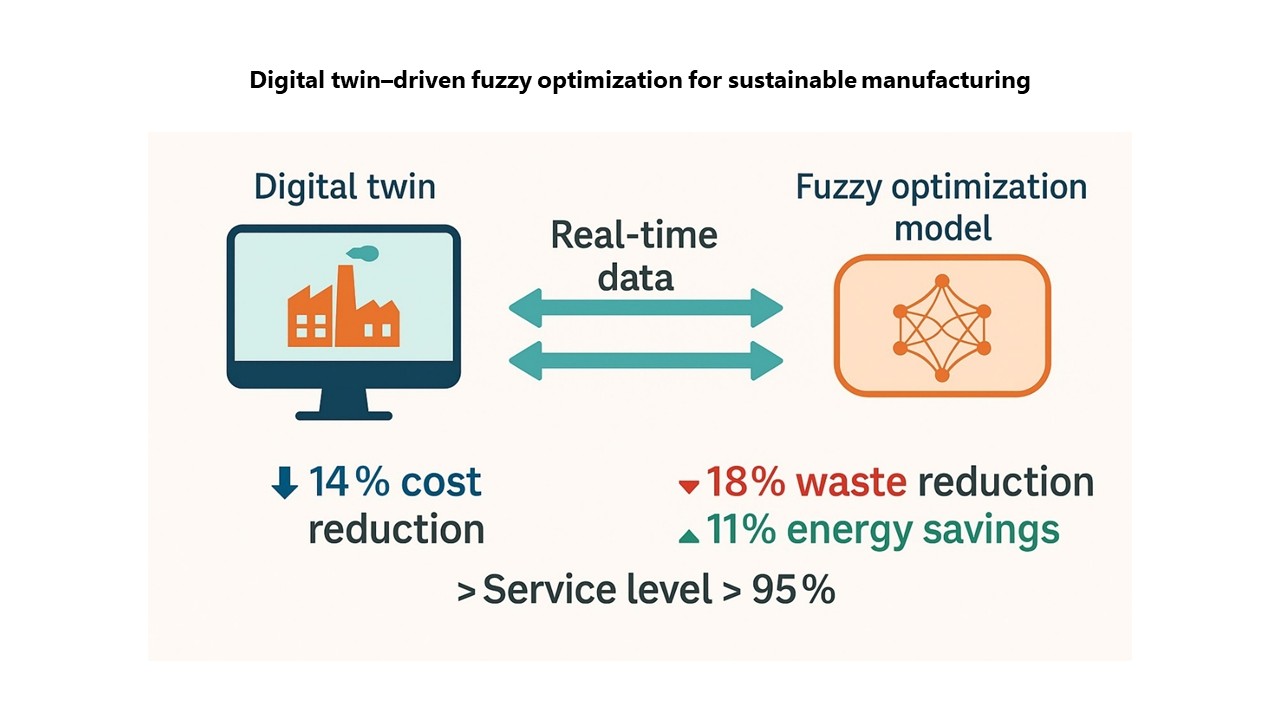
Sustainable manufacturing systems require intelligent methods to balance economic performance with environmental responsibility. This research presents a digital twin-fuzzy multi-objective optimization framework for simultaneously managing cost, energy consumption, and waste in sustainable manufacturing. In this framework, fuzzy logic is used to model data uncertainty, a digital twin is used to obtain real-time data from the manufacturing process, and the Non-dominated Sorting Genetic Algorithm II (NSGA-II) is used to generate a Pareto front and analyze the relationships between economic and environmental objectives. The proposed model was tested in 10 simulated scenarios based on digital twin data. The results showed that the proposed framework maintained the service level above 95%, reduced the total cost by 14% and the amount of waste by 18% compared to the baseline. Pareto front analysis also showed that although there is a relative conflict between economic and environmental objectives, this conflict is controllable. Also, sensitivity analysis revealed that energy ceiling and machinery efficiency have the greatest impact on the sustainability and profitability of the system. Overall, the proposed framework provides a reliable, quantitative decision-making tool for managers and policymakers on the path to green and sustainable production.
- Prauzek M, Gaiova K, Kucova T, Konecny J. Fuzzy energy management strategies for energy harvesting IoT nodes based on a digital twin concept. Future Gener Comput Syst. 2025;166:107717. https://doi.org/10.1016/j.future.2025.107717
- Sajadieh SMM, Noh SD. A review of digital twin integration in circular manufacturing for sustainable industry transition. 2025;17(16):7316. https://doi.org/10.3390/su17167316
- Movahed AB, Aliahmadi A, Parsanejad M, Nozari H. A systematic review of collaboration in supply chain 4.0 with meta-synthesis method. Supply Chain Anal. 2023;4:100052. https://doi.org/10.1016/j.sca.2023.100052
- Li L, Mao C, Sun H, Yuan Y, Lei B. Digital twin driven green performance evaluation methodology of intelligent manufacturing: hybrid model based on fuzzy rough-sets AHP, multistage weight synthesis, and PROMETHEE II. 2020;2020(1):3853925. https://doi.org/10.1155/2020/3853925
- Abdoune F, Ragazzini L, Nouiri M, Negri E, Cardin O. Toward digital twin for sustainable manufacturing: a data-driven approach for energy consumption behavior model generation. Comput Ind. 2023;150:103949. https://doi.org/10.1016/j.compind.2023.103949
- Agarwal A, Sinha I, Bhattacharyya S, Mamodiya U. Leveraging digital twin technology in industrial IoT for energy optimization and waste reduction . In: Accelerating Product Development Cycles with Digital Twins and IoT Integration. IGI Global ; 2025:301-322. https://doi.org/10.4018/979-8-3373-2028- ch015
- Dli M, Puchkov A, Meshalkin V, Abdeev I, Saitov R, Abdeev R. Energy and resource efficiency in apatite-nepheline ore waste processing using the digital twin approach. 2020;13(21):5829. https://doi.org/10.3390/en13215829
- Gandhimathi S, Gayathri K, Swapna HR, et al. A fuzzy blockchain-enabled digital twin model for predictive and sustainable urban waste management. Metall Mater Eng. 2025;31(6):187-197. https://doi.org/10.63278/mme.vi.1823
- Nozari H, Fallah M, Szmelter-Jarosz A, Krzemin´ski M. Analysis of security criteria for IoT-based supply chain: a case study of FMCG industries. Cent Eur Manag J. 2021;29(4):149- 171. https://doi.org/10.7206/cemj.2658-0845.63
- Paraschos PD, Papadopoulos G, Koulouriotis DE. Multi-objective evolution and swarm- integrated optimization of manufacturing pro- cesses in simulation-based environments. Ma- chines. 2025;13(7):611. https://doi.org/10.3390/machines13070611
- He B, Mao H. Digital twin-driven product sustainable design for low carbon footprint. J Com- put Inf Sci Eng. 2023;23(6):060805. https://doi.org/10.3390/machines13070611
- Zhang Z, Wei Z, Court S, et al. A review of digital twin technologies for enhanced sustain- ability in the construction industry. 2024;14(4):1113. https://doi.org/10.3390/buildings14041113
- Yuan G, Lv F, Shi J, et al. Integrated optimisation of human-robot collaborative disassembly planning and adaptive evaluation driven by a digital twin. Int J Prod Res. 2024;1-19. https://doi.org/10.1080/00207543.2024.2381710
- Alnaser AA, Maxi M, Elmousalami H. AI- powered digital twins and Internet of Things for smart cities and sustainable building environment. Appl Sci. 2024;14(24):12056. https://doi.org/10.3390/app142412056
- Abdi H, Nozari AIoE-enhanced multi- objective optimization for sustainable bioprocesses in smart bioreactors. In: Artificial Intelligence of Everything and Sustainable Development. Springer; 2025:19-38. https://doi.org/10.1007/978-981-96-7202-82
- Zhou F, Yu K, Xie W, Lyu J, Zheng Z, Zhou S. Digital twin-enabled smart maritime logistics management in the context of industry 5.0. IEEE Access. 2024;12:10920-10931. https://doi.org/10.1109/ACCESS.2024.3354838
- Ranawaka A, Alahakoon D, Sun Y, Hewap- athirana K. Leveraging the synergy of digital twins and artificial intelligence for sustain- able power grids: a scoping review. 2024;17(21):5342. https://doi.org/10.3390/en17215342
- Aliahmadi A, Nozari H, Ghahremani-Nahr J, Szmelter-Jarosz A. Evaluation of key impression of resilient supply chain based on artificial intelligence of things (AIoT). J Fuzzy Ext Appl. 2022;3(3):201-211. https://doi.org/10.22105/jfea.2022.345008.1221
- Maksimovi´c M, Joki´c S, Boˇskovi´c MCˇ. Innovative horizons for sustainable smart energy: exploring the synergy of 5G and digital twin technologies. Process Integr Optim Sustain. 2025;9(2):431-470. https://doi.org/10.1007/s41660-024-00478-4
- Rahmani R, Jesus C, Lopes SI. Implementations of digital transformation and digital twins: exploring the factory of the future. 2024;12(4):787. https://doi.org/10.3390/pr12040787
- Setyadi A, Soekotjo S, Lestari SD, Pawirosumarto S, Damaris A. Trends and opportunities in sustainable manufacturing: a systematic review of key dimensions from 2019 to 2024. Sus- tainability. 2025;17(2):789. https://doi.org/10.3390/su17020789