
Artificial intelligence and additive manufacturing as a coupled design system: Rethinking inference, manufacturability, and design education

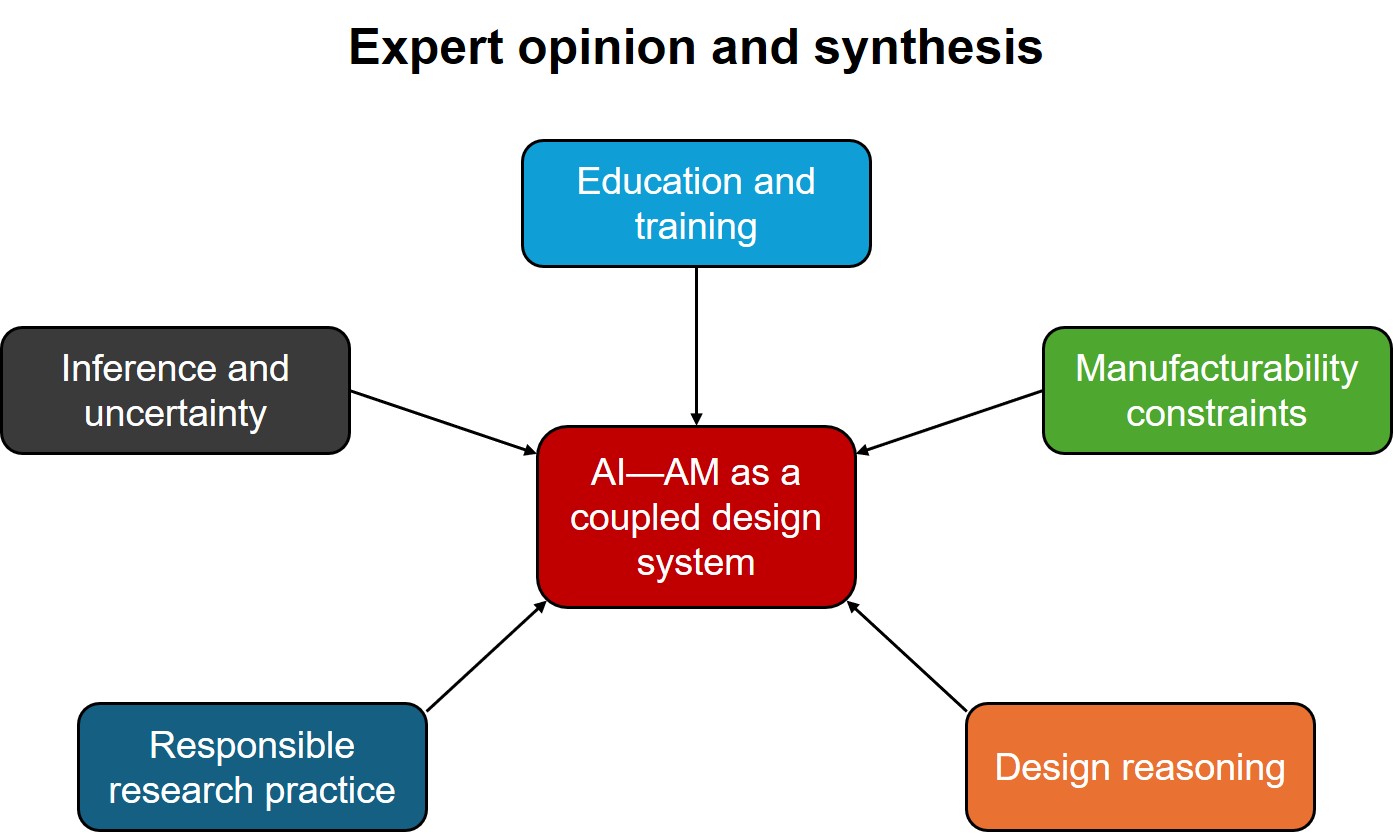
Artificial intelligence (AI) is becoming deeply integrated into additive manufacturing (AM) workflows, reshaping how designers approach geometry, materials, and process constraints. AI holds significant potential by accelerating design exploration, revealing complex patterns in AM behavior, and supporting earlier assessment of manufacturability. At the same time, it introduces new risks related to model transparency, data quality, physical validity, and the potential for overreliance by students and practitioners. This perspective examines these issues through four guiding questions that address the role of AI in AM-enabled design, the gaps that limit or enable AI contribution, the implications for engineering education, and the responsibilities of the research community in ensuring trustworthy and secure AI–AM integration. The main contributions of this perspective include: (i) Highlighting AI and AM as a coupled inference–fabrication system rather than independent tools; (ii) identifying zones of strong interdependence where inference and manufacturability interact; and (iii) articulating implications for design reasoning, education, and responsible research practice.
- National Aeronautics and Space Administration (NASA). NASA Systems Engineering Handbook. United States: NASA; 2016. Available from: https://www.nasa.gov/reference/ systems-engineering-handbook [Last accessed on 2025 Nov 12].
- Dekkers R, Chang CM, Kreutzfeldt J. The interface between “product design and engineering” and manufacturing: A review of the literature and empirical evidence. Int J Prod Econ. 2013;144(1):316-333. doi: 10.1016/j.ijpe.2013.02.020
- Wiberg A, Persson J, Olvander J. Design for additive manufacturing - a review of available design methods and software. Rapid Prototyp J. 2019;25(6):1080-1094. doi: 10.1108/rpj-10-2018-0262
- Gibson I, Rosen D, Stucker B, Khorasani M. Design for Additive Manufacturing. Berlin: Springer International Publishing; 2020. p. 555-607. doi: 10.1007/978-3-030-56127-7_19
- De Pastre MA, Quinsat Y, Lartigue C. Effects of additive manufacturing processes on part defects and properties: A classification review. Int J Interact Design Manuf. 2022;16(4):1471-1496. doi: 10.1007/s12008-022-00839-8
- Bhandarkar VV, Shahare HY, Mall AP, Tandon P. An overview of traditional and advanced methods to detect part defects in additive manufacturing processes. J Intell Manuf. 2024;36(7):4411-4446. doi: 10.1007/s10845-024-02483-3
- Colosimo BM, Huang Q, Dasgupta T, Tsung F. Opportunities and challenges of quality engineering for additive manufacturing. J Qual Technol. 2018;50(3):233-252. doi: 10.1080/00224065.2018.1487726
- Patterson AE, Allison JT. Mapping and enforcement of minimally restrictive manufacturability constraints in mechanical design. ASME Open J Eng. 2022;1:014502. doi: 10.1115/1.4054170
- Patterson AE, Chadha C, Jasiuk IM. Manufacturing process-driven structured materials (MPDSMs): Design and fabrication for extrusion-based additive manufacturing. Rapid Prototyp J. 2021;28(4):716-731. doi: 10.1108/rpj-04-2021-0072
- Thompson MK, Moroni G, Vaneker T, et al. Design for additive manufacturing: Trends, opportunities, considerations, and constraints. CIRP Ann. 2016;65(2):737-760. doi: 10.1016/j.cirp.2016.05.004
- Bikas H, Stavropoulos P, Chryssolouris G. Additive manufacturing methods and modelling approaches: A critical review. Int J Adv Manuf Technol. 2015;83(1-4): 389-405. doi: 10.1007/s00170-015-7576-2
- DebRoy T, Wei H, Zuback J, et al. Additive manufacturing of metallic components - process, structure and properties. Prog Mater Sci. 2018;92:112-224. doi: 10.1016/j.pmatsci.2017.10.001
- Meng L, McWilliams B, Jarosinski W, et al. Machine learning in additive manufacturing: A review. J Miner. 2020;72(6):2363-2377. doi: 10.1007/s11837-020-04155-y
- Mattera G, Chozaki SP, Norrish J. Advances in machine learning for parameters optimisation and in-situ monitoring of wire arc additive manufacturing. Weld World. 2025. doi: 10.1007/s40194-025-02200-5
- Thoring K, Huettemann S, Mueller RM. The augmented designer: A research agenda for generative AI-enabled design. Proc Design Soc. 2023;3:3345-3354. doi: 10.1017/pds.2023.335
- Lu Y, Zhang C, Zhang I, Li TJJ. Bridging the Gap between UX Practitioners’ Work Practices and AI-Enabled Design Support Tools. In: CHI Conference on Human Factors in Computing Systems Extended Abstracts, CHI ’22, ACM; 2022. p. 268. doi: 10.1145/3491101.3519809
- Guo T, Lohan DJ, Cang R, Ren MY, Allison JT. An Indirect Design Representation for Topology Optimization using Variational Autoencoder and Style Transfer. In: 2018 AIAA/ ASCE/AHS/ASC Structures, Structural Dynamics, and Materials Conference. American Institute of Aeronautics and Astronautics; 2018. p. 0804. doi: 10.2514/6.2018-0804
- Lee YH, Bayat S, Allison JT, Hossain MS, Griffith TD. Multidisciplinary modeling and control co-design of a floating offshore vertical-axis wind turbine system. J Mech Des. 2025;147(6):061702. doi: 10.1115/1.4068072
- Chadha C, Crowe KA, Carmen CL, Patterson AE. Exploring an AM-enabled combination-of-functions approach for modular product design. Designs. 2018;2(4):37. doi: 10.3390/designs2040037
- Yang S, Zhao YF. Additive manufacturing-enabled design theory and methodology: A critical review. Int J Adv Manuf Technol. 2015;80(1-4):327-342. doi: 10.1007/s00170-015-6994-5
- Hurkamp A, Ekanayaka V. A novel surrogate modelling approach for additive manufacturing processes. Proc Appl Math Mech. 2023;23(4):e202300294. doi: 10.1002/pamm.202300294
- Farrag A, Yang Y, Cao N, Won D, Jin Y. Physics-informed machine learning for metal additive manufacturing. Prog Addit Manuf. 2024;10(1):171-185. doi: 10.1007/s40964-024-00612-1
- Raissi M, Perdikaris P, Karniadakis G. Physics-informed neural networks: A deep learning framework for solving forward and inverse problems involving nonlinear partial differential equations. J Comput Phys. 2019;378:686-707. doi: 10.1016/j.jcp.2018.10.045
- Wang Z, Yang W, Liu Q, et al. Data-driven modeling of process, structure and property in additive manufacturing: A review and future directions. J Manuf Processes. 2022;77:13-31. doi: 10.1016/j.jmapro.2022.02.053.
- Everton SK, Hirsch M, Stravroulakis P, Leach RK, Clare AT. Review of in-situ process monitoring and in-situ metrology for metal additive manufacturing. Mater Des. 2016;95: 431-445. doi: 10.1016/j.matdes.2016.01.099
- Grasso M, Colosimo BM. Process defects and in situ monitoring methods in metal powder bed fusion: A review. Meas Sci Technol. 2017;28(4):044005. doi: 10.1088/1361-6501/aa5c4f
- Liu C, Tang K, Qin Y, Lei Q. Bridging Distribution Shift and AI Safety: Conceptual and Methodological Synergies. [arXiv Preprint]; 2025. doi: 10.48550/arxiv.2505.22829
- Scime L, Beuth J. Anomaly detection and classification in a laser powder bed additive manufacturing process using a trained computer vision algorithm. Addit Manuf. 2018;19:114-126. doi: 10.1016/j.addma.2017.11.009
- Winter PM, Eder S, Weissenbock J, et al. Trusted Artificial Intelligence: Towards Certification of Machine Learning Applications. [arXiv Preprint]; 2021. doi: 10.48550/arxiv.2103.16910
- Siddharth S, Prince B, Harsh A, Ramachandran S. The World of AI: A Novel Approach to AI Literacy for First-Year Engineering Students. [arXiv Preprint]; 2025. doi: 10.48550/arxiv.2506.08041
- LEGO Education. Computer Science and AI Kit. LEGO Education. Available from: https://education.lego.com/ en-us/lego-education-computer-science-and-ai/[Last accessed on 2026 Jan 13].
- VEX Robotics. VEX AIM Coding Robot. VEX Robotics. Available from: https://www.vexrobotics.com [Last accessed on 2026 Jan 13].
- Gharib M, Jalomo JA, Tijerina G. Novel Testbench and Controller for Teaching Python and Robotics in Mechatronics Engineering Education. In: Proceedings of the 2025 ASEE Annual Conference and Exposition; 2025.
- Gharib M, Miranda MA. A Novel Curriculum for an Engineering Degree in STEM Education and Teacher Preparation. In: Proceedings of the 2024 ASEE Annual Conference and Exposition; 2024.
- Parasuraman R, Riley V. Humans and automation: Use, misuse, disuse, abuse. Hum Factors J Hum Factors Ergon Soc. 1997;39(2):230-253. doi: 10.1518/001872097778543886
- Selwyn N. Should Robots Replace Teachers? AI and the Future of Education. Polity Press; 2019. Available from: https://www.wiley.com/en-gb/Should+Robots+Replace+Teachers%3F%3A+AI+and+the+Future+of+Education-p-9781509528967 [Last accessed on 2025 Nov 12].
- Shahriari K, Shahriari M. IEEE Standard Review - Ethically Aligned Design: A Vision for Prioritizing Human Wellbeing with Artificial Intelligence and Autonomous Systems. In: 2017 IEEE Canada International Humanitarian Technology Conference (IHTC). IEEE; 2017. p. 197-201. doi: 10.1109/ihtc.2017.8058187
- Tabassi E. Artificial Intelligence Risk Management Framework (AI RMF 1.0). United States: National Institute of Standards and Technology; 2023. doi: 10.6028/nist.ai.100-1