
Thermal-shield metastructures for routing heat flux in lightweight, high-efficiency heat sinks for multi-hotspot electronics

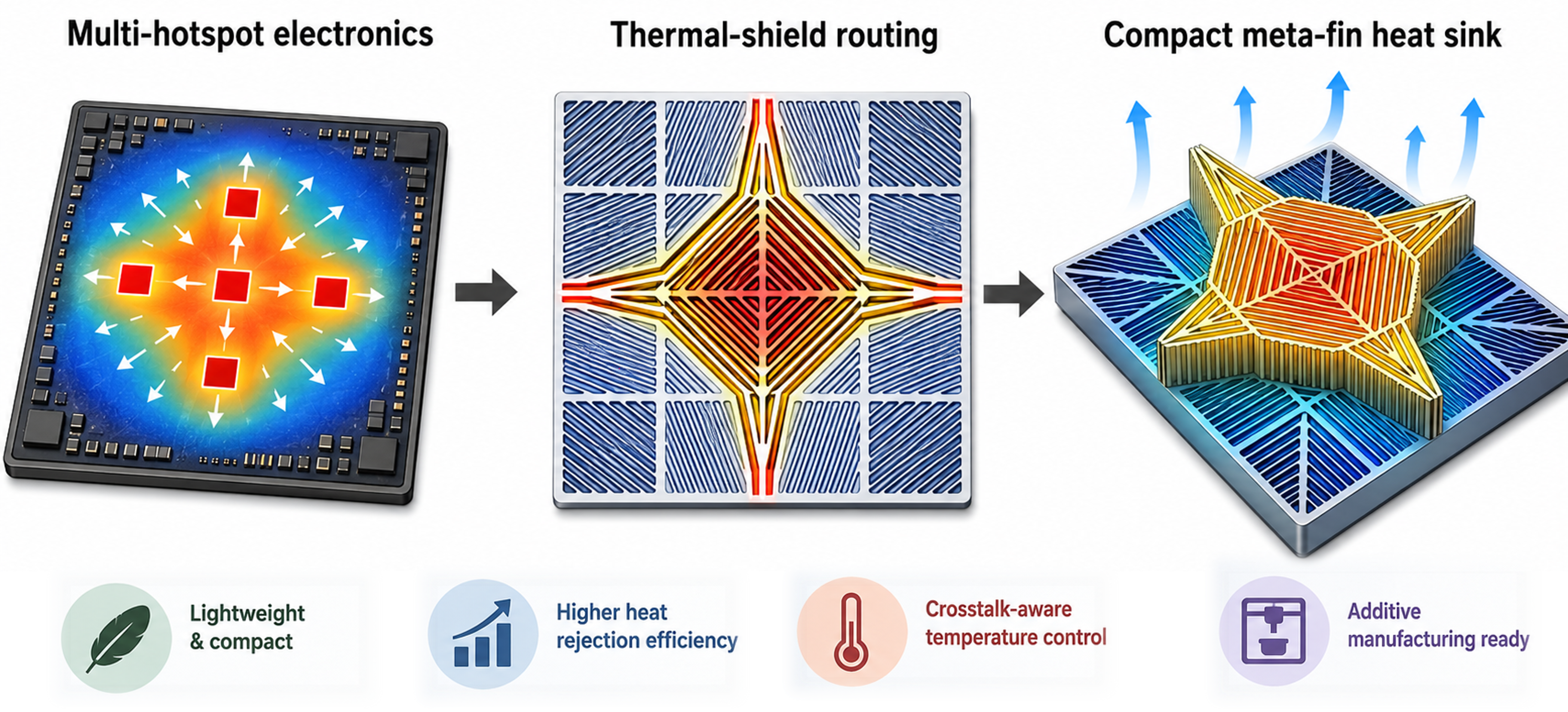
The continuing miniaturization and increasing power density of electronic and optoelectronic devices have made compact, lightweight, reliable heat dissipation challenging, particularly for boards with many discrete hotspots. Conventional finned heat sinks reject heat in an isotropic, undirected manner; therefore, much of the fin volume far from the active sources contributes little to convection but adds mass and occupies space. In this work, we embedded a thermal-shield metastructure into the fin field to convert a conventional sink into a heat-flux-routing device that concentrated conductive heat flow into prescribed regions, so fins were installed only where they are useful. Building on transformation-thermotics-inspired unit-cell thermal shifters formed by alternating high- and low-conductivity layers, we used the thermal-shield concept to prescribe a heat-routing fin layout, i.e., a metastructured (“meta-fin”) sink whose fins populate only the shield-defined region of a multi-hotspot module. Using transient three-dimensional finite-element heat-transfer simulations with prescribed convective boundary conditions, we compared it with pin- and plate-fin baseline sinks matched in surface area or volume and weight. The simulations showed that the meta-fin increased the surface-utilization efficiency by >10% relative to the full-footprint pin- and plate-fin baselines and exhibited 15%–25% higher transient heat rejection across the comparison set, while reducing material volume and mass by ~45% relative to the full-footprint baselines. Thus, its mass-normalized transient heat rejection was ~2× that of a conventional sink. It additionally enabled control of the on-chip temperature landscape, producing a diagonal temperature contrast more than 2.5× that of the conventional full-footprint designs. These improvements arise from redesigning the fin layout rather than introducing new functional materials. Moreover, rapid advances in additive manufacturing and 3D printing provide practical fabrication routes for such unconventional heat-sink form factors, supporting the future demonstration, refinement, and deployment of metastructure-based thermal management.
- Li Y, Roux S, Castelain C, Fan Y, Luo L. Design and optimization of heat sinks for the liquid cooling of electronics with multiple heat sources: A literature review. Energies. 2023;16(22):7468. doi: 10.3390/en16227468
- Li Z, Luo H, Jiang Y, et al. Comprehensive review and future prospects on chip-scale thermal management: Core of data center’s thermal management. Appl Therm Eng. 2024;251:123612. doi: 10.1016/j.applthermaleng.2024.123612
- Rahman MA, Hasnain SMM, Paramasivam P, Ayanie AG. Advancing thermal management in electronics: A review of innovative heat sink designs and optimization techniques. RSC Adv. 2024;14(43):31291-31319. doi: 10.1039/D4RA05845C
- Kim JC, Ren Z, Yuksel A, et al. Recent advances in thermal metamaterials and their future applications for electronics packaging. J Electron Packag. 2021;143(1):010801. doi: 10.1115/1.4047414
- Nair V, Baby A, Anoop MB, Indrajith S, Murali M, Nair MB. A comprehensive review of air-cooled heat sinks for thermal management of electronic devices. Int Commun Heat Mass Transf. 2024;159:108055. doi: 10.1016/j.icheatmasstransfer.2024.108055
- Hu X, Gong X, Zhu F, Xing X, Li Z, Zhang X. Thermal analysis and optimization of metal foam PCM-based heat sink for thermal management of electronic devices. Renew Energy. 2023;212:227-237. doi: 10.1016/j.renene.2023.05.021
- Sun S, Rankouhi B, Thoma DJ, et al. Topology optimization, additive manufacturing and thermohydraulic testing of heat sinks. Int J Heat Mass Transf. 2024;224:125281. doi: 10.1016/j.ijheatmasstransfer.2024.125281
- Luo JW, Chen L, Xia Y, Zheng X, Tao WQ. Three-dimensional multi-scale topology optimization of porous heat sink with predetermined unit cells for natural convection heat transfer. Int J Heat Mass Transf. 2024;225:125398. doi: 10.1016/j.ijheatmasstransfer.2024.125398
- Ji S, Choi J, Hong M, et al. Recent advances in thermal management via additive manufacturing. Eng Sci Addit Manuf. 2025;1(3):025260016. doi: 10.36922/ESAM025260016
- Careri F, Khan RHU, Todd C, Attallah MM. Additive manufacturing of heat exchangers in aerospace applications: A review. Appl Therm Eng. 2023;235:121387. doi: 10.1016/j.applthermaleng.2023.121387
- Liu C, Zhang M, Bi G, et al. Research on comprehensive heat dissipation characteristics of AlSi7Mg TPMS heat sinks manufactured by laser powder bed fusion. Appl Therm Eng. 2025;261:124941. doi: 10.1016/j.applthermaleng.2024.124941
- Ozguc S, Teague TFG, Pan L, Weibel JA. Experimental study of topology optimized, additively manufactured microchannel heat sinks designed using a homogenization approach. Int J Heat Mass Transf. 2023;209:124108. doi: 10.1016/j.ijheatmasstransfer.2023.124108
- Gallorini E, Hélie J, Piscaglia F. A multi-region adjoint-based solver for topology optimization in conjugate heat transfer problems. Comput Fluids. 2023;266:106042. doi: 10.1016/j.compfluid.2023.106042
- Sahin I, Moya C, Mollaali A, Lin G, Paniagua G. Deep operator learning-based surrogate models with uncertainty quantification for optimizing internal cooling channel rib profiles. Int J Heat Mass Transf. 2024;219:124813. doi: 10.1016/j.ijheatmasstransfer.2023.124813
- Song C, Liang X. Design optimization of 2D cross-flow heat exchanger using shape coupling neural network. Int J Heat Mass Transf. 2025;253:127616. doi: 10.1016/j.ijheatmasstransfer.2025.127616
- Lamotte-Dawaghreh J, Herring J, Pundla SA, et al. Electrochemical additive manufacturing-based design of a heat sink for single-phase natural convection immersion cooling application. J Electron Packag. 2024;146(4):041113. doi: 10.1115/1.4065987
- Zhou W, Dong K, Sun Q, et al. Research progress of the liquid cold plate cooling technology for server electronic chips: A review. Int J Energy Res. 2022;46(9):11574-11595. doi: 10.1002/er.7979
- Dixit A, Maithani R, Sharma S. Enhancing electronic system cooling: Exploring minichannel heat sink solutions. J Therm Anal Calorim. 2025;150:5357-5407. doi: 10.1007/s10973-025-14118-7
- Fan CZ, Gao Y, Huang JP. Shaped graded materials with an apparent negative thermal conductivity. Appl Phys Lett. 2008;92(25):251907. doi: 10.1063/1.2951600
- Pendry JB, Schurig D, Smith DR. Controlling electromagnetic fields. Science. 2006;312(5781):1780-1782. doi: 10.1126/science.1125907
- Cummer SA, Christensen J, Alù A. Controlling sound with acoustic metamaterials. Nat Rev Mater. 2016;1:16001. doi: 10.1038/natrevmats.2016.1
- Schurig D, Mock JJ, Justice BJ, et al. Metamaterial electromagnetic cloak at microwave frequencies. Science. 2006;314(5801):977-980. doi: 10.1126/science.1133628
- Zhang Z, Xu L, Qu T, et al. Diffusion metamaterials. Nat Rev Phys. 2023;5(4):218-235. doi: 10.1038/s42254-023-00565-4
- Li Y, Li W, Han T, et al. Transforming heat transfer with thermal metamaterials and devices. Nat Rev Mater. 2021;6:488-507. doi: 10.1038/s41578-021-00283-2
- Narayana S, Sato Y. Heat flux manipulation with engineered thermal materials. Phys Rev Lett. 2012;108(21):214303. doi: 10.1103/PhysRevLett.108.214303
- Han T, Bai X, Gao D, Thong JTL, Li B, Qiu CW. Experimental demonstration of a bilayer thermal cloak. Phys Rev Lett. 2014;112(5):054302. doi: 10.1103/PhysRevLett.112.054302
- Yang F, Tian B, Xu L, Huang J. Experimental demonstration of thermal chameleon-like rotators with transformation-invariant metamaterials. Phys Rev Appl. 2020;14(5):054024. doi: 10.1103/PhysRevApplied.14.054024
- Xu LJ, Huang JP. Transformation Thermotics and Extended Theories: Inside and Outside Metamaterials. Singapore: Springer; 2023. doi: 10.1007/978-981-19-5908-0
- Fan C, Wu CL, Wang Y, Wang B, Wang J. Thermal metamaterials: From static to dynamic heat manipulation. Phys Rep. 2024;1077:1-111. doi: 10.1016/j.physrep.2024.05.004
- Qiu Y, Nomura M, Zhang Z, et al. Roadmap on thermodynamics and thermal metamaterials. Front Phys. 2025;20(6):65500. doi: 10.15302/frontphys.2025.065500
- Li W, Sigmund O, Zhang XS. Analytical realization of complex thermal meta-devices. Nat Commun. 2024;15:5527. doi: 10.1038/s41467-024-49630-1
- Yang F, Zhang Z, Xu L, et al. Controlling mass and energy diffusion with metamaterials. Rev Mod Phys. 2024;96:015002. doi: 10.1103/RevModPhys.96.015002
- Li ZY, Ma TX, Yan D, et al. Non-Fourier thermal focusing by gradient thermal metamaterials based on the Cattaneo-Vernotte model. J Appl Phys. 2024;136(19):193106. doi: 10.1063/5.0228819
- Mclean H, Davies FH, Taylor NT, Hepplestone SP. Thermal metamaterials for enhanced non-Fourier heat transport. npj Metamaterials. 2025;1:7. doi: 10.1038/s44455-025-00008-3
- Yao NZ, Wang H, Wang B, Wang X, Huang JP. Convective thermal cloaks with homogeneous and isotropic parameters and drag-free characteristics for viscous potential flows. iScience. 2022;25(11):105461. doi: 10.1016/j.isci.2022.105461
- Dai GL, Zhou Y, Wang J, Yang F, Qu T, Huang JP. Convective cloak in Hele-Shaw cells with bilayer structures: Hiding objects from heat and fluid motion simultaneously. Phys Rev Appl. 2022;17(4):044006. doi: 10.1103/PhysRevApplied.17.044006
- Ju R, Xu G, Xu L, et al. Convective thermal metamaterials: Exploring high-efficiency, directional, and wave-like heat transfer. Adv Mater. 2023;35(23):e2209123. doi: 10.1002/adma.202209123
- Xu B, Liao Y, Fang Z, et al. Ultra-high-performance heat spreader based on a graphite architecture with three-dimensional thermal routing. Cell Rep Phys Sci. 2021;2(11):100621. doi: 10.1016/j.xcrp.2021.100621
- Zhu C, Bamidele EA, Shen X, Zhu G, Li B. Machine learning aided design and optimization of thermal metamaterials. Chem Rev. 2024;124(7):4258-4331. doi: 10.1021/acs.chemrev.3c00708
- Samad SN, Griffis J, Manogharan G, Kouraytem N. Multi-material additive manufacturing of metals: A review of structures and mechanical characteristics. Eng Sci Addit Manuf. 2025;1(2):025180010. doi: 10.36922/ESAM025180010
- Nipu SMA, Tang T, Joralmon D, et al. Advances and perspectives in multi-material additive manufacturing of heterogenous metal-polymer components. npj Adv Manuf. 2025;2:31. doi: 10.1038/s44334-025-00045-w
- Subeshan B, Hamzat AK, Asmatulu E. Fabricating three-dimensional metamaterials using additive manufacturing: An overview. J Manuf Mater Process. 2025;9(10):343. doi: 10.3390/jmmp9100343
- Park G, Kang S, Lee H, Choi W. Tunable multifunctional thermal metamaterials: Manipulation of local heat flux via assembly of unit-cell thermal shifters. Sci Rep. 2017;7:41000. doi: 10.1038/srep41000
- Jang D, Yu SH, Lee KS. Multidisciplinary optimization of a pin-fin radial heat sink for LED lighting applications. Int J Heat Mass Transf. 2012;55(4):515-521. doi: 10.1016/j.ijheatmasstransfer.2011.11.016