
Tailoring the microstructure through laser processing parameters for property optimization of a high-entropy alloy fabricated by laser powder bed fusion

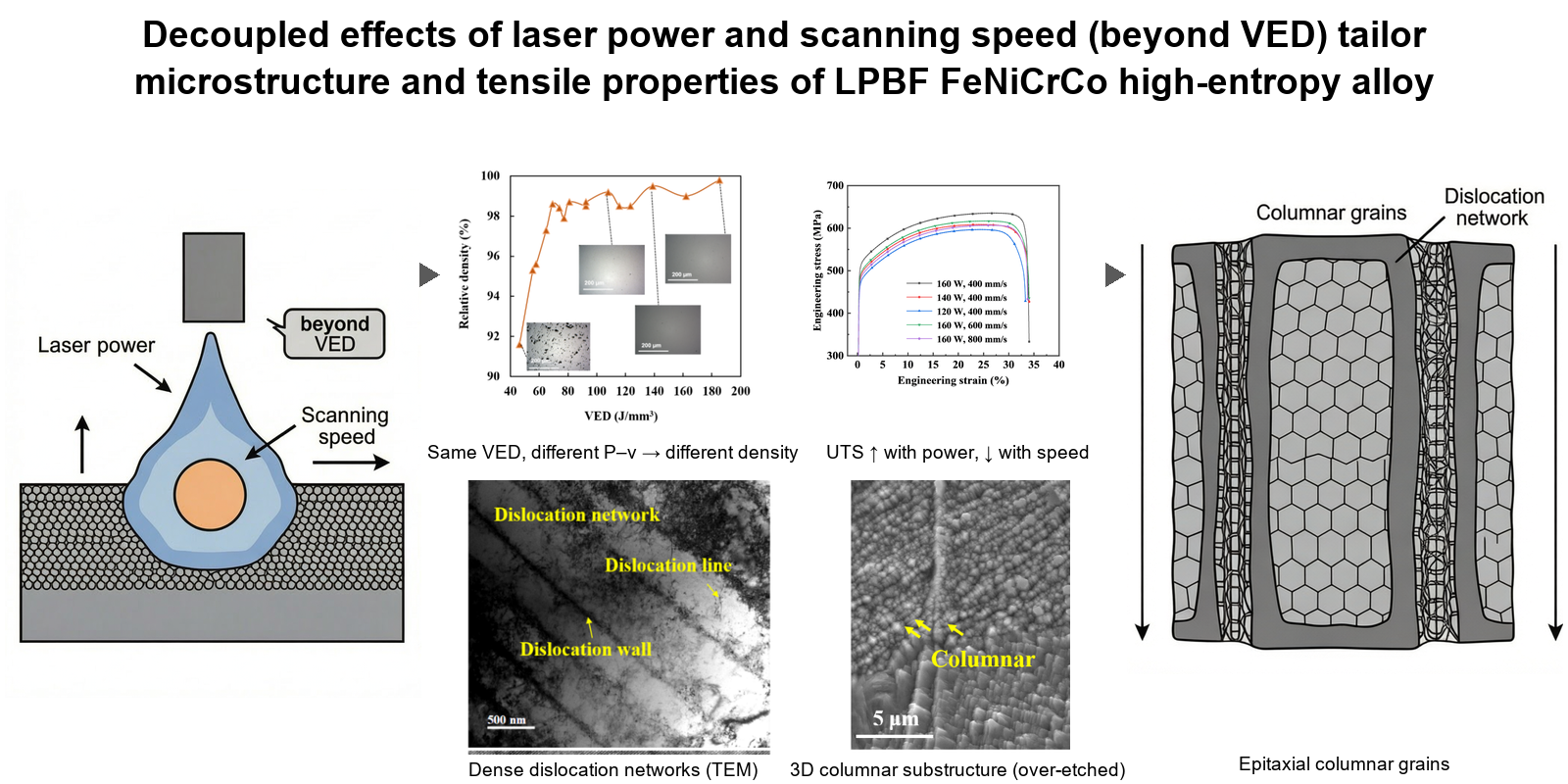
Laser powder bed fusion (LPBF) offers a promising route to high-entropy alloys (HEAs) with refined microstructures. Here the individual roles of laser power and scanning speed in governing the densification, microstructure, and tensile behavior of FeNiCrCo HEA are systematically examined, with particular attention to effects that go beyond the volumetric energy density (VED) descriptor. Through orthogonal experiments (laser power: 80–160 W, scanning speed: 400–1200 mm/s), the optimal processing window was identified at 160 W and 400 mm/s, achieving a relative density exceeding 99.8%. The as-built alloy exhibits a single-phase face-centered cubic (FCC) structure with homogeneous elemental distribution, consisting of columnar grains with subgrain boundaries composed of dense dislocation networks. Notably, laser power and scanning speed exert differentiated effects that VED alone cannot fully capture: increasing laser power promotes the formation of low-angle grain boundaries and enhances texture intensity, while varying scanning speed produces distinct effects on grain morphology and dislocation density. The ultimate tensile strength ranges from 596 to 635 MPa, increasing with laser power but decreasing with scanning speed, whereas the total elongation remains near 33 ± 4% for all conditions. This study establishes that decoupling laser power and scanning speed effects is essential for precise microstructural control in LPBF-fabricated HEAs.
- Yeh JW, Chen SK, Lin SJ, et al. Nanostructured High-Entropy Alloys with Multiple Principal Elements: Novel Alloy Design Concepts and Outcomes. Adv Eng Mater. 2004;6(5):299-303. doi: 10.1002/adem.200300567
- Miracle DB, Senkov ON. A critical review of high entropy alloys and related concepts. Acta Mater. 2017;122:448-511. doi: 10.1016/j.actamat.2016.08.081
- George EP, Raabe D, Ritchie RO. High-entropy alloys. Nat Rev Mater. 2019;4(8):515-534. doi: 10.1038/s41578-019-0121-4
- Li Z, Zhao S, Ritchie RO, Meyers MA. Mechanical properties of high-entropy alloys with emphasis on face-centered cubic alloys. Prog Mater Sci. 2019;102:296-345. doi: 10.1016/j.pmatsci.2018.12.003
- Zhang R, Yao H, Lin X, et al. Regulating mechanical properties of laser powder bed fusion manufactured CoCrFeMnNi high-entropy alloy using oversaturated boron doping. Virtual Phys Prototyp. 2025;20(1). doi: 10.1080/17452759.2025.2470923
- Gludovatz B, Hohenwarter A, Catoor D, Chang EH, George EP, Ritchie RO. A fracture-resistant high-entropy alloy for cryogenic applications. Science. 2014;345(6201):1153-1158. doi: 10.1126/science.1254581
- Jiang D, Luo M, Liu C, et al. 3D Printing parameter optimisation combined with heat treatment for achieving high density and enhanced performance in refractory high-entropy alloys. Virtual Phys Prototyp. 2025;20(1). doi: 10.1080/17452759.2025.2524524
- Liu Z, Mai T, Liu J, Zou T. Regulating microstructure, mechanical properties and corrosion resistance of laser direct energy deposited Al0.5Mn0.5CoCrFeNi high-entropy alloy by annealing heat treatment. Virtual Phys Prototyp. 2025;20(1). doi: 10.1080/17452759.2025.2458656
- Brif Y, Thomas M, Todd I. The use of high-entropy alloys in additive manufacturing. Scr Mater. 2015;99:93-96. doi: 10.1016/j.scriptamat.2014.11.037
- Lin D, Xu L, Jing H, Han Y, Zhao L, Minami F. Effects of annealing on the structure and mechanical properties of FeCoCrNi high-entropy alloy fabricated via selective laser melting. Addit Manuf. 2020;32. doi: 10.1016/j.addma.2020.101058
- Shu T, Yuan J, Liu F, Shen W, Cheng GJ. In-situ alloying and microstructural control in high entropy alloys with nano-carbide-framework via powder bed fusion. Addit Manuf. 2025;104. doi: 10.1016/j.addma.2025.104766
- Liu WH, Lu ZP, He JY, et al. Ductile CoCrFeNiMox high entropy alloys strengthened by hard intermetallic phases. Acta Mater. 2016;116:332-342. doi: 10.1016/j.actamat.2016.06.063
- Lin D, Xu L, Jing H, et al. A strong, ductile, high-entropy FeCoCrNi alloy with fine grains fabricated via additive manufacturing and a single cold deformation and annealing cycle. Addit Manuf. 2020;36. doi: 10.1016/j.addma.2020.101591
- He JY, Wang H, Huang HL, et al. A precipitation-hardened high-entropy alloy with outstanding tensile properties. Acta Mater. 2016;102:187-196. doi: 10.1016/j.actamat.2015.08.076
- Li Z, Pradeep KG, Deng Y, Raabe D, Tasan CC. Metastable high-entropy dual-phase alloys overcome the strength–ductility trade-off. Nature. 2016;534(7606):227-230. doi: 10.1038/nature17981
- Li Z. Interstitial equiatomic CoCrFeMnNi high-entropy alloys: carbon content, microstructure, and compositional homogeneity effects on deformation behavior. Acta Mater. 2019;164:400-412. doi: 10.1016/j.actamat.2018.10.050
- He JY, Liu WH, Wang H, et al. Effects of Al addition on structural evolution and tensile properties of the FeCoNiCrMn high-entropy alloy system. Acta Mater. 2014;62:105-113. doi: 10.1016/j.actamat.2013.09.037
- Ritchie RO. The conflicts between strength and toughness. Nat Mater. 2011;10(11):817-22. doi: 10.1038/nmat3115
- Bourke D, Monu MCC, Healy P, Sloane A, Ahad IU, Brabazon D. Effect of build distribution and particle properties on the physical characteristics of laser powder bed fusion of in situ alloyed nitinol. Eng Sci Add Manuf. 2025;1(3). doi: 10.36922/esam025340020
- Zhu T, Chen W. Mechanical behaviour of additively manufactured metals. Nat Mater. 2026;25(3):373-385. doi: 10.1038/s41563-025-02459-5
- Zhang Y, Huang T, He X, Wang X. Microstructure-controlled strengthening mechanisms and strategies in additively manufactured aluminum alloys: A review. Eng Sci Add Manuf. 2026;2(1). doi: 10.36922/esam025490033
- Han C, Fang Q, Shi Y, Tor SB, Chua CK, Zhou K. Recent Advances on High-Entropy Alloys for 3D Printing. Adv Mater. 2020;32(26):e1903855. doi: 10.1002/adma.201903855
- Zhang T, Yuan L. Dimensional accuracy and surface roughness of thin-wall geometries in laser powder bed fusion of 316L stainless steel. Eng Sci Addit Manuf. 2025;1(3). doi: 10.36922/esam025340022
- Liu H, Yang D, Jiang Q, et al. Additive manufacturing of metallic glasses and high-entropy alloys: Significance, unsettled issues, and future directions. J Mater Sci Technol. 2023;140:79-120. doi: 10.1016/j.jmst.2022.09.006
- Niu Z, Zhang J, Liu F, et al. Forming quality control of Laser Powder Bed Fusion GH3536 alloy: Surface quality, defects, and microstructure. Mater Sci Addit Manuf. 2025;4(4):025220042. doi: 10.36922/msam025220042
- Chua C, An J, Chua CK, Kuo C-N, Sing SL. Microstructure control for inoculated high-strength aluminum alloys fabricated by additive manufacturing: A state-of-the-art review. Prog Mater Sci. 2025;154:101502. doi: 10.1016/j.pmatsci.2025.101502
- Zhang Z, Yao B, Feng Z, et al. Microstructure evolution and mechanical properties of nuclear zircaloy-4 alloy fabricated by laser powder bed fusion at varying laser energy densities. Mater Sci Add Manuf. 2025;4(4):025220041. doi: 10.36922/msam025220041
- Chua C, Liu Y, Williams RJ, Chua CK, Sing SL. In-process and post-process strategies for part quality assessment in metal powder bed fusion: A review. J Manuf Syst. 2024;73:75-105. doi: 10.1016/j.jmsy.2024.01.004
- Westphal E, Seitz H. Porosity and density measurement of additively manufactured components: A comparative analysis of measurement methods across processes and materials. Mater Sci Add Manuf. 2025;4(2):025090010. doi: 10.36922/msam025090010
- Ren J, Zhang Y, Zhao D, et al. Strong yet ductile nanolamellar high-entropy alloys by additive manufacturing. Nature. 2022;608(7921):62-68. doi: 10.1038/s41586-022-04914-8
- Zhang L, Song B, Zhang J, Yao Y, Lu J, Shi Y. Decoupling microlattice metamaterial properties through a structural design strategy inspired by the Hall–Petch relation. Acta Mater. 2022;238:118214. doi: 10.1016/j.actamat.2022.118214
- Zaitceva M, Borisov A, Popovich A, Sufiiarov V. Selective laser melting of ferritic/martensitic oxide dispersion-strengthened steel: Processing, microstructure, and mechanical properties. Mater Sci Add Manuf. 2025;4(1):025060004. doi: 10.36922/msam025060004
- Sandua X, Arbizu E, Rodríguez Á, Veiga F, Martín MÁ, Rivero PJ. Influence of laser power and hatch spacing on the mechanical properties of AlSi10Mg processed by selective laser melting. Mater Sci Add Manuf. 2026;5(2):026040008. doi: 10.36922/msam026040008
- Shu T, Hu N, Liu F, Cheng GJ. Nanoparticles induced intragranular and dislocation substructures in powder bed fusion for strengthening of high-entropy-alloy. Mater Sci Eng A. 2023;878:145110. doi: 10.1016/j.msea.2023.145110
- Pham MS, Dovgyy B, Hooper PA, Gourlay CM, Piglione A. The role of side-branching in microstructure development in laser powder-bed fusion. Nat Commun.2020;11(1):749. doi: 10.1038/s41467-020-14453-3
- Afshani M, Quarto M, Bocchi S, Locatelli G, Persico T, D’Urso G. Strategies for high-quality fabrication of Inconel 625 parts via powder bed fusion–laser beam. Mater Sci Add Manuf. 2026;026130022. doi: 10.36922/msam026130022
- Voisin T, Forien J-B, Perron A, et al. New insights on cellular structures strengthening mechanisms and thermal stability of an austenitic stainless steel fabricated by laser powder-bed-fusion. Acta Mater. 2021;203. doi: 10.1016/j.actamat.2020.11.018
- Bertsch KM, Meric de Bellefon G, Kuehl B, Thoma DJ. Origin of dislocation structures in an additively manufactured austenitic stainless steel 316L. Acta Mater. 2020;199:19-33. doi: 10.1016/j.actamat.2020.07.063
- Chen Y, Li B, Chen B, Xuan F. High-cycle fatigue induced twinning in CoCrFeNi high-entropy alloy processed by laser powder bed fusion additive manufacturing. Addit Manuf. 2023;61:103319. doi: 10.1016/j.addma.2022.103319
- Lin D, Xi X, Ma R, et al. Fabrication of a strong and ductile FeCoCrNiMo0.3 high-entropy alloy with a micro-nano precipitate framework via laser powder bed fusion. Compos Part B Eng. 2023;266:111006. doi: 10.1016/j.compositesb.2023.111006
- Kim YK, Ram Lim K, Lee KA. Superior resistance to high–temperature creep in an additively manufactured precipitation–hardened CrMnFeCoNi high–entropy alloy nanocomposite. Mater Des. 2023;227:111761. doi: 10.1016/j.matdes.2023.111761
- Kim Y-K, Lee K-A. Influence of carbon contents on the cryogenic mechanical properties of precipitation-hardened CrMnFeCoNi high-entropy alloys manufactured by laser powder bed fusion. Mater Sci Eng A. 2023;873. doi: 10.1016/j.msea.2023.145042
- Kim Y-K, Lee K-A. Stabilized sub-grain and nano carbides-driven 1.2 GPa grade ultra-strong CrMnFeCoNi high-entropy alloy additively manufactured by laser powder bed fusion. J Mater Sci Technol. 2022;117:8-22. doi: 10.1016/j.jmst.2021.12.010
- Niu PD, Li RD, Yuan TC, et al. Microstructures and properties of an equimolar AlCoCrFeNi high entropy alloy printed by selective laser melting. Intermetallics. 2019;104:24-32. doi: 10.1016/j.intermet.2018.10.018
- Lin D, Xu L, Li X, et al. A Si-containing FeCoCrNi high-entropy alloy with high strength and ductility synthesized in situ via selective laser melting. Addit Manuf. 2020;35. doi: 10.1016/j.addma.2020.101340
- Zhou K, Cui D, Chai Z, et al. In-situ tailoring microstructures to promote strength-ductility synergy in laser powder bed fusion of NiCoCr medium-entropy alloy. Addit Manuf. 2023;66:103443. doi: 10.1016/j.addma.2023.103443
- Zhao YL, Meng FL, Yang T, et al. Enhanced helium ion irradiation tolerance in a Fe-Co-Ni-Cr-Al-Ti high-entropy alloy with L12 nanoparticles. J Mater Sci Technol. 2023;143:169-177. doi: 10.1016/j.jmst.2022.09.053
- Pan Q, Zhang L, Feng R, et al. Gradient cell-structured high-entropy alloy with exceptional strength and ductility. Science. 2021;374(6570):984-989. doi: 10.1126/science.abj8114
- Guo Y, Su H, Yang P, et al. New insight into tailorable eutectic high entropy alloys with remarkable strength–ductility synergy and ample shaping freedom fabricated using laser powder bed fusion. Addit Manuf. 2022;60:103257. doi: 10.1016/j.addma.2022.103257
- Liu L, Ding Q, Zhong Y, et al. Dislocation network in additive manufactured steel breaks strength–ductility trade-off. Mater Today. 2018;21(4):354-361. doi: 10.1016/j.mattod.2017.11.004
- Calcagnotto M, Ponge D, Demir E, Raabe D. Orientation gradients and geometrically necessary dislocations in ultrafine grained dual-phase steels studied by 2D and 3D EBSD. Mater Sci Eng A. 2010;527(10-11):2738-2746. doi: 10.1016/j.msea.2010.01.004
- Zhang C, Feng K, Kokawa H, Han B, Li Z. Cracking mechanism and mechanical properties of selective laser melted CoCrFeMnNi high entropy alloy using different scanning strategies. Mater Sci Eng A. 2020;789:139672. doi: 10.1016/j.msea.2020.139672
- Zhao Y, Guo Q, Du Z, et al. Critical role of subgrain orientation on the stability of mechanical properties of selective laser melting manufactured alloys. Mater Sci Eng A. 2022;832:142505. doi: 10.1016/j.msea.2021.142505
- Kruth J-P, Deckers J, Yasa E, Wauthlé R. Assessing and comparing influencing factors of residual stresses in selective laser melting using a novel analysis method. Proc Inst Mech Eng Part B J Eng Manuf. 2012;226(6):980-991. doi: 10.1177/0954405412437085
- Gorsse S, Hutchinson C, Goune M, Banerjee R. Additive manufacturing of metals: a brief review of the characteristic microstructures and properties of steels, Ti-6Al-4V and high-entropy alloys. Sci Technol Adv Mater. 2017;18(1):584-610. doi: 10.1080/14686996.2017.1361305
- Wang R, Zhang K, Davies C, Wu X. Evolution of microstructure, mechanical and corrosion properties of AlCoCrFeNi high-entropy alloy prepared by direct laser fabrication. J Alloy Compd. 2017;694:971-981. doi: 10.1016/j.jallcom.2016.10.138