
Toward edge-cloud integration of foundation models and AI agents in additive manufacturing

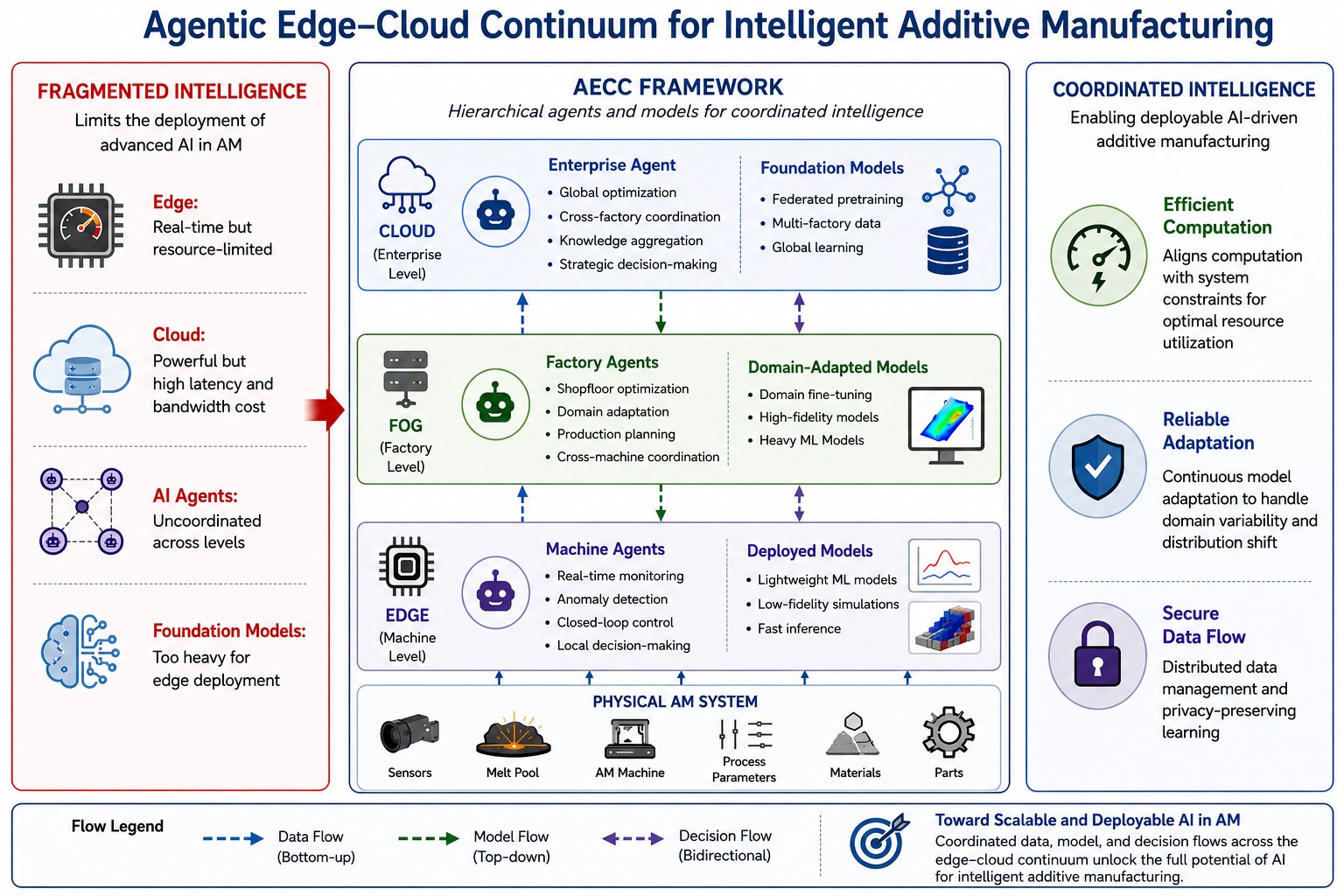
Additive manufacturing (AM) increasingly relies on artificial intelligence (AI) to enable real-time monitoring, adaptive control, and process optimization, yet the deployment of advanced models remains constrained by latency, resource limitations, data security, and domain variability in industrial environments. While edge computing supports real-time responsiveness and cloud computing enables large-scale learning, their isolated use leads to fragmented intelligence and limits system-level performance. This paper proposes an Agentic Edge-Cloud Continuum (AECC) framework that integrates foundation models and hierarchical AI agents across physical, edge, fog, and cloud layers to enable coordinated data processing, model adaptation, and decision-making. In this framework, foundation models are pretrained at the cloud using distributed multi-factory data through approaches such as federated learning, adapted into domain-specific, high-fidelity models at the fog layer, and further compressed for real-time deployment at the edge alongside low-fidelity simulations for physics-based validation. The coordinated data, model, and decision flows improve efficiency by aligning computation with system constraints, enhance reliability under domain variability through continuous adaptation, and support data security through distributed data management. By addressing the fragmentation of intelligence in current systems, the proposed framework provides a structured pathway toward scalable and deployable AI-driven AM. As a conceptual foundation, it also highlights the need for further research on communication protocols, foundation model development, and adaptive model updating strategies to realize its full potential.
- Chen L, Bi G, Yao X et al. In-situ process monitoring and adaptive quality enhancement in laser additive manufacturing: a critical review. J Manuf Syst. 2024;74:527- 574. doi: 10.1016/j.jmsy.2024.04.013
- Zhu K, Fuh J Y H, Lin X. Metal-based additive manufacturing condition monitoring: A review on machine learning based approaches. IEEE/ASME Trans Mechatron. 2021;27(5):2495- 2510. doi: 10.1109/TMECH.2021.3110818
- Yang M, Rezaei A, Vlasea M. Process Screening in Additive Manufacturing: Detection of Keyhole Mode using Surface Topography and Machine Learning. Addit Manuf Lett. 2025;13: 100275. doi: 10.1016/j.addlet.2025.100275
- Zhang Y, Safdar M, Xie J et al. A systematic review on data of additive manufacturing for machine learning applications: the data quality, type, preprocessing, and management. J Intell Manuf. 2023;34(8):3305-3340. doi: 10.1007/s10845-022-02017-9
- Yeung H, Kim F, Donmez A. Application of digital twins to laser powder bed fusion additive manufacturing process control. In: Volume 1: Additive Manufacturing; Advanced Materials Manufacturing; Biomanufacturing; Life Cycle Engineering. American Society of Mechanical Engineers; 2023. doi: 10.1115/msec2023-105627
- Xie J, Yang Z, Yang H-C, Lu Y, Zhao Y F. On the reusability of machine learning-based process monitoring systems for manufacturing digital twins. J Manuf Syst. 2026;84:333-356. doi: 10.1016/j.jmsy.2025.12.006
- Chen C, Li L, Wang T et al. Leveraging large language models for smart manufacturing: Reviews, enablers, challenges, and opportunities. J Manuf Syst. 2026;85:593-612. doi: 10.1016/j.jmsy.2026.02.008
- Lee J, Su H. Rethinking industrial artificial intelligence: A unified foundation framework. Int J AI Mater Design. 2025;2(2):56. doi: 10.36922/ijamd025080006
- Lee J, Su H. Agentic AI for smart manufacturing. Manuf Lett. 2025;46:92-96. doi: 10.1016/j.mfglet.2025.10.013
- Edwards KM, Bauer M, Jacquillat C, Hart AJ, Ahmed F. Agentic AI in engineering and manufacturing: industry perspectives on utility, adoption, challenges, and opportunities. arXiv. Preprint posted online 2026. doi: 10.48550/arXiv.2604.09633
- Safdar M, Xie J, Zhao Y F. Advancing machine learning in additive manufacturing: Perspectives on data challenges, model development, and industrial adoption. Eng Sci Addit Manuf. 2025; 1(1): 025040004. doi: 10.36922/ESAM025040004
- Zhang P, Chen R, Yang L, Zou Y, Gao L. Recent progress in digital twin-driven fault diagnosis of rotating machinery: A comprehensive review. Neurocomputing. 2025;634:129914. doi: 10.1016/j.neucom.2025.129914
- Dihan M S, Akash A I, Tasneem Z et al. Digital twin: Data exploration, architecture, implementation and future. Heliyon. 2024;10(5):e26503. doi: 10.1016/j.heliyon.2024.e26503
- Nguyen D A, Giang L B T, Nguyen V A et al., Artificial intelligence in metal additive manufacturing: Current status, challenges, and future developments. J Intell Manuf. 2026. doi: 10.1007/s10845-025-02771-6
- Wang P, Wu Z, Ten J J S, Huang J, Nai M L S. Towards intelligent defect detection in metal powder bed fusion: A review of in situ monitoring, data pre-processing, and machine learning. Mater Sci Eng R Rep. 2026;167:101112. doi: 10.1016/j.mser.2025.101112
- Vashishtha G, Chauhan S, Zimroz R, Yadav N, Kumar R, Gupta MK. Current applications of machine learning in additive manufacturing: a review on challenges and future trends. Arch Computat Methods Eng. 2024;32(4):2635-2668. doi: 10.1007/s11831-024-10215-2
- Thelen A, Zhang X, Fink O, et al. A comprehensive review of digital twin—part 2: roles of uncertainty quantification and optimization, a battery digital twin, and perspectives. Struct Multidiscip Optim. 2023;66(1):1. doi: 10.1007/s00158-022-03410-x
- Cagirici M, Guo S, Ding J, Ramamurty U, Wang P. Additive manufacturing of high-entropy alloys: current status and challenges. Smart Mater Manuf. 2024;2:100058. doi: 10.1016/j.smmf.2024.100058
- Ang L J J, Huang J, Nai M L S, Wang P. Additive manufacturing techniques for EH36 steels: Challenges and future directions. Eng Sci Addit Manuf. 2025;1(1): 025060005. doi: 10.36922/ESAM025060005
- Tang Y, Sajadi P, Rahmani Dehaghani M, Wang G G. A systematic online update method for reduced-order-model-based digital twin. J Intell Manuf. 2025;36(8): 5495-5523. doi: 10.1007/s10845-024-02524-x
- Tang Y, Dehaghani M R, Wang G G. Lifelong Updating of Digital Twin Models for Degraded Systems Using Autoencoder and LSTM. Appl Soft Comput. 2026;193:114870. doi: 10.1016/j.asoc.2026.114870
- Zemskov AD, Fu Y, Li R, et al. Security and privacy of digital twins for advanced manufacturing: a survey. arXiv. Preprint posted online 2024. doi: 10.48550/ARXIV.2412.13939
- Fullington D, Yangue E, Bappy M M, Liu C, Tian W. Leveraging small-scale datasets for additive manufacturing process modeling and part certification: Current practice and remaining gaps. J Manuf Syst. 2024;75:306-321. doi: 10.1016/j.jmsy.2024.04.021
- Jyeniskhan N, Shomenov K, Ali M H, Shehab E. Exploring the integration of digital twin and additive manufacturing technologies. Int J Lightweight Mater Manuf. 2024;7(6): 860- 881. doi: 10.1016/j.ijlmm.2024.06.004
- Qin Q, Liu Z, Zhong R et al. Robot digital twin systems in manufacturing: Technologies, applications, trends and challenges. Robot Comput-Integr Manuf. 2026;97:103103. doi: 10.1016/j.rcim.2025.103103
- Liu Y, Feng J, Lu J, Zhou S. A review of digital twin capabilities, technologies, and applications based on the maturity model. Adv Eng Inform. 2024;62:102592. doi: 10.1016/j.aei.2024.102592
- Ouahabi N, Chebak A, Kamach O, Laayati O, Zegrari M. Leveraging digital twin into dynamic production scheduling: A review. Robot Comput-Integr Manuf. 2024;89:102778. doi: 10.1016/j.rcim.2024.102778
- Ma S, Huang Y, Liu Y et al. Edge-cloud cooperation driven surface roughness classification method for selective laser melting. Adv Eng Inform. 2025;66:103473. doi: 10.1016/j.aei.2025.103473
- Jiang Z, Guo Y, Wang Z. Digital twin to improve the virtual-real integration of industrial IoT. J Ind Inf Integr. 2021;22:100196. doi: 10.1016/j.jii.2020.100196
- Pan Y, Qu T, Wu N, Khalgui M, Huang G Q. Digital twin based real-time production logistics synchronization system in a multi-level computing architecture. J Manuf Syst. 2021;58:246-260. doi: 10.1016/j.jmsy.2020.10.015
- Yang M, Yang Y, Jiang P. A design method for edge–cloud collaborative product service system: a dynamic event-state knowledge graph-based approach with real case study. Int J Prod Res. 2024;62(7): 2584-2605. doi: 10.1080/00207543.2023.2219345
- Guo L, Cheng Y, Zhang Y, et al. Development of cloud-edge collaborative digital twin system for FDM additive manufacturing. In: Proceedings of the 2021 IEEE 19th International Conference on Industrial Informatics (INDIN). IEEE; 2021:1-6. doi: 10.1109/indin45523.2021.9557492
- Liu C, Le Roux L, Körner C et al. Digital twin-enabled collaborative data management for metal additive manufacturing systems. J Manuf Syst. 2022;62:857-874. doi: 10.1016/j.jmsy.2020.05.010
- Ma S, Lv J, Huang Y, et al. Edge–cloud cooperation-driven sustainable smart optimization strategy for additive manufacturing. IEEE Trans Syst Man Cybern Syst. 2026;56(5):3174-3185. doi: 10.1109/tsmc.2026.3657115
- Wei W, Li Y, Wu H et al. Gcs-Unet: A lightweight attention network for coaxial melt pool monitoring in laser powder bed fusion. Smart Mater Manuf. 2025;3:100094. doi: 10.1016/j.smmf.2025.100094.
- Teerapittayanon S, McDanel B, Kung HT. Distributed Deep Neural Networks Over the Cloud, the Edge and End Devices. In: Proceedings of the 2017 IEEE 37th International Conference on Distributed Computing Systems (ICDCS). IEEE; 2017:328-339. doi: 10.1109/icdcs.2017.226
- Xie J, Zhao YF. Redundancy Analysis and Mitigation forMachine Learning-Based Process Monitoring of Additive Manufacturing. In: Volume 2A: 45th Computers and Information in Engineering Conference (CIE). American Society of Mechanical Engineers; 2025. doi: 10.1115/detc2025-168795
- Xie J, Zhang C, Sage M, Safdar M, Zhao Y F. A sequential cross-product knowledge accumulation, extraction and transfer framework for machine learning-based production process modelling. Int J Prod Res. 2024;62(12):4181-4201. doi: 10.1080/00207543.2023.2254854
- Xie J, Yang Z, Hu CC, Yang HC, Lu Y, Zhao YF. Investigation on domain adaptation of additive manufacturing monitoring systems to enhance digital twin reusability. In: Proceedings of the 2024 IEEE 20th International Conference on Automation Science and Engineering (CASE). IEEE; 2024:690-697. doi: 10.1109/case59546.2024.10711510
- Shi Z, Kan C, Tian W, Liu C. A blockchain-based G-code protection approach for cyber-physical security in additive manufacturing. J Comput Inf Sci Eng. 2021;21(4): 041007. doi: 10.1115/1.4048966
- Lu Q, Shen X, Zhou J, Li M. MBD-Enhanced asset administration shell for generic production line design. IEEE Trans Syst Man Cybern Syst. 2024;54(9):5593-5605. doi: 10.1109/TSMC.2024.3408296