
Shape morphing of extrusion-printed thermoresponsive hydrogels regulated by infill topology and layer design

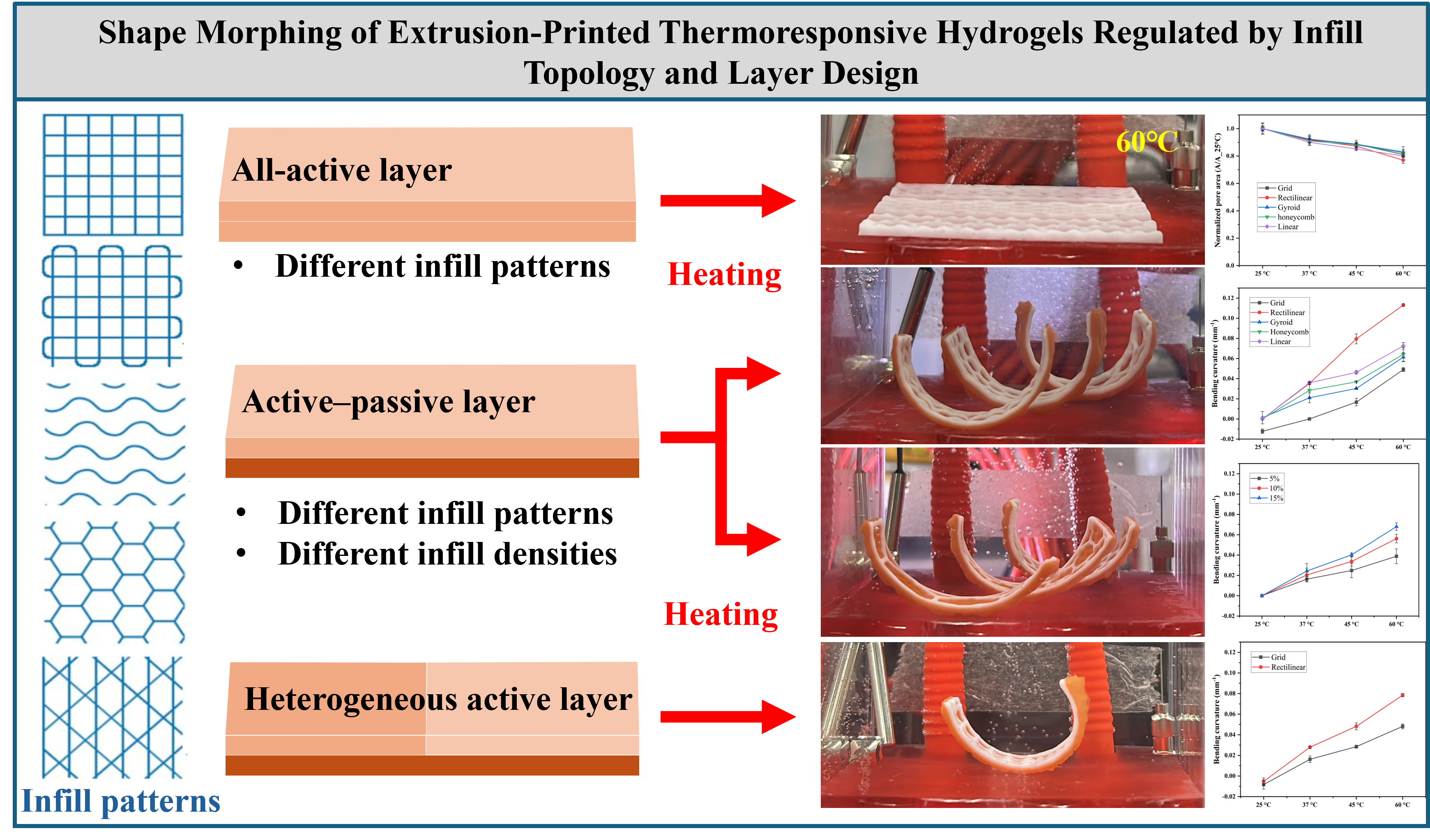
Four-dimensional (4D) printing offers an innovative method for fabricating thermoresponsive hydrogel structures with programmable shape changes. Although structural regulation has been explored in some stimuli-responsive shape-morphing materials, the influence of infill topology on thermally induced deformation in extrusion-printed thermoresponsive hydrogels remains insufficiently clarified. As a programmable structural feature in extrusion-based printing, infill topology can provide a practical route for regulating thermally induced deformation while retaining the potential advantages of infill-based lightweight design. In this study, a poly(N-isopropylacrylamide) (PNIPAM)-based thermoresponsive hydrogel ink was used as active ink, while alginate/laponite-based hydrogel ink was used as the passive constraining ink. These inks were used to fabricate hydrogel structures with different internal architectures, and their temperature-dependent deformation behaviors were systematically compared. Structures printed entirely from the active ink showed no obvious macroscopic bending during heating, although both cell area and overall shape area decreased with temperature. This suggests that the response of structures with only the active material was mainly dominated by thermal deswelling. In contrast, structures with an active–passive architecture exhibited clear temperature-dependent bending, showing that the active–passive mismatch was essential for converting material response into macroscopic shape change. Within this system, infill topology strongly affected bending level, with rectilinear patterns producing the strongest response and grid patterns the weakest. Under a fixed honeycomb topology, increasing active-layer infill density further enhanced bending. In addition, a heterogeneous active-layer design that combined two topologies in a single structure preserved local deformation differences, while the final bending response was governed by mechanical coupling throughout the structure. Overall, these results show that active–passive layer architecture, infill topology, and layer-specific infill design can regulate thermally induced shape morphing in printed hydrogel systems. This study guides the design of thermoresponsive hydrogel structures for soft actuation and related programmable devices.
- Li W, Sang M, Lou C, et al. Triple-Responsive Soft Actuator with Plastically Retentive Deformation and Magnetically Programmable Recovery. ACS Nano. 2023;17(23):24042- 24054. doi: 10.1021/acsnano.3c08888
- Jung Y, Kwon K, Lee J, Ko SH. Untethered Soft Actuators for Soft Standalone Robotics. Nat Commun. 2024;15(1):3510. doi: 10.1038/s41467-024-47639-0
- Kanaujia KA, Yadav VK, Yadav SS, Talha M, Saraf SA, Kumar S. 4D Printing in Healthcare: Innovations, Challenges, and Future Directions. ACS Appl Bio Mater. 2026;9(2):493-528. doi: 10.1021/acsabm.5c01165
- Huang X, Zhang L, Liu L, et al. Nanoparticle-Empowered 4D Printing: Materials, Stimuli, and Emerging Actuation Strategies. Adv Mater Technol. 2026;11(7):e01443. doi: 10.1002/admt.202501443
- Yousefi MA, Rahmatabadi D, Ahmadi M, et al. 4D Printing for Minimally Invasive Biomedical Applications: Programmable Smart Materials for Deployable Devices, Drug Delivery, and Tissue Regeneration. Mater Des. 2026;263:115555. doi: 10.1016/j.matdes.2026.115555
- Dong B, Wang Y, Lu Y. A Slicing and Path Generation Method for 3D Printing of Periodic Surface Structure. J Manuf Processes. 2024;120:694-702. doi: 10.1016/j.jmapro.2024.04.081
- Chu H, Yang W, Sun L, et al. 4D Printing: A Review on Recent Progresses. Micromachines. 2020;11(9):796. doi: 10.3390/mi11090796
- Wan X, Luo L, Liu Y, Leng J. Direct Ink Writing Based 4D Printing of Materials and Their Applications. Adv Sci. 2020;7(16):2001000. doi: 10.1002/advs.202001000
- Wang C, Zhao Z, Li Z, Jia Y, Sharma AA, Zhang XS. Direct Ink writing of Magnetic Soft materials with Optimized Printing Path. Addit Manuf. 2025;105:104770. doi: 10.1016/j.addma.2025.104770
- Li T, Huang Z, Tsui GC-P, Tang C-Y, Deng Y. Recent Advances in 4D Printing of Hydrogels. Rev Adv Mater Sci. 2024;63(1):20240028. doi: 10.1515/rams-2024-0028
- Abdullah MR, Peng Z, Rajendren Vb, et al. Comprehensive Review of 3D/4D Printing of Soft Materials, Methods and Applications. Appl Mater Today. 2025;43:102667. doi: 10.1016/j.apmt.2025.102667
- Yin X, Dong B, Lu Y. 4D Printing of Shape-Tunable Blood Vessels with Magnetic Stimuli-Responsive Hydrogels. In: Proceedings of the IISE Annual Conference and Expo 2025; Atlanta, GA. Institute of Industrial and Systems Engineers. 2025:393-398.
- Mehta P, Sharma M, Devi M. Hydrogels: An Overview of its Classifications, Properties, and Applications. J Mech Behav Biomed Mater. 2023;147:106145. doi: 10.1016/j.jmbbm.2023.106145
- Kumar A, Pandey S, Kumar K, Krishnamoorthi S, Tungala K. Hydrogels: Classification, Cross-linking Methods, Characteristics, and Current Trends in Biomedical Applications. Polym Bull. 2026;83(2):49. doi: 10.1007/s00289-025-06053-2
- Fuchs S, Shariati K, Ma M. Specialty Tough Hydrogels and Their Biomedical Applications. Adv Healthc Mater. 2020;9(2):e1901396. doi: 10.1002/adhm.201901396
- Grira S, Khalifeh HA, Alkhedher M, Ramadan M. 3D Printing Algae-Based Materials: Pathway Towards 4D Bioprinting. Bioprinting. 2023;33:e00291. doi: 10.1016/j.bprint.2023.e00291
- Neumann M, Di Marco G, Iudin D, et al. Stimuli-Responsive Hydrogels: The Dynamic Smart Biomaterials of Tomorrow. Macromolecules. 2023;56(21):8377-8392. doi: 10.1021/acs.macromol.3c00967
- Thoma A, Whatmore R, Amstad E. Microstructured Thermo-Responsive Double Network Granular Hydrogels. Mater Adv. 2025;6(15):5089-5099. doi: 10.1039/D5MA00511F
- Saifi A, Negi C, Bhuvan B, Kumar K. Harnessing Unidirectional Deformation Driven by Light and Temperature: Towards an Untethered Soft Microgripper in Diverse Environments. J Mater Chem A. 2026;14(22):13353- 13362. doi: 10.1039/D5TA09745B
- Bakarich SE, Gorkin III R, Panhuis Mih, Spinks GM. 4D Printing with Mechanically Robust, Thermally Actuating Hydrogels. Macromol Rapid Commun. 2015;36(12):1211- 1217. doi: 10.1002/marc.201500079
- Liu J, Erol O, Pantula A, et al. Dual-Gel 4D Printing of Bioinspired Tubes. ACS Appl Mater Interfaces. 2019;11(8):8492-8498. doi: 10.1021/acsami.8b17218
- Li Z, Sun D, Yang J, et al. 3D Printed Heterogeneous Bilayer Temperature-Responsive Hydrogel with Multi-Curvature Deformation. Polymer. 2024;296:126701. doi: 10.1016/j.polymer.2024.126701
- Li H, Bartolo PJDS, Zhou K. Direct 4D Printing of Hydrogels Driven by Structural Topology. Virtual Phys Prototyp. 2025;20(1):e2462962. doi: 10.1080/17452759.2025.2462962
- Díaz-Payno PJ, Kalogeropoulou M, Muntz I, et al. Swelling-Dependent Shape-Based Transformation of a Human Mesenchymal Stromal Cells-Laden 4D Bioprinted Construct for Cartilage Tissue Engineering. Adv Healthc Mater. 2023;12(2):2201891. doi: 10.1002/adhm.202201891
- Kuang X, Yue L, Qi H. Introduction to 4D Printing: Concepts and Material Systems. In: Zhou K, ed. Additive Manufacturing Technology: Design, Optimization, and Modeling. Wiley-VCH; 2023:1-42. doi: 10.1002/9783527833931.ch1
- Mao Y, Ding Z, Yuan C, et al. 3D Printed Reversible Shape Changing Components with Stimuli Responsive Materials. Sci Rep. 2016;6(1):24761. doi: 10.1038/srep24761
- Habib M, Liberati A, Nieswic N, et al. Shape-Morphing Photo-Crosslinked Alginate Hydrogels via Digital Light Processing 4D Printing. Appl Mater Today. 2026;48:103064. doi: 10.1016/j.apmt.2025.103064
- Sydney Gladman A, Matsumoto EA, Nuzzo RG, Mahadevan L, Lewis JA. Biomimetic 4D Printing. Nat Mater. 2016;15(4):413-418. doi: 10.1038/nmat4544
- Mulakkal MC, Trask RS, Ting VP, Seddon AM. Responsive Cellulose-Hydrogel Composite Ink for 4D Printing. Mater Des. 2018;160:108-118. doi: 10.1016/j.matdes.2018.09.009
- Fellin CR, Nelson A. Direct-Ink Write 3D Printing Multistimuli-Responsive Hydrogels and Post- Functionalization Via Disulfide Exchange. ACS Appl Polym Mater. 2022;4(5):3054-3061. doi: 10.1021/acsapm.1c01538
- Wang Y, Miao Y, Zhang J, et al. Three-Dimensional Printing of Shape Memory Hydrogels with Internal Structure for Drug Delivery. Mater Sci Eng C. 2018;84:44-51. doi: 10.1016/j.msec.2017.11.025
- Zhuo S, Halligan E, Tie BSH, Breheny C, Geever LM. Lower Critical Solution Temperature Tuning and Swelling Behaviours of NVCL-Based Hydrogels for Potential 4D Printing Applications. Polymers. 2022;14(15):3155. doi: 10.3390/polym14153155
- Tran HBD, Spiegel CA, Blasco E. 4D Printing of Thermoresponsive OEGMA-Based Hydrogels with Tunable Response. Macromol Mater Eng. 2025;310(9):70001. doi: 10.1002/mame.202500096
- Naficy S, Gately R, Gorkin III R, Xin H, Spinks GM. 4D Printing of Reversible Shape Morphing Hydrogel Structures. Macromol Mater Eng. 2017;302(1):1600212. doi: 10.1002/mame.201600212
- Podstawczyk D, Nizioł M, Szymczyk-Ziółkowska P, Fiedot- Toboła M. Development of Thermoinks for 4D Direct Printing of Temperature-Induced Self-Rolling Hydrogel Actuators. Adv Funct Mater. 2021;31(15):2009664. doi: 10.1002/adfm.202009664
- Hua M, Wu D, Wu S, Ma Y, Alsaid Y, He X. 4D Printable Tough and Thermoresponsive Hydrogels. ACS Appl Mater Interfaces. 2021;13(11):12689-12697. doi: 10.1021/acsami.0c17532
- Liu J, Xu W, Kuang Z, et al. Gradient Porous PNIPAM-Based Hydrogel Actuators with Rapid Response and Flexibly Controllable Deformation. J Mater Chem C. 2020;8:12092- 12099. doi: 10.1039/D0TC00139B
- Chen Z, Chen Y, Chen C, Zheng X, Li H, Liu H. Dual-Gradient PNIPAM-Based Hydrogel Capable of Rapid Response and Tunable Actuation. Chem Eng J. 2021;424:130562. doi: 10.1016/j.cej.2021.130562
- Basak S, Bandyopadhyay A. Next-Gen Biomimetic Actuators: Bilayer Hydrogel Evolution in the 21st Century and its Advancements from a Post-2020 Perspective. RSC Appl. Polym. 2024;2:583-605. doi: 10.1039/D4LP00089G
- Zhang J, Zheng L, Wu Z, Wang L, Li Y. Thermoresponsive Bilayer Hydrogel with Switchable Bending Directions as Soft Actuator. Polymer. 2022;253:124998. doi: 10.1016/j.polymer.2022.124998
- Li S, Yang H, Chen G, et al. 4D Printing of Biomimetic Anisotropic Self-Sensing Hydrogel Actuators. Chem Eng J. 2023;473:145444. doi: 10.1016/j.cej.2023.145444
- Nakamura K, Di Caprio N, Burdick JA. Engineered Shape- Morphing Transitions in Hydrogels Through Suspension Bath Printing of Temperature-Responsive Granular Hydrogel Inks. Adv Mater. 2024;36(47):2410661. doi: 10.1002/adma.202410661
- Wang L, Liu F, Qian J, Wu Z, Xiao R. Multi-Responsive PNIPAM–PEGDA Hydrogel Composite. Soft Matter. 2021;17(46):10421-10427. doi: 10.1039/D1SM01178B
- Zhang X, Aziz S, Salahuddin B, Zhu Z. Thermoresponsive Hydrogel Artificial Muscles. Matter. 2023;6(9):2735-2775. doi: 10.1016/j.matt.2023.05.030
- Kreller T, Distler T, Heid S, Gerth S, Detsch R, Boccaccini AR. Physico-Chemical Modification of Gelatine for the Improvement of 3D Printability of Oxidized Alginate- Gelatine Hydrogels Towards Cartilage Tissue Engineering. Mater Des. 2021;208:109877. doi: 10.1016/j.matdes.2021.109877
- Li Y, Nieva-Esteve G, Borrós S, Texidó Bartés R, Pena- Francesch A. 3D Printing of Silicone Organogel Elastomers for Structured Soft Biomaterials. ACS Biomater Sci Eng. 2025;11(3):1806-1817. doi: 10.1021/acsbiomaterials.4c01441
- Chang CC, Boland ED, Williams SK, Hoying JB. Direct‐ Write Bioprinting Three‐Dimensional Biohybrid Systems for Future Regenerative Therapies. J Biomed Mater Res Part B Appl Biomater. 2011;98(1):160-170. doi: 10.1002/jbm.b.31831
- Yin X, Hao J, Liu S, Lu Y. Hybrid Physics-Informed and Data-Driven Modeling of Material–Process–Property Relationships in Extrusion-Printed GelMA/Alginate Vascular Scaffolds. Addit Manuf. 2026;125:105251. doi: 10.1016/j.addma.2026.105251
- Klincewicz F, Kalidindi S, Korley LTJ. Tuning the Thermal Response of 3D-Printed Bilayer Hydrogels via Architectural Control Using Binary Ethanol–Water Solvent Systems. RSC Appl Polym. 2024;2(6):1062-1073. doi: 10.1039/D4LP00032C
- Liu W, Wang Z, Serna JA, et al. Enhancing Temperature Responsiveness of PNIPAM Through 3D-Printed Hierarchical Porosity. Adv Funct Mater. 2024;34(41):2403794. doi: 10.1002/adfm.202403794
- Dhamecha D, Le D, Chakravarty T, Perera K, Dutta A, Menon JU. Fabrication of PNIPAm-Based Thermoresponsive Hydrogel Microwell Arrays for Tumor Spheroid Formation. Mater Sci Eng C. 2021;125:112100. doi: 10.1016/j.msec.2021.112100
- Chung T, Han IK, Han J, Ahn K, Kim YS. Fast and Large Shrinking of Thermoresponsive Hydrogels with Phase- Separated Structures. Gels. 2021;7(1):18. doi: 10.3390/gels7010018
- Zhang M, Pal A, Zheng Z, Gardi G, Yildiz E, Sitti M. Hydrogel Muscles Powering Reconfigurable Micro- Metastructures with Wide-Spectrum Programmability. Nat Mater. 2023;22(10):1243-1252. doi: 10.1038/s41563-023-01649-3
- Galperin A, Long TJ, Ratner BD. Degradable, Thermo- Sensitive Poly(N-isopropyl acrylamide)-Based Scaffolds with Controlled Porosity for Tissue Engineering Applications. Biomacromolecules. 2010;11(10):2583-2592. doi: 10.1021/bm100521x
- Viola M, Valverde MG, Bernal PN, et al. Thermal Shrinking of Biopolymeric Hydrogels for High Resolution 3D Printing of Kidney Tubules. Adv Funct Mater. 2024;34(46):2406098. doi: 10.1002/adfm.202406098
- Ding A, Tang F, Alsberg E. The Emerging 4D Printing of Shape-Memory Thermomorphs for Self-Adaptative Biomedical Implants. Adv Funct Mater. 2025;35(28):2418348. doi: 10.1002/adfm.202418348
- Liu J, Jiang L, Liu A, He S, Shao W. Ultrafast Thermo- Responsive Bilayer Hydrogel Actuator Assisted by Hydrogel Microspheres. Sens Actuators B Chem. 2022;357:131434. doi: 10.1016/j.snb.2022.131434
- Liu Y, Cao Y, Feng X-Q, Cao C. Phase Transition and Optimal Actuation of Active Bilayer Structures. Extrem Mech Lett. 2019;29:100467. doi: 10.1016/j.eml.2019.100467
- Zhang K, Fan Y, Shen S, Yang X, Li T. Tunable Folding Assembly Strategy for Soft Pneumatic Actuators. Soft Robot. 2023;10(6):1099-1114. doi: 10.1089/soro.2022.0166
- Gleadall A, Visscher D, Yang J, Thomas D, Segal J. Review of Additive Manufactured Tissue Engineering Scaffolds: Relationship between Geometry and Performance. Burn Trauma. 2018;6:19. doi: 10.1186/s41038-018-0121-4
- Fourmann O, Hausmann MK, Neels A, et al. 3D Printing of Shape-Morphing and Antibacterial Anisotropic Nanocellulose Hydrogels. Carbohydr Polym. 2021;259:117716. doi: 10.1016/j.carbpol.2021.117716
- Laccone F, Pietroni N, Cignoni P, Malomo L. Bending- Reinforced Grid Shells for Free-form Architectural Surfaces. Comput Aided Des. 2024;168:103670. doi: 10.1016/j.cad.2023.103670
- Fu J, Ding J, Qu S, et al. Improved Light-Weighting Potential of SS316L Triply Periodic Minimal Surface Shell Lattices by Micro Laser Powder Bed Fusion. Mater Des. 2022;222:111018. doi: 10.1016/j.matdes.2022.111018
- Banaś N, Sawicki J. Evaluation of TPMS Lattice Parameters on the Mechanical Properties of Lightweight Gears Produced by Additive Manufacturing. Int J Adv Manuf Technol. 2026;143(9):5041-5055. doi: 10.1007/s00170-026-17811-5
- Georgopoulou A, Aguiriano Calvo M, Lucherini L, Lee S, Hughes J, Amstad E. Programmable Somatosensory Soft Robots. npj Flex Electron. 2026;10:58. doi: 10.1038/s41528-026-00558-0
- Peeketi AR, Swaminathan N, Annabattula RK. Design of Partially Covered Bilayer Thin Film Actuators. Mech Mater. 2023;187:104816. doi: 10.1016/j.mechmat.2023.104816
- Ding A, Tang F, Alsberg E. 4D Printing: A Comprehensive Review of Technologies, Materials, Stimuli, Design, and Emerging Applications. Chem Rev. 2025;125(7):3663-3771. doi: 10.1021/acs.chemrev.4c00070
- Jiang J, Yu Y, Lin C, Sun J, Ma X, Wang H. Robots Inspired by Inchworms: Structural Design and Applications. J Field Robot. 2026;43(2):1218-1248. doi: 10.1002/rob.70087
- Pan M, Liu M, Lei J, et al. Bioinspired Mechanisms and Actuation of Soft Robotic Crawlers. Adv Sci. 2025;12(16):2416764. doi: 10.1002/advs.202416764