
Vision-derived stability indicators from melt pool and wire dynamics in laser hot-wire directed energy deposition

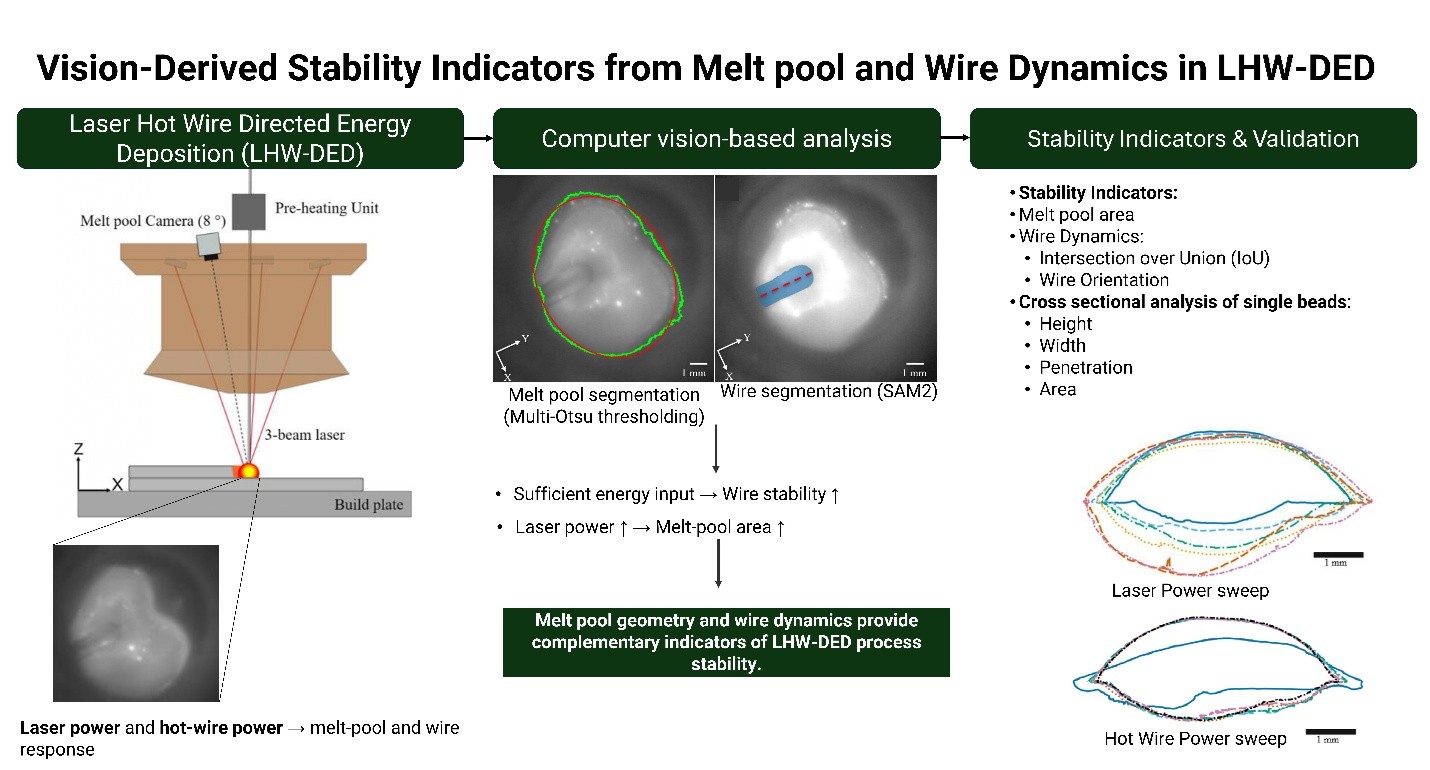
Laser hot-wire directed energy deposition (LHW-DED) improves process performance by enhancing wire preheating. Reliable in situ assessment of process stability remains challenging because the melt-pool behavior and wire transfer are commonly evaluated separately. This study develops vision-derived stability indicators by jointly characterizing melt-pool geometry and wire dynamics during the deposition of stainless steel 316LSi under varying laser power and hot-wire power. Optical videos were analyzed using multi-Otsu segmentation for melt-pool area extraction and the Segment Anything Model 2 for temporal wire segmentation. Melt-pool area was used to characterize the energy input, while frame-to-frame Intersection over Union (IoU), IoU volatility, and angle variability were evaluated as indicators of wire stability. Low energy conditions produced smaller melt pools and greater wire flutter, whereas sufficient energy inputs produced larger melt pools and more consistent wire behavior. Parameter-level correlations showed that melt-pool area for single beads was related to penetration depth and total cross-sectional area measured by optical microscopy. Melt-pool area was also associated with wire stability during the single-bead laser-power sweep. These results establish melt-pool geometry and wire dynamics as complementary indicators of LHW-DED stability and support future process qualification and in situ feedback control.
- Hoffmann M, Heinrich L, Paramanathan M, Fillingim KB, Elwany A, Feldhausen T. Hybrid additive manufacturing of AISI 316L via asynchronous powder and hot-wire laser directed energy deposition. J Manuf Processes. 2024;127:446-456. doi: 10.1016/j.jmapro.2024.07.144
- F42 Committee. Terminology for Additive Manufacturing—General Principles—Terminology. doi: 10.1520/ISOASTM52900-15
- Pinkerton AJ. Laser direct metal deposition: theory and applications in manufacturing and maintenance. In: Advances in Laser Materials Processing. Elsevier; 2010:461-491. doi: 10.1533/9781845699819.6.461
- Stawovy MT. Comparison of LCAC and PM Mo deposited using Sciaky EBAMTM. Int J Refract Met Hard Mater. 2018;73:162-167. doi: 10.1016/j.ijrmhm.2018.02.009
- Duda T, Raghavan LV. 3D Metal Printing Technology. IFAC-PapersOnLine. 2016;49(29):103-110. doi: 10.1016/j.ifacol.2016.11.111
- Wu B, Pan Z, Ding D, et al. A review of the wire arc additive manufacturing of metals: properties, defects and quality improvement. J Manuf Processes. 2018;35:127-139. doi: 10.1016/j.jmapro.2018.08.001
- Abranovic B, Chang-Davidson E, Beuth JL. Process mapping for laser hot wire additive manufacturing of Ti6Al4V. Rapid Prototyp J. 2025;31(6):1156-1174. doi: 10.1108/RPJ-05-2024-0216
- Kisielewicz A, Thalavai Pandian K, Sthen D, et al. Hot-Wire Laser-Directed Energy Deposition: Process Characteristics and Benefits of Resistive Pre-Heating of the Feedstock Wire. Metals. 2021;11(4):634. doi: 10.3390/met11040634
- Ghanadi N, Pasebani S. A Review on Wire-Laser Directed Energy Deposition: Parameter Control, Process Stability, and Future Research Paths. JMMP. 2024;8(2):84. doi: 10.3390/jmmp8020084
- DebRoy T, Wei HL, Zuback JS, et al. Additive manufacturing of metallic components – Process, structure and properties. Prog Mater Sci. 2018;92:112-224. doi: 10.1016/j.pmatsci.2017.10.001
- McLain B, Mathenia R, Sparks T, Liou F. Machine Vision to Provide Quantitative Analysis of Meltpool Stability for a Coaxial Wire Directed Energy Deposition Process. Materials. 2024;17(21):5311. doi: 10.3390/ma17215311
- Akbari M, Ding Y, Kovacevic R. Process Development for a Robotized Laser Wire Additive Manufacturing. In: Volume 2: Additive Manufacturing; Materials. American Society of Mechanical Engineers; 2017:V002T01A015. doi: 10.1115/MSEC2017-2951
- Heralić A, Christiansson AK, Lennartson B. Height control of laser metal-wire deposition based on iterative learning control and 3D scanning. Opt Lasers Eng. 2012;50(9):1230-1241. doi: 10.1016/j.optlaseng.2012.03.016
- Motta M, Demir AG, Previtali B. High-speed imaging and process characterization of coaxial laser metal wire deposition. Addit Manuf. 2018;22:497-507. doi: 10.1016/j.addma.2018.05.043
- Liu S, Liu W, Harooni M, Ma J, Kovacevic R. Real-time monitoring of laser hot-wire cladding of Inconel 625. Opt Laser Technol. 2014;62:124-134. doi: 10.1016/j.optlastec.2014.03.007
- Hagqvist P, Heralić A, Christiansson AK, Lennartson B. Resistance measurements for control of laser metal wire deposition. Opt Lasers Eng. 2014;54:62-67. doi: 10.1016/j.optlaseng.2013.10.010
- Ding D, Pan Z, Cuiuri D, Li H. Wire-feed additive manufacturing of metal components: technologies, developments and future interests. Int J Adv Manuf Technol. 2015;81(1-4):465-481. doi: 10.1007/s00170-015-7077-3
- Bernauer C, Merk T, Zapata A, Zaeh MF. Laser Metal Deposition with Coaxial Wire Feeding for the Automated and Reliable Build-Up of Solid Metal Parts. KEM. 2022;926:65-79. doi: 10.4028/p-ob7dg7
- Wei S, Wang G, Shin YC, Rong Y. Comprehensive modeling of transport phenomena in laser hot-wire deposition process. Int J Heat Mass Transf. 2018;125:1356-1368. doi: 10.1016/j.ijheatmasstransfer.2018.04.164
- Feng S, Wainwright J, Wang C, et al. Video Segmentation of Wire + Arc Additive Manufacturing (WAAM) Using Visual Large Model. Sensors. 2025;25(14):4346. doi: 10.3390/s25144346
- Sun Z, Guo W, Li L. In-process measurement of melt pool cross-sectional geometry and grain orientation in a laser directed energy deposition additive manufacturing process. Opt Laser Technol. 2020;129:106280. doi: 10.1016/j.optlastec.2020.106280
- Da Silva A, Frostevarg J, Kaplan AFH. Melt pool monitoring and process optimisation of directed energy deposition via coaxial thermal imaging. J Manuf Processes 2023;107:126-133. doi: 10.1016/j.jmapro.2023.10.021
- Gibson BT, Bandari YK, Richardson BS, et al. Melt pool monitoring for control and data analytics in large-scale metal additive manufacturing. In: Solid Freeform Fabrication 2019: Proceedings of the 30th Annual International Solid Freeform Fabrication Symposium – An Additive Manufacturing Conference. Accessed May 1, 2026. https://utw10945.utweb.utexas.edu/sites/default/files/2019/122%20Melt%20Pool%20Monitoring%20for%20Control%20and%20Data%20Analytic.pdf
- Kledwig C, Perfahl H, Reisacher M, Brückner F, Bliedtner J, Leyens C. Analysis of Melt Pool Characteristics and Process Parameters Using a Coaxial Monitoring System during Directed Energy Deposition in Additive Manufacturing. Materials. 2019;12(2):308. doi: 10.3390/ma12020308
- Pandiyan V, Cui D, Richter RA, Parrilli A, Leparoux M. Real-time monitoring and quality assurance for laser-based directed energy deposition: integrating co-axial imaging and self-supervised deep learning framework. J Intell Manuf. 2025;36(2):909-933. doi: 10.1007/s10845-023-02279-x
- Li J, Zhou Q, Huang X, Li M, Cao L. In situ quality inspection with layer-wise visual images based on deep transfer learning during selective laser melting. J Intell Manuf. 2023;34(2):853-867. doi: 10.1007/s10845-021-01829-5
- Hu D, Kovacevic R. Sensing, modeling and control for laser-based additive manufacturing. Int J Mach Tools Manuf. 2003;43(1):51-60. doi: 10.1016/S0890-6955(02)00163-3
- Zhang Y, Shen S, Li H, Hu Y. Review of in situ and real-time monitoring of metal additive manufacturing based on image processing. Int J Adv Manuf Technol. 2022;123(1-2):1-20. doi: 10.1007/s00170-022-10178-3
- Shah A, Weissbach R, Griggs DA, Hart AJ, Ertekin E, Tawfick S. Automated segmentation and analysis of microscopy images of laser powder bed fusion melt tracks. J Manuf Processes. 2025;154:61-70. doi: 10.1016/j.jmapro.2025.09.043
- Zhang K, Zhao T, Chen M, Zhang J, An Q. Improved U-net network with temporal adaptive Module for precise melt pool detection in LDED additive manufacturing. J Manuf Processes. 2025;153:650-664. doi: 10.1016/j.jmapro.2025.09.014
- De M, Dutta S, Mukherjee M. Enhanced in situ monitoring of metal deposition behaviour for pulsed wire arc directed energy deposition using integrated noncoaxial imaging and supervised deep learning framework. Sci Rep. 2025;15(1):42003. doi: 10.1038/s41598-025-26001-4
- He K, Gkioxari G, Dollár P, Girshick R. Mask R-CNN. arXiv. Preprint posted online 2017. doi: 10.48550/arXiv.1703.06870
- Asadi R, Queguineur A, Wiikinkoski O, et al. Process monitoring by deep neural networks in directed energy deposition: CNN-based detection, segmentation, and statistical analysis of melt pools. Robot Comput Integr Manuf. 2024;87:102710. doi: 10.1016/j.rcim.2023.102710
- Era IZ, Zhou F, Raihan AS, et al. In situ melt pool characterization via thermal imaging for defect detection in Directed Energy Deposition using Vision Transformers. J Manuf Processes. 2025;145:11-21. doi: 10.1016/j.jmapro.2025.03.123
- Kirillov A, Mintun E, Ravi N, et al. Segment Anything. arXiv. Preprint posted online 2023. doi: 10.48550/arXiv.2304.02643
- Ravi N, Gabeur V, Hu YT, et al. SAM 2: Segment Anything in Images and Videos. arXiv. Preprint posted online 2024. doi: 10.48550/arXiv.2408.00714
- Carion N, Gustafson L, Hu YT, et al. SAM 3: Segment Anything with Concepts. arXiv. Preprint posted online 2025. doi: 10.48550/arXiv.2511.16719
- Liao PS, Chen TS, Chung PC. A fast algorithm for multilevel thresholding. J Inf Sci Eng. 2001;17(5):713-717. doi: 10.6688/JISE.2001.17.5.1
- Chen J, Li H, Shen S, et al. Universal light SAM algorithm for in situ melting pool monitoring of L-DED/L-PBF/PAM processes. J Comput Des Eng. 2025;12(7):35-48. doi: 10.1093/jcde/qwaf057
- Bernauer C, Leitner P, Zapata A, et al. Segmentation-based closed-loop layer height control for enhancing stability and dimensional accuracy in wire-based laser metal deposition. Robot Comput-Integr Manuf. 2024;86:102683. doi: 10.1016/j.rcim.2023.102683
- Asadi R, Queguineur A, Ituarte IF. CNN-Based Wire Monitoring in LW-DED: Correlation with Surface Metrology. IOP Conf Ser Mater Sci Eng. 2025;1332(1):012039. doi: 10.1088/1757-899X/1332/1/012039
- Zhao Y, Sun J, Zhang G, Sun F, Li H. Enhancing SAM2 for Industrial Defect Detection via Dual-Adapter Fine-Tuning. IEEE Trans Instrum Meas. 2026;75:5009413. doi: 10.1109/tim.2026.3693442
- Putz F, Beirami S, Schmidt MA, et al. The Segment Anything foundation model achieves favorable brain tumor auto-segmentation accuracy in MRI to support radiotherapy treatment planning. Strahlenther Onkol. 2025;201(3):255-265. doi: 10.1007/s00066-024-02313-8
- Bambach M, Sizova I, Kies F, Haase C. Directed energy deposition of Inconel 718 powder, cold and hot wire using a six-beam direct diode laser set-up. Addit Manuf. 2021;47:102269. doi: 10.1016/j.addma.2021.102269
- Zhang K, Zhang XM, Liu WJ. Influences of Processing Parameters on Dilution Ratio of Laser Cladding Layer during Laser Metal Deposition Shaping. Adv Mater Res. 2012;549:785-789. doi: 10.4028/www.scientific.net/AMR.549.785