

Efficiency of food wastes and wetland plants as originating materials for the growth and cultivation of Pleurotus ostreatus

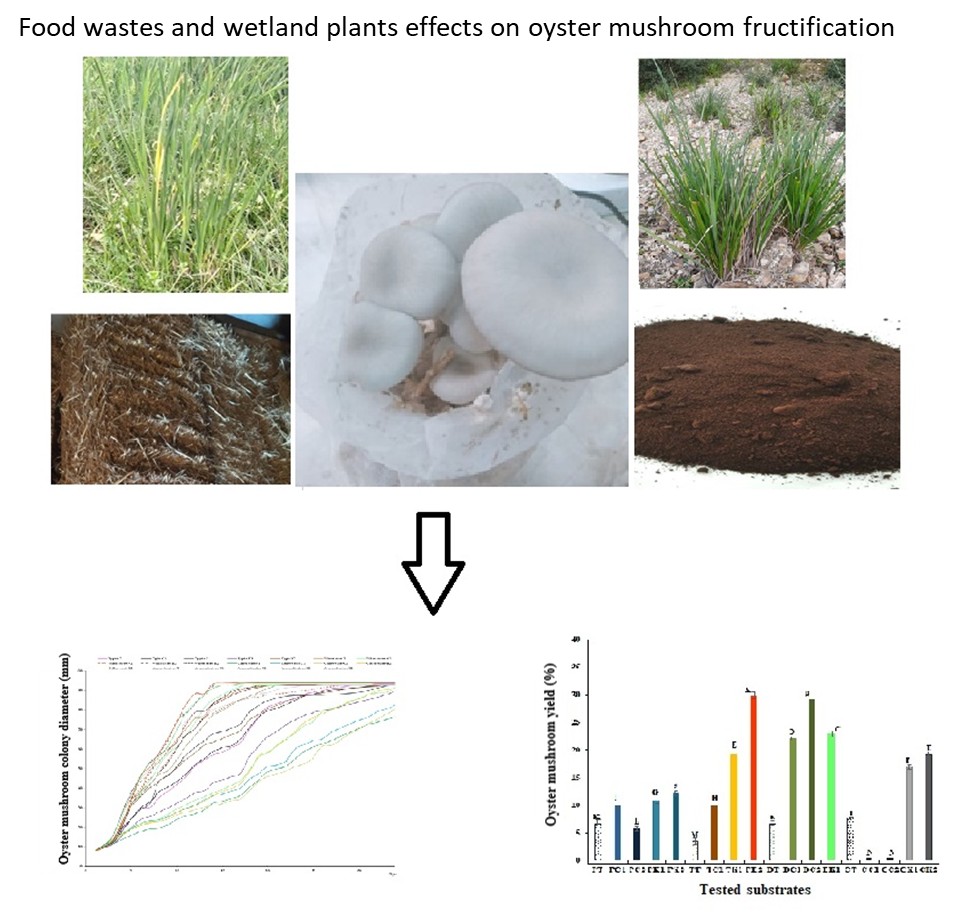
The valorization of lignocellulosic residues and unconventional plant biomass offers a promising strategy for sustainable mushroom production within a circular bioeconomy framework. This study evaluated the suitability of four substrates, namely wheat straw, Typha latifolia (cattail) biomass, Ampelodesmos mauritanicus biomass, and coffee waste, for the cultivation of Pleurotus ostreatus. The effects of two concentrations of glucose and potassium oxide on fungal colonization and fruiting performance were investigated under laboratory-scale conditions. The hypothesis was that substrate composition and nutrient supplementation would differentially influence mycelial development and mushroom production. Mycelial growth was evaluated through daily measurements of colony expansion, whereas fruiting performance was assessed through mushroom yield. Substrate type significantly affected both mycelial growth and yield. A. mauritanicus showed high potential for mycelial colonization, particularly after supplementation with glucose (20 g/L) or potassium (10 g/L). For fruiting body production, potassium supplementation improved cattail performance, with the highest yield obtained with 20 g/L potassium. Glucose and potassium supplementation also enhanced the productivity of A. mauritanicus. All tested fertilization concentrations increased P. ostreatus fructification from 1.5 to 8%, except when glucose was added to the coffee waste substrate. The tested supplementation rates had substrate-dependent effects, confirming that nutrient addition did not produce a universal response. Mineral analysis of harvested mushrooms revealed differences in nutritional composition among treatments. These results highlight the potential of cattail and A. mauritanicus biomass as alternative substrates for P. ostreatus cultivation. Further economic feasibility studies are required before scale-up applications.
- Losoya-Sifuentes C, Cruz M, Del Refugio Rocha-Pizaña M, Loredo-Treviño A, Belmares R. Edible mushrooms: a nutrient-rich ingredient for healthier food products—a review. Curr Nutr Rep. 2025;14(1):9. doi: 10.1007/s13668-024-00605-0
- Boro S, Kambhampati V, Das S, Saikia D. Edible mushrooms as meat analogues: a comprehensive review of nutritional, therapeutic, and market potential. Food Res Int. 2025;214:116632. doi: 10.1016/j.foodres.2025.116632
- Iqbal T, Sohaib M, Iqbal S, Rehman H. Comprehensive nutritional profiling and antioxidant capacity assessment of indigenous mushrooms Pleurotus ostreatus and Agaricus bisporus. Czech J Food Sci. 2024;42(3):174-183. doi: 10.17221/158/2023-CJFS
- Shahavi MH, Esfilar R, Golestani B, Sadeghabad MS, Biglaryan M. Comparative study of seven agricultural wastes for renewable heat and power generation using integrated gasification combined cycle based on energy and exergy analyses. Fuel. 2022;317:123430. doi: 10.1016/j.fuel.2022.123430
- Pandey A, Soccol CR, Nigam P, Brand D, Mohan R, Roussos S. Biotechnological potential of coffee pulp and coffee husk for bioprocesses. Biochem Eng J. 2000;6(2):153-162. doi: 10.1016/S1369-703X(00)00084-X
- Showkat QA, Rather JA, Abida J, Dar BN, Makroo HA, Majid D. Bioactive components, physicochemical and starch characteristics of different parts of Nelumbo nucifera Gaertn. plant: a review. Int J Food Sci Technol. 2021;56(5):2205-2214. doi: 10.1111/ijfs.14863
- Elbagory M, El-Nahrawy S, Omara AED, et al. Sustainable bioconversion of wetland plant biomass for Pleurotus ostreatus var. florida cultivation: studies on proximate and biochemical characterization. Agriculture. 2022;12(12):2095. doi: 10.3390/agriculture12122095
- Himshikha Dobhal S, Ayate D, Lal P. Influence of anthropogenic activities on the biological diversity of forest ecosystem. In: Rani M, Chaudhary BS, Jamal S, Kumar P, eds. Towards sustainable natural resources. Springer; 2022:215-233. doi: 10.1007/978-3-031-06443-2_12
- Hultberg M, Prade T, Bodin H, Vidakovic A, Asp H. Adding benefit to wetlands—valorization of harvested common reed through mushroom production. Sci Total Environ. 2018;637-638:1395-1399. doi: 10.1016/j.scitotenv.2018.05.106
- Jayaraman S, Yadav B, Dalal RC, et al. Mushroom farming: a review focusing on soil health, nutritional security and environmental sustainability. Farming Syst. 2024;2(3):100098. doi: 10.1016/j.farsys.2024.100098
- Faiq M, Rauf A, Qayash M, et al. Alternate substrates for the growth and yield of oyster mushroom (Pleurotus ostreatus). Pak J Weed Sci Res. 2025;31(1):66-73. doi: 10.17582/journal.PJWSR/2025/31.1.66.73
- Yang YR, Guo YX, Wang QY, et al. Impacts of composting duration on physicochemical properties and microbial communities during short-term composting for the substrate for oyster mushrooms. Sci Total Environ. 2022;847:157673. doi: 10.1016/j.scitotenv.2022.157673
- Xu H, Han G, Li Y, Meng Q, Zhang Y, Wang Y, Li S. Enhancing yield and quality: research and practice of agro-forest waste for Lentinus edodes (shiitake mushroom) cultivation. Front Nutr. 2025;12:1538039. doi: 10.3389/fnut.2025.1538039
- Miles PG, Chang ST. Mushrooms: cultivation, nutritional value, medicinal effect and environmental impact. Boca Raton, FL: CRC Press; 2004. doi: 10.1201/9780203492086
- Oei P. Mushroom cultivation. Paris, France: CTA; 1993.
- Effiong ME, Umeokwochi CP, Afolabi IS, Chinedu SN. Assessing the nutritional quality of Pleurotus ostreatus (oyster mushroom). Front Nutr. 2024;10:1279208. doi: 10.3389/fnut.2023.1279208
- Wang Q, Wang Y, Li T, et al. The interplay between the formation of Chinese cordyceps and the characteristics of soil properties and microbial network. Microbiol Spectr. 2025;13(7):e03277-24. doi: 10.1128/spectrum.03277-24
- Carrasco J, Zied DC, Pardo JE, Preston GM, Pardo-Giménez A. Supplementation in mushroom crops and its impact on yield and quality. AMB Express. 2018;8(1):1-9. doi: 10.1186/s13568-018-0678-0
- Akram S, Khan R, Iqbal O, et al. Enhancing oyster mushroom (Pleurotus spp.) yield performance across various substrates through chemical and biological supplements. Pak J Phytopathol. 2024;36(1):141-148. doi: 10.33866/phytopathol.036.01.1105
- Milkias E, Dobo B, Ayele S. The effect of substrate and substrate formulation on the yield of oyster mushroom (Pleurotus ostreatus). Mushroom Res. 2024;33(2):189-198. doi: 10.36036/MR.33.2.2024.155349
- Pereima IV, Ivanova TV. Stimulation of growth of species of the fungus of the genus Pleurotus (Fr.) P Kumm. at a glucose nutrition. Biotechnol Acta. 2017;10(6):45-52. doi: 10.15407/biotech10.06.045
- Buswell JA, Cai Y, Chang ST. Effect of nutrient nitrogen and manganese on manganese peroxidase and laccase production by Lentinula (Lentinus) edodes. FEMS Microbiol Lett. 1995;128(1):81-87. doi: 10.1111/j.1574-6968.1995.tb07504.x
- Curvetto NR, Figlas D, Devalis R, Delmastro S. Growth and productivity of different Pleurotus ostreatus strains on sunflower seed hulls supplemented with N-NH4+ and/or Mn(II). Bioresour Technol. 2002;84(2):171-176. doi: 10.1016/S0960-8524(02)00013-5
- Noble R, Thai M, Kertesz MA. Nitrogen balance and supply in Australasian mushroom composts. Appl Microbiol Biotechnol. 2024;108(1):151. doi: 10.1007/s00253-023-12933-2
- Rahman MH, Ahmed KU, Roy TS, Mandal SH, Alamm R. Effect of chemical fertilizer supplements with rice straw on the growth and yield of oyster mushroom (Pleurotus ostreatus). Int J Sustain Agr Tech. 2013;9(2):47-51.
- Prakash P, Anuradha S, Dhanalakshmi PK, Niveditha N. Application of statistical methods to optimize medium for increased yield of oyster mushroom (Pleurotus ostreatus). Int J Biol Technol. 2010;1(1):66-74.
- Styer JF. Preliminary study of the nutrition of the cultivated mushroom. Am J Bot. 1928;15(4):246-250. doi: 10.2307/2435921
- Edo Nashwan Y. Influence of glucose and peptone on the mycelial growth of oyster mushroom (Pleurotus ostreatus). J Duhok Univ. 2021;24(2):11-18. doi: 10.26682/ajuod.2021.24.2.2
- Kanhar QD, Jiskani MM, Pathan MA, Nizamani ZA. Effect of urea on growth and yield of oyster mushroom Pleurotus ostreatus (Jacq. ex Fr.) Kummer. Pak J Phytopathol. 2007;19(2):214-223.
- Mshandete AM. Cultivation of Pleurotus HK-37 and Pleurotus sapidus (oyster mushrooms) on cattail weed (Typha domingensis) substrate in Tanzania. Int J Res Biol Sci. 2011;1(3):35-44.
- Buğdaycı KE, Oğuz FK, Kara K, et al. Influence of harvesting periods and additives on the quality of silage from common reed (Phragmites australis) and cattail (Typha spp.). J Anim Feed Sci. 2025;34(2):249-258. doi: 10.22358/jafs/193488/2024
- Cicero I, Mirabile G, Venturella G. Potential medicinal fungi from freshwater environments as resources of bioactive compounds. J Fungi. 2025;11(1):54. doi: 10.3390/jof11010054
- Vetayasuporn S. Using cattails (Typha latifolia) as substrate for Pleurotus ostreatus (Fr.) Kummer cultivation. J Biol Sci. 2006;7(1):218-221. doi: 10.3923/jbs.2007.218.221
- Ahmed R, Niloy MAHM, Islam MS, et al. Optimizing tea waste as a sustainable substrate for oyster mushroom (Pleurotus ostreatus) cultivation: a comprehensive study on biological efficiency and nutritional aspect. Front Sustain Food Syst. 2024;7:1308053. doi: 10.3389/fsufs.2023.1308053
- Obodai M, Kine JCO, Vowotor KA. Comparative study on the growth and yield of Pleurotus ostreatus mushroom on different lignocellulosic by-products. J Indian Microbiol Biotechnol. 2003;30(3):146-149. doi: 10.1007/s10295-002-0021-1
- Winter A, Pedro E, Ślasko J, et al. Waste to fungi. In: Proceedings of the Seventh International Conference on Technological Ecosystems for Enhancing Multiculturality. New York, NY: ACM; 2019:115-122. doi: 10.1145/3362789.3362921
- Suwannarach N, Kumla J, Zhao Y, Kakumyan P. Impact of cultivation substrate and microbial community on improving mushroom productivity: a review. Biology. 2022;11(4):569. doi: 10.3390/biology11040569
- Niemiec M, Suder M, Okręglicka M, et al. Low-energy pretreatment of organic waste using a vortex layer reactor: effects on biogas production, carbon conversion, and process optimization. Energies. 2026;19(11):2732. doi: 10.3390/en19112732