

Synergistic effects and mechanism of hazardous chlorinated aromatic hydrocarbon formation during plastics combustion: A multiscale study

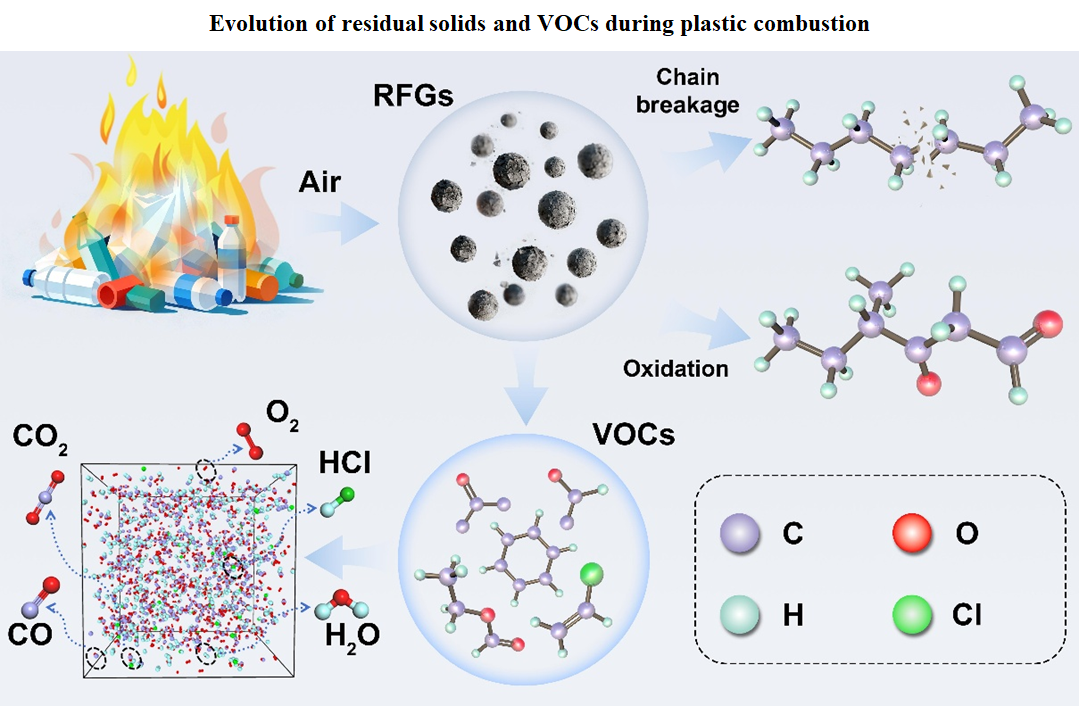
The combustion of waste plastics provides critical insights for researchers addressing environmental challenges. This study systematically investigates the combustion behavior, reaction kinetics, and mechanisms of polypropylene (PP), polystyrene (PS), polyvinyl chloride (PVC), and their ternary blend (PP:PS:PVC). Headspace gas chromatography–mass spectrometry analysis showed that the emitted volatile organic compounds ranged from volatile to semi-volatile regimes, with saturation mass concentrations spanning 0 μg·m−3 < log10C0 < 10 μg·m−3. Co-combustion substantially increased the relative abundance of oxygenated species, such as aldehydes, ketones, esters, and acids, compared with single-component plastics. Two-dimensional correlation spectroscopy indicated that the order of gas evolution was: gaseous acids, residual functional groups, aldehydes, ketones, esters, and, finally, aliphatic hydrocarbons, suggesting premature oxidation in the blend. Iso-conversional kinetic analysis showed that PVC had a significant catalytic effect, reducing the activation energy for PVC dehydrochlorination by approximately 40 kJ·mol−1 and for residual carbon oxidation by about 100 kJ·mol−1 in the blend compared with pure PVC. Cone calorimetry showed that PS had the highest total smoke release (3,188 m2·m−2) and PVC produced the highest carbon monoxide yield (0.192 kg·kg−1), indicating a greater hazard. The ternary blend showed an increased carbon monoxide yield of 0.183 kg·kg−1 compared with either PP or PS alone. Reactive force field simulations provided atomic-level evidence that PVC-derived chlorine radicals attack PP and PS chains, accelerate radical-driven oxidation, and promote the formation of chlorinated aromatics, such as chlorostyrene (C8H7Cl). These findings provide a theoretical basis for developing sustainable strategies for waste plastic combustion and pollution control.
- Aransiola SA, Victor-Ekwebelem MO, Daza BX, et al. Micro-and nano-plastics pollution in the marine environment: Progresses, drawbacks and future guidelines. Chemosphere. 2025;374:144211. doi: 10.1016/j.chemosphere.2025.144211
- Guan J, Dai Z, Wang R, et al. Pollution characteristics and control strategies of typical waste plastic recycling plants. J Environ Chem Eng. 2025;13(3):116398. doi: 10.1016/j.jece.2025.116398
- Yan Y, Wang Y. Boosting bioplastics’ discovery for curbing plastic pollution. Matter. 2025;8(7):102167. doi: 10.1016/j.matt.2025.102167
- Ryou H, Byun J, Bae J, Kim DK, Han J. Energy-efficient and environmentally friendly upcycling of waste plastic into fuels, chemicals, and polymers. Chem Eng J. 2025;511:162256. doi: 10.1016/j.cej.2025.162256
- Xu S, Han Z, Yuan K, et al. Upcycling chlorinated waste plastics. Nat Rev Methods Primers. 2023;3(1):44. doi: 10.1038/s43586-023-00227-w
- Wu X, Liu X, Song Y, et al. A Minimalist Design for a Dual-Catalyst System for High-Efficiency Conversion of Waste Plastics into Liquid Fuel Products. J Am Chem Soc. 2025;147(25):21907-21915. doi: 10.1021/jacs.5c05246
- Chea JD, Yenkie KM, Stanzione III JF, Ruiz-Mercado GJ. A generic scenario analysis of end-of-life plastic management: Chemical additives. J Hazard Mater. 2023;441:129902. doi: 10.1016/j.jhazmat.2022.129902
- Pottinger AS, Geyer R, Biyani N, et al. Pathways to reduce global plastic waste mismanagement and greenhouse gas emissions by 2050. Science. 2024;386(6726):1168-1173. doi: 10.1126/science.adr3837
- Yang Y, Qiu J, Zhang H, He P, Lü F. How soon will landfilled plastics integrate into the geological carbon cycle? Environ Sci Ecotechnol. 2025;26:100590. doi: 10.1016/j.ese.2025.100590
- Żukowski W, Jankowski D, Baron J, Wrona J. Combustion dynamics of polymer wastes in a bubbling fluidized bed. J Clean Prod. 2021;320:128807. doi: 10.1016/j.jclepro.2021.128807
- Chen Y, Awasthi AK, Wei F, Tan Q, Li J. Single-use plastics: Production, usage, disposal, and adverse impacts. Sci Total Environ. 2021;752:141772. doi: 10.1016/j.scitotenv.2020.141772
- Velis CA, Cook E. Mismanagement of plastic waste through open burning with emphasis on the global south: a systematic review of risks to occupational and public health. Environ Sci Technol. 2021;55(11):7186-7207. doi: 10.1021/acs.est.0c08536
- Zhou Q, Luo X, Gao X, et al. Impact of psychological distance on public acceptance of waste-to-energy combustion projects. Environ Impact Assess Rev. 2024;109:107631. doi: 10.1016/j.eiar.2024.107631
- Xu S, Li H, Wang Y, et al. Effect of chlorides on the melting behavior of municipal solid waste incineration fly ash. J Environ Chem Eng. 2025;13(2):116009. doi: 10.1016/j.jece.2025.116009
- Deng QX, Feng JR, Gao PP, Ni HG. Combined effects of vehicles and waste incineration on urban air halogenated and parent polycyclic aromatic hydrocarbons. Environ Int. 2023;171:107720. doi: 10.1016/j.envint.2022.107720
- Oluwoye I, Zeng Z, Mosallanejad S, Altarawneh M, Gore J, Dlugogorski BZ. Controlling NOx emission from boilers using waste polyethylene as reburning fuel. Chem Eng J. 2021;411:128427. doi: 10.1016/j.cej.2021.128427
- Zeng M, Ge Z, Wu Y, et al. Energy utilization of takeaway waste: Components separation and fuel preparation employing hydrothermal carbonization and gasification. Energy. 2024;299:131426. doi: 10.1016/j.energy.2024.131426
- Olhan S, Antil B, Behera BK. Repair technologies for structural polymeric composites: An automotive perspective. Compos Struct. 2025;352(3):118711. doi: 10.1016/j.compstruct.2024.118711
- Kai X, Li R, Yang T, Shen S, Ji Q, Zhang T. Study on the co-pyrolysis of rice straw and high-density polyethylene blends using TG-FTIR-MS. Energy Convers Manag. 2017;146:20-33. doi: 10.1016/j.enconman.2017.05.026
- Qin L, Han J, Zhao B, Wang Y, Chen WS, Xing FT. Thermal degradation of medical plastic waste by in-situ FTIR, TG-MS, and TG-GC/MS coupled analyses. J Anal Appl Pyrolysis. 2018;136:132-145. doi: 10.1016/j.jaap.2018.10.012
- Liu X, Tian K, Chen Z, Wei W, Xu B, Ni BJ. Online TG-FTIR-MS analysis of the catalytic pyrolysis of polyethylene and polyvinyl chloride microplastics. J Hazard Mater. 2023;441(5):129881. doi: 10.1016/j.jhazmat.2022.129881
- Wang X, Tang S, Ding L, et al. Contribution of plastic solid components to volatile organic compounds formation during plastics combustion. J Hazard Mater. 2024;480:135977. doi: 10.1016/j.jhazmat.2024.135977
- Li Y, Pöschl U, Shiraiwa M. Molecular corridors and parameterizations of volatility in the chemical evolution of organic aerosols. Atmos Chem Phys. 2016;16(5):3327-3344. doi: 10.5194/acp-16-3327-2016
- Kroll JH, Donahue NM, Jimenez JL, et al. Carbon oxidation state as a metric for describing the chemistry of atmospheric organic aerosol. Nat Chem. 2011;3(2):133-139. doi: 10.1038/nchem.948
- Wu X, Chen X, Jiang R, You J, Ouyang G. New insights into the photo-degraded polystyrene microplastic: Effect on the release of volatile organic compounds. J Hazard Mater. 2022;431:128523. doi: 10.1016/j.jhazmat.2022.128523
- Qiu Y, Zhong W, Shao Y, Yu A. Reactive force field molecular dynamics (ReaxFF MD) simulation of coal oxy-fuel combustion. Powder Technol. 2020;361:337-348. doi: 10.1016/j.powtec.2019.07.103
- Feng Y, Hao H, Chow CL, Lau, D. Exploring reaction mechanisms and kinetics of cellulose combustion via ReaxFF molecular dynamics simulations. Chem Eng J. 2024;488:151023. doi: 10.1016/j.cej.2024.151023
- Yu X, Chen J, Meng X, et al. Polyethylene deflagration characterization and kinetic mechanism analysis. Energy. 2024;303:131990. doi: 10.1016/j.energy.2024.131990
- Saha T, Bhowmick AK, Oda T, Miyauchi, T., Fujii, N. Understanding thermo-oxidative degradation of polyacrylic ester elastomer and its nanocomposites through molecular dynamics simulation and experiments. Polym Degrad Stab. 2021;183:109457. doi: 10.1016/j.polymdegradstab.2020.109457
- Hong D, Guo X. Molecular dynamics simulations of Zhundong coal pyrolysis using reactive force field. Fuel. 2017;210:58-66. doi: 10.1016/j.fuel.2017.08.061
- Xu F, Liu H, Wang Q, et al. ReaxFF-based molecular dynamics simulation of the initial pyrolysis mechanism of lignite. Fuel Process Technol. 2019;195:106147. doi: 10.1016/j.fuproc.2019.106147
- Ji J, Zhu W. Thermal decomposition of core–shell structured HMX@ Al nanoparticle simulated by reactive molecular dynamics. Comput Mater Sci. 2022;209:111405. doi: 10.1016/j.commatsci.2022.111405
- Song F, Li T, Zhang J, et al. Novel insights into the kinetics, evolved gases, and mechanisms for biomass (sugar cane residue) pyrolysis. Environ Sci Technol. 2019;53(22):13495-13505. doi: 10.1021/acs.est.9b04595
- Song F, Li T, Shi Q, et al. Novel insights into the molecular-level mechanism linking the chemical diversity and copper binding heterogeneity of biochar-derived dissolved black carbon and dissolved organic matter. Environ Sci Technol. 2021;55(17):11624-11636. doi: 10.1021/acs.est.1c00083
- Hur J, Jung KY, Jung YM. Characterization of spectral responses of humic substances upon UV irradiation using two-dimensional correlation spectroscopy. Water Res. 2011;45(9):2965-2974. doi: 10.1016/j.watres.2011.03.013
- Park Y, Jin S, Park E, et al. Chemical images and 2D-COS analysis of spin-coated PHBHx/PEG blend films. J Mol Struct. 2020;1216:128344. doi: 10.1016/j.molstruc.2020.128344
- Noda I. Close-up view on the inner workings of two-dimensional correlation spectroscopy. Vib Spectrosc. 2012;60:146-153. doi: 10.1016/j.vibspec.2012.01.006
- Chen W, Teng CY, Qian C, Yu HQ. Characterizing properties and environmental behaviors of dissolved organic matter using two-dimensional correlation spectroscopic analysis. Environ Sci Technol. 2019;53(9):4683-4694. doi: 10.1021/acs.est.9b01103
- Peng BY, Wang WX. In Vivo visualization of microplastic degradability and intestinal functional responses in a plastivore insect. J Hazard Mater. 2025;486:137109. doi: 10.1016/j.jhazmat.2025.137109
- Kissinger HE. Variation of peak temperature with heating rate in differential thermal analysis. J Res Natl Bur Stand. 1956;57(4):217-221. doi: 10.6028/jres.057.026
- Ozawa T, Isozaki H, Negishi A. A new type of quantitative differential thermal analysis. Thermochim Acta. 1970;1(6):545-553. doi: 10.1016/0040-6031(70)80006-5
- Starink MJ. A new method for the derivation of activation energies from experiments performed at constant heating rate. Thermochim Acta. 1996;288(1-2):97-104. doi: 10.1016/S0040-6031(96)03053-5
- Dewapriya MAN, Miller RE. Quantum and classical molecular dynamics simulations of shocked polyurea and polyurethane. Comput Mater Sci. 2022;203:111166. doi: 10.1016/j.commatsci.2021.111166
- Wood MA, Van Duin ACT, Strachan A. Coupled thermal and electromagnetic induced decomposition in the molecular explosive αHMX; a reactive molecular dynamics study. J Phys Chem A. 2014;118(5):885-895. doi: 10.1021/jp406248m
- Li W, Yu S, Zhang L, Chen J, Cao W, Lan Y. ReaxFF molecular dynamics simulations of n-eicosane reaction mechanisms during pyrolysis and combustion. Int J Hydrog Energy. 2021;46(78):38854-38870. doi: 10.1016/j.ijhydene.2021.08.234
- Batuer, A, Chen, D, He, X, Huang Z. Simulation methods of cotton pyrolysis based on ReaxFF and the influence of volatile removal ratio on volatile evolution and char formation. Chem Eng J. 2021;405:126633. doi: 10.1016/j.cej.2020.126633
- Bhoi S, Banerjee T, Mohanty K. Molecular dynamic simulation of spontaneous combustion and pyrolysis of brown coal using ReaxFF. Fuel. 2014;136:326-333. doi: 10.1016/j.fuel.2014.07.058
- Chen R, Lu S, Zhang Y, Lo, S. Pyrolysis study of waste cable hose with thermogravimetry/Fourier transform infrared/mass spectrometry analysis. Energy Convers Manag. 2017;153:83-92. doi: 10.1016/j.enconman.2017.09.071
- Xu G, Cai X, Wang L, et al. Thermogravimetric-infrared analysis and performance optimization of co-pyrolysis of oily sludge and rice husks. Int J Hydrog Energy. 2022;47(64):27437-27451. doi: 10.1016/j.ijhydene.2022.06.099
- Nel HA, Chetwynd AJ, Kelly CA, et al. An untargeted thermogravimetric analysis-fourier transform infrared-gas chromatography-mass spectrometry approach for plastic polymer identification. Environ Sci Technol. 2021;55(13):8721-8729. doi: 10.1021/acs.est.1c01085
- Hong D, Gao P, Wang C. A comprehensive understanding of the synergistic effect during co-pyrolysis of polyvinyl chloride (PVC) and coal. Energy. 2022;239:122258. doi: 10.1016/j.energy.2021.122258
- de la Fuente AM, Marhuenda-Egea FC, Ros M, et al. Thermogravimetry coupled with mass spectrometry was successfully used to quantify polyethylene and polystyrene microplastics in organic amendments. Environ Res. 2022;213:113583. doi: 10.1016/j.envres.2022.113583
- Wang G, Li D, Yuan X, et al. Co-hydrothermal carbonization of polyvinyl chloride and pyrolysis carbon black for the preparation of clean solid fuels. Fuel. 2024;361:130550. doi: 10.1016/j.fuel.2023.130550
- Huo Y, Guo Z, Li Q, et al. Chemical fingerprinting of HULIS in particulate matters emitted from residential coal and biomass combustion. Environ Sci Technol. 2021;55(6):3593-3603. doi: 10.1021/acs.est.0c08518
- Lu Q, Zhao Y, Robinson AL. Comprehensive organic emission profiles for gasoline, diesel, and gas-turbine engines including intermediate and semi-volatile organic compound emissions. Atmos Chem Phys. 2018;18(23):17637-17654. doi: 10.5194/acp-18-17637-2018
- Zhao Y, Saleh R, Saliba G, et al. Reducing secondary organic aerosol formation from gasoline vehicle exhaust. Proc Natl Acad Sci USA. 2017;114(27):6984-6989. doi: 10.1073/pnas.1620911114
- Liu M, Han B, Bai J, et al. Insights into the co-combustion characteristics and synergistic effects of biomass and polyethylene plastic under rapid heating conditions. Energy. 2025;325:136113. doi: 10.1016/j.energy.2025.136113
- Zeng G, Su Y, Jiang J, Huang Z. Nitrogenative Degradation of Polystyrene Waste. J Am Chem Soc. 2025;147(3):2737-2746. doi: 10.1021/jacs.4c15500
- Han H, Yan P, Li Q, et al. Photothermal upcycling of waste polyvinyl chloride plastics. Environ Sci Technol. 2024;58(49):21861-21870. doi: 10.1021/acs.est.4c07350
- Jiang Q, Zhao Y, Zhang C, Yang J, Wang D. Investigation on the overlapping bands of syndiotactic polystyrene by using 2D-IR spectroscopy. J Mol Struct. 2016;1124:98-102. doi: 10.1016/j.molstruc.2016.03.103
- Song F, Li T, Wu F, Leung KMY, Bai Y, Zhao X. Dynamic evolution and covariant response mechanism of volatile organic compounds and residual functional groups during the online pyrolysis of coal and biomass fuels. Environ Sci Technol. 2022;56(9):5409-5420. doi: 10.1021/acs.est.1c08400
- Panahi-Sarmad M, Kasbi SF, Shojaei S, et al. Influence of polypropylene and nano-clay on thermal and thermos-oxidative degradation of poly (lactide acid): TG-FTIR, TG-DSC studies and kinetic analysis. Thermochim Acta. 2020;691:178709. doi: 10.1016/j.tca.2020.178709
- Gao Q, Ni L, Rong S, et al. Disposal of bamboo-based plastic substitute waste: A case study on co-pyrolysis and co-combustion of bamboo and polylactic acid. Energy. 2025;329:136822. doi: 10.1016/j.energy.2025.136822
- Chaudhuri P, Pande R, Baraiya NA. From char to flame: Evaluating bamboo bio-char combustion via cone calorimetry and thermogravimetric analysis. Energy. 2025;314:134313. doi: 10.1016/j.energy.2024.134313
- Zhang Y, Zhang C, Li W, et al. Reaction mechanism of stearic acid pyrolysis via reactive molecular dynamics simulation and TG-IR technology. Renew Energy. 2023;217:119115. doi: 10.1016/j.renene.2023.119115
- Li W, Zhang X, Liu R, et al. Thermal decomposition, flame propagation, and combustion reactions behaviours of stearic acid by experiments and molecular dynamic simulation. Chem Eng J. 2023;461:141906. doi: 10.1016/j.cej.2023.141906
- Ganguly S, Das P, Banerjee S, Das NC. Advancement in science and technology of carbon dot-polymer hybrid composites: A review. Funct Compos Struct. 2019;1(2):022001. doi: 10.1088/2631-6331/ab0c80
- Deng T, Chen Y, Hou D. Practically simple, catalyst-free, and scalable approach for all-component upcycling of mixed PVC/PA plastics. Waste Manag. 2025;205:115002. doi: 10.1016/j.wasman.2025.115002