
Integrating algal consortia into domestic wastewater biorefineries: Mechanisms, efficiency, and circular economy perspectives

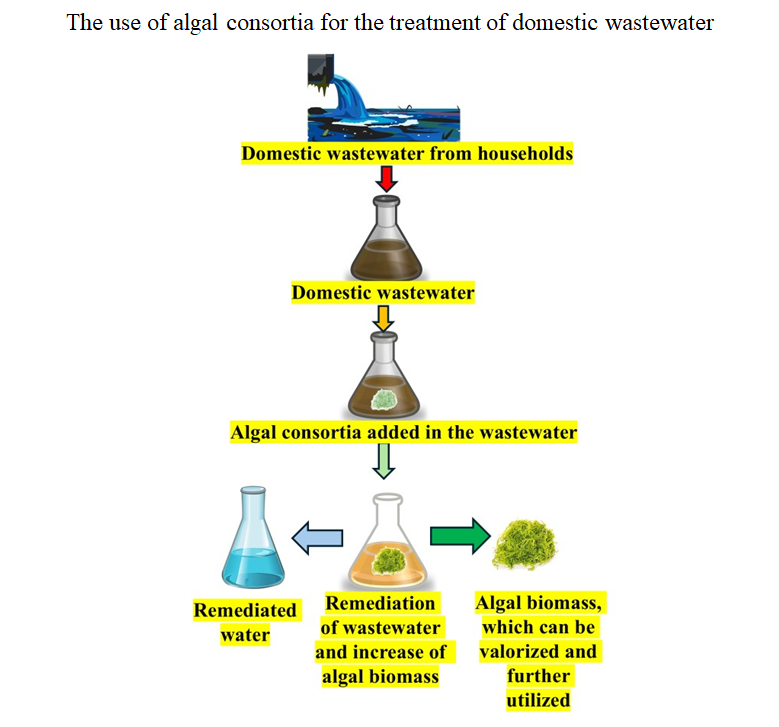
Urbanization is occurring on a large scale at an unprecedented pace. In this context, algal consortia represent a sustainable and environmentally friendly solution for domestic wastewater remediation. This review focuses on mixed algal consortia as a treatment approach for domestic wastewater containing organic and inorganic pollutants, including nitrogen, phosphorus, heavy metals, and other chemicals. These consortia demonstrate enhanced pollutant removal efficiencies through synergistic biosorption, bioaccumulation, and biodegradation mediated by multiple algal species. Indeed, algal biomass can be valorized in biorefineries to produce a range of resources, including biofuels, biopolymers, and organic phyco-fertilizers, thereby advancing the circular bioeconomy. Overall, this review positions algal consortia as a potentially low-cost platform that integrates wastewater remediation with bioresource recovery, promoting the transformation of urban ecosystems toward a greener, more resilient future.
- Hena S, Fatimah S, Tabassum S. Cultivation of algae consortium in a dairy farm wastewater for biodiesel production. Water Res Ind. 2015;10:1-14. doi: 10.1016/j.wri.2015.02.002
- Mondal A, Mukherjee A, Pal R. Phycosynthesis of nanoiron particles and their applications- a review. Biocatal Agric Biotechnol. 2024a;55:102986. doi: 10.1016/j.bcab.2023.102986.
- Mondal A, Paul S, Pal R, Paul S. Nano iron loaded algal biomass: For better yield, amino acid and iron content in rice-a ‘nano-phycofertilizer’. Algal Res. 2024b;81:103573. doi: 10.1016/j.algal.2024.103573
- Gururani P, Bhatnagar P, Kumar V, Vlaskin MS, Grigorenko AV. Algal consortia: A novel and integrated approach for wastewater treatment. Water. 2022;14(22):3784. doi: 10.3390/w14223784
- Dey I, Mondal A, Pal R. Algae-based systems for removal of emerging pollutants from sewage sludge. Biotechnol Rem Emer Poll Wastew Sys. 2025a:109-133. doi: 10.1007/978-981-96-3945-8_5
- Dey I, Mondal A, Satpati GG, Pal R. Tannery wastewater remediation potential of cyanobacteria and algae with nutrient recovery, ecological monitoring and biomass valorization: A circular economy. Nex Chem Eng. 2025b;1:100009. doi: 10.1016/j.nxcen.2025.100009
- Cai T, Park SY, Li Y. Nutrient recovery from wastewater streams by microalgae: Status and prospects. Renew Sustain Energy Rev. 2013;19:360-369. doi: 10.1016/j.rser.2012.11.030
- Ahmad F, Khan AU, Yasar A. Comparative phycoremediation of sewage water by various species of algae. Proc Pak Acad Sci. 2013;50(2):131-139.
- Moondra N, Jariwala ND, Christian RA. Role of phycoremediation in domestic wastewater treatment. Water Conserv Manag. 2021;5(2):66-70. doi: 10.26480/wcm.02.2021.66.70
- Gonçalves AL, Pires JC, Simões M. A review on the use of microalgal consortia for wastewater treatment. Algal Res. 2017;24:403-415. doi: 10.1016/j.algal.2016.11.008
- Koul B, Yadav D, Singh S, Kumar M, Song M. Insights into the domestic wastewater treatment (DWWT) regimes: A review. Water. 2022;14(21):3542. doi: 10.3390/w14213542
- Manasa RL, Mehta A. Wastewater: Sources of pollutants and its remediation. In Environmental Biotechnology. Vol. 2. Berlin: Springer; 2020. p. 197-219. doi: 10.1007/978-3-030-38196-7_9
- Dey I, Mukherjee C, Pal R. Impact of tannery wastewater treatment plant effluent on phytoplankton community of receiving stream heading to the Indian Sundarbans. Inland Water Biol. 2024;17(1):71-81. doi: 10.1134/S199508292401019X
- Thakur TK, Barya MP, Dutta J, et al. Integrated phytobial remediation of dissolved pollutants from domestic wastewater through constructed wetlands: An interactive macrophyte-microbe-based green and low-cost decontamination technology with prospective resource recovery. Water. 2023;15(22):3877. doi: 10.3390/w15223877
- Mahapatra DM, Chanakya HN, Ramachandra TV. Bioremediation and lipid synthesis through mixotrophic algal consortia in municipal wastewater. Bioresour Technol. 2014;168:142-150. doi: 10.1016/j.biortech.2014.03.130
- Chahal S, Bhandari R. Cyanobacterial phycoremediation: A sustainable approach to dairy wastewater management. Environ Technol. 2025;46:3077-3089. doi: 10.1080/09593330.2025.2453947
- Cheng J, Qiu Y, Huang R, Yang W, Zhou J, Cen K. Biodiesel production from wet microalgae by using graphene oxide as solid acid catalyst. Bioresour Technol. 2016;221:344-349. doi: 10.1016/j.biortech.2016.09.064
- Cheah YT, Chan DJC. A methodological review on the characterization of microalgal biofilm and its extracellular polymeric substances. J Appl Microbiol. 2022;132(5):3490-3514. doi: 10.1111/jam.15455
- Diankristanti PA, Ng IS. Marine microalgae for bioremediation and waste-to-worth valorization: Recent progress and prospects. Blue Biotechnol. 2024;1(1):10. doi: 10.1186/s44315-024-00010-w
- Li P, Wang D, Hu Z, et al. Insight into the potential mechanism of bicarbonate assimilation promoted by mixotrophic in CO2 absorption and microalgae conversion system. Chemos. 2024;349:140903. doi: 10.1016/j.chemosphere.2023.140903
- Neilson AH, Lewin RA. The uptake and utilization of organic carbon by algae: An essay in comparative biochemistry. Phycol. 1974;13(3):227-264. doi: 10.2216/i0031-8884-13-3-227.1
- Kumar A, Bera S. Revisiting nitrogen utilization in algae: A review on the process of regulation and assimilation. Biores Technol Rep. 2020;12:100584. doi: 10.1016/j.biteb.2020.100584
- Vega JM, Menacho A, León J. Nitrate assimilation by microalgae. Trends Photochem Photobiol. 1991;2:69-111.
- Taylor MW, Barr NG, Grant CM, Rees TAV. Changes in amino acid composition of Ulva intestinalis (Chlorophyceae) following addition of ammonium or nitrate. Phycol 2006;45(3):270-276. doi: 10.2216/05-15.1
- Larsdotter K, Jansen JLC, Dalhammar G. Biologically mediated phosphorus precipitation in wastewater treatment with microalgae. Environ Technol. 2007;28(9):953-960. doi: 10.1080/09593332808618855
- Banerjee S, Lahiri R, Choudhury AK, et al. Unraveling the potential of cyanobacteria as food and investigating its production and nutritional properties. Biocatal Agric Biotechnol. 2024;62:103421. doi: 10.1016/j.bcab.2024.103421
- Chen Z, Osman AI, Rooney DW, Oh WD, Yap PS. Remediation of heavy metals in polluted water by immobilized algae: Current applications and future perspectives. Sustain. 2023;15(6):5128. doi: 10.3390/su15065128.
- Zabochnicka-Świątek M, Krzywonos M. Potentials of biosorption and bioaccumulation processes for heavy metal removal. Pol J Environ Studies. 2014:23(2):551-561.
- Bilal M, Rasheed T, Sosa-Hernández JE, Raza A, Nabeel F, Iqbal HM. Biosorption: An interplay between marine algae and potentially toxic elements-a review. Mar Drugs. 2018;16(2):65. doi: 10.3390/md16020065
- Doshi H, Seth C, Ray A, Kothari IL. Bioaccumulation of heavy metals by green algae. Curr Microbiol. 2008;56(3):246-255. doi: 10.1007/s00284-007-9070-z
- Ali AY, Idris AM, Eltayeb MA, El-Zahhar AA, Ashraf IM. Bioaccumulation and health risk assessment of toxic metals in red algae in Sudanese Red Sea coast. Tox Rev. 2021;40(4):1327-1337. doi: 10.1080/15569543.2019.1697886
- Flouty R, Estephane G. Bioaccumulation and biosorption of copper and lead by a unicellular algae Chlamydomonas reinhardtii in single and binary metal systems: A comparative study. J Environ Manage. 2012;111:106-114. doi: 10.1016/j.jenvman.2012.06.042
- Mathew MM, Khatana K, Vats V, et al. Biological approaches integrating algae and bacteria for the degradation of wastewater contaminants-a review. Front Microbiol. 2022;12:801051. doi: 10.3389/fmicb.2021.801051
- Wang M, Zhang W, He T, Rong L, Yang Q. Degradation of polycyclic aromatic hydrocarbons in aquatic environments by a symbiotic system consisting of algae and bacteria: Green and sustainable technology. Arc Microbiol. 2024;206(1):10. doi: 10.1007/s00203-023-03734-2
- Mugnai S, Derossi N, Hendlin Y. Algae communication conspecific and interspecific: The concepts of phycosphere and algal-bacteria consortia in a photobioreactor (PBR). Plant Signal Behav. 2023;18(1):2148371. doi: 10.1080/15592324.2022.2148371
- Shukla M, Kumar S. Algal biorefineries for biofuels and other value-added products. In: Biorefining of Biomass to Biofuels. Berlin: Springer; 2017. p. 305-341. doi: 10.1007/978-3-319-67678-4_14
- Mishra VK, Goswami R. A review of production, properties and advantages of biodiesel. Biofuels. 2018;9(2):273-289. doi: 10.1080/17597269.2017.1336350
- Kumar AN, Yoon JJ, Kumar G, Kim SH. Biotechnological valorization of algal biomass: An overview. Syst Microbiol Bioman. 2021;1(2):131-141. doi: 10.1007/s43393-020-00012-w
- Wu JY, Tso R, Teo HS, Haldar S. The utility of algae as sources of high value nutritional ingredients, particularly for alternative/complementary proteins to improve human health. Front Nut. 2023;10:1277343. doi: 10.3389/fnut.2023.1277343
- John SU, Onu CE, Ezechukwu CMJ, Nwokedi IC, Onyenanu CN. Multi-product biorefineries for biofuels and value-added products: Advances and future perspectives. Acad Green Ener. 2025;2(1):1-39.doi: 10.20935/AcadEnergy7605
- Sarma S, Sharma S, Rudakiya D, et al. Valorization of microalgae biomass into bioproducts promoting circular bioeconomy: A holistic approach of bioremediation and biorefinery. 3 Biotech. 2021;11(8):378. doi: 10.1007/s13205-021-02911-8
- Elliott DC. Review of recent reports on process technology for thermochemical conversion of whole algae to liquid fuels. Algal Res. 2016;13:255-263. doi: 10.1016/j.algal.2015.12.002
- Zhou Y, Hu C. Catalytic thermochemical conversion of algae and upgrading of algal oil for the production of high-grade liquid fuel: A review. Catalysts. 2020;10(2):145. doi: 10.3390/catal10020145
- Chi NTL, Duc PA, Mathimani T, Pugazhendhi A. Evaluating the potential of green alga Chlorella sp. For high biomass and lipid production in biodiesel viewpoint. Biocatal Agric Biotechnol. 2019;17:184-188. doi: 10.1016/j.bcab.2018.11.011
- Wieczorek N, Kucuker MA, Kuchta K. Fermentative hydrogen and methane production from microalgal biomass (Chlorella vulgaris) in a two-stage combined process. Appl Energy. 2014;132:108-117. doi: 10.1016/j.apenergy.2014.07.003
- Wang Y, Yang H, Zhang X, Han F, Tu W, Yang W. Microalgal hydrogen production. Small Met. 2020;4(3):1900514. doi: 10.1002/smtd.201900514
- Naaz F, Bhattacharya A, Pant KK, Malik A. Investigations on energy efficiency of biomethane/biocrude production from pilot scale wastewater grown algal biomass. Appl Energy. 2019;254:113656. doi: 10.1016/j.apenergy.2019.113656
- Zhu L, Li Z, Hiltunen E. Theoretical assessment of biomethane production from algal residues after biodiesel production. Energy Environ. 2018;7(1):273. doi: 10.1002/wene.273
- Cheng HH, Whang LM, Wu SH. Enhanced bioenergy recovery from oil-extracted microalgae residues via twoidues H2/CH4 or H2/butanol anaerobic fermentation. Biotechnol J. 2016;11(3):375-383. doi: 10.1002/biot.201500285
- Goo BG, Baek G, Choi DJ, et al. Characterization of a renewable extracellular polysaccharide from defatted microalgae Dunaliella tertiolecta. Biores Technol. 2013;129:343-350. doi: 10.1016/j.biortech.2012.11.077
- Lam MK, Tan IS, Lee KT. Utilizing lipid-extracted microalgae biomass residues for maltodextrin production. Chem Eng. 2014;235:224-230. doi: 10.1016/j.cej.2013.09.023
- Mirsiaghi M, Reardon KF. Conversion of lipid-extracted Nannochloropsis salina biomass into fermentable sugars. Algal Res. 2015;8:145-152. doi: 10.1016/j.algal.2015.01.013
- Vicente D, Proença DN, Morais PV. The role of bacterial polyhydroalkanoate (PHA) in a sustainable future: A review on the biological diversity. Int J Environ Res Public Health. 2023;20(4):2959. doi: 10.3390/ijerph20042959
- Koyande AK, Show PL, Guo R, Tang B, Ogino C, Chang JS. Bio-processing of algal bio-refinery: A review on current advances and future perspectives. Bioengineered. 2019;10(1):574-592. doi: 10.1080/21655979.2019.1679697
- Benalaya I, Alves G, Lopes J, Silva LR. A review of natural polysaccharides: Sources, characteristics, properties, food, and pharmaceutical applications. Int J Mol Sci. 2024;25(2):1322. doi: 10.3390/ijms25021322
- Durdakova M, Kolackova M, Ridoskova A, et al. Exploring the potential nutritional benefits of Arthrospira maxima and Chlorella vulgaris: A focus on vitamin B12, amino acids, and micronutrients. Food Chem. 2024;452:139434. doi: 10.1016/j.foodchem.2024.139434
- Uma VS, Usmani Z, Sharma M, et al. Valorization of algal biomass to value-added metabolites: Emerging trends and opportunities. Phytochem Rev. 2023;22(4):1015-1040. doi: 10.1007/s11101-022-09805-4
- Ferreira A, Bastos CR, Marques-Dos-Santos C, Acién- Fernández FG, Gouveia L. Algaeculture for agriculture: From past to future. Front Agron. 2023;5:1064041. doi: 10.3389/fagro.2023.1064041
- Sabnam S, Mondal A, Paul S. Advancing seed priming with algal extracts: A review of mechanistic roles in seed germination and plant growth. Explor Environ Res. 2025;2(2):025120025. doi: 10.36922/EER025120025
- Mondal A, Sabnam S, Paul S. Sirocladium kumaoense derived iron nanoparticles as a biopriming agent for enhanced early growth of rice seedlings. J Appl Phycol. 2025;37:1-15. doi: 10.1007/s10811-025-03680-0
- Maina S, Kachrimanidou V, Koutinas A. A roadmap towards a circular and sustainable bioeconomy through waste valorization. Curr Opin Green Sustain. 2017;8:18-23. doi: 10.1016/j.cogsc.2017.07.007
- Leong YK, Chang JS. Bioprocessing for production and applications of bioplastics from algae. In: Biomass Biofuels Biochem. Netherlands: Elsevier; 2022. p. 105-132. doi: 10.1016/B978-0-323-96142-4.00008-7
- Ghosh D, Hossain S. Role of sustainable bioenergy and green fuels in building climate-resilient futures. In: Climate Resilience: Impact of Quantum Computing and Artificial Intelligence on Urban Planing. Berlin: Springer; 2025. p. 257-274. doi: 10.1007/978-3-032-06791-3_13
- Rani S, Gunjyal N, Ojha CSP, Singh RP. Review of challenges for algae-based wastewater treatment: Strain selection wastewater characteristics abiotic and biotic factors. J Hazard Toxic Radioact Waste. 2021;25(2):03120004. doi: 10.1061/(ASCE)HZ.2153-5515.0000578
- Malik R, Saleem S, Basharat M, Bhatti MF, Sheikh Z. Effect of hydraulic retention time on wastewater treatment and microalgal growth at low light intensity. Algal Res. 2024;80:103545. doi: 10.1016/j.algal.2024.103545
- Zhang TY, Hu HY, Wu YH, et al. Promising solutions to solve the bottlenecks in the large-scale cultivation of microalgae for biomass/bioenergy production. Renew Sustain Energy Rev. 2016;60:1602-1614. doi: 10.1016/j.rser.2016.02.008
- Petsas AS, Vagi MC. Effects on the photosynthetic activity of algae after exposure to various organic and inorganic pollutants. In: Chlorophy. London: InTechOpen; 2017. p. 37. doi: 10.5772/67991
- Monfet E, Unc A. Defining wastewaters used for cultivation of algae. Algal Res. 2017;24:520-526. doi: 10.1016/j.algal.2016.12.008