
A hidden connection in neurocardiology between atrial fibrillation and ischemic periventricular leukoencephalopathy (leukoaraiosis): Current opinions and perspectives

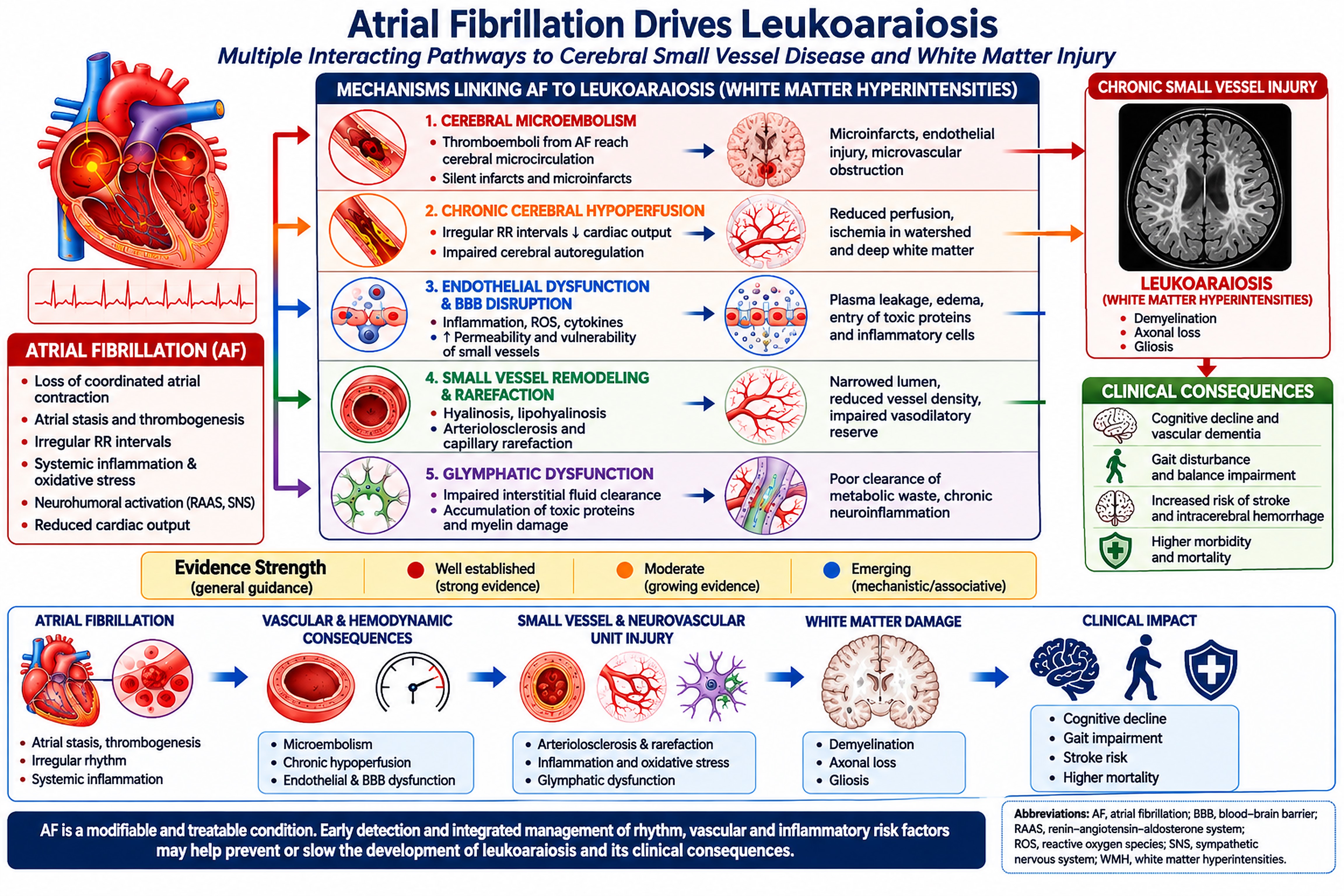
Neurocardiology is a rapidly evolving multidisciplinary medical field at the intersection of cardiology and neurology. It examines the complex, mostly bidirectional relationships and physiological and pathophysiological interactions between the nervous and cardiovascular systems. The interconnections between atrial fibrillation and ischemic periventricular leukoencephalopathy (leukoaraiosis) are neither well known nor well studied. Nevertheless, the overall body of literature suggests a largely unidirectional relationship, in which long-standing atrial fibrillation causes central nervous system changes described as leukoaraiosis. Therefore, leukoaraiosis, often described as a surrogate for cerebral small vessel disease, is regarded in this article as a neuroanatomical aspect/consequence of previously detected arrhythmogenic disease—atrial fibrillation. It is no wonder that, despite many experimental and clinical investigations, an ancient term is still often used in the literature to describe a new spectrum of various clinical problems. However, previous global experience with the heart–brain axis suggests that this relationship is rarely unidirectional, since these two organs predominantly cooperate through reciprocal action and reaction, and the way leukoaraiosis affects the cardiovascular system remains unclear. In accordance with this, numerous pieces of research and a great deal of clinical practice in neurocardiology focus on mapping the unrevealed anatomical pathways of the cardiac neuraxis and on developing closed-loop neuromodulation therapies to treat various complex cardiovascular diseases, including neuromodulation therapies in the opposite direction along the cardiac neuraxis (for the treatment of neurological diseases). A thorough literature review of investigations and studies from PubMed/MEDLINE, Ovid, EMBASE, Scopus, Google Scholar, DOAJ, and the Cochrane Library databases was conducted to assess key data on the connection between atrial fibrillation and leukoaraiosis, along with its practical implications and future perspectives.
- Pantoni L, Garcia JH. The significance of cerebral white matter abnormalities 100 years after Binswanger’s report: a review. Stroke. 1995;26(7):1293-1301. doi: 10.1161/01.str.26.7.1293
- Longstreth WT, Manolio TA, Arnold A, et al. Clinical correlates of white matter findings on cranial magnetic resonance imaging of 3301 elderly people. Stroke. 1996;27(8):1274-1282. doi: 10.1161/01.str.27.8.1274
- Breteler MMB, van Amerongen NM, van Swieten JC, et al. Cognitive correlates of ventricular enlargement and cerebral white matter lesions on magnetic resonance imaging: the Rotterdam Study. Stroke. 1994;25(6):1109-1115. doi: 10.1161/01.str.25.6.1109
- Inzitari D. Leukoaraiosis: an independent risk factor for stroke? Stroke. 2003;34(8):2067-2071. doi: 10.1161/01.STR.0000080934.68280.82
- Breteler M, van Swieten JC, Bots ML, et al. Cerebral white matter lesions, vascular risk factors, and cognitive function in a population-based study: the Rotterdam Study. Neurology. 1994;44(7):1246-1252. doi: 10.1212/WNL.44.7.1246
- Streifler JY, Eliasziw M, Benavente OR, et al; North American Symptomatic Carotid Endarterectomy Trial Group. Prognostic importance of leukoaraiosis in patients with symptomatic internal carotid artery stenosis. Stroke. 2002;33(6):1651-1655. doi: 10.1161/01.str.0000018010.38749.08
- Fazekas F, Chawluk J, Alavi A, Hurtig H, Zimmerman R. MR signal abnormalities at 1.5 T in Alzheimer’s dementia and normal aging. AJR Am J Roentgenol. 1987;149(2):351-356. doi: 10.2214/ajr.149.2.351
- Burton A, Fazekas F. A specialist in not overspecialising. Lancet Neurol. 2019;18(10):917. doi: 10.1016/S1474-4422(19)30084-5
- Kim K, MacFall J, Payne M. Classification of white matter lesions on magnetic resonance imaging in elderly persons. Biol Psychiatry. 2008;64(4):273-280. doi: 10.1016/j.biopsych.2008.03.024
- Wiggins ME, Jones J, Tanner JJ, et al. Pilot investigation: older adults with atrial fibrillation demonstrate greater brain leukoaraiosis in infracortical and deep regions relative to non-atrial fibrillation peers. Front Aging Neurosci. 2020;12:271. doi: 10.3389/fnagi.2020.00271
- Gurol ME. Atrial fibrillation and FLAIR/T2 white matter hyperintensities on MRI. J Neurol Neurosurg Psychiatry. 2018;89(1):1-2. doi: 10.1136/jnnp-2017-316290
- Ntaios G, Lip GY, Lambrou D, et al. Leukoaraiosis and stroke recurrence risk in patients with and without atrial fibrillation. Neurology. 2015;84(12):1213-1219. doi: 10.1212/WNL.0000000000001402
- Crosta F, Desideri G, Marini C. Leukoaraiosis is an independent predictor of intracranial hemorrhage in patients with atrial fibrillation. J Thromb Thrombolysis. 2019;47(4):527-532. doi: 10.1007/s11239-019-01839-4
- Wei CC, Zhang ST, Wang YH, et al. Association between leukoaraiosis and hemorrhagic transformation after cardioembolic stroke due to atrial fibrillation and/or rheumatic heart disease. J Neurol Sci. 2017;378:94-99. doi: 10.1016/j.jns.2017.05.001
- Miyao S, Takano A, Teramoto J, Takahashi A. Leukoaraiosis in relation to prognosis for patients with lacunar infarction. Stroke. 1992;23(10):1434-1438. doi: 10.1161/01.str.23.10.1434
- Rockwood K, Moorhouse PK, Song X. Disease progression in vascular cognitive impairment: cognitive, functional and behavioural outcomes in the Consortium to Investigate Vascular Impairment of Cognition (CIVIC) cohort study. J Neurol Sci. 2007;252(2):106-112. doi: 10.1016/j.jns.2006.10.015
- Rost NS, Fitzpatrick K, Biffi A, et al. White matter hyperintensity burden and susceptibility to cerebral ischemia. Stroke. 2010;41(12):2807-2811. doi: 10.1161/STROKEAHA.110.595355
- Dubas F, Gray F, Roullet E, Escourolle R. Leucoencéphalopathies artériopathiques (17 cas anatomo-cliniques) [Arteriopathic leukoencephalopathy (17 anatomo-clinical cases)]. Rev Neurol. 1985;141(2):93-108. [In French]
- Miki Y, Sakamoto S. Age-related white matter lesions (leukoaraiosis): an update. Brain Nerve. 2013;65(7):789-799. [In Japanese]
- Pavlović D. Neuropsihološka dijagnostika i neurobihevioralna procena [Neuropsychological Diagnostics and Neurobehavioral Assessment]. Elit medica; 1996.
- O’Sullivan M. Leukoaraiosis. Pract Neurol. 2008;8:26-38. doi: 10.1136/jnnp.2007.139428
- Wei CC, Zhang ST, Liu JF, et al. Association between fibrinogen and leukoaraiosis in patients with ischemic stroke and atrial fibrillation. J Stroke Cerebrovasc Dis. 2017;26(11):2630-2637. doi: 10.1016/j.jstrokecerebrovasdis.2017.06.027
- Wu K, Wang J, Li X, Xin Z, et al. Association between fibrinogen and cognitive impairment in patients with ischemic cerebrovascular disease. J Stroke Cerebrovasc Dis. 2025;34(5):108227. doi: 10.1016/j.jstrokecerebrovasdis.2025.108227
- de Leeuw FE, de Groot JC, Oudkerk M, et al. Atrial fibrillation and the risk of cerebral white matter lesions. Neurology. 2000;54(9):1795-1801. doi: 10.1212/WNL.54.9.1795
- Kobayashi A, Iguchi M, Shimizu S, Uchiyama S. Silent cerebral infarcts and cerebral white matter lesions in patients with nonvalvular atrial fibrillation. J Stroke Cerebrovasc Dis. 2012;21(4):310-317. doi: 10.1016/j.jstrokecerebrovasdis.2010.09.004
- Mayasi Y, Helenius J, McManus DD, et al. Atrial fibrillation is associated with anterior predominant white matter lesions in patients presenting with embolic stroke. J Neurol Neurosurg Psychiatry. 2018;89(1):6-13. doi: 10.1136/jnnp-2016-315457
- Shao IY, Power MC, Mosley T, et al. Association of atrial fibrillation with white matter disease. Stroke. 2019;50(4):989-991. doi: 10.1161/STROKEAHA.118.023386
- Aeschbacher S, Blum S, Meyre PB, et al. Blood pressure and brain lesions in patients with atrial fibrillation. Hypertension. 2021;77(2):662-671. doi: 10.1161/HYPERTENSIONAHA.120.16025
- Pezel T, Ambale-Venkatesh B, Quinaglia T, et al. Change in left atrioventricular coupling index to predict incident atrial fibrillation: the Multi-Ethnic Study of Atherosclerosis (MESA). Radiology. 2022;303(2):317-326. doi: 10.1148/radiol.210315
- Srichawla BS, Barbini MK, Lessard D, Saczynski JS, McManus DD, Moonis M. Fazekas score predicts cognitive decline and frailty in older adults: insights from the SAGE-AF cohort study. Neurol Res Pract. 2025;7(1):78. doi: 10.1186/s42466-025-00439-3
- Stegmann T, Joundi RA, Srivastava A, et al. Atrial fibrillation and atherosclerosis cause different vascular brain lesions on magnetic resonance imaging. Eur Heart J. 2025;46(47):5177-5188. doi: 10.1093/eurheartj/ehaf550
- Nesapiragasan V, Hayıroğlu Mİ, Sciacca V, Sommer P, Sohns C, Fink T. Catheter ablation approaches for the treatment of arrhythmia recurrence in patients with a durable pulmonary vein isolation. Balkan Med J. 2023;40(6):386-394. doi: 10.4274/balkanmedj.galenos.2023.2023-9-48
- Hayıroğlu Mİ, Korucu BC, Eke M, et al. Ethanol infusion into the vein of Marshall enhances mitral isthmus block and reduces atrial fibrillation recurrence: a comprehensive meta-analysis. Turk Kardiyol Dern Ars. 2026;54(2):175-181. doi: 10.5543/tkda.2025.47364
- Çetin T, Dereli Ş, Çam R, et al. Comprehensive substrate modification in persistent AF: PVI plus posterior wall isolation with and without vein of Marshall ethanol infusion and mitral isthmus ablation. J Cardiovasc Electrophysiol. 2026;37(6):1189-1198. doi: 10.1111/jce.70332
- Hindricks G, Potpara T, Dagres N, et al. 2020 ESC guidelines for the diagnosis and management of atrial fibrillation developed in collaboration with the European Association for Cardio-Thoracic Surgery (EACTS): the Task Force for the diagnosis and management of atrial fibrillation of the European Society of Cardiology (ESC) developed with the special contribution of the European Heart Rhythm Association (EHRA) of the ESC. Eur Heart J. 2021;42(5):373-498. doi: 10.1093/eurheartj/ehaa612
- Sciacca V, Fink T, Körperich H, et al. Magnetic resonance assessment of left atrial scar formation following a novel very high-power short-duration workflow for atrial fibrillation ablation. Europace. 2023;25(4):1392-1399. doi: 10.1093/europace/euac284
- Kottkamp H, Berg J, Bender R, Rieger A, Schreiber D. Box isolation of fibrotic areas (BIFA): a patient-tailored substrate modification approach for ablation of atrial fibrillation. J Cardiovasc Electrophysiol. 2016;27(1):22-30. doi: 10.1111/jce.12870
- Maloney JD, Milner L, Barold S, Czerska B, Markel M. Two-staged biatrial linear and focal ablation to restore sinus rhythm in patients with refractory chronic atrial fibrillation: procedure experience and follow-up beyond 1 year. Pacing Clin Electrophysiol. 1998;21(12):2527-2532. doi: 10.1111/j.1540-8159.1998.tb01213.x
- Romero J, Natale A, Di Biase L. Atrial fibrillation ablation beyond pulmonary veins: the role of left atrial appendage. Rev Port Cardiol. 2017;36(suppl 1):31-41. doi: 10.1016/j.repc.2017.09.011
- Weng W, Birnie DH, Ramirez FD, et al. Outcomes of a comprehensive strategy during repeat atrial fibrillation ablation. J Interv Card Electrophysiol. 2022;65(2):391-399. doi: 10.1007/s10840-022-01190-4
- Katritsis DG, Pokushalov E, Romanov A, et al. Autonomic denervation added to pulmonary vein isolation for paroxysmal atrial fibrillation: a randomized clinical trial. J Am Coll Cardiol. 2013;62(24):2318-2325. doi: 10.1016/j.jacc.2013.06.053
- Joglar JA, Chung MK, Armbruster AL, et al. 2023 ACC/AHA/ACCP/HRS guideline for the diagnosis and management of atrial fibrillation: a report of the American College of Cardiology/American Heart Association Joint Committee on Clinical Practice Guidelines. Circulation. 2024;149(1):e1-e156. doi: 10.1161/CIR.0000000000001193
- Potpara T, Romiti GF, Sohns C. The 2024 European Society of Cardiology guidelines for diagnosis and management of atrial fibrillation: a viewpoint from a practicing clinician’s perspective. Thromb Haemost. 2024;124(12):1087-1094. doi: 10.1055/a-2434-9244
- Cabana MD, Rand CS, Powe NR, et al. Why don’t physicians follow clinical practice guidelines? A framework for improvement. JAMA. 1999;282(15):1458-1465. doi: 10.1001/jama.282.15.1458
- Andrade JG, Aguilar M, Atzema C, et al. The 2020 Canadian Cardiovascular Society/Canadian Heart Rhythm Society comprehensive guidelines for the management of atrial fibrillation. Can J Cardiol. 2020;36(12):1847-1948. doi: 10.1016/j.cjca.2020.09.001