

Design, characterization, and fabrication of a 3D-printed patient-specific and personalized cranial immobilization system for radiotherapy treatment

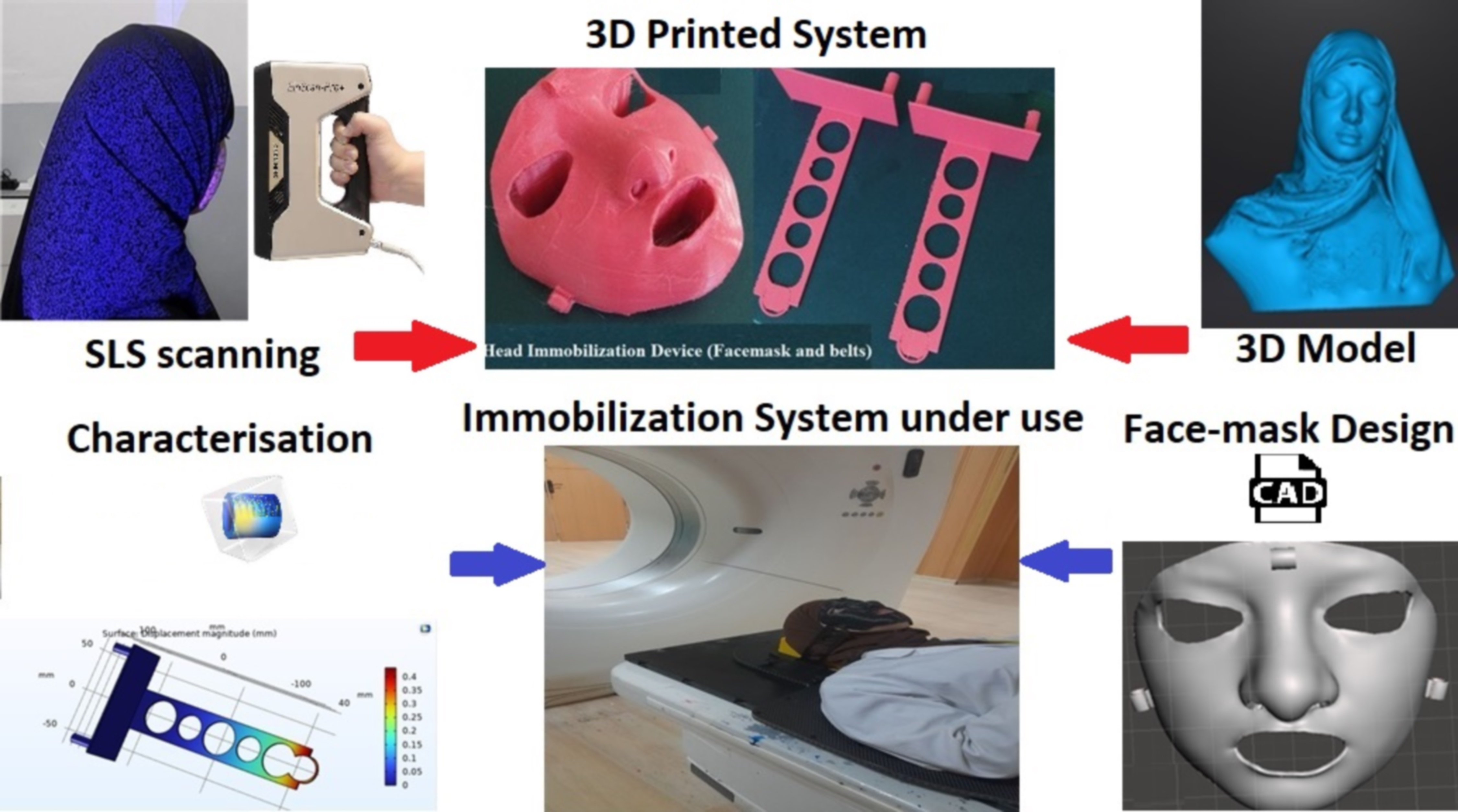
Accurate immobilization is essential in cranial radiotherapy because modern treatment techniques rely on high geometric precision and tight setup tolerances. Conventional thermoplastic masks remain the clinical standard, but they may be uncomfortable, anxiety-provoking, and insufficiently adapted to individual facial anatomy. This study investigates the design, fabrication, and preclinical validation of a personalized immobilization system composed of a facial shell and fixation belts. The necessary facial surface was acquired using an EinScan Pro+ scanner. The facial shell was designed in Meshmixer, while the fixation belts and hooks were modeled in Fusion 360 according to the geometry of a Klarity Optek™ indexing board. Final components were sliced in Cura and fabricated on an Artillery Sidewinder X1 printer. Polylactic acid (PLA) and thermoplastic polyurethane (TPU) were numerically evaluated in COMSOL Multiphysics 6.3 for thermal phase transition during printing, irradiation-induced heating under a 6 MV radiotherapy photon beam (400 MU/min for 15 min), and tensile mechanical behavior of the fixation belts. The workflow successfully produced a 2.5-mm-thick patient-specific immobilization device with excellent anatomical conformity and compatibility with the clinical support system. Simulated peak temperatures remained low for both PLA (27.85 °C) and TPU (28.45 °C), indicating thermal stability during photon irradiation. Mechanical simulations showed peak stress of approximately 0.7 MPa and maximum displacement (deformation) of 0.012 mm for PLA and 0.4 mm for TPU, both below a 1-mm tolerance threshold. The proposed workflow supports the feasibility of personalized 3D-printed cranial immobilization devices, with TPU emerging as a promising material because it combines structural stability with greater flexibility and patient comfort.
- Khan FM. The Physics of Radiation Therapy. 3rd ed. Philadelphia: Lippincott Williams & Wilkins; 2003.
- Delaney G, Jacob S, Featherstone C, Barton M. The role of radiotherapy in cancer treatment. Cancer. 2005;104(6):1129-1137. doi: 10.1002/cncr.21324
- Baskar R, Lee KA, Yeo R, Yeoh KW. Cancer and radiation therapy: current advances and future directions. Int J Med Sci. 2012;9(3):193-199. doi: 10.7150/ijms.3635
- Verellen D, De Ridder M, Linthout N, Tournel K, Soete G, Storme G. Innovations in image-guided radiotherapy. Nat Rev Cancer. 2007;7(12):949-960. doi: 10.1038/nrc2288
- Mackie TR, Kapatoes J, Ruchala K, et al. Image guidance for precise conformal radiotherapy. Int J Radiat Oncol Biol Phys. 2003;56:89-105. doi: 10.1016/s0360-3016(03)00090-7
- Rosenthal DI, Chambers MS, Fuller CD, et al. Beam path toxicities to non-target structures during intensity-modulated radiation therapy for head and neck cancer. Int J Radiat Oncol Biol Phys. 2008;72(3):747-755. doi: 10.1016/j.ijrobp.2008.01.012
- Tryggestad E, Christian M, Ford E, et al. Inter- and intrafraction patient positioning uncertainties for intracranial radiotherapy: a study of four frameless, thermoplastic mask-based immobilization strategies using daily cone-beam CT. Int J Radiat Oncol Biol Phys. 2011;80(1):281-290. doi: 10.1016/j.ijrobp.2010.06.022
- Li G, Ballangrud A, Kuo LC, et al. Motion monitoring for cranial frameless stereotactic radiosurgery using video-based three-dimensional optical surface imaging. Med Phys. 2011;38(7):3981-3994. doi: 10.1118/1.3596526
- Onimaru R, Shirato H, Fujino M, et al. The effect of tumor location and respiratory function on tumor movement estimated by real-time tracking radiotherapy (RTRT) system. Int J Radiat Oncol Biol Phys. 2005;63(1):164-169. doi: 10.1016/j.ijrobp.2005.01.025
- Cerviño LI, Gupta S, Rose MA, Yashar C, Jiang SB. Using surface imaging and visual coaching to improve the reproducibility and stability of deep-inspiration breath hold for left-breast-cancer radiotherapy. Phys Med Biol. 2009;54(22):6853-6865. doi: 10.1088/0031-9155/54/22/007
- Rengier F, Mehndiratta A, von Tengg-Kobligk H, et al. 3D printing based on imaging data: review of medical applications. Int J Comput Assist Radiol Surg. 2010;5(4):335-341. doi: 10.1007/s11548-010-0476-x
- Mitsouras D, Liacouras P, Imanzadeh A, et al. Medical 3D Printing for the Radiologist. Radiographics. 2015;35(7):1965-1988. doi: 10.1148/rg.2015140320
- Martelli N, Serrano C, van den Brink H, et al. Advantages and disadvantages of 3-dimensional printing in surgery: A systematic review. Surgery. 2016;159(6):1485-1500. doi: 10.1016/j.surg.2015.12.017
- Fredieu JR, Kerbo J, Herron M, Klatte R, Cooke M. Anatomical models: a digital revolution. Med Sci Educ. 2015;25(2):183-194. doi: 10.1007/s40670-015-0115-9
- Canters RA, Lips IM, Wendling M, et al. Clinical implementation of 3D printing in the construction of patient specific bolus for electron beam radiotherapy for non-melanoma skin cancer. Radiother Oncol. 2016;121(1):148-153. doi: 10.1016/j.radonc.2016.07.011
- Burleson S, Baker J, Hsia AT, Xu Z. Use of 3D printers to create a patient-specific 3D bolus for external beam therapy. J Appl Clin Med Phys. 2015;16(3):166-178. doi: 10.1120/jacmp.v16i3.5247
- Rooney MK, Rosenberg DM, Braunstein S, et al. Three-dimensional printing in radiation oncology: A systematic review of the literature. J Appl Clin Med Phys. 2020;21(8):15-26. doi: 10.1002/acm2.12907
- Katamesh AA, Subaiea GM, Mostafa M, et al. Revolutionizing Cancer Care: The Role of 3D Printing in Personalized Oncology. ACS Omega. 2025;10(35):39350-39370. doi: 10.1021/acsomega.5c01642
- Bell T, Li B, Zhang S. Structured Light Techniques and Applications. In: Webster JG, ed. Wiley Encyclopedia of Electrical and Electronics Engineering. Hoboken, New Jersey: Wiley; 2016. doi: 10.1002/047134608x.w8298
- Geng J. Structured-light 3D surface imaging: a tutorial. Adv Opt Photonics. 2011;3(2):128-160. doi: 10.1364/AOP.3.000128
- Sansoni G, Trebeschi M, Docchio F. State-of-the-art and applications of 3D imaging sensors in industry, cultural heritage, medicine, and criminal investigation. Sensors. 2009;9(1):568-601. doi: 10.3390/s90100568
- Kharfi F, Belatar M, Benkahila K. 3D-printed personalized bolus designed through structured-light scanning for adaptive radiotherapy. Adv Radiother Nucl Med. 2025;3(4):38-48. doi: 10.36922/ARNM025250032
- Dhawan AP, D’Alessandro B, Fu X. Optical imaging modalities for biomedical applications. IEEE Rev Biomed Eng. 2010;3:69-92. doi: 10.1109/RBME.2010.2081975
- Baumann FW, Schuermann M, Odefey U, Pfeil M. From G-code to STL: reconstruct models from 3D printing as a service. In: IOP Conference Series: Materials Science and Engineering. Bristol: IOP Publishing; 2017;280(1):012033. doi: 10.1088/1757-899X/280/1/012033
- Chia HN, Wu BM. Recent advances in 3D printing of biomaterials. J Biol Eng. 2015;9:4. doi: 10.1186/s13036-015-0001-4
- Ventola CL. Medical applications for 3D printing: current and projected uses. Pharm Ther. 2014;39(10):704-711.
- Javaid M, Haleem A. Current status and challenges of Additive manufacturing in orthopaedics: An overview. J Clin Orthop Trauma. 2019;10(2):380-386. doi: 10.1016/j.jcot.2018.05.008
- Tack P, Victor J, Gemmel P, Annemans L. 3D-printing techniques in a medical setting: a systematic literature review. Biomed Eng Online. 2016;15(1):115. doi: 10.1186/s12938-016-0236-4
- Salmi M. Additive manufacturing processes in medical applications. Materials. 2021;14(1):191. doi: 10.3390/ma14010191
- Rankin TM, Giovinco NA, Cucher DJ, Watts G, Hurwitz B, Armstrong DG. Three-dimensional printing surgical instruments: are we there yet? J Surg Res. 2014;189(2):193-197. doi: 10.1016/j.jss.2014.02.020
- Schubert C, van Langeveld MC, Donoso LA. Innovations in 3D printing: a 3D overview from optics to organs. Br J Ophthalmol. 2014;98(2):159-161. doi: 10.1136/bjophthalmol-2013-304446
- Melchels FPW, Domingos MAN, Klein TJ, Malda J, Bartolo PJ, Hutmacher DW. Additive manufacturing of tissues and organs. Prog Polym Sci. 2012;37(8):1079-1104. doi: 10.1016/j.progpolymsci.2011.11.007
- Gross BC, Erkal JL, Lockwood SY, Chen C, Spence DM. Evaluation of 3D printing and its potential impact on biotechnology and the chemical sciences. Anal Chem. 2014;86(7):3240-3253. doi: 10.1021/ac403397r
- Javaid M, Haleem A, Vaishya R, Bahl S, Suman R, Vaish A. Industry 4.0 technologies and their applications in fighting COVID-19 pandemic. Diabetes Metab Syndr. 2020;14(4):419-422. doi: 10.1016/j.dsx.2020.04.032
- Direkwatana C, Rattanapan N. 3D printing process for patient-specific models and applications. Rama Med J. 2025;48(2):e270830. doi: 10.33165/rmj.48.02.e270830
- Salmi M, Tuomi J, Paloheimo K, et al. Patient‐specific reconstruction with 3D modeling and DMLS additive manufacturing. Rapid Prototyp J. 2012;18(3):209-214. doi: 10.1108/13552541211218126
- Rybicki FJ. Medical 3D printing and the physician-artist. Lancet. 2018;391(10121):651-652. doi: 10.1016/S0140-6736(18)30212-5
- Kharfi F, Benkahila K, Boulkhessaim F, et al. Implementation of 3D Printing and Modeling Technologies for the Fabrication of Dose Boluses for External Radiotherapy at the CLCC of Sétif, Algeria. Technol Cancer Res Treat. 2024;23. doi: 10.1177/15330338241266479
- Ghediri N, Kharfi F, Benkahila K, et al. Dosimetric Validation and Surface Fit Evaluation of 3D-Printed Dose Boluses for Radiation Therapy Applications. Int J Cancer Manag. 2025;18(1):e159515. doi: 10.5812/ijcm-159515
- Contesini M, Guberti M, Saccani R, et al. Setup errors in patients with head-neck cancer (HNC), treated using the Intensity Modulated Radiation Therapy (IMRT) technique: how it influences the customised immobilisation systems, patient’s pain and anxiety. Radiat Oncol. 2017;12(1):72. doi: 10.1186/s13014-017-0807-y