

Artificial intelligence-assisted thermoluminescence and optically stimulated luminescence dose analysis in radiological protection, medical imaging, nuclear medicine, and radiotherapy

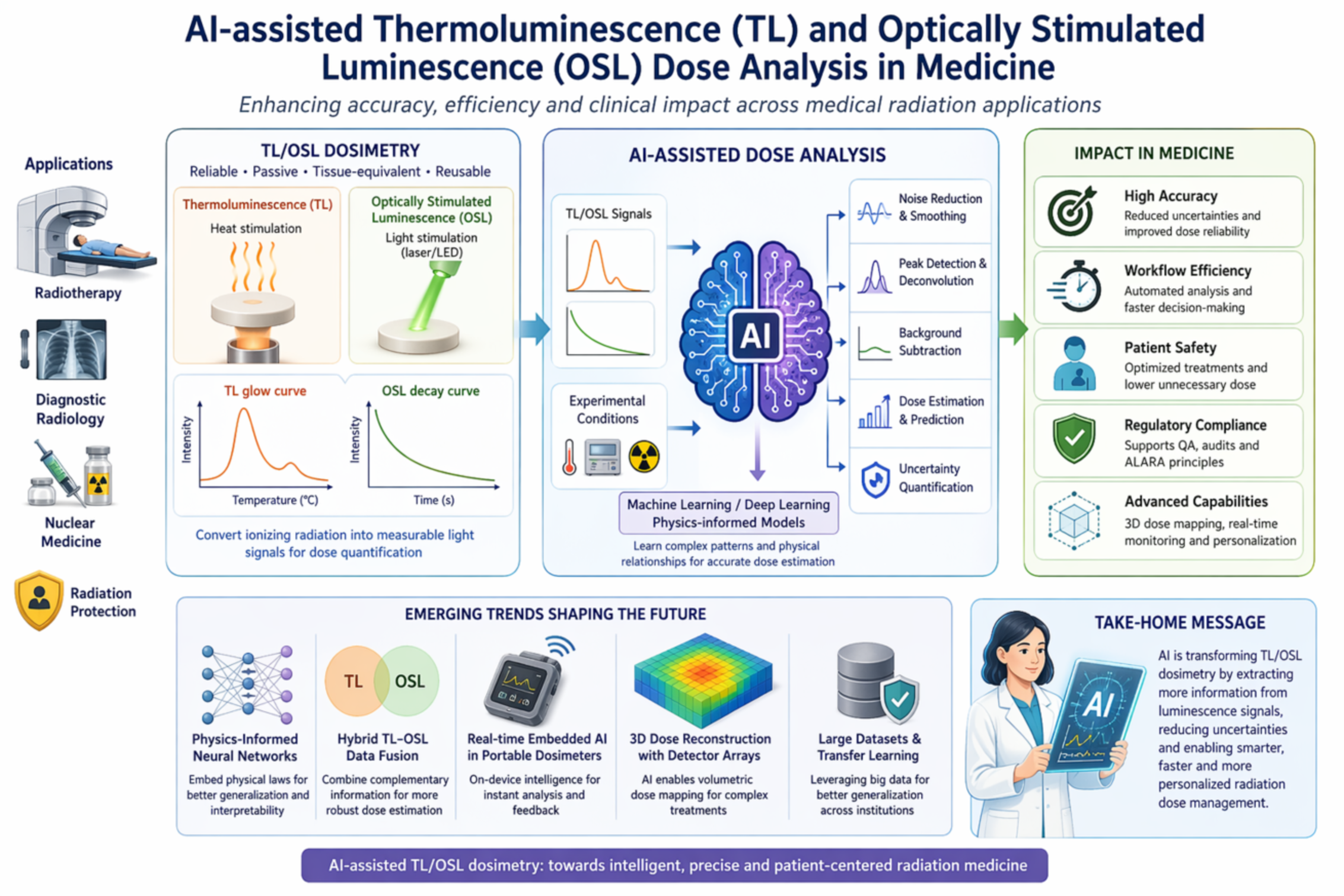
Thermoluminescence (TL) and optically stimulated luminescence (OSL) dosimetry have long been established as reliable techniques for quantifying ionizing radiation dose in radiation protection, medical imaging, radiotherapy, and nuclear medicine. The main value of TL and OSL dosimetry in medical applications lies in their ability to provide accurate, passive, and small-scale radiation measurements. These systems are essential for patient safety (in vivo dosimetry) and regulatory radiation protection for staff. While TL requires heat to release stored energy, OSL uses light stimulation (lasers/light-emitting diodes) and may allow repeated readouts of the same dosimeter, providing a key advantage for data verification. This review examines the emerging role of artificial intelligence (AI) in enhancing dose analysis. It synthesizes current knowledge of luminescent dosimetry principles with recent advances in machine learning and deep learning, highlighting how AI-driven models improve glow-curve and decay-curve processing, reduce uncertainties, and enable high-precision dose estimation across medical applications. The review also explores new trends such as physics-informed neural networks, hybrid TL–OSL data fusion, real-time embedded AI in portable dosimeters, and three-dimensional dose reconstruction using AI-assisted detector arrays. By integrating foundational dosimetry science with state-of-the-art computational methods, the review provides a comprehensive overview of how AI can strengthen accuracy, efficiency, and clinical impact in luminescence-based dosimetry.
- McKeever SWS. Thermoluminescence of Solids. Cambridge, UK: Cambridge University Press; 1985. doi: 10.1017/CBO9780511564994
- Horowitz YS. Thermoluminescence & Thermoluminescent Dosimetry. Cambridge: CRC Press; 1984. doi: 10.1201/9780429292248
- Yukihara EG, McKeever SWS. Optically Stimulated Luminescence: Fundamentals and Applications. 1st ed. Chichester, West Sussex, UK: John Wiley & Sons; 2011.
- Yukihara EG, Bos AJJ, Bilski P, McKeever SWS. The quest for new thermoluminescence and optically stimulated luminescence materials: Needs, strategies and pitfalls. Radiat Meas. 2022;158:106846. doi: 10.1016/j.radmeas.2022.106846
- Amols HI, Weinhous MS, Reinstein LE. The variability of clinical thermoluminescent dosimetry systems: a multi-institutional study. Med Phys. 1987;14(2):291-295. doi: 10.1118/1.596140
- Bøtter-Jensen L, McKeever SWS, Wintle AG. Optically stimulated luminescence dosimetry. 1st ed. Amsterdam, the Netherlands: Elsevier Science. 2003. doi: 10.1016/B978-0-444-50684-9.X5077-6
- Greenspan H, van Ginneken B, Summers RM. Guest Editorial Deep Learning in Medical Imaging: Overview and Future Promise of an Exciting New Technique. IEEE Trans Med Imaging. 2016;35(5):1153-1159. doi: 10.1109/TMI.2016.2553401
- Esteva A, Robicquet A, Ramsundar B, et al. A guide to deep learning in healthcare. Nat Med. 2019;25:24-29. doi: 10.1038/s41591-018-0316-z
- Amit G, Vagerman R, Revayev O. ‘TLDetect’: AI-Based Application for Detection and Correction of Anomalous TLD Glow Curves. Sensors. 2024; 24(21):6904. doi: 10.3390/s24216904
- Yüksel M, Deniz F, Ünsal E. ANN-Based Prediction of OSL Decay Curves in Quartz from Turkish Mediterranean Beach Sand. Crystals. 2025; 15(8):733. doi: 10.3390/cryst15080733
- Pathan M S, Pradhan SM, Selvam TP. Deep learning-based restoration of thermoluminescence glow curves for improving personnel dose assessment. Phys Scr. 2026;101:016003. doi: 10.1088/1402-4896/ae2fa2
- Gaza R, McKeever SWS, Akselrod MS, et al. A fiber-dosimetry method based on OSL from Al2O3:C for radiotherapy applications. Radiat Meas. 2004;38(4–6):809- 812. doi: 10.1016/j.radmeas.2003.12.004
- Kazemzadeh A, Rasti R, Tavakoli MB. Artificial intelligence for radiotherapy dose prediction: A comprehensive review. Cancer/Radiothérapie. 2025;29(4):104630. doi: 10.1016/j.canrad.2025.104630
- Sadel M, Høye EM, Skyt PS, Muren LP, Petersen JBB, Balling P. Three-dimensional radiation dosimetry based on optically-stimulated luminescence. J Phys Conf Ser. 2017;847:012044. doi: 10.1088/1742-6596/847/1/012044
- Tsapaki V. Radiation dose optimization in diagnostic and interventional radiology: Current issues and future perspectives. Phys Med. 2020;79:16-21. doi: 10.1016/j.ejmp.2020.09.015
- Mezaache A, Benkhelifa CZ, Şahiner E, Kharfi F. Study of dose response, luminescence kinetics, and reading modes combination advantage of TLD-100H radiation dosimeter. Int J Radiat Res. 2024;22(4):1079-1083. doi: 10.61186/ijrr.22.4.1079
- Kharfi F, Şahiner E, Benkhelifa CZ, Garoui A. Effect of IRSL-BLSL-TSL reading modes combination on thermoluminescence (TL) response of BeO dosimeter. J Lumin. 2024;39(5):e4755. doi: 10.1002/bio.4755
- Benkhelifa CZ, Boulanouar M, Şahiner E, Kharfi F. Determination of the kinetic parameters of BeO luminescent material using different methods towards X-ray irradiation. Radiat Phys Chem. 2023;212:111139. doi: 10.1016/j.radphyschem.2023.111139
- Benkhelifa CZ, Hamici M Kharfi F. Elaboration and TL&OSL response study of 1% Sb-doped Al2O3 dosimeter for high-energy radiation detection and dosimetry. J Sol-Gel Sci Technol. 2023;106:654–662. doi: 10.1007/s10971-023-06078-x
- Lehner F, Lombardo P, Castillo S, Hupe O, Magnor M. RadField3D: a data generator and data format for deep learning in radiation-protection dosimetry for medical applications. J Radiol Prot. 2025;45(2):021508. doi: 10.1088/1361-6498/add53d
- Lee S, Kim H, Jung H, Lim KT. Comparative analysis of machine learning-based dose assessment algorithms for TL dosimetry. Nucl Eng Technol. 2024;56(12):5414-5421. doi: 10.1016/j.net.2024.08.030
- Lee SY, Kim JL, Lee KJ. Feasibility of using neural networks to unfold the response of multi-element TLD for mixed-field dosimetry. In: Proceedings of the 10th International Congress of the International Radiation Protection Association (IRPA-10); May 14-19, 2000; Hiroshima, Japan. Available from: https://www.irpa.net/irpa10/cdrom/00658. pdf [Last accessed on March 15, 2025].
- Lee SY, Kim BH, Lee KJ. Application of artificial neural intelligence for personal dose assessment using a multi-area OSL dosimetry system. Radiat Meas. 2001;33(3):293-304. doi: 10.1016/s1350-4487(00)00147-5
- Amit G, Datz H. Improvement of dose estimation using artificial neural networks. Radiat Prot Dosim. 2018;184(1):36-43. doi: 10.1093/rpd/ncy185
- Mentzel F, Derugin E, Jansen H, et al. No more glowing in the dark: How deep learning improves exposure date estimation in thermoluminescence dosimetry. J Radiol Prot. 2021;41(4):S506-S521. doi: 10.1088/1361-6498/ac20ae
- Pathan MS, Pradhan SM, Selvam TP, Sapra BK. A multi-stage machine learning algorithm for estimating personal dose equivalent using thermoluminescent dosimeters. Mach Learn Sci Technol. 2024;5(1):015001. doi: 10.1088/2632-2153/ad1c31
- Rindhatayathon P, Sukyaprot K, Sudchai W, et al. Machine learning approaches for improving dosimeter reading accuracy conforming with new operational quantities recommended by ICRU 95. Appl Radiat Isot. 2025;225:112013. doi: 10.1016/j.apradiso.2025.112013
- Amit G, Datz H. Automatic detection of anomalous thermoluminescent dosimeter glow curves using machine learning. Radiat Meas. 2018;117:80-85. doi: 10.1016/j.radmeas.2018.07.014
- Amit G, Datz H. Computerized categorization of TLD glow curve anomalies using multi-class classification support vector machines. Radiat Meas. 2019;125:1-6. doi: 10.1016/j.radmeas.2019.04.015
- Kröninger K, Mentzel F, Theinert R, Walbersloh J. A machine learning approach to glow curve analysis. Radiat Meas. 2019;125:34-39. doi: 10.1016/j.radmeas.2019.02.015
- Dogan T. A comparison of artificial intelligence methods in the estimation of thermoluminescence glow curves. Appl Sci. 2023;13(24):13027. doi: 10.3390/app132413027
- Mentzel F, Kröninger K, Röhrig L, et al. Extending information relevant for personal dose monitoring obtained from glow curves using artificial neural networks. Radiat Meas. 2020;136:106375. doi: 10.1016/j.radmeas.2020.106375
- Pathan MS, Pradhan SM, Selvam TP, Sapra BK. A machine learning approach for correcting glow curve anomalies in CaSO₄:Dy-based TLD dosimeters used in personnel monitoring. J Radiol Prot. 2023;43(3):031503. doi: 10.1088/1361-6498/ace3d3
- Raissi M, Perdikaris P, Karniadakis GE. Physics-informed neural networks: a deep learning framework for solving forward and inverse problems involving nonlinear partial differential equations. J Comput Phys. 2019;378:686-707. doi: 10.1016/j.jcp.2018.10.045
- Karniadakis GE, Kevrekidis IG, Lu L, Perdikaris P, Wang S, Yang L. Physics-informed machine learning. Nat Rev Phys. 2021;3(6):422-440. doi: 10.1038/s42254-021-00314-5
- Raissi M. Deep hidden physics models: deep learning of nonlinear partial differential equations. J Mach Learn Res. 2018;19:1-24. Available from: https://www.jmlr.org/papers/ volume19/18-046/18-046.pdf [Last accessed on June 9, 2025].
- Ramachandram D, Taylor GW. Deep multimodal learning: a survey on recent advances and trends. IEEE Signal Process Mag. 2017;34(6):96-108. doi: 10.1109/MSP.2017.2738401
- Xu Q, Zhang Z, Wang G, Chen Y. Physics-Guided Multi- Representation Learning with Quadruple Consistency Constraints for Robust Cloud Detection in Multi-Platform Remote Sensing. Remote Sens. 2025;17(17):2946. doi: 10.3390/rs17172946
- Baltrusaitis T, Ahuja C, Morency LP. Multimodal machine learning: a survey and taxonomy. IEEE Trans Pattern Anal Mach Intell. 2019;41(2):423-443. doi: 10.1109/TPAMI.2018.2798607
- Mashangva1 M, Singh MN, Singh TB. Estimation of optimal trapping parameters relevant to persistent luminescence. IJPAP. 2011;49(9):583-589. Available from: http://nopr. niscpr.res.in/handle/123456789/12587 [Last accessed on March 23, 2025].
- Akselrod MS, Bøtter-Jensen L, McKeever SWS. Optically stimulated luminescence and its use in medical dosimetry. Radiat Meas. 2007;41:S78–S99. doi: 10.1016/j.radmeas.2007.01.004
- Vetter K, Barnowski R, Cates JW, et al. Advances in Nuclear Radiation Sensing: Enabling 3-D Gamma-Ray Vision. Sensors. 2019;19(11):2541. doi: 10.3390/s19112541