

PhD, Associate Professor of Clinical Sciences,
Chair of Eng. in Medicine Society IEEE LI Section
Dept. of Osteopathic Manipulative Medicine, College of Osteopathic Medicine (NYITCOM), New York Institute of Technology, Old Westbury, NY 11568, USAAI-assisted medical diagnostics; Image processing; Computational mechanics; Biomechanical engineering; Computational biomechanics; Brain injuries; Fetus injuries; Hydrated soft tissue; Impact biomechanics; Cardiovascular fluid-structure interaction; High performance computing
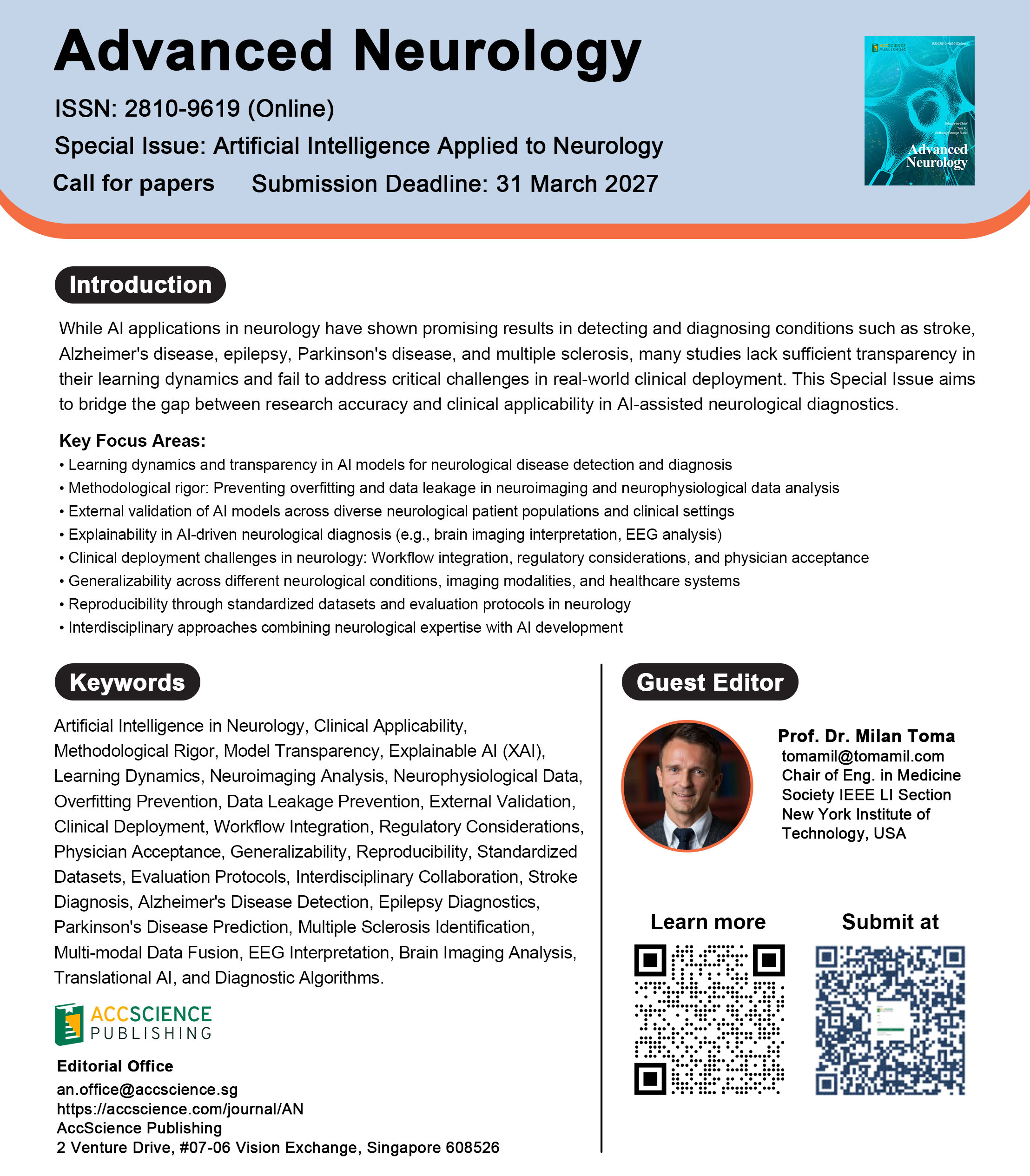
While AI applications in neurology have shown promising results in detecting and diagnosing conditions such as stroke, Alzheimer's disease, epilepsy, Parkinson's disease, and multiple sclerosis, many studies lack sufficient transparency in their learning dynamics and fail to address critical challenges in real-world clinical deployment. This Special Issue aims to bridge the gap between research accuracy and clinical applicability in AI-assisted neurological diagnostics.
Key Focus Areas:
- Learning dynamics and transparency in AI models for neurological disease detection and diagnosis
- Methodological rigor: Preventing overfitting and data leakage in neuroimaging and neurophysiological data analysis
- External validation of AI models across diverse neurological patient populations and clinical settings
- Explainability in AI-driven neurological diagnosis (e.g., brain imaging interpretation, EEG analysis)
- Clinical deployment challenges in neurology: Workflow integration, regulatory considerations, and physician acceptance
- Generalizability across different neurological conditions, imaging modalities, and healthcare systems
- Reproducibility through standardized datasets and evaluation protocols in neurology
- Interdisciplinary approaches combining neurological expertise with AI development
Artificial intelligence in neurology: Beyond accuracy toward clinical responsibility
Spectral-conditioned hypernetworks for meta-learning neuroimaging normalization with concept-guided transparency