
Adsorption of arsenic from gold mine wastewater onto iron oxide-coated sand and activated chars pyrolysed by the traditional-charcoal-production method

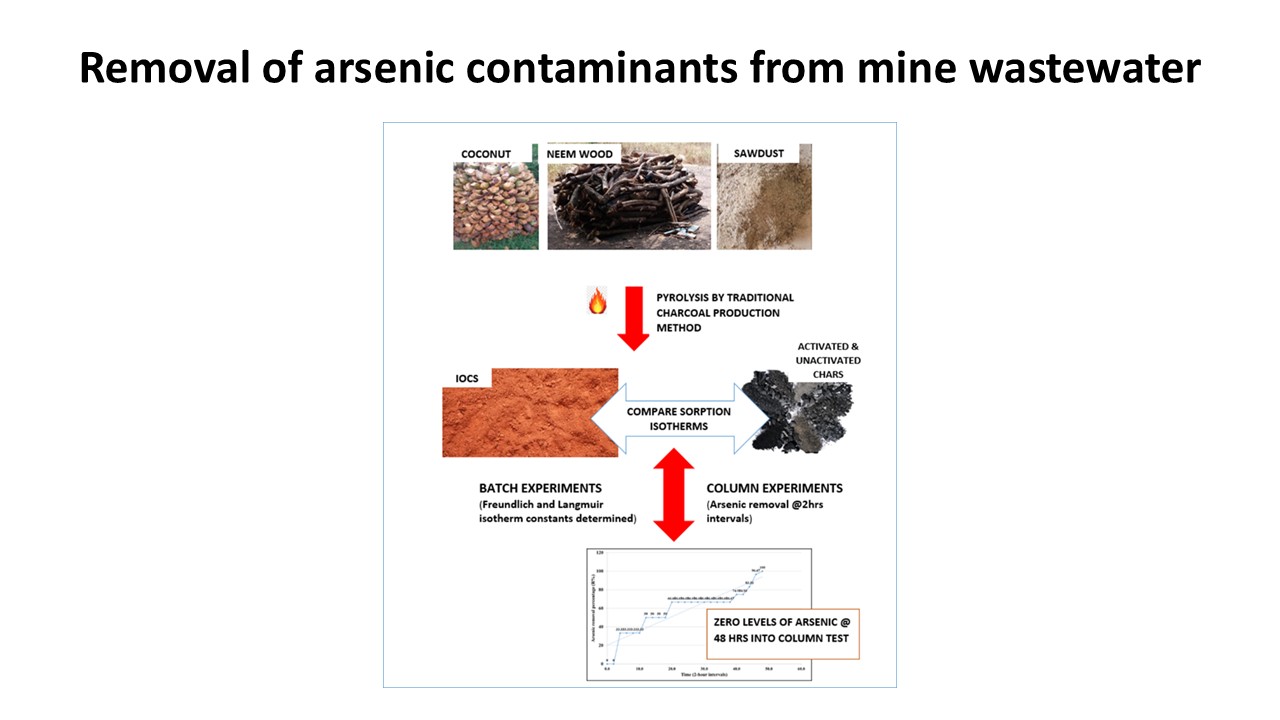
Ghana’s artisanal and small-scale mining (ASM) releases harmful contaminants, including arsenic, into the environment at levels exceeding acceptable limits. For miners to reduce arsenic levels in their tailings before discharge, the cost of remediation materials and processes must be significantly lower than it is now. This study uses unactivated and activated chars produced from agricultural waste, informed by the United Nations Food and Agriculture Organization and other studies on traditional charcoal-making methods, to assess the potential of sorption techniques to reduce arsenic levels in tailings, both alone and when combined with iron oxide-coated sand (IOCS). Sorption phenomena were measured through batch and column experiments. The Freundlich and Langmuir sorption isotherms were used to characterise the adsorbents. IOCS alone achieved an average removal efficiency of 91.65%, compared with 40.20%, 37.40%, and 21.40% for the unactivated chars, and 76.83%, 73.5%, and 78.83% for the activated chars from sawdust, coconut husk, and neem wood feedstocks, respectively. The column experiment combining IOCS and activated chars in a multi-layer, four-stage system achieved 100% removal efficiency within 46 hours. Generally, the traditional charcoal preparation method can be used to produce effective, low-cost adsorbents from agricultural waste for arsenic removal from mining effluents. Employing a combination of activated chars and IOCS results in rapid arsenic removal. A consistent approach to prevent the ASM industry from contaminating Ghana’s water resources with excessive arsenic is to issue directives requiring the use of activated chars made from agricultural waste, combined with IOCS for mine remediation. This strategy can also generate multiple alternative employment opportunities within the mining sector.
- Nyamador RK, Boakye P, Oduro-Kwarteng S, Awuah E. Ghana’s mining legislation: An overview of how the small-scale and large-scale mining environment-related regulations compare. J Environ Manag. 2026;398:128503. doi: 10.1016/j.jenvman.2025.128503
- Bansah KJ. Artisanal and small-scale mining formalisation in Ghana: The government’s approach and its implications for cleaner and safer production. J Clean Prod. 2023;399:136648. doi: 10.1016/j.jclepro.2023.136648
- Obodai J, Duncan AE, Adjei KA, Odai SNA. Preliminary Investigation of Surface and Groundwater Quality along the Upper Part of the Ankobra River, Impacted by Illegal Mining Activities. Water Air Soil Pollut. 2023;234(3). doi: 10.1007/s11270-023-06170-6
- Acquah PC. Environmental Management in the Small-scale Mining Industry in Ghana. In: Seminar on the effect of mining on Ghana’s environment with particular reference to proposed Mining and Environmental Guidelines: Proceedings from the national seminar on the environmental guidelines to regulate mining activities in Ghana. Cantonments Accra: Minerals Commission; 1993:14–22. Accessed May 23, 2023. http:// www.google.com.gh.books/edition/ghana_s_mining_and_ environmental_guidelines
- American Cancer Society. Arsenic and Cancer Risk. American Cancer Society; 2023. Accessed May 22, 2026. https://www.cancer.org/cancer/risk-prevention/chemicals/ arsenic.html
- United Kingdom Health Security Agency 2024. Arsenic: Toxicological Overview. UK Health Security Agency; 2024. Accessed May 22, 2026. https://www.gov.uk/government/ publications/arsenic-properties-incident-management-and-toxicology/arsenic-toxicological-overview
- Agency for Toxic Substances and Disease Registry. The ATSDR 2025 Substance Priority List. US Department of Health and Human Services; 2026. Accessed May 22, 2026. https://www.atsdr.cdc.gov/programs/substance-priority-list.html
- Ahmed S, Haque KE, Moniruzzaman M, et al. Hydrogeochemistry, water quality, and potential human health risk assessment of groundwater in a drought-prone area, Bangladesh. Ground. Sustain Dev. 2025;29:101450. doi: 10.1016/j.gsd.2025.101450
- Haider H, Shafiquzzaman Md, Guangji H. Low-cost filtration for metal(loids) removal from groundwater in rural Bangladesh: probabilistic human health risk mitigation effect. Environ Geochem Health. 2025;47(7):1-21.doi: 10.1007/s10653-025-02549-y
- Habib M, Reza A, Hasan MI, et al. Evaluating arsenic contamination in northwestern Bangladesh: A GIS-Based assessment of groundwater vulnerability and human health impacts. Heliyon. 2024;10(6):e27917. doi: 10.1016/j.heliyon.2024.e27917
- Wu R, Podgorski J, Berg M, Polya D. Geostatistical model of the spatial distribution of arsenic in groundwaters in Gujarat State, India. Environ Geochem Health. 2021;43(7):2649– 2664. doi: 10.1007/s10653-020-00655-7
- Smith AH, Lingas EO, Rahman M. Contamination of drinking-water by arsenic in Bangladesh: a public health emergency. Bull World Health Organ. 2000;78(9):1093–1103. Accessed June 3, 2026. https://www.who.int/publications/i/ item/PMC2560840
- Ankapong M, Ashong GW, Adjaottor AA, Ababio AB, Kwaansa-Ansah EE, Toku M. Assessment and management of arsenic contamination in groundwater from Sanso, Ghana: Health risk implications, source identification, adsorption and immobilisation for safe disposal. Toxicol Rep. 2025;15:102157. doi: 10.1016/j.toxrep.2025.102157
- Apau J, Enyemadze I. Speciation of arsenic in drinking water at Amansie West District. 2014;3(3):431-440. Accessed June 24, 2022. https://www.academia.edu/108254099/ Speciation_of_arsenic_in_drinking_water_at_Amansie_ West_District?force_claim_to_highlight=true
- Owusu-Sekyere E. The Buruli ulcer morbidity in the Amansie West District of Ghana: a myth or a reality? J Public Health Epidemiol. 2013;5(10):402–409. doi: 10.5897/JPHE2013.0494
- Duker AA, Carranza EJM, Hale M. Spatial dependency of Buruli ulcer prevalence on arsenic-enriched domains in Amansie West District, Ghana: Implications for arsenic mediation in Mycobacterium ulcerans infection. Int J Health Geogr. 2004;3(1):19. doi: 10.1186/1476-072X-3-19
- Minerals Commission, Ghana. Small-Scale and Community Mining Operational Manual. Minerals Commission; 2021. Accessed June 23, 2022. https://www.mincom. gov.gh/wp-content/uploads/2021/11/Small-Scale-and- Community-Mining-Operational-Manual-Sep.-2021-1.pdf
- Tychsen J, Boamah D, Ahadjie J, et al. Artisanal and Small-Scale Mining Handbook for Ghana with a regional perspective. Denmark: Geological Survey of Denmark and Greenland (GEUS); 2017. Accessed June 24, 2023. https://www.delvedatabase.org/uploads/resources/Artisanal-and-Small-Scale-Mining-Handbook-for-Ghana-with-a-regional-perspective.pdf
- Panasenko AE, Makarenko NV, Barinov NN, Mashtalyar DV. Cu(II) adsorption from aqueous media using rice waste-derived composite biomaterials based on inositol phosphates. Int J Environ Sci Technol. 2026;23(4). doi: 10.1007/s13762-025-06788-5
- Karić N, Maia AS, Teodorović A, et al. Bio-waste valorisation: Agricultural wastes as biosorbents for removal of (in)organic pollutants in wastewater treatment. Chem Eng J Adv. 2022;9:100239. doi: 10.1016/j.ceja.2021.100239
- Long M, Jiang H, Li X. Biosorption of Cu2+, Pb2+, Cd2+ and their mixture from aqueous solutions by Michelia figo sawdust. Sci Rep. 2021;11(1):11527. doi: 10.1038/s41598-021-91052-2
- Mahmoud EN, Fayed FY, Ibrahim KM, Jaafreh S. Removal of Cadmium, Copper, and Lead From Water Using Bio- Sorbent From Treated Olive Mill Solid Residue. Environ Health Insights. 2021:15. doi: 10.1177/11786302211053176
- Acheampong MA, Lens PNL. Treatment of gold mining effluent in pilot fixed bed sorption system. Hydrometallurgy. 2014;141:1–7. doi: 10.1016/j.hydromet.2013.10.013
- Singh A, Kumar D, Gaur JP. Continuous metal removal from solution and industrial effluents using Spirogyra biomass-packed column reactor. Water Res. 2012;46(3):779–788. doi: 10.1016/j.watres.2011.11.050
- Food and Agriculture Organisation of the United Nations. Industrial Charcoal Making. Food and Agriculture Organization of the United Nations; 1985. FAO Forestry Paper 63. Accessed May 22, 2023. Roma Italy: FAO; https://openknowledge.fao.org/server/api/core/ bitstreams/70a6e42a-9303-43e0-92d3-c65baa8f0972/ content
- Nketiah KS, Asante J, Hansen CP. An estimation of national charcoal production: the case of Ghana. Int For Rev. 2022;24(1):30–42. doi: 10.1505/146554822835224847
- Nketiah KS, Asante J. Estimating national charcoal production level in Ghana. Tropenbos Ghana; 2018. Accessed June 24, 2023. https://www.researchgate.net/ publication/331492844_Estimating_National_Charcoal_ Production_in_Ghana
- Oduor N, Kitheka E, Kimwemwe J, Githiomi J. Sustainable Charcoal Production Guideline: A manual for charcoal producers and extension officers. Nairobi, Kenya: Miti Mingi Maisha Bora Programme of the Kenya Forest Service; 2015. Accessed June 24, 2024. https://www.academia. edu/27722116/Sustainable_Charcoal_Production_ Guideline_A_manual_for_cahrcoal_producers_and_ extension_officersrvice
- Obiri BD, Nunoo I, Obeng E, Owusu W, Marfo E. The Charcoal Industry in Ghana: An alternative livelihood option for displaced illegal chainsaw lumber producers. Netherlands: Tropenbos International; 2014. Accessed June 24, 2023. https://inclusive-finance.tropenbos.org/resources/ publications
- Tchobanoglous G, Burton FL, Stensel HD. Wastewater Engineering, Treatment and Reuse. New York, NY, US: McGraw-Hill; 2003. Accessed June 24, 2023. https://www.scribd.com/doc/294668973/Wastewater-Engineering- Treatment-and-Reuse
- Asare R, Kazapoe RW, Fynn OF, et al. Groundwater quality, pollution sources, and health risk assessment in a mining-dominated district: A case study from Atiwa West, Ghana. J Afr Earth Sci. 2026;236:106029. doi: 10.1016/j.jafrearsci.2026.106029
- Stepanov SA, Large RR, Kiseeva ES, et al. Phase relations of arsenian pyrite and arsenopyrite. Ore Geol Rev. 2021;136:104285. doi: 10.1016/j.oregeorev.2021.104285
- Salvi S, Velásquez G, Miller JM, Béziat D, Siebenaller L, Bourassa Y. The Pampe gold deposit (Ghana): Constraints on sulfide evolution during gold mineralisation. Ore Geol Rev. 2016;78:673-686. doi: 10.1016/j.oregeorev.2015.11.006
- Kortatsi BK. Hydrochemical framework of groundwater in the Ankobra Basin, Ghana. Aquat Geochem. 2007;13(1):41– 74. doi: 10.1007/s10498-006-9006-4
- Smedley PL. Arsenic in rural groundwater in Ghana. J Afr Earth Sci. 1996;22(4):459–470. doi: 10.1016/0899-5362(96)00023-1
- Abdelfattah A, Ali SS, Ramadan H, et al. Microalgae-based wastewater treatment: Mechanisms, challenges, recent advances, and future prospects. Environ Sci Ecotechnol. 2023;100205. doi: 10.1016/j.ese.2022.100205
- Priyadarshanee M, Das S. Biosorption and removal of toxic heavy metals by metal tolerating bacteria for bioremediation of metal contamination: A comprehensive review. J Environ Chem Eng. 2021;9(1):104686. doi: 10.1016/j.jece.2020.104686
- Beni AA, Esmaeili A. Biosorption, an efficient method for removing heavy metals from industrial effluents: A Review. Environ Technol Innov. 2020;17:100503. doi: 10.1016/j.eti.2019.100503
- Parsons JG, Peralta-Videa JR, Gardea-Torresdey JL. Chapter 21 Use of plants in biotechnology: Synthesis of metal nanoparticles by inactivated plant tissues, plant extracts, and living plants. In: eds: Dibyendu Sarkar, Rupali Datta, Robyn Hannigan, Developments in Environmental Science. Amsterdam, The Netherlands: Elsevier; 2007;5:463-485. doi: 10.1016/S1474-8177(07)05021-8
- Gardea-Torresdey JL, Peralta-Videa JR, de la Rosa G, Parsons JG. Phytoremediation of heavy metals and study of the metal coordination by X-ray absorption spectroscopy. Coord Chem Rev. 2005;249(17–18):1797-1810. doi: 10.1016/j.ccr.2005.01.001
- Wiafe S, Buamah R, Essandoh H, Darkwah L. Assessment of Typha capensis for the remediation of soil contaminated with As, Hg, Cd and Pb. Environ Monit Assess. 2019;191(6):346. doi: 10.1007/s10661-019-7484-2
- Mazur LP, Cechinel MAP, Guelli U de Souza SMA, Boaventura RAR, Vilar VJP. Brown marine macroalgae as natural cation exchangers for toxic metal removal from industrial wastewaters: A review. J Environ Manag. 2018;223:215-253. doi: 10.1016/j.jenvman.2018.05.086
- Ang WL, Mohammad AW. State of the art and sustainability of natural coagulants in water and wastewater treatment. J Clean Prod. 2020;262:121267. doi: 10.1016/j.jclepro.2020.121267
- Li Z, Jiang N, Wu F, Zhou Z. Experimental investigation of phosphorus adsorption capacity of the waterworks sludges from five cities in China. Ecol Eng. 2013;(53):165–172. doi: 10.1016/j.ecoleng.2012.12.038
- Alardhi SM, Salman AD, Breig SJM, et al. Artificial neural network and response surface methodology for modeling reverse osmosis process in wastewater treatment. J Ind Eng Chem. 2024;133:599-613. doi: 10.1016/j.jiec.2024.02.039
- Trishitman D, Cassano A, Basile A, Rastogi NK. 9 - Reverse osmosis for industrial wastewater treatment. In: Angelo Basile A, Alfredo Cassano A, Navin K. Rastogi AK, eds. Current Trends and Future Developments on (Bio-) Membranes. Amsterdam, The Netherlands: Elsevier; 2020:207-228. doi: 10.1016/B978-0-12-816777-9.00009-5
- Joo SH, Tansel B. Novel technologies for reverse osmosis concentrate treatment: A review. J Environ Manag. 2015;150:322-335. doi: 10.1016/j.jenvman.2014.10.027
- Danat BT, Wuana RA, Chahul HF, Iorungwa MS. Review of adsorption isotherms models. Appl Water Sci. 2026;16(3). doi: 10.1007/s13201-025-02682-0
- Dawood S, Sen T. Review on Dye Removal from Its Aqueous Solution into Alternative Cost-Effective and Non-Conventional Adsorbents. J Chem Process Eng. 2014;1(104):1–11. doi: 10.17303/jce.2014.105
- Ramakrishna DM, Viraraghavan T, Jin Y. Iron Oxide Coated Sand for Arsenic Removal: Investigation of Coating Parameters Using Factorial Design Approach. Pract Period Hazard Toxic Radioact Waste Manag. 2006;10(4):198–206. doi: 10.1061/(ASCE)1090-025X(2006)10:4(198)
- Bhatnagar A, Jain AK. A Comparative Adsorption Study with Different Industrial Wastes as Adsorbents for the Removal of Cationic Dyes from Water. J Colloid Interface Sci. 2005;281(1):49-55. doi: 10.1016/j.jcis.2004.08.076
- Ossai IC, Hamid FS, Redzwan G, et al. Progress in wastewater treatment, separation and purification technologies: mechanisms, benefits, challenges, efficiencies, and sustainability perspectives. J Environ Manag. 2026;399:128591. doi: 10.1016/j.jenvman.2026.128591
- Fetter CW, Boving T, Kreamer D. Contaminant Hydrogeology. 3rd ed. Long Grove, IL, USA: Waveland Press Inc; 2018. Accessed June 24, 2023. https://www.scribd.com/ document/993285044/Contaminant-Hydrogeology-3rd- Edition-C-W-Fetter-pdf-version
- Richardson JF, Harker JH, Buckhurst JR. Chapter 18 - Ion Exchange. In: Chemical Engineering Series. Chemical Engineering (Fifth Edition). Long Grove, Illinois, USA: Butterworth-Heinemann; 2002:1053-1075. doi: 10.1016/B978-0-08-049064-9.50029-1
- Li D, Huang H, Ye T, et al. Study on the optimum preparation process conditions of iron oxide coated sand. In: Proceedings of the 2011 International Conference on Computer Distributed Control and Intelligent Environmental Monitoring. IEEE; 2011:1823-1826. doi: 10.1109/cdciem.2011.197
- Shafiquzzaman Md, Hasan MMd, Azam MS, et al. Assessing the impact of seasonal groundwater variability on the performance of arsenic removal by iron amended ceramic filter. Sustain. Water Resour Manag. 2024;10(102). doi: 10.1007/s40899-024-01088-1
- Kumar P, Pérez JAE, Cledon M, et al. Removal of microcystin-LR and other water pollutants using sand coated with bio-optimised carbon submicron particles: Graphene oxide and reduced graphene oxide. Chem Eng J. 2020;397:125398. doi: 10.1016/j.cej.2020.125398
- Nguyen KM, Nguyen BQ, Nguyen HT, Nguyen HTH. Adsorption of Arsenic and Heavy Metals from Solutions by Unmodified Iron-Ore Sludge. Appl Sci. 2019;9(4):619. doi: 10.3390/app9040619
- Hao L, Liu M, Wang N, Li G. A critical review on arsenic removal from water using iron-based adsorbents. RSC Adv. 2018;8(69):39545–39560. doi: 10.1039/c8ra08512a
- Danish M, Ahmad T. A review on utilisation of wood biomass as a sustainable precursor for activated carbon production and application. Renew Sustain Energy Rev. 2018;87:1–21. doi: 10.1016/j.rser.2018.02.003
- Gratuito MK, Panyathanmaporn T, Chumnanklang RA, Sirinuntawittaya N, Dutta A. Production of activated carbon from coconut shell: optimisation using response surface methodology. Bioresour Technol. 2008;99(11):4887–4895. doi: 10.1016/j.biortech.2007.09.042
- Diaz-Vanegas C, Casiot C, Lin L, et al. Performance of Semi-passive Systems for the Biological Treatment of High-As Acid Mine Drainage: Results from a Year of Monitoring at the Carnoulès Mine (Southern France). Mine Water Environ. 2022:41(3):679–694. doi: 10.1007/s10230-022-00885-4
- Ippolito JA, Cui L, Kammann C, et al. Feedstock Choice, Pyrolysis Temperature and Type Influence Biochar Characteristics: A Comprehensive Meta-Data Analysis Review. Biochar. 2020;2(4):421–438. doi: 10.1007/s42773-020-00067-x
- Ippolito JA, Spokas KA, Novak JM, Lentz RD, Cantrell KB. Biochar elemental composition and factors influencing nutrient retention. In: Lehmann J, Joseph S, eds. Biochar for environmental management: science, technology and implementation. 2nd ed. London, UK: Routledge; 2015:137– 161. Accessed June 24, 2024. https://scispace.com/pdf/ biochar-elemental-composition-and-factors-influencing- 2ltgj2idjd.pdf
- Mansoori SAA, Reza Z, Mohammad H, et al. HSS anions reduction combined with the analytical test of aqueous MDEA in South Pars gas complex. Nat Gas Ind. B 2022;9(3):318-324. doi: 10.1016/j.ngib.2022.06.004
- Budhiary KNS, Sumantri I. Langmuir and Freundlich isotherm adsorption using activated charcoal from banana peel to reduce total suspended solid (TSS) levels in tofu industry liquid waste. In: Proceedings of the IOP Conference Series: Materials Science and Engineering. Bristol, UK: IOP Publishing Ltd; 2021;1053(1):012113. doi: 10.1088/1757-899X/1053/1/012113
- Boakye P, Tran HN, Lee DS, Woo SH. Effect of water washing pretreatment on property and adsorption capacity of macroalgae-derived biochar. J Environ Manag. 2019;233:165–174. doi: 10.1016/j.jenvman.2018.12.031
- Sewu DD, Boakye P, Woo SH. Highly efficient adsorption of cationic dye by biochar produced with Korean cabbage waste. Bioresour Technol. 2017;224:206–213. doi: 10.1016/j.biortech.2016.11.009
- Rizzo L, Fiorentino A, Grassi M, Attanasio D, Guida M. Advanced treatment of urban wastewater by sand filtration and graphene adsorption for wastewater reuse: Effect on a mixture of pharmaceuticals and toxicity. J Environ Chem Eng. 2015;3(1):122-128. doi: 10.1016/j.jece.2014.11.011
- Sewu DD, Boakye P, Jung H, Woo SH. Synergistic dye adsorption by biochar from co-pyrolysis of spent mushroom substrate and Saccharina japonica. Bioresour Technol. 2017;244(1):1142–1149. doi: 10.1016/j.biortech.2017.08.103
- Chiban M, Soudani A, Sinan F, Persin M. Single, binary and multi-component adsorption of some anions and heavy metals on environmentally friendly Carpobrotus edulis plant. Colloids Surf B Biointerfaces. 2011:82(2):267-276. doi: 10.1016/j.colsurfb.2010.09.013