

Integrated effects of controlled traffic farming and irrigation scheduling on water productivity and yield of pumpkin under semi-arid sprinkler irrigation

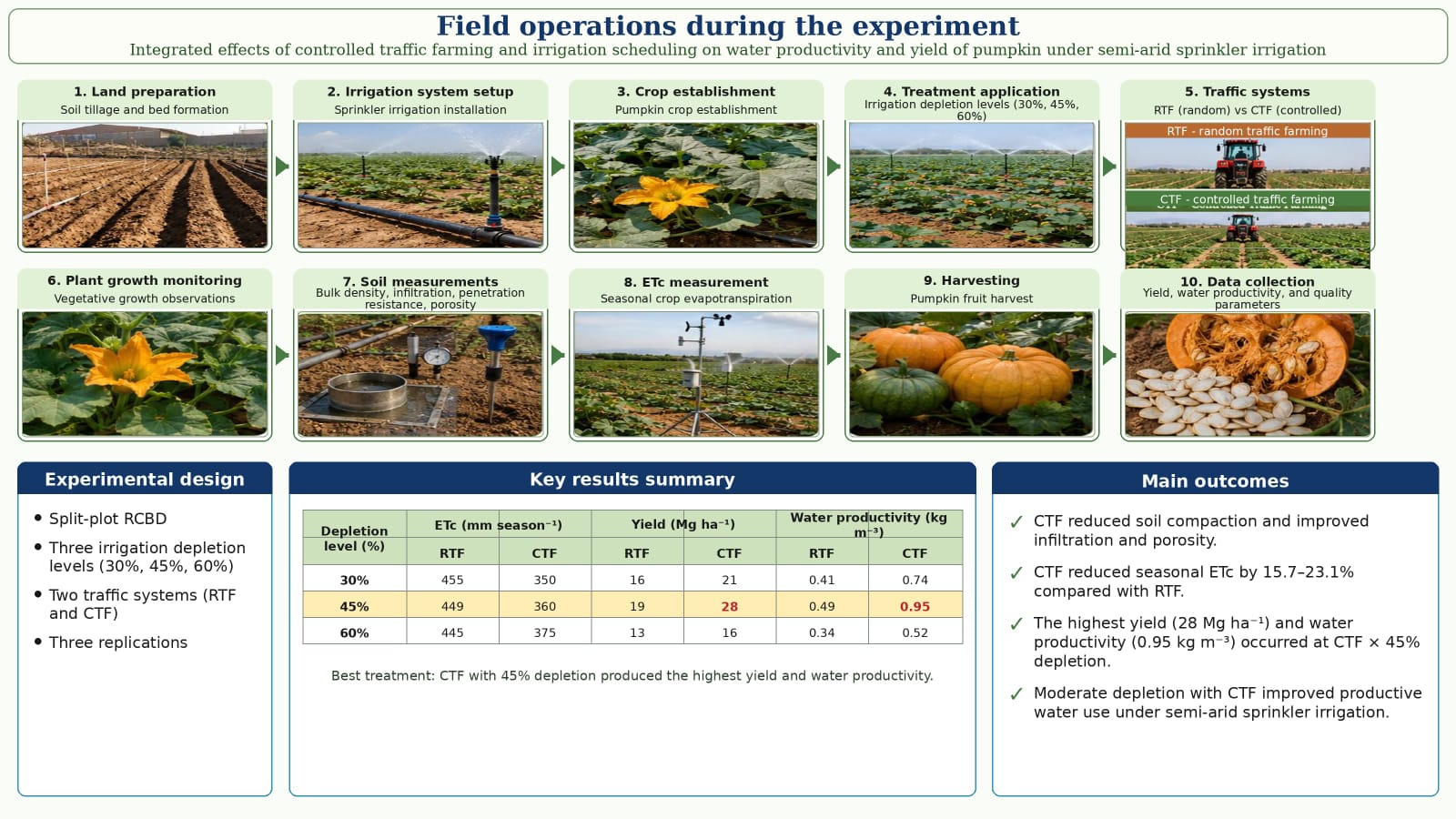
Water-use efficiency in semi-arid agriculture is strongly influenced by irrigation management and soil structural conditions within the crop root zone. Repeated machinery traffic can degrade soil pore continuity and hydraulic conductivity, reducing infiltration efficiency and limiting productive water use under sprinkler irrigation systems. This study evaluated the combined effects of controlled traffic farming (CTF) and irrigation depletion regimes on seasonal crop evapotranspiration (ETc), growth, yield, and water productivity of pumpkin (Cucurbita pepo L.) under semi-arid field conditions in Kirkuk Governorate, Iraq, during the 2024 growing season. A split-plot randomized complete block design was used with three irrigation depletion levels (30%, 45%, and 60% of available soil water) as main plots and two traffic systems (CTF and random traffic farming [RTF]) as subplots. Seasonal ETc was higher under RTF (445–455 mm) compared to CTF (350–375 mm), indicating reduced water loss under controlled traffic. The highest yield (28 Mg ha−1) and water productivity (0.95 kg m−3) were achieved under the combination of CTF and 45% depletion. Severe depletion (60%) reduced growth and yield due to excessive water stress, while 30% depletion likely caused over-irrigation, reducing aeration and increasing non-productive water use. Overall, CTF improved soil hydraulic behavior and enhanced irrigation efficiency by minimizing traffic-induced compaction. Regression analysis revealed strong relationships among ETc, irrigation depletion, traffic system, and water productivity (R2 = 0.91). The results suggest that integrating controlled traffic farming with moderate irrigation depletion optimizes soil water availability and root-zone aeration, thereby improving productive water use in semi-arid irrigated agriculture.
- Al-Gburi HF, Mouhamad RS, Al-Naji AJ, et al. Evaluation of trace elements in Iraqi soils using multivariate statistical analysis and pollution indices. Discov Environ. 2026;4(1):69. doi: 10.1007/s44274-026-00587-6
- Al-Azzawi AH, Al-Delfi JM, Mouhamad RS. Effect of tillage methods on incorporating nitrogen fertilizer in soil and on CO2 emission. AIP Conf Proc. 2024;3229:050012. doi: 10.1063/5.0235942
- Rabot E, Wiesmeier M, Schlüter S, Vogel HJ. Soil structure as an indicator of soil functions: A review. Geoderma. 2018;314:122-137. doi: 10.1016/j.geoderma.2017.11.009
- Antille DL, Peets S, Galambošová J, et al. Review: Soil compaction and controlled traffic farming in arable and grass cropping systems. Agron Res. 2019;17(3):653-682. doi: 10.15159/AR.19.133
- Nawaz MF, Bourrié G, Trolard F. Soil compaction impact and modelling: A review. Agron Sustain Dev. 2013;33(2):291- 309. doi: 10.1007/s13593-011-0071-8
- McPhee JE, Aird PL, Hardie MA, Corkrey SR. The effect of controlled traffic on soil physical properties and tillage requirements for vegetable production. Soil Tillage Res. 2015;149:33-45. doi: 10.1016/j.still.2014.12.018
- Colombi T, Braun S, Keller T, Walter A. Artificial macropores attract crop roots and enhance plant productivity on compacted soils. Sci Total Environ. 2017;574:1283-1293. doi: 10.1016/j.scitotenv.2016.07.194
- Keller T, Colombi T, Ruiz S, et al. Long-term soil structure observatory for monitoring post-compaction evolution of soil structure. Vadose Zone J. 2017;16(4):1-16. doi: 10.2136/vzj2016.11.0118
- Etana A, Holm L, Rydberg T, Keller T. Soil and crop responses to controlled traffic farming in reduced tillage and no-till: Some experiences from field experiments and on-farm studies in Sweden. Acta Agric Scand B Soil Plant Sci. 2020;70(4):333-340. doi: 10.1080/09064710.2020.1728372
- Tullberg JN, Yule DF, McGarry D. Controlled traffic farming — from research to adoption in Australia. Soil Tillage Res. 2007;97(2):272-281. doi: 10.1016/j.still.2007.09.007
- Costa JM, Ortuño MF, Chaves MM. Deficit irrigation as a strategy to save water: Physiology and potential application to horticulture. J Integr Plant Biol. 2007;49(10):1421-1434. doi: 10.1111/j.1672-9072.2007.00556.x
- Fereres E, Soriano MA. Deficit irrigation for reducing agricultural water use. J Exp Bot. 2007;58(2):147-159. doi: 10.1093/jxb/erl165
- Al-Bajalan KHM, Kka NME. Impact of water deficit on growth and seed quality of Cucurbita pepo L. under separate selenium and calcium applications. Passer J Basic Appl Sci. 2025;7(2):574-585. doi: 10.24271/psr.2025.515533.2063
- Gee GW, Or D. Particle-size analysis. In: Dane JH, Topp GC, eds. Methods of Soil Analysis. Part 4: Physical Methods. Madison, WI: Soil Science Society of America; 2002:255- 293.
- Soil Survey Staff. Soil Survey Manual. USDA Handbook 18. Washington, DC: United States Department of Agriculture, Natural Resources Conservation Service; 2017.
- Sparks DL, Page AL, Helmke PA, et al, eds. Methods of Soil Analysis. Part 3: Chemical Methods. Madison, WI: Soil Science Society of America; 1996.
- Burt R, ed. Soil Survey Laboratory Methods Manual. Soil Survey Investigations Report No. 42, Version 5.0. Lincoln, NE: USDA-NRCS; 2014.
- Olsen SR, Sommers LE. Phosphorus. In: Page AL, Miller RH, Keeney DR, eds. Methods of Soil Analysis. Part 2: Chemical and Microbiological Properties. 2nd ed. Madison, WI: American Society of Agronomy and Soil Science Society of America; 1982:403-430.
- Allen RG, Pereira LS, Raes D, Smith M. Crop Evapotranspiration: Guidelines for Computing Crop Water Requirements. FAO Irrigation and Drainage Paper 56. Rome: Food and Agriculture Organization of the United Nations; 1998.