

Impacts of financial development and economic growth matter in environmental sustainability: Empirical insights from Vietnam

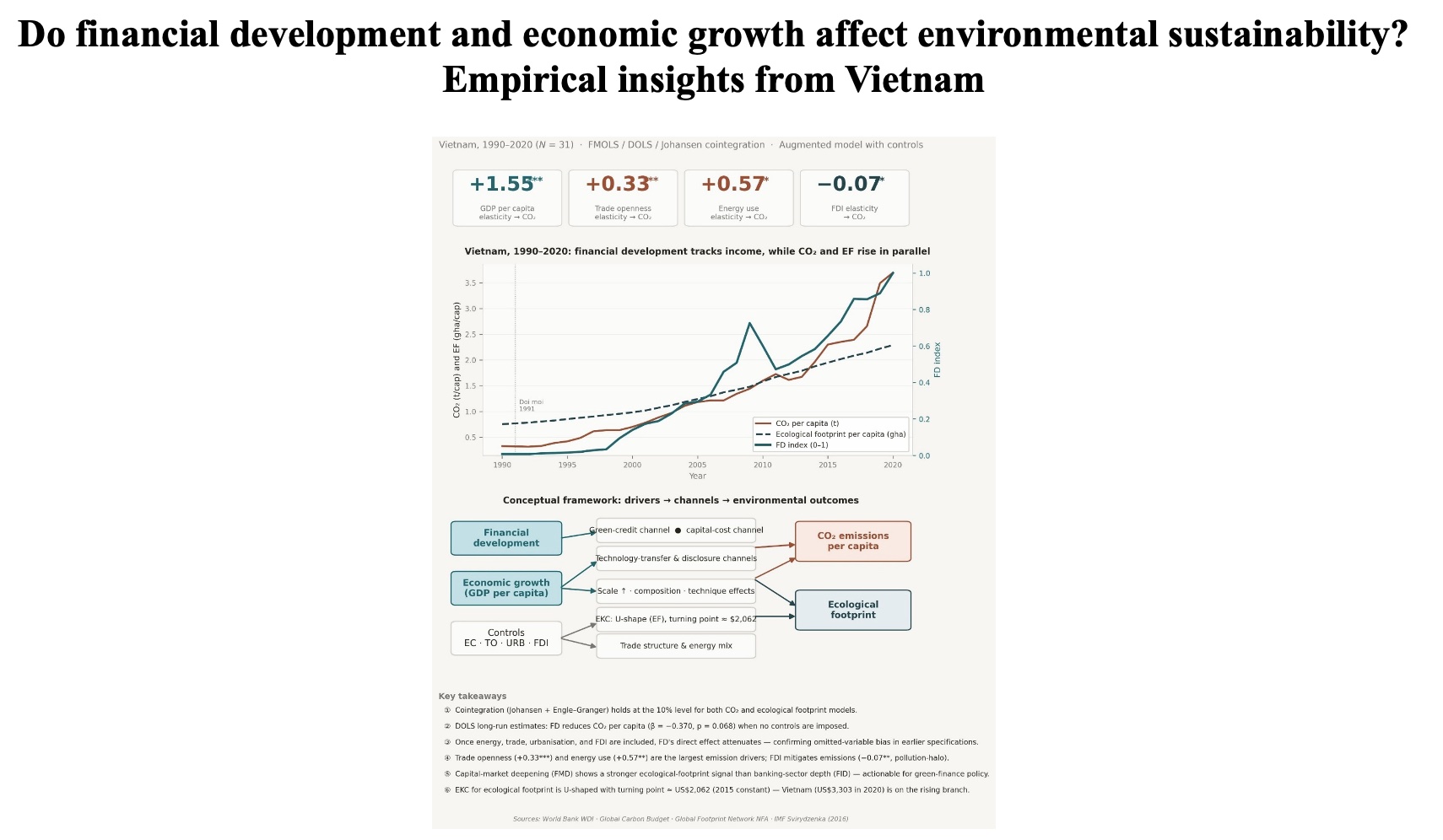
As an emerging economy with rapid growth and financial deepening, Vietnam offers a critical case for environmental-economic analysis. This study investigates the long-run relationship between financial development, economic growth and environmental sustainability in Vietnam over 1990–2020. Using two environmental indicators (per-capita CO2 emissions and the per-capita ecological footprint) and a composite financial development index together with energy consumption, trade openness, urbanisation and foreign direct investment as control variables, we estimated long-run elasticities by fully modified ordinary least squares (OLS), dynamic OLS, and canonical cointegrating regression, and tested the environmental Kuznets curve (EKC) hypothesis with a squared per-capita-income term. Cointegration was assessed using the Johansen and Engle–Granger procedures; structural breaks were tested using the Zivot–Andrews endogenous-break procedure; and a vector error-correction model was used to recover long-run equilibrium dynamics. Financial development is associated with lower CO2 emissions but with a higher ecological footprint, suggesting that the two indicators capture distinct dimensions of environmental pressure. Per-capita income remains the dominant driver of both indicators, with CO2’s elasticity above unity. Third, the EKC takes a U-shaped form for the ecological footprint, with an estimated turning point near US$2,062 (in constant 2015 prices); Vietnam currently sits above this threshold and on the rising segment of the curve. Disaggregating the financial development index shows that capital-market deepening, rather than banking depth or access, exerts the stronger environmental effect. The results support a green-finance policy mix that targets capital-market composition and energy intensity, and are of direct relevance to Vietnam’s National Green Growth Strategy 2021–2030 and net-zero-by-2050 commitment.
- Global Footprint Network. National Footprint and Biocapacity Accounts, 2022 Edition. Oakland, CA: Global Footprint Network; 2022. Accessed June 1, 2024.
- Phillips PCB, Hansen BE. Statistical inference in instrumental variables regression with I(1) processes. Rev Econ Stud. 1990;57(1):99-125. doi: 10.2307/2297545
- Khan M, Ozturk I. Examining the direct and indirect effects of financial development on CO2 emissions for 88 developing countries. J Environ Manage. 2021;293:112812. doi: 10.1016/j.jenvman.2021.112812
- Tamazian A, Chousa JP, Vadlamannati KC. Does higher economic and financial development lead to environmental degradation: evidence from BRIC countries. Energy Policy. 2009;37(1):246-253. doi: 10.1016/j.enpol.2008.08.025
- Saidi K, Mbarek MB. The impact of income, trade, urbanization, and financial development on CO₂ emissions in 19 emerging economies. Environ Sci Pollut Res. 2017;24(14):12748-12757. doi: 10.1007/s11356-016-6303-3
- Shahbaz M, Shahzad SJH, Ahmad N, Alam S. Financial development and environmental quality: the way forward. Energy Policy. 2018;98:353-368. doi: 10.1016/j.enpol.2016.09.002
- Grossman GM, Krueger AB. Economic growth and the environment. Q J Econ. 1995;110(2):353-377. doi: 10.2307/2118443
- Isik C, Ongan S, Özdemir D. The economic growth/ development and environmental degradation: evidence from the US state-level EKC hypothesis. Environ Sci Pollut Res. 2019;26(30):30772-30781. doi: 10.1007/s11356-019-06276-7
- Pata UK, Aydin M. Testing the EKC hypothesis for the top six hydropower energy-consuming countries: evidence from Fourier bootstrap ARDL procedure. J Clean Prod. 2020;264:121699. doi: 10.1016/j.jclepro.2020.121699
- Ali K, Bakhsh S, Ullah S, Ullah A, Ullah S. Industrial growth and CO2 emissions in Vietnam: the key role of financial development and fossil fuel consumption. Environ Sci Pollut Res. 2021;28(6):7515-7527. doi: 10.1007/s11356-020-10996-6
- Hung NT, Trang NT, Thang NT. Quantile relationship between globalization, financial development, economic growth, and carbon emissions: evidence from Vietnam. Environ Sci Pollut Res. 2022;29(40):60098-60116. doi: 10.1007/s11356-022-20126-z
- Nguyen TP, Duong TT, Nguyen TTH. U-shaped relationship between financial development and greenhouse gases in Vietnam: ARDL bound test approach. Pol J Environ Stud. 2024;33(6):5345-5358. doi: 10.15244/pjoes/196733
- Zeraibi A, Balsalobre-Lorente D, Murshed M. The influences of renewable electricity generation, technological innovation, financial development, and economic growth on ecological footprints in ASEAN-5 countries. Environ Sci Pollut Res. 2021;28(37):51003-51021. doi: 10.1007/s11356-021-14301-x
- Bui TTT, Cao TH. Effects of economic growth, foreign direct investment, energy consumption, and urbanization on the ecological footprint in Vietnam. J Finance Mark Res. 2024;15(8):15-31. doi: 10.52932/jfm.v15i8.602
- Xuan HT, Hung NT. Green growth and environmental degradation: an empirical study in Vietnam. VNU J Econ Bus. 2025;5(1):75-87. doi: 10.57110/vnu-jeb.v5i1.415
- Dickey DA, Fuller WA. Distribution of the estimators for autoregressive time series with a unit root. J Am Stat Assoc. 1979;74(366a):427-431. doi: 10.1080/01621459.1979.10482531
- Phillips PCB, Perron P. Testing for a unit root in time series regression. Biometrika. 1988;75(2):335-346. doi: 10.1093/biomet/75.2.335
- Newey WK, West KD. A simple, positive semi-definite, heteroskedasticity and autocorrelation consistent covariance matrix. Econometrica. 1987;55(3):703-708. doi: 10.2307/1913610
- Kwiatkowski D, Phillips PCB, Schmidt P, Shin Y. Testing the null hypothesis of stationarity against the alternative of a unit root. J Econom. 1992;54(1-3):159-178. doi: 10.1016/0304-4076(92)90104-Y
- Hamilton JD. Time Series Analysis. Princeton, NJ: Princeton University Press; 1994.
- Zivot E, Andrews DWK. Further evidence on the great crash, the oil-price shock, and the unit-root hypothesis. J Bus Econ Stat. 1992;10(3):251-270. doi: 10.2307/1391541
- Johansen S. Statistical analysis of cointegration vectors. J Econ Dyn Control. 1988;12(2-3):231-254. doi: 10.1016/0165-1889(88)90041-3
- Engle RF, Granger CWJ. Co-integration and error correction: representation, estimation, and testing. Econometrica. 1987;55(2):251-276. doi: 10.2307/1913236
- Stock JH, Watson MW. A simple estimator of cointegrating vectors in higher order integrated systems. Econometrica. 1993;61(4):783-820. doi: 10.2307/2951763
- Park JY. Canonical cointegrating regressions. Econometrica. 1992;60(1):119-143. doi: 10.2307/2951679
- Svirydzenka K. Introducing a New Broad-based Index of Financial Development. IMF Working Paper. Washington, DC: International Monetary Fund; 2016;16(05):1. doi: 10.5089/9781513583709.001
- World Bank. World Development Indicators. Washington, DC: The World Bank; 2023. Accessed June 1, 2024.
- Friedlingstein P, O’Sullivan M, Jones MW, et al. Global Carbon Budget 2022. Earth Syst Sci Data. 2022;14(11):4811- 4900. doi: 10.5194/essd-14-4811-2022
- Ritchie H, Roser M, Rosado P. CO₂ and Greenhouse Gas Emissions. Our World in Data. 2020. Accessed June 1, 2024. https://ourworldindata.org/co2-and-greenhouse-gas-emissions
- Ulucak R, Bilgili F. A reinvestigation of EKC model by ecological footprint measurement for high, middle and low income countries. J Clean Prod. 2018;188:144-157. doi: 10.1016/j.jclepro.2018.03.191
- Destek MA, Sinha A. Renewable, non-renewable energy consumption, economic growth, trade openness and ecological footprint: evidence from organisation for economic co-operation and development countries. J Clean Prod. 2020;242:118537. doi: 10.1016/j.jclepro.2019.118537