

Programmable hydrogel matrices for oral and maxillofacial organoids: Engineering mechanobiological and biochemical niches to reverse tissue senescence

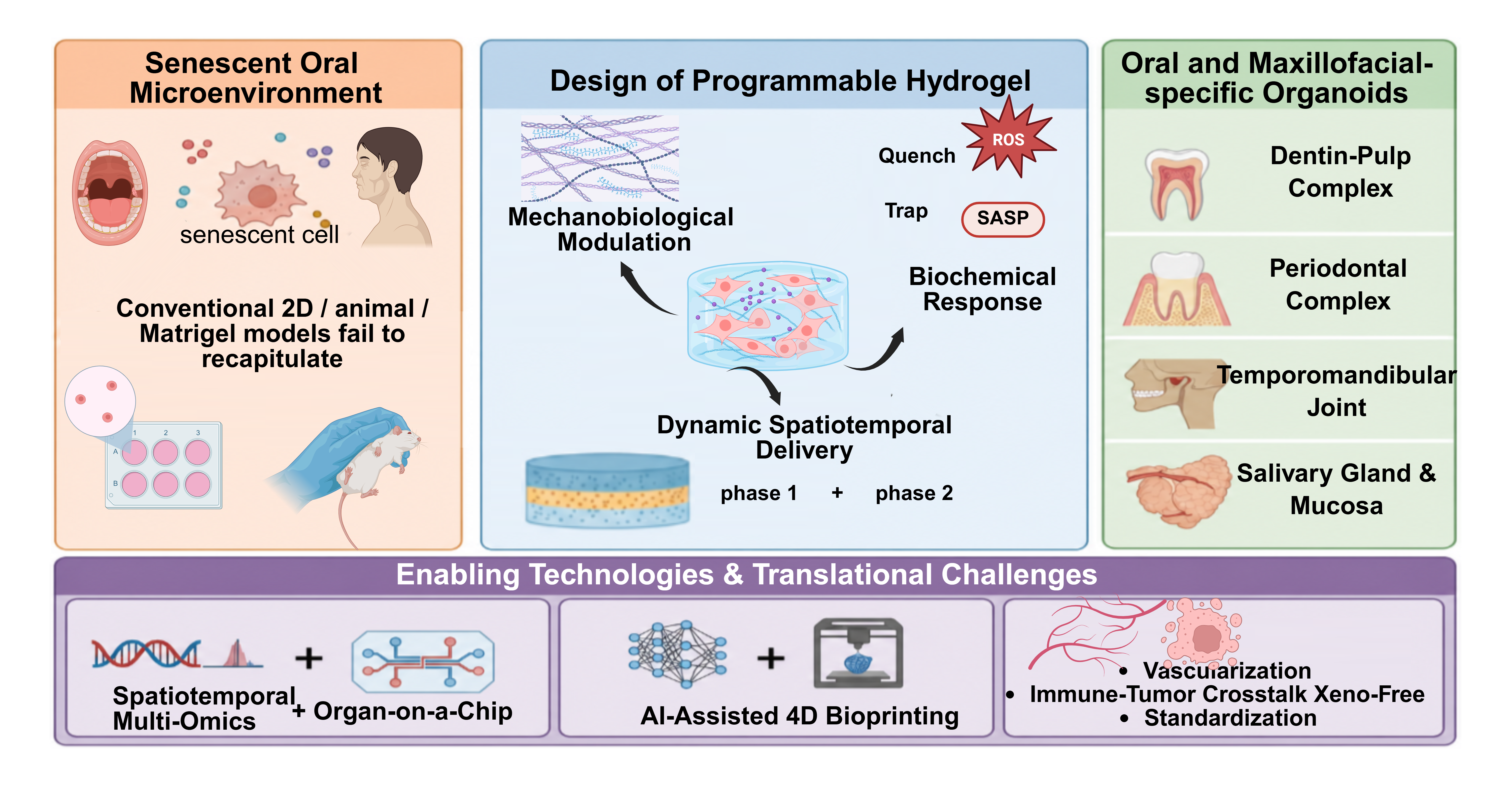
Age-related degeneration of oral and maxillofacial tissues, associated with extracellular matrix sclerosis and the senescence-associated secretory phenotype (SASP), poses an escalating challenge in the context of global population aging. Conventional static biomaterials and two-dimensional in vitro culture systems cannot adequately recapitulate this dynamic pathological microenvironment, and animal models are limited by interspecies differences that hinder translational fidelity. Organoid technology can recapitulate key aspects of tissue-specific architecture, cellular heterogeneity, and functional organization, thereby providing physiologically relevant three-dimensional models for aging research and regenerative medicine. These models not only enable disease modeling and pathogenesis studies to investigate senescence mechanisms that are difficult to resolve in conventional in vivo models and support high-throughput screening of anti-aging compounds, but also provide a basis for organoid transplantation in functional tissue regeneration. As an emerging and promising regenerative strategy, organoid-based therapy therefore offers new opportunities for reconstructing aging oral and maxillofacial tissues. However, its clinical potential remains constrained by the lack of programmable matrices capable of dynamically mitigating key features of the senescent microenvironment. This review examines the emergence of programmable hydrogels as tunable active matrices for oral and maxillofacial organoid engineering within senescent microenvironments. We analyze material-based strategies for modulating senescence-associated phenotypes, including mechanobiological approaches, such as tunable stress relaxation to attenuate pathological mechanical memory, and biochemical interventions that target reactive oxygen species via nanozyme catalysis and modulate SASP signaling through spatiotemporal delivery control. We further evaluate the application of these matrices for lineage-specific tissue reconstruction across the dentin–pulp complex, periodontal tissue, temporomandibular joint, salivary gland, and mucosal barrier. Finally, we discuss how integrating spatiotemporal multi-omics, microfluidic organ-on-a-chip platforms, and artificial intelligence-assisted bioprinting may advance organoid engineering, while highlighting key translational barriers related to neurovascularization, safety, standardized manufacturing, and regulatory compliance.
- GBD 2021 Oral Disorders Collaborators. Trends in the global, regional, and national burden of oral conditions from 1990 to 2021: a systematic analysis for the Global Burden of Disease Study 2021. Lancet. 2025;405(10482):897-910. doi: 10.1016/S0140-6736(24)02811-3
- Wu H, Zhang Q, Zhu J, Wu L, Xiao Y, Yang X. Biomaterials targeting senescent cells for bone regeneration: State-of-the-art and future perspectives. Bioact Mater. 2025;54:686-714. doi: 10.1016/j.bioactmat.2025.09.002
- Loewa A, Feng JJ, Hedtrich S. Human disease models in drug development. Nat Rev Bioeng. 2023;1(8):545-559. doi: 10.1038/s44222-023-00063-3
- Xu M, Kong D, Sun S, et al. Organoids for disease modeling and treatment: state-of-the-art. Exp Hematol Oncol. 2026;15(1):10. doi: 10.1186/s40164-026-00743-x
- Morizane R, Lamers MM. Organoids in disease modeling and regenerative medicine. Cell Mol Life Sci. 2025;82(1):169. doi: 10.1007/s00018-025-05692-y
- Wu Y, Li X, Liu H, et al. Organoids in the oral and maxillofacial region: present and future. Int J Oral Sci. 2024;16(1):61. doi: 10.1038/s41368-024-00324-w
- Soto-Gamez A, Gunawan JP, Barazzuol L, Pringle S, Coppes RP. Organoid-based personalized medicine: from tumor outcome prediction to autologous transplantation. Stem Cells. 2024;42(6):499-508. doi: 10.1093/stmcls/sxae023
- Tao B, Li X, Hao M, et al. Organoid-Guided Precision Medicine: From Bench to Bedside. MedComm. 2025;6(5):e70195. doi: 10.1002/mco2.70195
- Yang Y, Wang YB, Yin H, et al. Organoids in aging research: Decoding mechanisms, accelerating interventions, and bridging translation. Organoid Res. 2025;1(4):025450032. doi: 10.36922/OR025450032
- Xiang D, He A, Zhou R, et al. Building consensus on the application of organoid-based drug sensitivity testing in cancer precision medicine and drug development. Theranostics. 2024;14(8):3300-3316. doi: 10.7150/thno.96027
- Zhang FL, Hu Z, Wang YF, et al. Organoids transplantation attenuates intestinal ischemia/reperfusion injury in mice through L-Malic acid-mediated M2 macrophage polarization. Nat Commun. 2023;14(1):6779. doi: 10.1038/s41467-023-42502-0
- Wolff L, Hendrix S. Rethinking Matrigel: The Complex Journey to Matrix Alternatives in Organoid Culture. Adv Sci. 2025;12(47):e08734. doi: 10.1002/advs.202508734
- Xiang G, Yin B, Shiroud Heidari B, et al. Programmable Hydrogels: Frontiers in Dynamic Closed-Loop Systems, Biomimetic Synergy, and Clinical Translation. Adv Sci. 2025;12(47):e12037. doi: 10.1002/advs.202512037
- López-Otín C, Blasco MA, Partridge L, Serrano M, Kroemer G. Hallmarks of aging: An expanding universe. Cell. 2023;186(2):243-278. doi: 10.1016/j.cell.2022.11.001
- Pu M, Cao H, Zhang H, et al. ROS-responsive hydrogels: from design and additive manufacturing to biomedical applications. Mater Horiz. 2024;11(16):3721-3746. doi: 10.1039/d4mh00289j
- Zhang C, Shen Y, Huang M, et al. Dynamic hydrogel mechanics in organoid engineering: From matrix design to translational paradigms. Bioact Mater. 2025;55:144-170. doi: 10.1016/j.bioactmat.2025.09.021
- Park JH, Sagar V, Leong KW, Kim HW, Kim HS. Mechanobiological engineering strategies for oral and maxillofacial tissue regeneration. Biomaterials. 2026;332:124158. doi: 10.1016/j.biomaterials.2026.124158
- Guo L, Ge L, Li Y, et al. Age-mimicking hydrogel stiffness recapitulates the mechanical niche of the hippocampus to regulate neural stem cell senescence. Mater Today Bio. 2026;37:102985. doi: 10.1016/j.mtbio.2026.102985
- Wang L, Jiang Y, Zhao C. The effects of advanced glycation end-products on skin and potential anti-glycation strategies. Exp Dermatol. 2024;33(4):e15065. doi: 10.1111/exd.15065
- Lin Z, Xu G, Lu X, et al. Piezo1 exacerbates inflammation-induced cartilaginous endplate degeneration by activating mitochondrial fission via the Ca2+/CaMKII/Drp1 axis. Aging Cell. 2025;24(4):e14440. doi: 10.1111/acel.14440
- Madl CM, Wang YX, Holbrook CA, et al. Hydrogel biomaterials that stiffen and soften on demand reveal that skeletal muscle stem cells harbor a mechanical memory. Proc Natl Acad Sci USA. 2024;121(35):e2406787121. doi: 10.1073/pnas.2406787121
- Lai W, Geliang H, Bin X, Wang W. Effects of hydrogel stiffness and viscoelasticity on organoid culture: a comprehensive review. Mol Med. 2025;31(1):83. doi: 10.1186/s10020-025-01131-7
- Dai X, Wu D, Xu K, Ming P, Cao S, Yu L. Viscoelastic Mechanics: From Pathology and Cell Fate to Tissue Regeneration Biomaterial Development. ACS Appl Mater Interfaces. 2025;17(6):8751-8770. doi: 10.1021/acsami.4c18174
- Ling Q, Li H, Zhao J, et al. Mechanically heterogeneous hydrogel with cell-programmed network restructuring promotes tissue regeneration by mechano-epigenetic modulation. Nat Commun. 2026;17(1):2184. doi: 10.1038/s41467-026-69004-z
- Alipour-Khezri E, Moqadami A, Zununi Vahed S, et al. Cytosolic DNA sensing pathway in senescence and aging: Underlying mechanisms and targeted interventions. Biomed Pharm. 2025;193:118790. doi: 10.1016/j.biopha.2025.118790
- Fan Y, Niu Z, Yin L, et al. Membrane biomimetic nanoenzyme-incorporated hybrid glycyrrhizic acid hydrogel for precise mitochondrial ROS scavenging for osteoarthritis treatment. Mater Today Bio. 2025;32:101778. doi: 10.1016/j.mtbio.2025.101778
- Wang W, Zhang X, Zhang L, et al. An Immunomodulating Regenerating Hydrogel That Rescues the Oxidative Microenvironment and Reverses Cell Senescence for Osteoporotic Bone Defects. ACS Nano. 2025;19(31):28353-28371. doi: 10.1021/acsnano.5c06549
- Xing M, Chen S, Zhu M, et al. Nanozyme hydrogels remodel pathological microenvironment for temporomandibular joint osteoarthritis therapy via inhibiting MAPK signal pathway. Bioact Mater. 2026;60:216-242. doi: 10.1016/j.bioactmat.2026.01.031
- Wang Y, Tan L, Yang Y, et al. Targeting the ROS-ferroptosis-inflammation cycle with a nanozyme-functionalized hydrogel for intervertebral disc repair. Nat Commun. 2025;16(1):11253. doi: 10.1038/s41467-025-66116-w
- Zhong M, Zhang L, Wang Z, et al. Molecular-Cellular Two- Pronged Reprogramming of Inflammatory Soft-Tissue Interface with an Immunosuppressive Pure DNA Hydrogel. Nano Lett. 2025;25(13):5087-5096. doi: 10.1021/acs.nanolett.4c05340
- Yi D, Wang T, Xu S, et al. Injectable ROS/pH-Responsive Hydrogel for Synergistic Chemo-Photodynamic Tumor Therapy and Enhanced Wound Healing. Adv Healthc Mater. 2026;15(1):e02349. doi: 10.1002/adhm.202502349
- Zhang Q, Chen W, Li G, et al. A Factor-Free Hydrogel with ROS Scavenging and Responsive Degradation for Enhanced Diabetic Bone Healing. Small. 2024;20(24):e2306389. doi: 10.1002/smll.202306389
- Zhang L, Xiang K, Li J, et al. Photoactivatable Exosenolytics Activate Natural Killer Cells for Delaying Osteoarthritis. ACS Nano. 2025;19(25):23028-23045. doi: 10.1021/acsnano.5c03344
- Zhang Q, Wang T, Ren J, et al. Multifunctional astragalus polysaccharide composited microneedle promotes oral ulcers healing by inhibiting ferroptosis via Nrf2/HO-1/ SLC7A11 axis. Mater Today Bio. 2025;32:101873. doi: 10.1016/j.mtbio.2025.101873
- Zhang Y, Zhang D, Yue X, et al. Fmoc-DDT@Fos hydrogel mitigates temporomandibular joint osteoarthritis through regulating macrophage reprogramming and ferroptosis. Mater Today Bio. 2026;37:102906. doi: 10.1016/j.mtbio.2026.102906
- Zhou B, Magana L, Hong Z, et al. The angiocrine Rspondin3 instructs interstitial macrophage transition via metabolic-epigenetic reprogramming and resolves inflammatory injury. Nat Immunol. 2020;21(11):1430-1443. doi: 10.1038/s41590-020-0764-8
- Liu S, Cheng S, Chen B, et al. Microvesicles-hydrogel breaks the cycle of cellular senescence by improving mitochondrial function to treat osteoarthritis. J Nanobiotechnol. 2023;21(1):429. doi: 10.1186/s12951-023-02211-8
- Su GL, Peng YJ, Ruan HZ, Cheng J, Deng T, Zhang YF. Regulating periodontal disease with smart stimuli-responsive systems: Antimicrobial activity, immunomodulation, periodontium regeneration. Mater Today Bio. 2025;32:101863. doi: 10.1016/j.mtbio.2025.101863
- Blatchley MR, Anseth KS. Middle-out methods for spatiotemporal tissue engineering of organoids. Nat Rev Bioeng. 2023;1(5):329-345. doi: 10.1038/s44222-023-00039-3
- Liang C, Guo J, Qiao W, Lee SJ. Spatiotemporal immunomodulation with programmable biomaterials to promote musculoskeletal tissue regeneration. Bioact Mater. 2026;62:202-228. doi: 10.1016/j.bioactmat.2026.02.020
- Peng YH, Hsiao SK, Gupta K, et al. Dynamic matrices with DNA-encoded viscoelasticity for cell and organoid culture. Nat Nanotechnol. 2023;18:1463-1473. doi: 10.1038/s41565-023-01483-3
- Lee S, Yoo J, Bae G, et al. Photonic control of ligand nanospacing in self-assembly regulates stem cell fate. Bioact Mater. 2023;34:164-180. doi: 10.1016/j.bioactmat.2023.12.011
- Liu Y, Wang T, Wang W. Photopharmacology and photoresponsive drug delivery. Chem Soc Rev. 2025;54(12):5792-5835. doi: 10.1039/d5cs00125k
- Li S, Zheng W, Deng W, et al. Logic-Based Strategy for Spatiotemporal Release of Dual Extracellular Vesicles in Osteoarthritis Treatment. Adv Sci. 2024;11(26):e2403227. doi: 10.1002/advs.202403227
- Yin BC, Ye BC, Tan W, Wang H, Xie CC. Colorimetric logic gates based on aptamer-crosslinked hydrogels. Chem Commun. 2012;48(9):1248-1250. doi: 10.1039/c1cc15639j
- Zhang Y, Wu Y, Xu S, et al. CRISPR-responsive RCA-based DNA hydrogel biosensing platform with customizable signal output for rapid detection. Anal Chem. 2024;96(40):15998- 16006. doi: 10.1021/acs.analchem.4c03450
- Do S, Lee C, Lee T, Kim DN, Shin Y. Engineering DNA-based synthetic condensates with programmable material properties, compositions, and functionalities. Sci Adv. 2022;8(41):eabj1771. doi: 10.1126/sciadv.abj1771
- Tang J, Ji C, Lu X, et al. DNA Origami Plasmonic Nanoantenna for Programmable Biosensing of Multiple Cytokines in Cancer Immunotherapy. Anal Chem. 2024;96(23):9684- 9692. doi: 10.1021/acs.analchem.4c01626
- Sarah R, Schimmelpfennig K, Rohauer R, Lewis CL, Limon SM, Habib A. Characterization and machine learning-driven property prediction of a novel hybrid hydrogel bioink considering extrusion-based 3D bioprinting. Gels. 2025;11(1):45. doi: 10.3390/gels11010045
- Kruglov V, Jang IH, Camell CD. Inflammaging and fatty acid oxidation in monocytes and macrophages. Immunometabolism. 2024;6(1):e00038. doi: 10.1097/IN9.0000000000000038
- Motoike S, Inada Y, Toguchida J, Kajiya M, Ikeya M. Jawbone-like organoids generated from human pluripotent stem cells. Nat Biomed Eng. 2025;9(11):1816-1834. doi: 10.1038/s41551-025-01419-3
- Han HM, Kim SY, Kim DH. Mechanotransduction for therapeutic approaches: Cellular aging and rejuvenation. APL Bioeng. 2025;9(2):021502. doi: 10.1063/5.0263236
- Elosegui-Artola A, Gupta A, Najibi AJ, et al. Matrix viscoelasticity controls spatiotemporal tissue organization. Nat Mater. 2023;22(1):117-127. doi: 10.1038/s41563-022-01400-4
- Han B, Cao C, Wang A, et al. Injectable Double-Network Hydrogel-Based Three-Dimensional Cell Culture Systems for Regenerating Dental Pulp. ACS Appl Mater Interfaces. 2023;15(6):7821-7832. doi: 10.1021/acsami.2c20848
- Zhang Y, Huang X, Luo Y, et al. A carbon dot nanozyme hydrogel enhances pulp regeneration activity by regulating oxidative stress in dental pulpitis. J Nanobiotechnol. 2024;22(1):537. doi: 10.1186/s12951-024-02810-z
- Meng H, Su J, Shen Q, et al. A Smart MMP-9-responsive Hydrogel Releasing M2 Macrophage-derived Exosomes for Diabetic Wound Healing. Adv Healthc Mater. 2025;14(10):e2404966. doi: 10.1002/adhm.202404966
- Qiu P, Ouyang Y, Liu S, et al. Environmental Response Temporal Release Injectable Hydrogel for Controlled Growth Factor Release to Enhance Inflammatory Periodontal Bone Defect Regeneration. Adv Mater. 2026;38(3):e12531. doi: 10.1002/adma.202512531
- Shen CY, Zhou QR, Wu X, et al. Accelerating cartilage regeneration with DNA-SF hydrogel sustained release system-based cartilage organoids. Mil Med Res. 2025;12(1):39. doi: 10.1186/s40779-025-00625-z
- Zhang Y, Li D, Liu M, et al. An Oral Mucosa-Inspired Wet- Adhesion Janus Hydrogel With Asymmetric Bifunctionalities of Antifouling/Antioxidant for Treating Oral Ulcer in Diabetes. Small. 2026;22(23):e13928. doi: 10.1002/smll.202513928
- Munguia-Lopez JG, Pillai S, Zhang Y, et al. Expansion of functional human salivary acinar cell spheroids with reversible thermo-ionically crosslinked 3D hydrogels. Int J Oral Sci. 2025;17(1):39. doi: 10.1038/s41368-025-00368-6
- Wang X, Wang L, Zhou L, et al. NUP62 alleviates senescence and promotes the stemness of human dental pulp stem cells via NSD2-dependent epigenetic reprogramming. Int J Oral Sci. 2025;17(1):34. doi: 10.1038/s41368-025-00362-y
- Yuan S, Yang X, Wang X, Chen J, Tian W, Yang B. Injectable Xenogeneic Dental Pulp Decellularized Extracellular Matrix Hydrogel Promotes Functional Dental Pulp Regeneration. Int J Mol Sci. 2023;24(24):17483. doi: 10.3390/ijms242417483
- Wu J, Yun Z, Song W, et al. Highly oriented hydrogels for tissue regeneration: design strategies, cellular mechanisms, and biomedical applications. Theranostics. 2024;14(5):1982- 2035. doi: 10.7150/thno.89493
- Zhang Z, Li C, Guo J, et al. “Young-Mechanical Niche” biomimetic hydrogel promotes dental pulp regeneration through YAP-dependent mechanotransduction. Chem Eng J. 2024;501:157483. doi: 10.1016/j.cej.2024.157483
- Li X, Yu Z, Jiang S, et al. An amelogenin-based peptide hydrogel promoted the odontogenic differentiation of human dental pulp cells. Regen Biomater. 2022;9:rbac039. doi: 10.1093/rb/rbac039
- Liu L, Wu D, Tu H, et al. Applications of hydrogels in drug delivery for oral and maxillofacial diseases. Gels. 2023;9(2):146. doi: 10.3390/gels9020146
- Wu S, Zhou Y, Chen L, et al. Evaluation of chitosan hydrogel for sustained delivery of VEGF for odontogenic differentiation of dental pulp stem cells. Stem Cells Int. 2019;2019:1515040. doi: 10.1155/2019/1515040
- Wang L, Wei X, He X, et al. Osteoinductive dental pulp stem cell-derived extracellular vesicle-loaded multifunctional hydrogel for bone regeneration. ACS Nano. 2024;18(12):8777-8797. doi: 10.1021/acsnano.3c11542
- Mitsiadis TA, Pagella P. “Dental Pulp-On-Chip” Microfluidic Devices for Emulating Human Dental Pulp Tissue Physiology and Pathology. J Endod. 2026;52(4):538-547. doi: 10.1016/j.joen.2025.12.008
- Hermans F, Hemeryck L, Bueds C, et al. Organoids from mouse molar and incisor as new tools to study tooth-specific biology and development. Stem Cell Rep. 2023;18(5):1166-1181. doi: 10.1016/j.stemcr.2023.03.011
- Liu F, Wu Q, Liu Q, et al. Dental pulp stem cells-derived cannabidiol-treated organoid-like microspheroids show robust osteogenic potential via upregulation of WNT6. Commun Biol. 2024;7(1):972. doi: 10.1038/s42003-024-06655-y
- Smaida R, Hua G, Benkirane-Jessel N, Fioretti F. Three- Dimensional Models of the Dental Pulp: Bridging Fundamental Biology and Regenerative Therapy. Int J Mol Sci. 2025;26(22):10960. doi: 10.3390/ijms262210960
- França CM, Tahayeri A, Rodrigues NS, et al. The tooth on-a-chip: a microphysiologic model system mimicking the biologic interface of the tooth with biomaterials. Lab Chip. 2020;20(2):405-413. doi: 10.1039/c9lc00915a
- Shao X, Hu Z, Su H, Wang Y, Lin Y. Effects of tension on mitochondrial autophagy and osteogenic differentiation of periodontal ligament stem cells. Cell Prolif. 2024;57(3):e13561. doi: 10.1111/cpr.13561
- Yue Z, Nie L, Zhao P, Ji N, Liao G, Wang Q. Senescence-associated secretory phenotype and its impact on oral immune homeostasis. Front Immunol. 2022;13:1019313. doi: 10.3389/fimmu.2022.1019313
- Meyers AK, Zhu X. The NLRP3 Inflammasome: Metabolic Regulation and Contribution to Inflammaging. Cells. 2020;9(8):1808. doi: 10.3390/cells9081808
- Liao Y, Chen J, Zhao Y, et al. The novel Nrf2 agonist neobavaisoflavone attenuates periodontitis by inhibiting osteoclastogenesis through iron homeostasis regulation and senescence suppression. Free Radic Biol Med. 2026;245:168- 184. doi: 10.1016/j.freeradbiomed.2025.12.058
- Tang Y, Su S, Yu R, et al. Unraveling ferroptosis in osteogenic lineages: implications for dysregulated bone remodeling during periodontitis progression. Cell Death Discov. 2024;10(1):195. doi: 10.1038/s41420-024-01969-6
- Li Q, He W, Li W, et al. Band-Aid-Like Self-Fixed Barrier Membranes Enable Superior Bone Augmentation. Adv Sci. 2023;10(16):e2206981. doi: 10.1002/advs.202206981
- Yang X, Ma Y, Wang X, et al. A 3D-Bioprinted Functional Module Based on Decellularized Extracellular Matrix Bioink for Periodontal Regeneration. Adv Sci. 2023;10(5):e2205041. doi: 10.1002/advs.202205041
- Wang M, Li W, Hao J, et al. Molecularly cleavable bioinks facilitate high-performance digital light processing-based bioprinting of functional volumetric soft tissues. Nat Commun. 2022;13(1):3317. doi: 10.1038/s41467-022-31002-2
- Liu X, Wan X, Sui B, et al. Piezoelectric hydrogel for treatment of periodontitis through bioenergetic activation. Bioact Mater. 2024;35:346-361. doi: 10.1016/j.bioactmat.2024.02.011
- Cheng Y, Zhao P, Zhang N, Guo J, Niu J, Li F. M2 macrophage-derived extracellular vesicle/polydopamine hydrogel attenuates diabetic periodontitis-induced bone loss via the NEK7/NLRP3/IL-1β pathway. Sci Rep. 2025;16(1):4080. doi: 10.1038/s41598-025-34266-y
- Wu X, Xia Y, Dai H, et al. Metabolic Control During Macrophage Polarization by a Citrate-Functionalized Scaffold for Maintaining Bone Homeostasis. Adv Healthc Mater. 2024;13(22):e2400770. doi: 10.1002/adhm.202400770
- Zhao L, Xu Z, Zhao P, et al. Sympathetic nerve inhibition enhances calvarial bone repair via senescent macrophage-induced osteogenesis and angiogenesis. Cell Death Discov. 2025;11(1):564. doi: 10.1038/s41420-025-02886-y
- Li Q, Xu K, Li J, et al. Metabolic small molecules materialized hydrogel promotes diabetic bone regeneration through osteoimmunological remodeling. Biomaterials. 2026;325:123597. doi: 10.1016/j.biomaterials.2025.123597
- Huang X, Lan Y, Shen J, et al. M2 macrophages secrete glutamate-containing extracellular vesicles to alleviate osteoporosis by reshaping osteoclast precursor fate. Mol Ther. 2024;32(4):1158-1177. doi: 10.1016/j.ymthe.2024.02.005
- Lu Y, Song J, Lv Y, et al. An Osteoconductive Janus Hydrogel with Full Barrier Protection and Adaptable Degradation Properties for Superior Bone Regeneration. Adv Sci. 2025;12(34):e06736. doi: 10.1002/advs.202506736
- Che Z, Sheng X, Wu Y, et al. Sequential release of bioactive factors from functionalized metal-organic framework hydrogel enhances interfacial osseointegration of 3D-printed titanium alloy porous scaffolds. Theranostics. 2026;16(2):852- 875. doi: 10.7150/thno.120711
- Sriram G, Makkar H. Microfluidic organ-on-chip systems for periodontal research: advances and future directions. Front Bioeng Biotechnol. 2025;12:1490453. doi: 10.3389/fbioe.2024.1490453
- Matos LO, Sordi MB, Birjandi AA, Sharpe PT, Cruz ACC. Breaking Barriers: Evaluating Challenges in Advancing Periodontal Ligament Cell-Derived Organoids. Dent J. 2025;13(9):422. doi: 10.3390/dj13090422
- Wojtas M, Lausch AJ, Sone ED. Glycosaminoglycans accelerate biomimetic collagen mineralization in a tissue-based in vitro model. Proc Natl Acad Sci USA. 2020;117(23):12636-12642. doi: 10.1073/pnas.1914899117
- Liu M, Wu B, Yang F, et al. Understanding the hierarchical structure of collagen fibers of the human periodontal ligament: Implications for biomechanical characteristics. Acta Biomater. 2024;188:253-265. doi: 10.1016/j.actbio.2024.09.016
- Connizzo BK, Sun L, Lacin N, et al. Nonuniformity in Periodontal Ligament: Mechanics and Matrix Composition. J Dent Res. 2021;100(2):179-186. doi: 10.1177/0022034520962455
- Tuwatnawanit T, Wessman W, Belisova D, Sumbalova Koledova Z, Tucker AS, Anthwal N. FSP1/S100A4-Expressing Stem/Progenitor Cells Are Essential for Temporomandibular Joint Growth and Homeostasis. J Dent Res. 2025;104(5):551-560. doi: 10.1177/00220345251313795
- Chen BY, Pathak JL, Lin HY, et al. Inflammation Triggers Chondrocyte Ferroptosis in TMJOA via HIF-1α/TFRC. J Dent Res. 2024;103(7):712-722. doi: 10.1177/00220345241242389
- Ely EV, Lenz KL, Paradi SG, et al. Chondrocyte-specific knockout of Piezo1 and Piezo2 protects against post-traumatic osteoarthritis structural damage and pain in mice. Arthritis Res Ther. 2025;27(1):152. doi: 10.1186/s13075-025-03620-w
- Nie X, Abbasi Y, Chung MK. Piezo1 and Piezo2 collectively regulate jawbone development. Development. 2024;151(9):dev202386. doi: 10.1242/dev.202386
- Xu X, Sui B, Liu X, Sun J. A bioinspired and high-strengthed hydrogel for regeneration of perforated temporomandibular joint disc: Construction and pleiotropic immunomodulatory effects. Bioact Mater. 2023;25:701-715. doi: 10.1016/j.bioactmat.2022.07.006
- Li L, Li Z, Yue M, et al. Mechano-Iontronic Hydrogels Generating Biomimetic Endogenous Bioelectricity for Promoting Cartilage Regeneration. Adv Mater. 2026;38(2):e14604. doi: 10.1002/adma.202514604
- Ruscitto A, Chen P, Tosa I, et al. Lgr5-expressing secretory cells form a Wnt inhibitory niche in cartilage critical for chondrocyte identity. Cell Stem Cell. 2023;30(9):1179-1198.E7. doi: 10.1016/j.stem.2023.08.004
- Wang Y, You Y, Chen H, et al. 3D-bioprinted anti-senescence organoid scaffolds repair cartilage defect and prevent joint degeneration via miR-23b/ELOVL5-mediated metabolic rewiring. Chem Eng J. 2024;491:152049. doi: 10.1016/J.CEJ.2024.152049
- Sun Y, You Y, Wu Q, Hu R, Dai K. Senescence-targeted MicroRNA/Organoid composite hydrogel repair cartilage defect and prevention joint degeneration via improved chondrocyte homeostasis. Bioact Mater. 2024;39:427-442. doi: 10.1016/j.bioactmat.2024.05.036
- Zhang D, Zhang Y, Xia S, Chen L, Shen P, Yang C. Orosomucoid 1 Ameliorates Temporomandibular Joint Osteoarthritis by Maintaining Cartilage Homeostasis. Adv Sci. 2025;12(36):e00028. doi: 10.1002/advs.202500028
- Dufour A, Essayan L, Kim B, Salles V, Marquette C. Biofabrication of Spatially Organized Temporo-mandibular Fibrocartilage Assembloids. Adv Healthc Mater. 2025;14(15):e2405000. doi: 10.1002/adhm.202405000
- Elashiry M, Cornelius Timothius CJ, Zaman R, et al. The Role of Cellular Senescence in Oral Health and Disease. Int J Mol Sci. 2026;27(5):2269. doi: 10.3390/ijms27052269
- de Lau WBM, Wijnakker JJAPM, van Son GJF, et al. A single-chain derivative of an integrin-activating antibody potentiates organoid growth in Matrigel and collagen hydrogels. Nat Biotechnol. 2025. doi: 10.1038/s41587-025-02874-8
- Metkari AS, Fowler EW, Witt RL, Jia X. Matrix Degradability Contributes to the Development of Salivary Gland Progenitor Cells with Secretory Functions. ACS Appl Mater Interfaces. 2023;15(27):32148-32161. doi: 10.1021/acsami.3c03064
- Song Y, Sharipol A, Uchida H, et al. Encapsulation of Primary Salivary Gland Acinar Cell Clusters and Intercalated Ducts (AIDUCs) within Matrix Metalloproteinase (MMP)- Degradable Hydrogels to Maintain Tissue Structure and Function. Adv Healthc Mater. 2022;11(7):e2101948. doi: 10.1002/adhm.202101948
- Cho JM, Ahn S, Yoon YJ, et al. Extracellular vesicles derived from salivary gland stem cells cultured on microwell scaffolds loaded with WNT3A promote the recovery of salivary gland function damaged by radiation via the YWHAZ-PI3K-AKT pathway. Bioact Mater. 2025;52:492-510. doi: 10.1016/j.bioactmat.2025.06.024
- Zhang X, Zu Q, Deng C, et al. Biodegradable Double-Layer Hydrogels with Sequential Drug Release for Multi-Phase Collaborative Regulation in Scar-Free Wound Healing. J Funct Biomater. 2025;16(5):164. doi: 10.3390/jfb16050164
- Zhang Y, Wang T, Dong X, et al. Salivary Amylase-Responsive Buccal Tablets Wipe Out Chemotherapy-Rooted Refractory Oral Mucositis. Adv Sci. 2024;11(11):e2308439. doi: 10.1002/advs.202308439
- Wei X, Wang M, Dong X, et al. Internal-External Homologous Drug-Loaded Exosome-Like Nanovesicles Released from Semi-IPN Hydrogel Enhancing Wound Healing of Chemoradiotherapy-Induced Oral Mucositis. Int J Nanomed. 2025;20:4105-4121. doi: 10.2147/IJN.S508530
- Phan TV, Pimpakan T, Suwanchaikasem P, et al. Decellularized matrix-hyaluronic acid-alginate hybrid hydrogels to enable a multi-layered full-thickness oral mucosa-on-a-chip. J Dent. 2025;163:106115. doi: 10.1016/j.jdent.2025.106115
- Chen Y, Tang H, Zhang Y, et al. Multiplexed self-adaptable Janus hydrogels rescue epithelial malfunction to promote complete trachea repair. Nat Commun. 2025;16(1):5734. doi: 10.1038/s41467-025-61135-z
- Yoon YJ, Kim D, Tak KY, et al. Salivary gland organoid culture maintains distinct glandular properties of murine and human major salivary glands. Nat Commun. 2022;13(1):3291. doi: 10.1038/s41467-022-30934-z
- Park SE, Georgescu A, Huh D. Organoids-on-a-chip. Science. 2019;364(6444):960-965. doi: 10.1126/science.aaw7894
- Hiratsuka K, Miyoshi T, Kroll KT, et al. Organoid-on-a-chip model of human ARPKD reveals mechanosensing pathomechanisms for drug discovery. Sci Adv. 2022;8(38):eabq0866. doi: 10.1126/sciadv.abq0866
- Zhang S, Xiao Y, Mo X, et al. Simultaneous profiling of RNA isoforms and chromatin accessibility of single cells of human retinal organoids. Nat Commun. 2024;15(1):8022. doi: 10.1038/s41467-024-52335-0
- Makkar H, Zhou Y, Tan KS, Lim CT, Sriram G. Modeling Crevicular Fluid Flow and Host-Oral Microbiome Interactions in a Gingival Crevice-on-Chip. Adv Healthc Mater. 2023;12(6):e2202376. doi: 10.1002/adhm.202202376
- Gao W, Wang X, Zhou Y, et al. Organoid Vascularization: Strategies and Applications. Adv Healthc Mater. 2025;14(20):e2500301. doi: 10.1002/adhm.202500301
- Mahjoubnia A, Cai D, Wu Y, et al. Digital light 4D printing of bioresorbable shape memory elastomers for personalized biomedical implantation. Acta Biomater. 2024;177:165-177. doi: 10.1016/j.actbio.2024.02.009
- Chen X, Raghunathan K, Bao B, et al. A niche-dependent redox rheostat regulates epithelial stem cell fate. Nat Commun. 2025;16(1):11713. doi: 10.1038/s41467-025-66636-5
- Walker CJ, Crocini C, Ramirez D, et al. Nuclear mechanosensing drives chromatin remodeling in persistently activated fibroblasts. Nat Biomed Eng. 2021;5(12):1485-1499. doi: 10.1038/s41551-021-00709-w
- Dong C, Meng X, Zhang T, et al. Single-cell EpiChem jointly measures drug-chromatin binding and multimodal epigenome. Nat Methods. 2024;21(9):1624-1633. doi: 10.1038/s41592-024-02360-0
- Muniraj G, Tan RHS, Dai Y, Wu R, Alberti M, Sriram G. Microphysiological Modeling of Gingival Tissues and Host- Material Interactions Using Gingiva-on-Chip. Adv Healthc Mater. 2023;12(32):e2301472. doi: 10.1002/adhm.202301472
- Huang C, Sanaei F, Verdurmen WPR, Yang F, Ji W, Walboomers XF. The Application of Organs-on-a-Chip in Dental, Oral, and Craniofacial Research. J Dent Res. 2023;102(4):364-375. doi: 10.1177/00220345221145555
- Ding S, Hsu C, Wang Z, et al. Patient-derived micro-organospheres enable clinical precision oncology. Cell Stem Cell. 2022;29(6):905-917.e6. doi: 10.1016/j.stem.2022.04.006
- Pierfelice TV, D’Amico E, Petrini M, et al. A Systematic Review on Organ-on-a-Chip in PDMS or Hydrogel in Dentistry: An Update of the Literature. Gels. 2024;10(2):102. doi: 10.3390/gels10020102
- Liao H, Hu S, Yang H, et al. Data-driven de novo design of super-adhesive hydrogels. Nature. 2025;644(8075):89-95. doi: 10.1038/s41586-025-09269-4
- Liu C, Zhang X, Liu X, Yang Q. Mechanical Field Guiding Structure Design Strategy for Meta-Fiber Reinforced Hydrogel Composites by Deep Learning. Adv Sci. 2024;11(22):e2310141. doi: 10.1002/advs.202310141
- Xu Y, Sarah R, Habib A, Liu Y, Khoda B. Constraint based Bayesian optimization of bioink precursor: a machine learning framework. Biofabrication. 2024;16(4). doi: 10.1088/1758-5090/ad716e
- Dhand AP, Davidson MD, Burdick JA. Lithography-based 3D printing of hydrogels. Nat Rev Bioeng. 2024;3(2):108-125. doi: 10.1038/s44222-024-00251-9
- Ding A, Lee SJ, Tang R, Gasvoda KL, He F, Alsberg E. 4D Cell-Condensate Bioprinting. Small. 2022;18(36):e2202196. doi: 10.1002/smll.202202196
- Qin Q, Lee S, Patel N, et al. Neurovascular coupling in bone regeneration. Exp Mol Med. 2022;54(11):1844-1855. doi: 10.1038/s12276-022-00899-6
- Wang F, Qiu J, Guan S, et al. An ultrasound-responsive hydrogel with piezoelectric-enhanced electrokinetic effect accelerates neurovascular regeneration for diabetic wound healing. Mater Today. 2025;84:48-64. doi: 10.1016/j.mattod.2025.02.003
- Xiao S, Qin D, Wang X, et al. Cellular senescence: a double-edged sword in cancer therapy. Front Oncol. 2023;13:1189015. doi: 10.3389/fonc.2023.1189015
- Mullard A. Is the FDA’s plan to phase out animal toxicity testing realistic?. Nat Rev Drug Discov. 2025;24(6):413-414. doi: 10.1038/d41573-025-00087-x
- Suwardi A, Wang F, Xue K, et al. Machine Learning-Driven Biomaterials Evolution. Adv Mater. 2022;34(3):e2102703. doi: 10.1002/adma.202102703
- Tran H, Gurnani R, Kim C, et al. Design of functional and sustainable polymers assisted by artificial intelligence. Nat Rev Mater. 2024;9(12):866-886. doi: 10.1038/S41578-024-00708-8
- McDonald SM, Augustine EK, Lanners Q, et al. Applied machine learning as a driver for polymeric biomaterials design. Nat Commun. 2023;14(1):5132. doi: 10.1038/s41467-023-40459-8
- Ming X, Yang Z, Huang Y, et al. A chimeric peptide promotes immune surveillance of senescent cells in injury, fibrosis, tumorigenesis and aging. Nat Aging. 2024;5(1):28-47. doi: 10.1038/s43587-024-00750-9
- Gharios R, Ross ML, Li A, Kottantharayil SP, Hoye J, DeForest CA. Boolean logic-gated protein presentation through autonomously compiled molecular topology. Nat Chem Biol. 2025;21(12):1981-1991. doi: 10.1038/s41589-025-02037-5
- Yang R, Qi Y, Zhang X, Gao H, Yu Y. Living biobank: Standardization of organoid construction and challenges. Chin Med J. 2024;137(24):3050-3060. doi: 10.1097/cm9.0000000000003414
- Kapoor S, Cantrell EM, Peng K, et al. REFORMS: Consensus-based Recommendations for Machine-learning-based Science. Sci Adv. 2024;10(18):eadk3452. doi: 10.1126/sciadv.adk3452
- Wang K, Lan X, Chen J, et al. One-Step Coaxial 3D Printing of Pre-Vascularized Skin Organoid Models with ADSC Microspheres for Enhanced Wound Healing. Adv Sci. 2026;13(9):e17409. doi: 10.1002/advs.202517409