

Advancing tumor organoid 3D culture with functionalized hydrogels: Applications in precision medicine and technological challenges

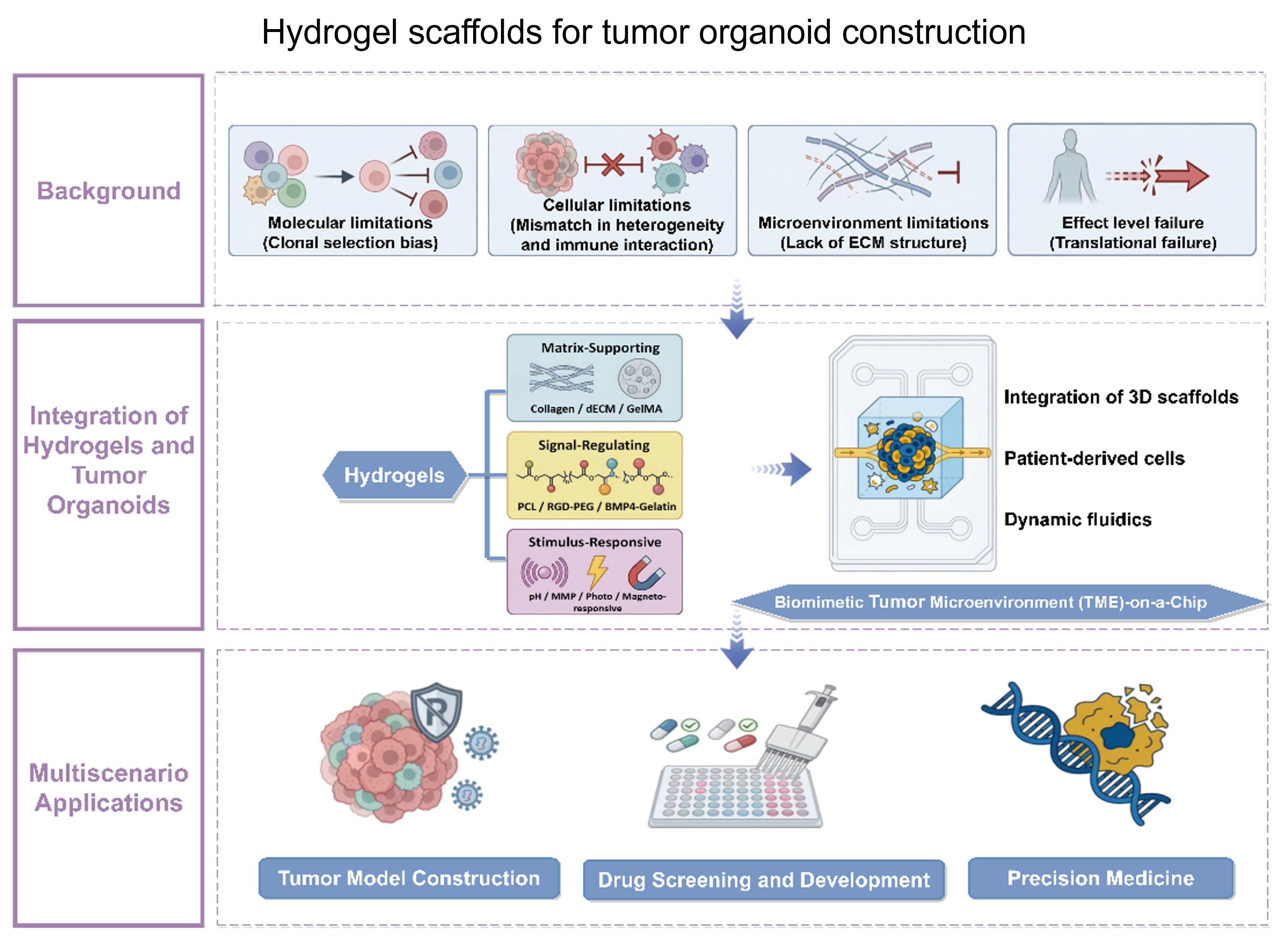
Traditional tumor models are limited by short in vitro survival, pronounced interspecies differences, and inadequate recapitulation of tumor heterogeneity. This review systematically classifies hydrogels into matrix-supporting, signal-regulating, and stimulus-responsive categories based on functional characteristics, and summarizes the fabrication strategies of natural, synthetic, and composite hydrogels. Tumor organoids preserve the genotype and phenotype of primary tumors; their integration with hydrogels provides complementary advantages, enabling the reconstruction of biomimetic tumor microenvironments, long-term in vitro culture, and personalized tumor modeling. Hydrogel-tumor organoid systems therefore demonstrate substantial value in tumor model development, high-throughput drug screening, and the investigation of drug resistance mechanisms. However, several challenges remain, including insufficient matching of mechanical properties, batch-to-batch variability of hydrogels, stringent organoid culture requirements, and the lack of standardized protocols—among which the standardization of natural hydrogels represents a major barrier to clinical translation. Finally, this review highlights emerging technological directions, including intelligent hydrogels and 3D bioprinting, outlines trends in interdisciplinary integration, and discusses future clinical application prospects. Addressing issues related to standardization and cost will be critical for fully unlocking the potential of hydrogel–organoid platforms in precision oncology.
- Dimou P, Trivedi S, Liousia M, D’Souza RR, Klampatsa A. Precision-Cut Tumor Slices (PCTS) as an Ex Vivo Model in Immunotherapy Research. Antibodies. 2022;11(2): 26. doi: 10.3390/antib11020026
- Liu Y, Wu W, Cai C, Zhang H, Shen H, Han Y. Patient-derived xenograft models in cancer therapy: technologies and applications. Signal Transduct Target Ther. 2023;8(1):160. doi: 10.1038/s41392-023-01419-2
- Crespo M, Vilar E, Tsai SY, et al. Colonic organoids derived from human induced pluripotent stem cells for modeling colorectal cancer and drug testing. Nat Med. 2017;23(7):878– 884. doi: 10.1038/nm.4355
- Lonberg N. The Problem with Syngeneic Mouse Tumor Models. Cancer Immunol Res. 2025;13(4):456–462. doi: 10.1158/2326-6066.Cir-24-1046
- Luo Z, Zhou X, Mandal K, et al. Reconstructing the tumor architecture into organoids. Adv Drug Deliv Rev. 2021;176:113839. doi: 10.1016/j.addr.2021.113839
- Su J, Satchell SC, Wertheim JA, Shah RN. Poly(ethylene glycol)-crosslinked gelatin hydrogel substrates with conjugated bioactive peptides influence endothelial cell behavior. Biomaterials. 2019;201:99–112. doi: 10.1016/j.biomaterials.2019.02.001
- Rijal G, Li W. A versatile 3D tissue matrix scaffold system for tumor modeling and drug screening. Sci Adv. 2017;3(9):e1700764. doi: 10.1126/sciadv.1700764
- Kim JR, Cho YS, Park JH, Kim TH. Poly(HEMA-co-MMA) Hydrogel Scaffold for Tissue Engineering with Controllable Morphology and Mechanical Properties Through Self- Assembly. Polymers. 2024;16(21):3014. doi: 10.3390/polym16213014
- Moghaddam AS, Dunne K, Breyer W, Wu Y, Pashuck ET. Hydrogels with multiple RGD presentations increase cell adhesion and spreading. Acta Biomater. 2025;199:142–153. doi: 10.1016/j.actbio.2025.04.037
- Bustamante-Madrid P, Barbáchano A, Albandea-Rodríguez D, et al. Vitamin D opposes multilineage cell differentiation induced by Notch inhibition and BMP4 pathway activation in human colon organoids. Cell Death Dis. 2024;15(4):301. doi: 10.1038/s41419-024-06680-z
- Feyissa Z, Edossa GD, Gupta NK, Negera D. Development of double crosslinked sodium alginate/chitosan based hydrogels for controlled release of metronidazole and its antibacterial activity. Heliyon. 2023;9(9):e20144. doi: 10.1016/j.heliyon.2023.e20144
- Morwood AJ, El-Karim IA, Clarke SA, Lundy FT. The Role of Extracellular Matrix (ECM) Adhesion Motifs in Functionalised Hydrogels. Molecules. 2023;28(12):4616. doi: 10.3390/molecules28124616
- Andrade F, Roca-Melendres MM, Durán-Lara EF, Rafael D, Schwartz S. Stimuli-Responsive Hydrogels for Cancer Treatment: The Role of pH, Light, Ionic Strength and Magnetic Field. Cancers. 2021;13(5):1164. doi: 10.3390/cancers13051164
- Rana MM, De la Hoz Siegler H. Evolution of Hybrid Hydrogels: Next-Generation Biomaterials for Drug Delivery and Tissue Engineering. Gels. 2024;10(4):216. doi: 10.3390/gels10040216
- Thai VL, Ramos-Rodriguez DH, Mesfin M, Leach JK. Hydrogel degradation promotes angiogenic and regenerative potential of cell spheroids for wound healing. Mater Today Bio. 2023;22:100769. doi: 10.1016/j.mtbio.2023.100769
- Chen MH, Wang LL, Chung JJ, Kim YH, Atluri P, Burdick JA. Methods To Assess Shear-Thinning Hydrogels for Application As Injectable Biomaterials. ACS Biomater Sci Eng. 2017;3(12):3146–3160. doi: 10.1021/acsbiomaterials.7b00734
- Li J, Mooney DJ. Designing hydrogels for controlled drug delivery. Nat Rev Mater. 2016;1(12). doi: 10.1038/natrevmats.2016.71
- Mohammadzadeh V, Atapour-Mashhad H, Shahvali S, et al. Hydrogels as advanced drug delivery platforms for cancer immunotherapy: promising innovations and future outlook. J Nanobiotechnology. 2025;23(1):545. doi: 10.1186/s12951-025-03613-6
- Rijal G, Li W. 3D scaffolds in breast cancer research. Biomaterials. 2016;81:135–156. doi: 10.1016/j.biomaterials.2015.12.016
- Blanco-Fernandez B, Ibañez-Fonseca A, Orbanic D, et al. Elastin-like Recombinamer Hydrogels as Platforms for Breast Cancer Modeling. Biomacromolecules. 2023;24(10):4408– 4418. doi: 10.1021/acs.biomac.2c01080
- Li X, Sheng S, Li G, et al. Research Progress in Hydrogels for Cartilage Organoids. Adv Healthc Mater. 2024;13(22):e2400431. doi: 10.1002/adhm.202400431
- Ma P, Chen Y, Lai X, et al. The Translational Application of Hydrogel for Organoid Technology: Challenges and Future Perspectives. Macromol Biosci. 2021;21(10):e2100191. doi: 10.1002/mabi.202100191
- Hu W, Lazar MA. Modelling metabolic diseases and drug response using stem cells and organoids. Nat Rev Endocrinol. 2022;18(12):744–759. doi: 10.1038/s41574-022-00733-z
- Chen Z, Wang J, Kankala RK, et al. Decellularized extracellular matrix-based disease models for drug screening. Mater Today Bio. 2024;29:101280. doi: 10.1016/j.mtbio.2024.101280
- Tzeng YT, Hsiao JH, Tseng LM, Hou MF, Li CJ. Breast cancer organoids derived from patients: A platform for tailored drug screening. Biochem Pharmacol. 2023;217:115803. doi: 10.1016/j.bcp.2023.115803
- Thorel L, Perréard M, Florent R, et al. Patient-derived tumor organoids: a new avenue for preclinical research and precision medicine in oncology. Exp Mol Med. 2024;56(7):1531–1551. doi: 10.1038/s12276-024-01272-5
- Catoira MC, González-Payo J, Fusaro L, Ramella M, Boccafoschi F. Natural hydrogels R&D process: technical and regulatory aspects for industrial implementation. J Mater Sci Mater Med. 2020;31(8):64. doi: 10.1007/s10856-020-06401-w
- Sato T, Stange DE, Ferrante M, et al. Long-term expansion of epithelial organoids from human colon, adenoma, adenocarcinoma, and Barrett’s epithelium. Gastroenterology. 2011;141(5):1762–1772. doi: 10.1053/j.gastro.2011.07.050
- Zeming KK, Thakor NV, Zhang Y, Chen CH. Real-time modulated nanoparticle separation with an ultra-large dynamic range. Lab Chip. 7 2016;16(1):75–85. doi: 10.1039/c5lc01051a
- Zou Z, Lin Z, Wu C, et al. Micro-Engineered Organoid-on-a-Chip Based on Mesenchymal Stromal Cells to Predict Immunotherapy Responses of HCC Patients. Adv Sci. 2023;10(27):e2302640. doi: 10.1002/advs.202302640
- Rijal G, Li W. Native-mimicking in vitro microenvironment: an elusive and seductive future for tumor modeling and tissue engineering. J Biol Eng. 2018;12(1):20. doi: 10.1186/s13036-018-0114-7
- Sievers J, Mahajan V, Welzel PB, Werner C, Taubenberger A. Precision Hydrogels for the Study of Cancer Cell Mechanobiology. Adv Healthc Mater. 2023;12(14):e2202514. doi: 10.1002/adhm.202202514
- Liu S, Jin P. Advances and Challenges in 3D Bioprinted Cancer Models: Opportunities for Personalized Medicine and Tissue Engineering. Polymers. 2025;17(7):948. doi: 10.3390/polym17070948
- Coughlin MF, Kamm RD. The Use of Microfluidic Platforms to Probe the Mechanism of Cancer Cell Extravasation. Adv Healthc Mater. 2020;9(8):e1901410. doi: 10.1002/adhm.201901410
- Baumgartner C. Computational modeling and simulation in oncology. Clin Transl Med. 2025;15(9):e70456. doi: 10.1002/ctm2.70456
- Lu P, Ruan D, Huang M, et al. Harnessing the potential of hydrogels for advanced therapeutic applications: current achievements and future directions. Signal Transduct Target Ther. 2024;9(1):166. doi: 10.1038/s41392-024-01852-x
- Shi Y, Guan Z, Cai G, et al. Patient-derived organoids: a promising tool for breast cancer research. Front Oncol. 2024;14:1350935. doi: 10.3389/fonc.2024.1350935
- Zhang Y, Que J. BMP Signaling in Development, Stem Cells, and Diseases of the Gastrointestinal Tract. Annu Rev Physiol. 2020;82:251–273. doi: 10.1146/annurev-physiol-021119-034500
- Rijal G. The decellularized extracellular matrix in regenerative medicine. Regen Med. 2017;12(5):475–477. doi: 10.2217/rme-2017-0046
- Papanicolaou M, Parker AL, Yam M, et al. Temporal profiling of the breast tumour microenvironment reveals collagen XII as a driver of metastasis. Nat Commun. 2022;13(1):4587. doi: 10.1038/s41467-022-32255-7
- Zeltz C, Gullberg D. The integrin-collagen connection--a glue for tissue repair? J Cell Sci. 2016;129(4):653–664. doi: 10.1242/jcs.180992
- Keller CR, Ruud KF, Martinez SR, Li W. Identification of the Collagen Types Essential for Mammalian Breast Acinar Structures. Gels. 2022;8(12):837. doi: 10.3390/gels8120837
- Randriamanantsoa S, Papargyriou A, Maurer HC, et al. Spatiotemporal dynamics of self-organized branching in pancreas-derived organoids. Nat Commun. 2022;13(1):5219. doi: 10.1038/s41467-022-32806-y
- Sarrigiannidis SO, Rey JM, Dobre O, González-García C, Dalby MJ, Salmeron-Sanchez M. A tough act to follow: collagen hydrogel modifications to improve mechanical and growth factor loading capabilities. Mater Today Bio. 2021;10:100098. doi: 10.1016/j.mtbio.2021.100098
- Enrico A, Voulgaris D, Östmans R, et al. 3D Microvascularized Tissue Models by Laser-Based Cavitation Molding of Collagen. Adv Mater. 2022;34(11):e2109823. doi: 10.1002/adma.202109823
- Xu J, Yang S, Su Y, et al. A 3D bioprinted tumor model fabricated with gelatin/sodium alginate/decellularized extracellular matrix bioink. Int J Bioprint. 2023;9(1):630. doi: 10.18063/ijb.v9i1.630
- Bupphathong S, Quiroz C, Huang W, Chung PF, Tao HY, Lin CH. Gelatin Methacrylate Hydrogel for Tissue Engineering Applications-A Review on Material Modifications. Pharmaceuticals. 2022;15(2):171. doi: 10.3390/ph15020171
- Tordi P, Ridi F, Samorì P, Bonini M. Cation-Alginate Complexes and Their Hydrogels: A Powerful Toolkit for the Development of Next-Generation Sustainable Functional Materials. Advanced Functional Materials. 2025;35(9). doi: 10.1002/adfm.202416390
- Hurtado A, Aljabali AAA, Mishra V, Tambuwala MM, Serrano-Aroca Á. Alginate: Enhancement Strategies for Advanced Applications. Int J Mol Sci. 2022;23(9):4486. doi: 10.3390/ijms23094486
- Fang G, Lu H, Rodriguez de la Fuente L, et al. Mammary Tumor Organoid Culture in Non-Adhesive Alginate for Luminal Mechanics and High-Throughput Drug Screening. Adv Sci. 2021;8(21):e2102418. doi: 10.1002/advs.202102418
- Ma Y, Zhang B, Sun H, et al. The Dual Effect of 3D-Printed Biological Scaffolds Composed of Diverse Biomaterials in the Treatment of Bone Tumors. Int J Nanomed. 2023;18:293– 305. doi: 10.2147/ijn.S390500
- Michalicha A, Belcarz A, Giannakoudakis DA, Staniszewska M, Barczak M. Designing Composite Stimuli-Responsive Hydrogels for Wound Healing Applications: The State-of-the-Art and Recent Discoveries. Materials. 2024;17(2):278. doi: 10.3390/ma17020278
- Muthiah Pillai NS, Eswar K, Amirthalingam S, Mony U, Kerala Varma P, Jayakumar R. Injectable Nano Whitlockite Incorporated Chitosan Hydrogel for Effective Hemostasis. ACS Appl Bio Mater. 2019;2(2):865–873. doi: 10.1021/acsabm.8b00710
- Bedell ML, Torres AL, Hogan KJ, et al. Human gelatin-based composite hydrogels for osteochondral tissue engineering and their adaptation into bioinks for extrusion, inkjet, and digital light processing bioprinting. Biofabrication. 2022;14(4):045012. doi: 10.1088/1758-5090/ac8768
- Blanco-Fernandez B, Rey-Vinolas S, Bağcı G, et al. Bioprinting Decellularized Breast Tissue for the Development of Three- Dimensional Breast Cancer Models. ACS Appl Mater Interfaces. 2022;14(26):29467–29482. doi: 10.1021/acsami.2c00920
- Ullah A, Kim DY, Lim SI, Lim HR. Hydrogel-Based Biointerfaces: Recent Advances, Challenges, and Future Directions in Human-Machine Integration. Gels. 2025;11(4):232. doi: 10.3390/gels11040232
- Zhang J, Zeng Z, Chen Y, et al. 3D-printed GelMA/CaSiO(3) composite hydrogel scaffold for vascularized adipose tissue restoration. Regen Biomater. 2023;10:rbad049. doi: 10.1093/rb/rbad049
- Sanz-Horta R, Matesanz A, Gallardo A, et al. Technological advances in fibrin for tissue engineering. J Tissue Eng. 2023;14. doi: 10.1177/20417314231190288
- Tayler IM, Stowers RS. Engineering hydrogels for personalized disease modeling and regenerative medicine. Acta Biomater. 2021;132:4–22. doi: 10.1016/j.actbio.2021.04.020
- Gao X, Caruso BR, Li W. Advanced Hydrogels in Breast Cancer Therapy. Gels. 2024;10(7):479. doi: 10.3390/gels10070479
- Pak S, Chen F. Functional Enhancement of Guar Gum- Based Hydrogel by Polydopamine and Nanocellulose. Foods. 2023;12(6):1304. doi: 10.3390/foods12061304
- Yin B, Gosecka M, Bodaghi M, et al. Engineering multifunctional dynamic hydrogel for biomedical and tissue regenerative applications. Chem Eng J. 2024;487:150403. doi: 10.1016/j.cej.2024.150403
- Wang Q, Zhang Y, Ma Y, Wang M, Pan G. Nano-crosslinked dynamic hydrogels for biomedical applications. Mater Today Bio. 2023;20:100640. doi: 10.1016/j.mtbio.2023.100640
- Valentino A, Yazdanpanah S, Conte R, Calarco A, Peluso G. Smart Nanocomposite Hydrogels as Next-Generation Therapeutic and Diagnostic Solutions. Gels. 2024;10(11):689. doi: 10.3390/gels10110689
- Liu Z, Tang Y, Chen Y, Lu Z, Rui Z. Dynamic covalent adhesives and their applications: Current progress and future perspectives. Chem Eng J. 2024;497:22. doi: 10.1016/j.cej.2024.154710
- Koch MK, Ravichandran A, Murekatete B, et al. Exploring the Potential of PEG-Heparin Hydrogels to Support Long- Term Ex Vivo Culture of Patient-Derived Breast Explant Tissues. Adv Healthc Mater. 2023;12(14):e2202202. doi: 10.1002/adhm.202202202
- Seidlitz T, Schmäche T, Garcίa F, et al. Sensitivity towards HDAC inhibition is associated with RTK/MAPK pathway activation in gastric cancer. EMBO Mol Med. 2022;14(10):e15705. doi: 10.15252/emmm.202215705
- Sun Y, Nie Y, Wang L, Gong JP, Tanaka S, Tsuda M. Tumor-mimetic hydrogel stiffness regulates cancer stemness properties in H-Ras-transformed cancer model cells. Biochem Biophys Res Commun. 2025;743:151163. doi: 10.1016/j.bbrc.2024.151163
- Karimi M, Sahandi Zangabad P, Ghasemi A, et al. Temperature-Responsive Smart Nanocarriers for Delivery Of Therapeutic Agents: Applications and Recent Advances. ACS Appl Mater Interfaces. 2016;8(33):21107–21133. doi: 10.1021/acsami.6b00371
- Gheysoori P, Paydayesh A, Jafari M, Peidayesh H. Thermoresponsive nanocomposite hydrogels based on Gelatin/poly (N–isopropylacrylamide) (PNIPAM) for controlled drug delivery. Eur Polym J. 2023;186:111846. doi: 10.1016/j.eurpolymj.2023.111846
- Tsai JS, Wei SH, Chen CW, et al. Pembrolizumab and Chemotherapy Combination Prolonged Progression- Free Survival in Patients with NSCLC with High PD-L1 Expression and Low Neutrophil-to-Lymphocyte Ratio. Pharmaceuticals. 2022;15(11):1407. doi: 10.3390/ph15111407
- Delgado-Pujol EJ, Martínez G, Casado-Jurado D, et al. Hydrogels and Nanogels: Pioneering the Future of Advanced Drug Delivery Systems. Pharmaceutics. 2025;17(2):215. doi: 10.3390/pharmaceutics17020215
- Gouveia BG, Rijo P, Gonçalo TS, Reis CP. Good manufacturing practices for medicinal products for human use. J Pharm Bioallied Sci. 2015;7(2):87–96. doi: 10.4103/0975-7406.154424
- Segneanu AE, Bejenaru LE, Bejenaru C, et al. Advancements in Hydrogels: A Comprehensive Review of Natural and Synthetic Innovations for Biomedical Applications. Polymers. 2025;17(15):2026. doi: 10.3390/polym17152026
- Luo Y, Zhou X, Liu C, et al. Scavenging ROS and inflammation produced during treatment to enhance the wound repair efficacy of photothermal injectable hydrogel. Biomater Adv. 2022;141:213096. doi: 10.1016/j.bioadv.2022.213096
- Ren J, Jiang Z, He J, Wang X, Jin W, Yu Z. Current status and perspectives on design, fabrication, surface modification, and clinical applications of biodegradable magnesium alloys. J Magnes Alloy. 2025;13(8):3564–3595. doi: 10.1016/j.jma.2025.07.006
- LeSavage BL, Suhar RA, Broguiere N, Lutolf MP, Heilshorn SC. Next-generation cancer organoids. Nat Mater. 2022;21(2):143–159. doi: 10.1038/s41563-021-01057-5
- Acciaretti F, Vesentini S, Cipolla L. Fabrication Strategies Towards Hydrogels for Biomedical Application: Chemical and Mechanical Insights. Chem Asian J. 2022;17(22):e202200797. doi: 10.1002/asia.202200797
- Yang Y, Ren Y, Song W, Yu B, Liu H. Rational design in functional hydrogels towards biotherapeutics. Materials & Design. 2022;223:111086. doi: 10.1016/j.matdes.2022.111086
- Wu L, Zhao J, Huang J, Huang P, Zhao H. Advances and challenges in three-dimensional bioprinting of bone organoids: Materials, techniques, and functionalization strategies. IJB. 2025;11(5):1-22. doi: 10.36922/ijb025190183
- Papaioannou TG, Manolesou D, Dimakakos E, Tsoucalas G, Vavuranakis M, Tousoulis D. 3D Bioprinting Methods and Techniques: Applications on Artificial Blood Vessel Fabrication. Acta Cardiol Sin. 2019;35(3):284–289. doi: 10.6515/acs.201905_35(3).20181115a
- Mao Y, Yu K, Isakov MS, Wu J, Dunn ML, Jerry Qi H. Sequential Self-Folding Structures by 3D Printed Digital Shape Memory Polymers. Sci Rep. 2015;5:13616. doi: 10.1038/srep13616
- Xue B, Xu Z, Li L, et al. Hydrogels with programmed spatiotemporal mechanical cues for stem cell-assisted bone regeneration. Nat Commun. 2025;16(1):3633. doi: 10.1038/s41467-025-59016-6
- Sacco P, Piazza F, Marsich E, Abrami M, Grassi M, Donati I. Ionic Strength Impacts the Physical Properties of Agarose Hydrogels. Gels. 2024;10(2):94. doi: 10.3390/gels10020094
- Xuan X, Li Y, Xu X, et al. Three-Dimensional Printable Magnetic Hydrogels with Adjustable Stiffness and Adhesion for Magnetic Actuation and Magnetic Hyperthermia Applications. Gels. 2025;11(1):67. doi: 10.3390/gels11010067