

Machine learning and artificial intelligence for antigen discovery and immunogen design: A critical appraisal of computational strategies in medical microbiology

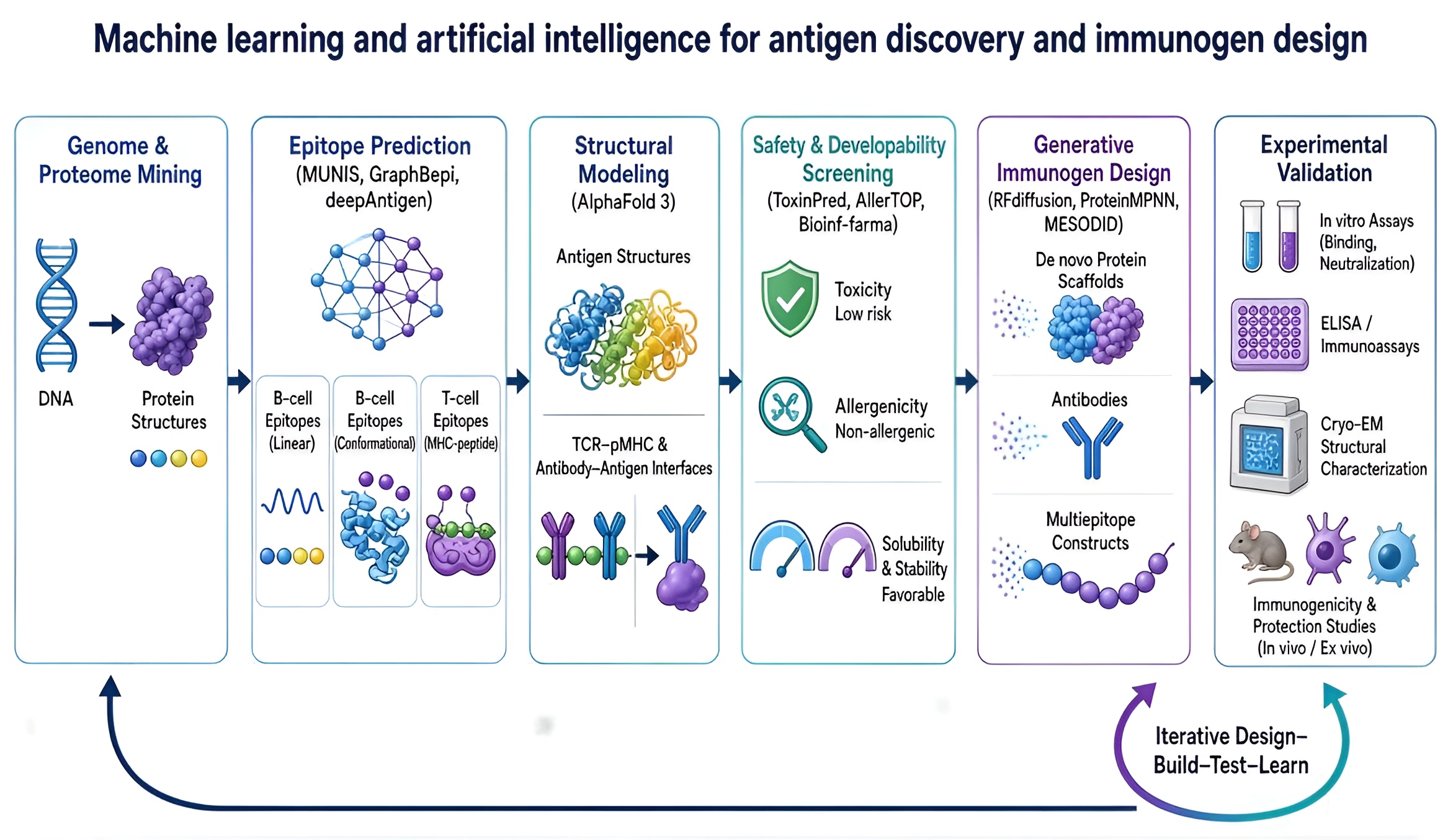
Background: Conventional vaccine development is slow, costly, and prone to attrition, with target antigen selection representing a major bottleneck. Machine learning (ML) and artificial intelligence (AI) are increasingly proposed to accelerate vaccine development. Aim: To critically evaluate ML- and AI-supported strategies for antigen discovery, epitope mapping, and immunogen engineering against bacterial, viral, fungal, and parasitic pathogens. Methods: Guided by PRISMA 2020, literature from January 2020 to April 2026 was retrieved from PubMed/MEDLINE, Web of Science, Scopus, and bioRxiv. Eligible studies described computational tools for antigen/epitope prediction or immunogen design, reported performance metrics, and, where relevant, experimental confirmation. Methods were grouped into five categories and assessed for architecture, accuracy, validation, and limitations. Results: Three developments shape the field: deep-learning epitope predictors (MUNIS, ROC-AUC ≈0.980; GraphBepi); AlphaFold 3-based modeling of TCR-pMHC and antibody-antigen complexes; and generative platforms (RFdiffusion, ProteinMPNN, MESODID) yielding experimentally verified antibodies and multiepitope scaffolds. Integrated pipelines (PLGDL, VaxSeer) and safety/developability filters permit end-to-end candidate ranking. Obstacles include sparse, demographically biased training data, limited conformational epitope accuracy, neglected glycosylation, and frequent laboratory failure of designed proteins. Conclusion: AI methods have advanced from concepts to experimentally supported tools that can accelerate antigen identification. Translation into licensed vaccines will require repeated laboratory validation, standardized reporting, and training sets reflecting population diversity. Relevance for Patients: By compressing antigen selection, these strategies may bring vaccines against endemic, emerging, and refractory pathogens to clinical evaluation sooner, while attention to dataset bias and in silico safety screening can promote equitable and safe products.
- Pronker ES, Weenen TC, Commandeur H, Claassen EHJHM, Osterhaus ADME. Risk in vaccine research and development quantified. PLoS ONE. 2013;8(3):e57755. doi: 10.1371/journal.pone.0057755
- Rappuoli R. Reverse vaccinology, a genome-based approach to vaccine development. Vaccine. 2001;19(17-19):2688-2691. doi: 10.1016/S0264-410X(00)00554-5
- Pizza M, Scarlato V, Masignani V, et al. Identification of vaccine candidates against serogroup B meningococcus by whole-genome sequencing. Science. 2000;287(5459):1816-1820. doi: 10.1126/science.287.5459.1816
- Bravi B. Development and use of machine learning algorithms in vaccine target selection. npj Vaccines. 2024;9:15. doi: 10.1038/s41541-023-00795-8
- Sanchez-Trincado JL, Gomez-Perosanz M, Reche PA. Fundamentals and methods for T- and B-cell epitope prediction. J Immunol Res. 2017;2017:2680160. doi: 10.1155/2017/2680160
- Reynisson B, Alvarez B, Paul S, Peters B, Nielsen M. NetMHCpan-4.1 and NetMHCIIpan-4.0: improved predictions of MHC antigen presentation by concurrent motif deconvolution and integration of MS MHC eluted ligand data. Nucleic Acids Res. 2020;48(W1):W449-W454. doi: 10.1093/nar/gkaa379
- Jurtz V, Paul S, Andreatta M, Marcatili P, Peters B, Nielsen M. NetMHCpan-4.0: improved peptide-MHC class I interaction predictions integrating eluted ligand and peptide binding affinity data. J Immunol. 2017;199(9):3360-3368. doi: 10.4049/jimmunol.1700893
- Villanueva-Flores F, Sanchez-Villamil JI, Garcia-Atutxa I. AI-driven epitope prediction: a systematic review, comparative analysis, and practical guide for vaccine development. npj Vaccines. 2025;10:207. doi: 10.1038/s41541-025-01258-y
- Gasperini G, Baylor N, Black S, et al. Vaccinology in the artificial intelligence era. Sci Transl Med. 2025;17(794):eadu3791. doi: 10.1126/scitranslmed.adu3791
- Page MJ, McKenzie JE, Bossuyt PM, et al. The PRISMA 2020 statement: an updated guideline for reporting systematic reviews. BMJ. 2021;372:n71. doi: 10.1136/bmj.n71
- Wohlwend J, Nathan A, Shalon N, et al. Deep learning enhances the prediction of HLA class I-presented CD8+ T cell epitopes in foreign pathogens. Nat Mach Intell. 2025;7(2):232-243. doi: 10.1038/s42256-024-00971-y
- Zhao W, Sher X. Systematically benchmarking peptide-MHC binding predictors: from synthetic to naturally processed epitopes. PLoS Comput Biol. 2018;14(11):e1006457. doi: 10.1371/journal.pcbi.1006457
- Que J, Xue G, Wang T, et al. Identifying T cell antigen at the atomic level with graph convolutional network. Nat Commun. 2025;16:5171. doi: 10.1038/s41467-025-60461-6
- Cai Y, Chen R, Song M, et al. CNNeoPP: a large language model-enhanced deep learning pipeline for personalized neoantigen prediction and liquid biopsy applications. Front Immunol. 2026;17:1722117. doi: 10.3389/fimmu.2026.1722117
- Yu H, Joseph-McCarthy D, Vajda S. Improving B-cell epitope prediction. Drug Discov Today. 2025;30(11):104489. doi: 10.1016/j.drudis.2025.104489
- Zeng Y, Wei Z, Yuan Q, et al. Identifying B-cell epitopes using AlphaFold2 predicted structures and pretrained language model. Bioinformatics. 2023;39(4):btad187. doi: 10.1093/bioinformatics/btad187.
- Hu RS, Gu K, Ehsan M, et al. Transformer-based deep learning enables improved B-cell epitope prediction in parasitic pathogens: a proof-of-concept study on Fasciola hepatica. PLoS Negl Trop Dis. 2025;19(4):e0012985. doi: 10.1371/journal.pntd.0012985
- Rajmane PR, Khiani SR. Hybrid deep learning framework for enhanced prediction of linear B-cell epitopes using forward-based feature filtering. Discov Artif Intell. 2025;5:311. doi: 10.1007/s44163-025-00588-z
- Xu Y, Wei G, Zhou J, et al. RoBep: a region-oriented deep learning model for B-cell epitope prediction. Bioinformatics. 2026;42(1):btag006. doi: 10.1093/bioinformatics/btag006
- Yuan X. BeeTLe: An Imbalance-Aware Deep Sequence Model for Linear B-Cell Epitope Prediction and Classification with Logit-Adjusted Losses. arXiv. Preprint posted online 2023. doi: 10.48550/arXiv.2309.02071
- Zai Y, Zhao Y, Wang X, et al. Integrating protein language and geometric deep learning models for enhanced vaccine antigen prediction. Nat Commun. 2026;17(1):1033. doi: 10.1038/s41467-025-67778-2
- Shi W, Wohlwend J, Wu M, Barzilay R. Influenza vaccine strain selection with an AI-based evolutionary and antigenicity model. Nat Med. 2025;31(11):3862-3870. doi: 10.1038/s41591-025-03917-y
- Shen Y, Jiang Z, Liu R. Dynamic integration of feature- and template-based methods improves the prediction of conformational B cell epitopes. Structure. 2025;33(4):798-807.e4. doi: 10.1016/j.str.2025.01.018
- Jiang F, Guo Y, Ma H, et al. AlphaEpi: enhancing B cell epitope prediction with AlphaFold 3. In: Proceedings of the 15th ACM Conference on Bioinformatics, Computational Biology, and Health Informatics. Association for Computing Machinery; 2024:1-8. doi: 10.1145/3698587.3701389
- Choi S, Kim D. B cell epitope prediction by capturing spatial clustering property of the epitopes using graph attention network. Sci Rep. 2024;14:27496. doi: 10.1038/s41598-024-78506-z
- You Z, Ma J, Li H, Hu YF, Huang JD. BConformeR: A Conformer Based on Mutual Sampling for Unified Prediction of Continuous and Discontinuous Antibody Binding Sites. arXiv. Preprint posted online 2025. doi: 10.48550/arXiv.2508.12029
- Gupta S, Kapoor P, Chaudhary K, et al. In silico approach for predicting toxicity of peptides and proteins. PLoS One. 2013;8(9):e73957. doi: 10.1371/journal.pone.0073957
- Muhammad AM, Salum GM, Abd El Meguid M, Fotouh BE, Dawood RM. Bioinformatics analysis of multi-epitope peptide vaccines against hepatitis C virus: a molecular docking study. J Genet Eng Biotechnol. 2023;21(1):123. doi: 10.1186/s43141-023-00583-w
- Dimitrov I, Bangov I, Flower DR, Doytchinova I. AllerTOP v.2—a server for in silico prediction of allergens. J Mol Model. 2014;20(6):2278. doi: 10.1007/s00894-014-2278-5
- AlgPred 3.0. A web server for predicting allergenic peptides and mapping IgE epitopes. Indian Institute of Technology Delhi. Accessed September 15, 2026. https://webs.iiitd.edu.in/raghava/algpred3/?utm_source=chatgpt.com
- Dimitrov I, Naneva L, Doytchinova I, Bangov I. AllergenFP: allergenicity prediction by descriptor fingerprints. Bioinformatics. 2014;30(6):846-851. doi: 10.1093/bioinformatics/btt619
- Nguyen MN, Krutz NL, Limviphuvadh V, Lopata AL, Gerberick GF, Maurer-Stroh S. AllerCatPro 2.0: a web server for predicting protein allergenicity potential. Nucleic Acids Res. 2022;50(W1):W36-W43. doi: 10.1093/nar/gkac446
- Limviphuvadh V, Ruethers T, Nguyen MN, et al. Fish isoallergens and variants: database compilation, in silico allergenicity prediction challenges, and epitope-based threshold optimization. Front Bioinform. 2025;5:1669237. doi: 10.3389/fbinf.2025.1669237
- Dhall A, Patiyal S, Sharma N, Usmani SS, Raghava GPS. Computer-aided prediction and design of IL-6 inducing peptides: IL-6 plays a crucial role in COVID-19. Brief Bioinform. 2021;22(2):936-945. doi: 10.1093/bib/bbaa259
- Dhall A, Patiyal S, Sharma N, Usmani SS, Raghava GPS. A web-based method for the identification of IL6-based immunotoxicity in vaccine candidates. Methods Mol Biol. 2023;2673:317-327. doi: 10.1007/978-1-0716-3239-0_22
- Gasteiger E, Hoogland C, Gattiker A, et al. Protein identification and analysis tools on the ExPASy server. In: Walker JM, ed. The Proteomics Protocols Handbook. Humana Press; 2005:571-607. doi: 10.1385/1-59259-890-0:571
- Wang C, Zou Q. Prediction of protein solubility based on sequence physicochemical patterns and distributed representation information with DeepSoluE. BMC Biol. 2023;21:12. doi: 10.1186/s12915-023-01510-8
- Pudžiuvelytė I, Olechnovič K, Godliauskaite E, Sermokas K, Urbaitis T, Gasiunas G, Kazlauskas D. TemStaPro: protein thermostability prediction using sequence representations from protein language models. Bioinformatics. 2024;40(4):btae157. doi: 10.1093/bioinformatics/btae157
- Alam U, Chaudhary K, Kumar N, Tomer R, Patiyal S, Raghava GPS. PEPlife2: an updated repository of the half-life of peptides and proteins. Immuno. 2026;6(2):26. doi: 10.3390/immuno6020026
- Bondi H, Crespi M, Orlando M, et al. Bioinf-Farma: supervised integration of epitope prediction and recombinant protein developability for automated vaccine candidate prioritization. bioRxiv. Preprint posted online June 18, 2026. doi: 10.64898/2026.06.15.732271
- Jumper J, Evans R, Pritzel A, et al. Highly accurate protein structure prediction with AlphaFold. Nature. 2021;596(7873):583-589. doi: 10.1038/s41586-021-03819-2
- Abramson J, Adler J, Dunger J, et al. Accurate structure prediction of biomolecular interactions with AlphaFold 3. Nature. 2024;630(8016):493-500. doi: 10.1038/s41586-024-07487-w
- Haas CM, Jasti N, Dosey A, et al. From sequence to scaffold: computational design of protein nanoparticle vaccines from AlphaFold2-predicted building blocks. Proc Natl Acad Sci U S A. 2025;122(45):e2409566122. doi: 10.1073/pnas.2409566122
- Shi Y, Parks JM, Smith JC. Comparative analysis of TCR and TCR-pMHC complex structure prediction tools. J Chem Inf Model. 2025;65(13):7156-7173. doi: 10.1021/acs.jcim.5c00298
- Le HN, de Freitas MV, Antunes DA. Strengths and limitations of web servers for the modeling of TCRpMHC complexes. Comput Struct Biotechnol J. 2024;23:2938-2948. doi: 10.1016/j.csbj.2024.06.028
- Spoendlin FC, Fernández-Quintero ML, Raghavan SSR, et al. Predicting the conformational flexibility of antibody and T cell receptor complementarity-determining regions. Nat Mach Intell. 2025;7(10):1755-1767. doi: 10.1038/s42256-025-01131-6
- Watson JL, Juergens D, Bennett NR, et al. De novo design of protein structure and function with RFdiffusion. Nature. 2023;620(7976):1089-1100. doi: 10.1038/s41586-023-06415-8
- Bennett NR, Watson JL, Ragotte RJ, et al. Atomically accurate de novo design of antibodies with RFdiffusion. Nature. 2026;649(8095):183-193. doi: 10.1038/s41586-025-09721-5
- Nelson JAD, Garfinkle SE, Lin ZJ, et al. Machine learning enables de novo multiepitope design of Plasmodium falciparum circumsporozoite protein to target trimeric L9 antibody. Proc Natl Acad Sci U S A. 2025;122(49):e2512358122. doi: 10.1073/pnas.2512358122
- Anishchenko I, Pellock SJ, Chidyausiku TM, et al. De novo protein design by deep network hallucination. Nature. 2021;600(7889):547-552. doi: 10.1038/s41586-021-04184-w
- Zhang J, Zhou W, Yu J, Yan C, Liu J. A machine learning-based method to optimize the immunogenicity of human leukocyte antigen class I-restricted neoantigens. Brief Bioinform. 2025;26(6):bbaf582. doi: 10.1093/bib/bbaf582
- Chesterman C, Desautels T, Sierra L-J, et al. Design of cross-reactive antigens with machine learning and high-throughput experimental evaluation. Front Bioinform. 2025;5:1580967. doi: 10.3389/fbinf.2025.1580967
- Atkins TK, Solanki A, Vasmatzis G, Cornette J, Riedel M. Evaluating NetMHCpan performance on non-European HLA alleles not present in training data. Front Immunol. 2024;14:1288105. doi: 10.3389/fimmu.2023.1288105
- Atkins TK, Solanki A, Vasmatzis G, Cornette J, Riedel M. Geographically Biased Composition of NetMHCpan Training Datasets and Evaluation of MHC-Peptide Binding Prediction Accuracy on Novel Alleles. bioRxiv. Preprint posted online September 6, 2023. doi: 10.1101/2023.09.03.556092
- Lin Z, Akin H, Rao R, et al. Evolutionary-scale prediction of atomic-level protein structure with a language model. Science. 2023;379(6637):1123-1130. doi: 10.1126/science.ade2574