

Oleanolic acid as an adjunct in type 2 diabetes mellitus

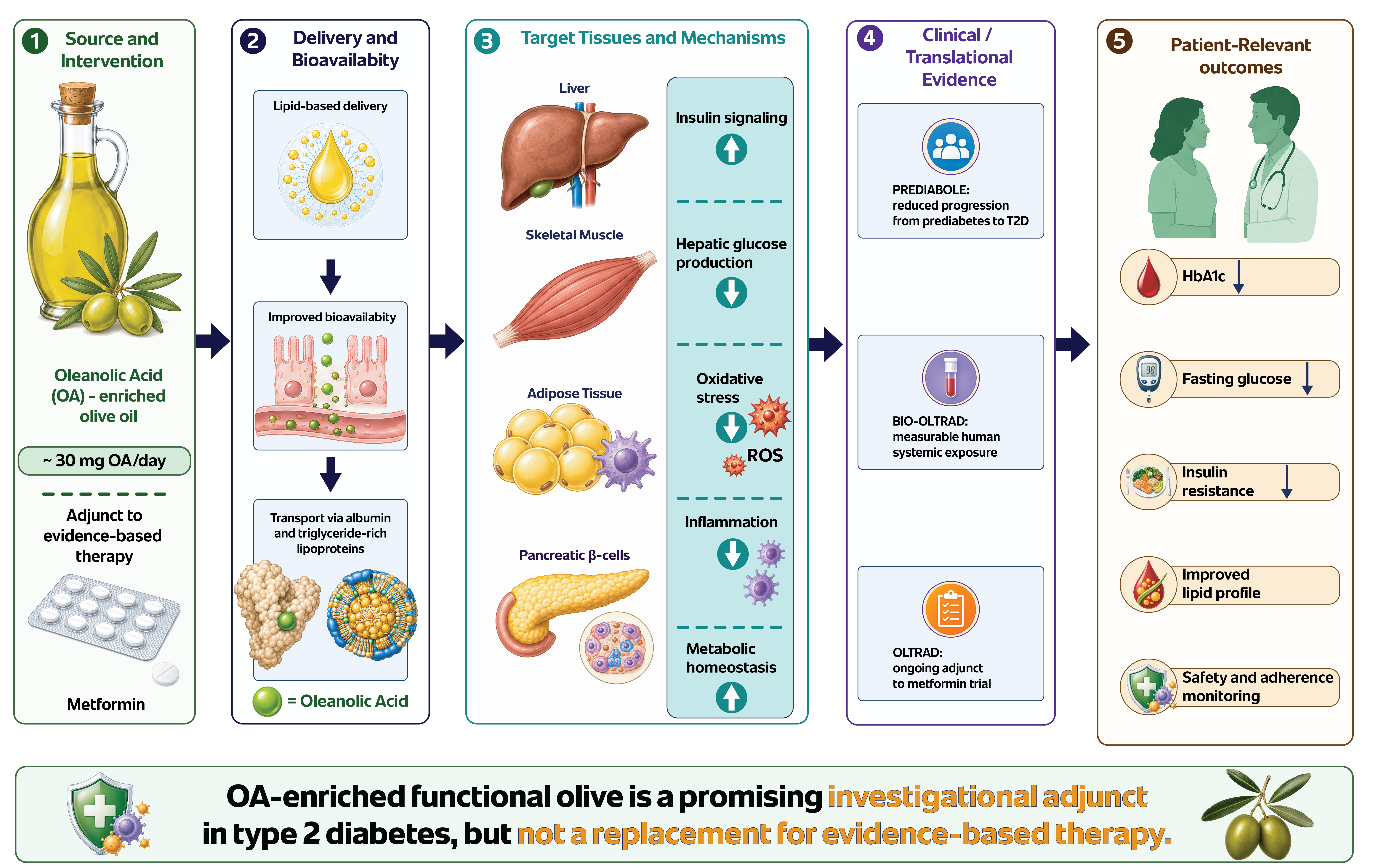
Background: Type 2 diabetes mellitus (T2DM) is a progressive cardiometabolic disease in which many patients require treatment intensification despite lifestyle intervention and evidence-based pharmacotherapy. Oleanolic acid (OA), a pentacyclic triterpenoid found in olives and other plants, has shown insulin-sensitizing, antioxidant, anti-inflammatory, and hepatometabolic effects in experimental models. Aim: This narrative translational review evaluates OA as a potential investigational adjunct in T2DM, with emphasis on formulation-dependent bioavailability, translational limitations, clinical endpoints, safety, and patient relevance. Methods: We synthesized mechanistic, preclinical, pharmacokinetic, clinical, regulatory, and trial-registry evidence. As this was not a systematic review or meta-analysis, the evidence was interpreted narratively, with attention to study design, formulation, dose, model validity, comparator use, and potential sources of bias. Results: Preclinical studies suggest that OA may influence insulin signaling, hepatic glucose production, oxidative stress, inflammatory pathways, lipid metabolism, and β-cell stress. However, most mechanistic data derive from cell or animal models, often using high doses, short treatment durations, or models with limited human predictability. Human evidence remains limited. PREDIABOLE reported reduced progression from prediabetes to T2DM after long-term intake of OA-enriched olive oil, while BIO-OLTRAD demonstrated measurable systemic exposure after a 30 mg OA dose in functional olive oil. OLTRAD is testing this formulation as an adjunct to metformin-based therapy. Conclusion: OA is a plausible investigational adjunct, but clinical efficacy in established T2DM has not been established. Its future value depends on reproducible exposure, clinically meaningful outcomes, long-term safety, compatibility with contemporary therapies, and avoidance of disease-treatment claims unsupported by human trials. Relevance for Patients: OA-enriched functional foods may eventually complement, but should not replace, evidence-based diabetes treatment.
- Genitsaridi I, Salpea P, Salim A, et al. 11th edition of the IDF Diabetes Atlas: global, regional, and national diabetes prevalence estimates for 2024 and projections for 2050. Lancet Diabetes Endocrinol. 2026;14(2):149-156. doi: 10.1016/S2213-8587(25)00299-2
- American Diabetes Association Professional Practice Committee. 9. Pharmacologic Approaches to Glycemic Treatment: Standards of Care in Diabetes—2026. Diabetes Care. 2026;49(Suppl 1):S183-S215. doi: 10.2337/dc26-s009
- Davies MJ, Aroda VR, Collins BS, et al. Management of Hyperglycemia in Type 2 Diabetes, 2022. A Consensus Report by the American Diabetes Association (ADA) and the European Association for the Study of Diabetes (EASD). Diabetes Care. 2022;45(11):2753-2786. doi: 10.2337/dci22-0034
- Castellano JM, Guinda A, Delgado T, Rada M, Cayuela JA. Biochemical Basis of the Antidiabetic Activity of Oleanolic Acid and Related Pentacyclic Triterpenes. Diabetes. 2013;62(6):1791-1799. doi: 10.2337/db12-1215
- Castellano JM, Ramos‐Romero S, Perona JS. Oleanolic Acid: Extraction, Characterization and Biological Activity. Multidiscip Digit Publ Inst. 2022;14(3):623. doi: 10.3390/nu14030623
- Fernández-Aparicio Á, Correa-Rodríguez M, Castellano JM, Schmidt-RioValle J, Perona JS, González-Jiménez E. Potential Molecular Targets of Oleanolic Acid in Insulin Resistance and Underlying Oxidative Stress: A Systematic Review. Antioxidants. 2022;11(8):1517. doi: 10.3390/antiox11081517
- Wang X, Chen Y, Abdelkader D, Hassan W, Sun H, Liu J. Combination Therapy with Oleanolic Acid and Metformin as a Synergistic Treatment for Diabetes. J Diabetes Res. 2015;2015:1-12. doi: 10.1155/2015/973287
- Rada M, Castellano JM, Perona JS, Guinda Á. GC‐FID determination and pharmacokinetic studies of oleanolic acid in human serum. Biomed Chromatogr. 2015;29(11):1687- 1692. doi: 10.1002/bmc.3480
- García-González A, Espinosa-Cabello JM, Cerrillo I, et al. Bioavailability and systemic transport of oleanolic acid in humans, formulated as a functional olive oil. Food Funct. 2023;14(21):9681-9694. doi: 10.1039/D3FO02725B
- Santos‐Lozano JM, Rada M, Lapetra J, et al. Prevention of type 2 diabetes in prediabetic patients by using functional olive oil enriched in oleanolic acid: The PREDIABOLE study, a randomized controlled trial. Diabetes Obes Metab. 2019;21(11):2526-2534. doi: 10.1111/dom.13838
- Castellano JM. Oleanolic Acid as Therapeutic Adjuvant for Type 2 Diabetes Mellitus (OLTRAD STUDY). Clinicaltrials. gov; 2025. Accessed May 21, 2026. https://clinicaltrials.gov/ study/NCT06030544
- Porter CJH, Trevaskis NL, Charman WN. Lipids and lipid-based formulations: optimizing the oral delivery of lipophilic drugs. Nat Rev Drug Discov. 2007;6(3):231-248. doi: 10.1038/nrd2197
- Rezhdo O, Speciner L, Carrier R. Lipid-associated oral delivery: Mechanisms and analysis of oral absorption enhancement. J Control Release. 2016;240:544-560. doi: 10.1016/j.jconrel.2016.07.050
- Loza-Rodríguez H, Estrada-Soto S, Alarcón-Aguilar FJ, et al. Oleanolic acid induces a dual agonist action on PPARγ/α and GLUT4 translocation: A pentacyclic triterpene for dyslipidemia and type 2 diabetes. Eur J Pharmacol. 2020;883:173252. doi: 10.1016/j.ejphar.2020.173252
- Radwan MO, Kadasah SF, Aljubiri SM, et al. Harnessing Oleanolic Acid and Its Derivatives as Modulators of Metabolic Nuclear Receptors. Biomolecules. 2023;13(10):1465. doi: 10.3390/biom13101465
- Wang X, Liu R, Zhang W, et al. Oleanolic acid improves hepatic insulin resistance via antioxidant, hypolipidemic and anti-inflammatory effects. Mol Cell Endocrinol. 2013;376(1-2):70-80. doi: 10.1016/j.mce.2013.06.014
- Zeng XY, Wang YP, Cantley J, et al. Oleanolic Acid Reduces Hyperglycemia beyond Treatment Period with Akt/FoxO1- Induced Suppression of Hepatic Gluconeogenesis in Type-2 Diabetic Mice. Wang Y, ed. PLoS ONE. 2012;7(7):e42115. doi: 10.1371/journal.pone.0042115
- Gamede M, Mabuza L, Ngubane P, Khathi A. Plant-derived oleanolic acid ameliorates markers associated with non-alcoholic fatty liver disease in a diet-induced pre-diabetes rat model. Diabetes Metab Syndr Obes Targets Ther. 2019;Volume 12:1953-1962. doi: 10.2147/DMSO.S218626
- Günther A, Bednarczyk-Cwynar B. Oleanolic Acid: A Promising Antioxidant—Sources, Mechanisms of Action, Therapeutic Potential, and Enhancement of Bioactivity. Antioxidants. 2025;14(5):598. doi: 10.3390/antiox14050598
- Günther A, Bednarczyk-Cwynar B. Oleanolic Acid in Organelle Stress: Mitochondrial Dysfunction, Endoplasmic Reticulum Stress, Autophagy, and Apoptosis. Stresses. 2026;6(2):22. doi: 10.3390/stresses6020022
- Li W, Zeng H, Xu M, et al. Oleanolic Acid Improves Obesity- Related Inflammation and Insulin Resistance by Regulating Macrophages Activation. Front Pharmacol. 2021;12:697483. doi: 10.3389/fphar.2021.697483
- Gamede M, Mabuza L, Ngubane P, Khathi A. Plant-derived oleanolic acid ameliorates markers of subclinical inflammation and innate immunity activation in diet-induced pre-diabetic rats. Ther Adv Endocrinol Metab. 2020;11:2042018820935771. doi: 10.1177/2042018820935771
- Gamede M, Mabuza L, Ngubane P, Khathi A. The Effects of Plant-Derived Oleanolic Acid on Selected Parameters of Glucose Homeostasis in a Diet-Induced Pre-Diabetic Rat Model. Molecules. 2018;23(4):794. doi: 10.3390/molecules23040794
- Rena G, Hardie DG, Pearson ER. The mechanisms of action of metformin. Diabetologia. 2017;60(9):1577-1585. doi: 10.1007/s00125-017-4342-z
- Li WF, Wang P, Li H, Li TY, Feng M, Chen SF. Oleanolic acid protects against diabetic cardiomyopathy via modulation of the nuclear factor erythroid 2 and insulin signaling pathways. Exp Ther Med. 2017;14(1):848-854. doi: 10.3892/etm.2017.4527
- American Diabetes Association Professional Practice Committee for Diabetes*, Bajaj M, McCoy RG, et al. 6. Glycemic Goals, Hypoglycemia, and Hyperglycemic Crises: Standards of Care in Diabetes—2026. Diabetes Care. 2026;49(Supplement_1):S132-S149. doi: 10.2337/dc26-S006
- Li C, He J, Li Y, et al. Cardioprotective role of oleanolic acid in patients with type 2 diabetes mellitus. Heliyon. 2024;10(11):e31303. doi: 10.1016/j.heliyon.2024.e31303
- Mapanga RF, Rajamani U, Dlamini N, et al. Oleanolic Acid: A Novel Cardioprotective Agent That Blunts Hyperglycemia- Induced Contractile Dysfunction. Kukreja R, ed. PLoS ONE. 2012;7(10):e47322. doi: 10.1371/journal.pone.0047322
- Battelino T, Danne T, Bergenstal RM, et al. Clinical Targets for Continuous Glucose Monitoring Data Interpretation: Recommendations From the International Consensus on Time in Range. Diabetes Care. 2019;42(8):1593-1603. doi: 10.2337/dci19-0028
- Calvert M, Blazeby J, Altman DG, et al. Reporting of Patient- Reported Outcomes in Randomized Trials: The CONSORT PRO Extension. JAMA. 2013;309(8):814. doi: 10.1001/jama.2013.879
- U.S. Food and Drug Administration. Patient-Focused Drug Development: Selecting, Developing, or Modifying Fit-for- Purpose Clinical Outcome Assessments. 2026. Accessed May 21, 2026. https://www.fda.gov/regulatory-information/search-fda-guidance-documents/patient-focused-drug-development-selecting-developing-or-modifying-fit-purpose-clinical-outcome
- Baethge C, Goldbeck-Wood S, Mertens S. SANRA—a scale for the quality assessment of narrative review articles. Res Integr Peer Rev. 2019;4(1):5. doi: 10.1186/s41073-019-0064-8
- Page MJ, McKenzie JE, Bossuyt PM, et al. The PRISMA 2020 statement: an updated guideline for reporting systematic reviews. BMJ. 2021:n71. doi: 10.1136/bmj.n71
- Dubey VK, Patil CR, Kamble SM, et al. Oleanolic acid prevents progression of streptozotocin induced diabetic nephropathy and protects renal microstructures in Sprague Dawley rats. J Pharm Pharm. 2013;4(1):47-52. doi: 10.4103/0976-500X.107678
- Iskender H, Dokumacıoglu E, Hayirli A, Terim Kapakin KA, Bolat I, Manavoglu Kirman E. Effects of oleanolic acid administration on renal NF-κB/IL-18/IL-6 and YKL-40/ KIM-1 pathways in experimental diabetic rats. Iran J Basic Med Sci. 2023;26(10):1188–1193. doi: 10.22038/ijbms.2023.71321.15504
- Liang X, Giacomini KM. Transporters Involved in Metformin Pharmacokinetics and Treatment Response. J Pharm Sci. 2017;106(9):2245-2250. doi: 10.1016/j.xphs.2017.04.078
- Xu Y, Yang X, Lu Y, Liu J. Hepatotoxicity from long-term administration of hepatoprotective low doses of oleanolic acid in mice. Toxicol Appl Pharmacol. 2025;497:117277. doi: 10.1016/j.taap.2025.117277
- Liu J, Lu Y, Wu Q, Xu S, Shi F, Klaassen CD. Oleanolic acid reprograms the liver to protect against hepatotoxicants, but is hepatotoxic at high doses. Liver Int. 2019;39(3):427-439. doi: 10.1111/liv.13940
- De Zeeuw D, Akizawa T, Audhya P, et al. Bardoxolone Methyl in Type 2 Diabetes and Stage 4 Chronic Kidney Disease. N Engl J Med. 2013;369(26):2492-2503. doi: 10.1056/NEJMoa1306033
- Kim KA, Lee JS, Park HJ, et al. Inhibition of cytochrome P450 activities by oleanolic acid and ursolic acid in human liver microsomes. Life Sci. 2004;74(22):2769-2779. doi: 10.1016/j.lfs.2003.10.020
- Cao NT, Nguyen NA, Le TK, Cha GS, Park KD, Yun CH. Regioselective Hydroxylation of Oleanolic Acid Catalyzed by Human CYP3A4 to Produce Hederagenenin, a Chiral Metabolite. Catalysts. 2021;11(2):267. doi: 10.3390/catal11020267
- U.S. Food and Drug Administration. Dietary Supplements. FDA. 2024. Accessed May 21, 2026. https://www.fda.gov/ food/dietary-supplements
- Botanicals. European Food Safety Authority (EFSA). 2026. Accessed May 21, 2026. https://www.efsa.europa.eu/en/ topics/topic/botanicals
- Lu YF, Xiaoli W, Xu YS, Liu J. Repeated Oral Administration of Oleanolic Acid Produces Cholestatic Liver Injury in Mice. Molecules. 2013;18(3):3060-3071. doi: 10.3390/molecules18033060
- American Diabetes Association Professional Practice Committee. 11. Chronic Kidney Disease and Risk Management: Standards of Care in Diabetes—2026. Diabetes Care. 2026;49(Suppl 1):S246-S260. doi: 10.2337/dc26-s011
- Pan D, Qu Y, Shi C, et al. Oleanolic acid and its analogues: promising therapeutics for kidney disease. Chin Med. 2024;19(1):74. doi: 10.1186/s13020-024-00934-w
- Iskender H, Dokumacioglu E, Terim Kapakin KA, et al. Effect of Oleanolic acid administration on hepatic AMPK, SIRT-1, IL-6 and NF-κB levels in experimental diabetes. J Diabetes Metab Disord. 2023;22(1):581-590. doi: 10.1007/s40200-022-01178-x
- U.S. Food and Drug Administration. FDA and FTC Send Warning Letters to 10 Companies for Illegally Selling Dietary Supplements Claiming to Treat Diabetes. FDA. 2024. Accessed May 21, 2026. https://www.fda.gov/food/hfp-constituent-updates/fda-and-ftc-send-warning-letters-10-companies-illegally-selling-dietary-supplements-claiming-treat
- Sasmita D, Gurudutta P, Nityananda S, Biswakanth K. The promising role of oleanolic acid in the management of diabetes mellitus: A review. J Appl Pharm Sci. 2021. doi: 10.7324/JAPS.2021.110918
- Claro-Cala CM, Jiménez-Altayó F, Zagmutt S, Rodriguez- Rodriguez R. Molecular Mechanisms Underlying the Effects of Olive Oil Triterpenic Acids in Obesity and Related Diseases. Nutrients. 2022;14(8):1606. doi: 10.3390/nu14081606
- Luo Q, Wei Y, Lv X, Chen W, Yang D, Tuo Q. The Effect and Mechanism of Oleanolic Acid in the Treatment of Metabolic Syndrome and Related Cardiovascular Diseases. Molecules. 2024;29(4):758. doi: 10.3390/molecules29040758
- DeFronzo RA. From the Triumvirate to the Ominous Octet: A New Paradigm for the Treatment of Type 2 Diabetes Mellitus. Diabetes. 2009;58(4):773-795. doi: 10.2337/db09-9028
- Kahn BB, Flier JS. Obesity and insulin resistance. J Clin Invest. 2000;106(4):473-481. doi: 10.1172/JCI10842
- Brownlee M. Biochemistry and molecular cell biology of diabetic complications. Nature. 2001;414(6865):813-820. doi: 10.1038/414813a
- Ceriello A, Motz E. Is Oxidative Stress the Pathogenic Mechanism Underlying Insulin Resistance, Diabetes, and Cardiovascular Disease? The Common Soil Hypothesis Revisited. Arterioscler Thromb Vasc Biol. 2004;24(5):816- 823. doi: 10.1161/01.ATV.0000122852.22604.78
- Hotamisligil GS. Inflammation and metabolic disorders. Nature. 2006;444(7121):860-867. doi: 10.1038/nature05485
- Donath MY, Shoelson SE. Type 2 diabetes as an inflammatory disease. Nat Rev Immunol. 2011;11(2):98-107. doi: 10.1038/nri2925
- Yong J, Johnson JD, Arvan P, Han J, Kaufman RJ. Therapeutic opportunities for pancreatic β-cell ER stress in diabetes mellitus. Nat Rev Endocrinol. 2021;17(8):455-467. doi: 10.1038/s41574-021-00510-4
- Lytrivi M, Tong Y, Virgilio E, Yi X, Cnop M. Diabetes mellitus and the key role of endoplasmic reticulum stress in pancreatic β cells. Nat Rev Endocrinol. 2025;21(9):546-563. doi: 10.1038/s41574-025-01129-5
- Son J, Accili D. Reversing pancreatic β-cell dedifferentiation in the treatment of type 2 diabetes. Exp Mol Med. 2023;55(8):1652-1658. doi: 10.1038/s12276-023-01043-8
- Wasim M, Bergonzi MC. Unlocking the Potential of Oleanolic Acid: Integrating Pharmacological Insights and Advancements in Delivery Systems. Pharmaceutics. 2024;16(6):692. doi: 10.3390/pharmaceutics16060692
- Xi J, Chang Q, Chan CK, et al. Formulation Development and Bioavailability Evaluation of a Self-Nanoemulsified Drug Delivery System of Oleanolic Acid. AAPS PharmSciTech. 2009;10(1):172-182. doi: 10.1208/s12249-009-9190-9
- Percie Du Sert N, Hurst V, Ahluwalia A, et al. The ARRIVE guidelines 2.0: Updated guidelines for reporting animal research. Boutron I, ed. PLoS Biol. 2020;18(7):e3000410. doi: 10.1371/journal.pbio.3000410
- Song M, Hang T jun, Wang Y, et al. Determination of oleanolic acid in human plasma and study of its pharmacokinetics in Chinese healthy male volunteers by HPLC tandem mass spectrometry. J Pharm Biomed Anal. 2006;40(1):190-196. doi: 10.1016/j.jpba.2005.06.034
- De Stefani C, Lodovichi J, Albonetti L, et al. Solubility and Permeability Enhancement of Oleanolic Acid by Solid Dispersion in Poloxamers and γ-CD. Molecules. 2022;27(9):3042. doi: 10.3390/molecules27093042
- Su L, Yang, Huang, Dou, Zhai. Self-microemulsifying drug delivery system for improved oral bioavailability of oleanolic acid: design and evaluation. Int J Nanomedicine. 2013:2917. doi: 10.2147/IJN.S47510
- Stelling-Férez J, López-Miranda S, Gabaldón JA, Nicolás FJ. Oleanolic Acid Complexation with Cyclodextrins Improves Its Cell Bio-Availability and Biological Activities for Cell Migration. Int J Mol Sci. 2023;24(19):14860. doi: 10.3390/ijms241914860
- Das I, Rajagopal N, Reddy Y, Kampa Sundara B. Oleanolic Acid in Nanomedicine: Emerging Formulation Strategies and Applications. J Pharm Innov. 2025;20(6):266. doi: 10.1007/s12247-025-10143-z
- Chen M, Zhong Z, Tan W, Wang S, Wang Y. Recent advances in nanoparticle formulation of oleanolic acid. Chin Med. 2011;6(1):20. doi: 10.1186/1749-8546-6-20
- Salas-Salvadó J, Bulló M, Babio N, et al. Reduction in the Incidence of Type 2 Diabetes With the Mediterranean Diet. Diabetes Care. 2011;34(1):14-19. doi: 10.2337/dc10-1288
- Schwingshackl L, Lampousi AM, Portillo MP, Romaguera D, Hoffmann G, Boeing H. Olive oil in the prevention and management of type 2 diabetes mellitus: a systematic review and meta-analysis of cohort studies and intervention trials. Nutr Diabetes. 2017;7(4):e262-e262. doi: 10.1038/nutd.2017.12
- 21 CFR 101.93 -- Certain types of statements for dietary supplements. U.S. National Archives Federal Register. Accessed June 18, 2026. https://www.ecfr.gov/current/title-21/part-101/section-101.93
- EU register of health claims. European Commission-Food Safety. Accessed June 18, 2026. https://food.ec.europa.eu/food-safety/labelling-and-nutrition/nutrition-and-health-claims/eu-register-health-claims_en
- Health Canada. Natural health product regulation in Canada: Overview. Government of Canada. 2004. Accessed June 18, 2026. https://www.canada.ca/en/health-canada/services/drugs-health-products/natural-non-prescription/ regulation.html
- Therapeutic Goods Administration. Listed complementary medicines. Australian Government - Department of Health, Disability and Ageing.2022. Accessed June 18, 2026. https:// www.tga.gov.au/products/medicines/listed-medicines/ overview/listed-complementary-medicines
- Japan Consumer Affairs Agency. [Foods with Function Claims]. Accessed June 18, 2026. https://www.caa.go.jp/policies/policy/food_labeling/foods_with_function_claims/?utm_source=chatgpt.com [In Japanese]
- Hoffmann TC, Glasziou PP, Boutron I, et al. Better reporting of interventions: template for intervention description and replication (TIDieR) checklist and guide. BMJ. 2014;348(mar07 3):g1687. doi: 10.1136/bmj.g1687
- Chan AW, Tetzlaff JM, Altman DG, et al. SPIRIT 2013 Statement: Defining Standard Protocol Items for Clinical Trials. Ann Intern Med. 2013;158(3):200-207. doi: 10.7326/0003-4819-158-3-201302050-00583
- Schulz KF, Altman DG, Moher D, for the CONSORT Group. CONSORT 2010 Statement: updated guidelines for reporting parallel group randomised trials. BMJ. 2010;340(mar23 1):c332. doi: 10.1136/bmj.c332