

Predictive equations highlight limitations of self-reported dietary adherence in a randomized, controlled, plant-based feeding intervention

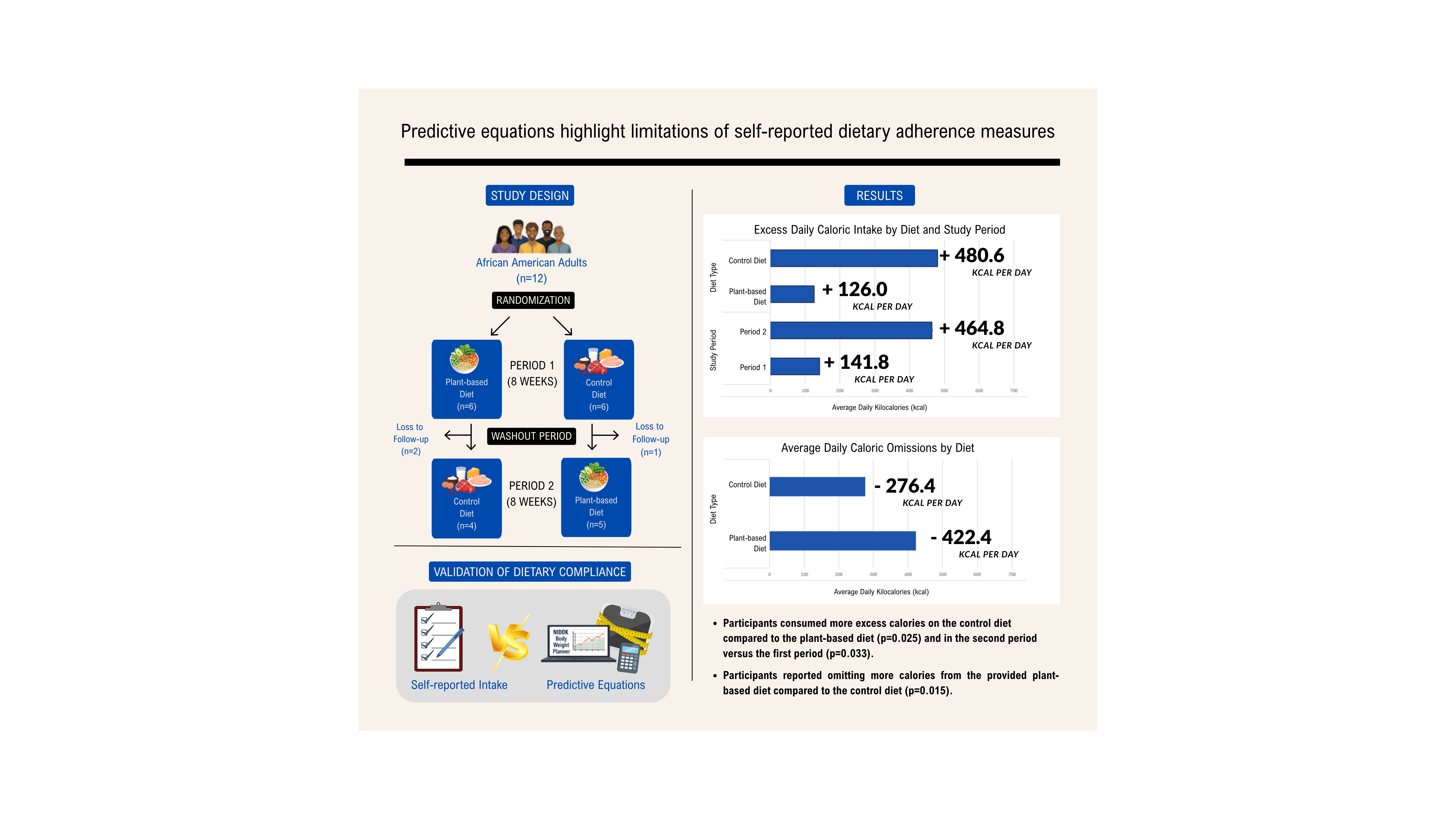
Background: Randomized controlled feeding trials are ideal for studying diet-disease relationships, but interpreting results requires accurate dietary adherence measures. Aim: This study assesses dietary adherence using self-reported measures and estimates from predictive equations in the National Institute of Diabetes and Digestive and Kidney Diseases Body Weight Planner and evaluates differences in adherence across diet treatments and study periods in a feeding trial. Methods: In a randomized, counterbalanced, crossover trial, 12 African American adults with prediabetes or early, untreated type 2 diabetes received either a plant-based diet (PBD) or an isocaloric control diet for eight weeks, followed by a washout period and the alternate diet. Primary measures included self-reported dietary adherence and estimates of actual caloric intake using predictive equations. T-tests evaluated differences by treatment and period. Results: Nine participants completed the study. Study completers (n = 9) consumed a greater caloric excess beyond the kilocalories provided by the study diets during the control treatment (480.6 ± 525.9 kcal/day) versus the PBD treatment (126.0 ± 585.4 kcal/day; p = 0.025) and in the second period (464.8 ± 592.4 kcal/day) versus the first period (141.8 ± 529.5 kcal/day; p = 0.033). Participants also reported omitting more kilocalories from the study diets during the PBD treatment (422.4 ± 289.1 kcal/day) versus the control treatment (276.4 ± 185.0 kcal/day; p = 0.015). Conclusion: Predictive equations showed significant differences in dietary adherence by treatment and period, underscoring the limitations of self-reported intake and highlighting the need for more objective measures. Relevance for patients: Variable adherence to study diets suggests the original study should be viewed as an effectiveness study, not an efficacy study.
- Lichtenstein AH, Petersen K, Barger K, et al. Perspective: Design and Conduct of Human Nutrition Randomized Controlled Trials. Adv Nutr. 2021;12(1):4-20. doi: 10.1093/advances/nmaa109
- Most MM, Ershow AG, Clevidence BA. An overview of methodologies, proficiencies, and training resources for controlled feeding studies. J Am Diet Assoc. 2003;103(6):729-735. doi: 10.1053/jada.2003.50132
- Tien DS, Hockey M, So D, et al. Recommendations for Designing, Conducting, and Reporting Feeding Trials in Nutrition Research. Adv Nutr. 2024;15(10):100283. doi: 10.1016/j.advnut.2024.100283
- Wu B, White K, Maw MTT, et al. Adherence to Diet and Meal Timing in a Randomized Controlled Feeding Study of Time-Restricted Feeding. Nutrients. 2022;14(11):2283. doi: 10.3390/nu14112283
- Swain JF, Windhauser MM, Hoben KP, Evans MA, μgee BB, Steele PD. Menu design and selection for multicenter controlled feeding studies: process used in the Dietary Approaches to Stop Hypertension trial. DASH Collaborative Research Group. J Am Diet Assoc. 1999;99(8):S54-S59. doi: 10.1016/S0002-8223(99)00417-4
- Krishnan S, Lee F, Burnett DJ, et al. Challenges in Designing and Delivering Diets and Assessing Adherence: A Randomized Controlled Trial Evaluating the 2010 Dietary Guidelines for Americans. Curr Dev Nutr. 2020;4(3):nzaa022. doi: 10.1093/cdn/nzaa022
- Maruvada P, Lampe JW, Wishart DS, et al. Perspective: Dietary Biomarkers of Intake and Exposure-Exploration with Omics Approaches. Adv Nutr. 2020;11(2):200-215. doi: 10.1093/advances/nmz075
- Lo FPW, Sun Y, Qiu J, Lo B. Image-Based Food Classification and Volume Estimation for Dietary Assessment: A Review. IEEE J Biomed Health Inform. 2020;24(7):1926-1939. doi: 10.1109/JBHI.2020.2987943
- Hall KD, Sacks G, Chandramohan D, et al. Quantification of the effect of energy imbalance on bodyweight. Lancet. 2011;378(9793):826-837. doi: 10.1016/S0140-6736(11)60812-X
- National Institute of Diabetes and Digestive and Kidney Diseases. Body Weight Planner. Accessed June 27, 2024. https://www.niddk.nih.gov/bwp
- Hibbing PR, Shook RP, Panda S, Manoogian ENC, Mashek DG, Chow LS. Predicting energy intake with an accelerometer-based intake-balance method. Br J Nutr. 2023;130(2):344-352. doi: 10.1017/S0007114522003312
- Tuso PJ, Ismail MH, Ha BP, Bartolotto C. Nutritional update for physicians: plant-based diets. Perm J. 2013;17(2):61-66. doi: 10.7812/TPP/12-085
- U.S. Department of Agriculture and U.S. Department of Health and Human Services. Dietary Guidelines for Americans, 2020-2025. 9th ed. 2020. Accessed June 1, 2022. https://www.dietaryguidelines.gov/sites/default/files/2020-12/Dietary_Guidelines_for_Americans_2020-2025.pdf
- National Academies of Sciences, Engineering, and Medicine. Rethinking the Acceptable Macronutrient Distribution Range for the 21st Century: A Letter Report. Washington, D.C., USA: National Academies Press; 2024. doi: 10.17226/27957
- Craig CL, Marshall AL, Sjostrom M, et al. International physical activity questionnaire: 12-country reliability and validity. Med Sci Sports Exerc. 2003;35(8):1381-1395. doi: 10.1249/01.MSS.0000078924.61453.FB
- Hall DM, Most MM. Dietary adherence in well-controlled feeding studies. J Am Diet Assoc. 2005;105(8):1285-1288. doi: 10.1016/j.jada.2005.05.009
- Greger M. A Whole Food Plant-Based Diet Is Effective for Weight Loss: The Evidence. Am J Lifestyle Med. 2020;14(5):500-510. doi: 10.1177/1559827620912400
- Tran E, Dale HF, Jensen C, Lied GA. Effects of Plant-Based Diets on Weight Status: A Systematic Review. Diabetes Metab Syndr Obes. 2020;13:3433-3448. doi: 10.2147/DMSO.S272802
- Moore CJ, Lindke A, Cox GO. Using Sensory Science to Evaluate Consumer Acceptance of Recipes in a Nutrition Education Intervention for Limited Resource Populations. J Nutr Educ Behav. 2020;52(2):134-144. doi: 10.1016/j.jneb.2019.07.012
- Gibbons C, Hopkins M, Beaulieu K, Oustric P, Blundell JE. Issues in Measuring and Interpreting Human Appetite (Satiety/Satiation) and Its Contribution to Obesity. Curr Obes Rep. 2019;8(2):77-87. doi: 10.1007/s13679-019-00340-6
- Leidy HJ, Gooding R, Hicks-Roof K. Perspective: Key Considerations When Developing and Publishing Dietary Interventions for Human Clinical Trials. J Nutr. 2024;154(10):2904-2908. doi: 10.1016/j.tjnut.2024.08.024
- Dhurandhar NV, Schoeller D, Brown AW, et al. Energy balance measurement: when something is not better than nothing. Int J Obes. 2015;39(7):1109-1113. doi: 10.1038/ijo.2014.199
- Staudacher HM, Yao CK, Chey WD, Whelan K. Optimal Design of Clinical Trials of Dietary Interventions in Disorders of Gut-Brain Interaction. Am J Gastroenterol. 2022;117(6):973-984. doi: 10.14309/ajg.0000000000001732
- McCoy CE. Understanding the Intention-to-treat Principle in Randomized Controlled Trials. West J Emerg Med. 2017;18(6):1075-1078. doi: 10.5811/westjem.2017.8.35985
- Putt ME. Power to detect clinically relevant carry-over in a series of cross-over studies. Stat Med. 2006;25(15):2567- 2586. doi: 10.1002/sim.2275
- Sanghvi A, Redman LM, Martin CK, Ravussin E, Hall KD. Validation of an inexpensive and accurate mathematical method to measure long-term changes in free-living energy intake. Am J Clin Nutr. 2015;102(2):353-358. doi: 10.3945/ajcn.115.111070
- Prado-Novoa O, Howard KR, Laskaridou E, et al. Validity of predictive equations for total energy expenditure against doubly labeled water. Sci Rep. 2024;14(1):15754. doi: 10.1038/s41598-024-66767-7