

Emerging rehabilitation technologies in Guillain–Barré syndrome: Advances, challenges, and future directions – A systematic scoping review

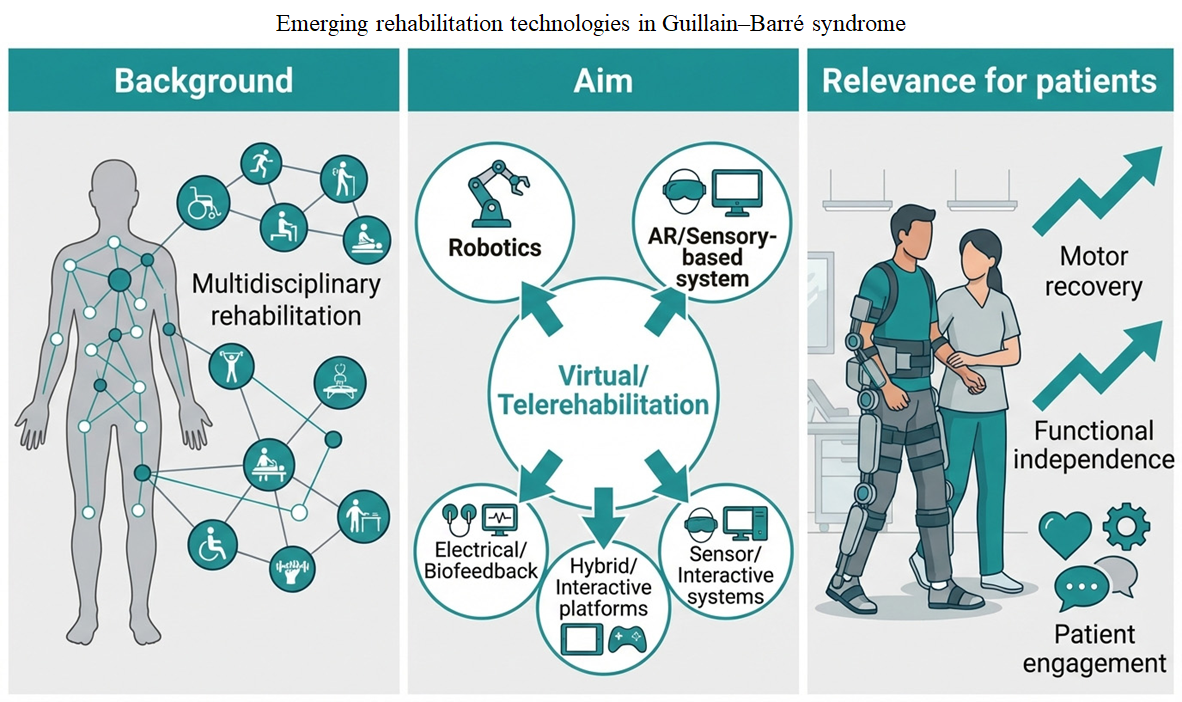
Guillain–Barré syndrome (GBS) causes acute flaccid paralysis and long-term motor and functional deficits, often necessitating prolonged, multidisciplinary rehabilitation. In recent years, rapid advances in biomedical and digital technologies have broadened the therapeutic landscape for neurorehabilitation; however, their use and methodological quality in GBS have not yet been comprehensively reviewed. Objective: This scoping review systematically maps and synthesizes emerging rehabilitation technologies in GBS, grouping them into five clusters: robotics, electrical/biofeedback therapies, virtual and telerehabilitation, augmented reality/sensor-based systems, and hybrid/interactive platforms. It integrates both primary studies (n = 18) and systematic reviews (n = 3) to assess outcome trends (motor recovery, functional independence, and secondary measures such as quality of life, usability, and engagement) and to evaluate methodological quality using the Joanna Briggs Institute’s critical appraisal tools. Relevance for patients: The mapping of technologies demonstrated consistent improvements in motor recovery and functional outcomes among GBS survivors, especially with robotic and electrical/biofeedback therapies. High-quality evidence (≥80% “Yes”) predominated in this area, supporting the safe and effective integration of technology-based rehabilitation. The review highlights the clinical relevance of engineering-assisted, interactive strategies that foster adaptive, personalized recovery and enhance patient engagement throughout long-term neurorehabilitation.
- Van Den Berg B, Walgaard C, Drenthen J, et al. Guillain-Barré syndrome: pathogenesis, diagnosis, treatment and prognosis. Nat Rev Neurol. 2014;10(8):469-482. doi: 10.1038/nrneurol.2014.121
- Willison HJ, Jacobs BC, van Doorn PA. Guillain-Barré syndrome. Lancet. 2016;388(10045):717-727. doi: 10.1016/S0140-6736(16)00339-1
- Sejvar JJ, Baughman AL, Wise M, et al. Population incidence of Guillain-Barré syndrome: a systematic review and meta-analysis. Neuroepidemiology. 2011;36(2):123-133. doi: 10.1159/000324710
- Khan F, Amatya B. Rehabilitation interventions in patients with acute demyelinating inflammatory polyneuropathy: a systematic review. Eur J Phys Rehabil Med. 2012;48(3):507- 522.
- Mekki M, Delgado AD, Fry A, et al. Robotic rehabilitation and spinal cord injury: a narrative review. Neurotherapeutics. 2018;15(3):604-617. doi: 10.1007/s13311-018-0642-3
- Novak I, Morgan C, Fahey M, et al. State of the evidence traffic lights 2019: systematic review of interventions for preventing and treating children with cerebral palsy. Curr Neurol Neurosci Rep. 2020;20(2):3. doi: 10.1007/s11910-020-1022-z
- Sîrbu CA, Thompson DC, Plesa FC, et al. Neurorehabilitation in multiple sclerosis: a review of present approaches and future considerations. J Clin Med. 2022;11(23):7003. doi: 10.3390/jcm11237003
- Hwang S, Min KC, Song CS. Assistive technology on upper extremity function for stroke patients: a systematic review with meta-analysis. J Hand Ther. 2024;37(4):507-519. doi: 10.1016/j.jht.2023.12.014
- Daly JJ, Wolpaw JR. Brain-computer interfaces in neurological rehabilitation. Lancet Neurol. 2008;7(11):1032- 1043. doi: 10.1016/S1474-4422(08)70223-0
- Toopchizadeh V, Barzegar M, Taleschian-Tabrizi N, et al. Long-term disability and poor outcome predictors of Guillain-Barré syndrome in children: a systematic review. J Pediatr Rev. 2023;11(1):11-24. Available from: http://jpr.mazums.ac.ir/article-1-487-fa.html [Last accessed on 2026 Jan 08].
- Martino Cinnera A, D’Arienzo M, Piatti D. Robot-assisted therapy in Guillain-Barré syndrome: systematic review of primary evidence and study protocol for a randomized clinical trial. J Clin Med. 2024;13(23):7153. doi: 10.3390/jcm13237153
- Sulli S, Scala L, Berardi A, et al. The efficacy of rehabilitation in people with Guillain-Barré syndrome: a systematic review of randomized controlled trials. Expert Rev Neurother. 2021;21(4):455-461. doi: 10.1080/14737175.2021.1890034
- Torres-Reyes AB, Reyes-Hernández I, Domínguez-Ramírez OA, et al. Use of biomedical engineering for rehabilitation of patients with disability caused by Guillain-Barré syndrome: a systematic review. Rev Mex Ing Bioméd. 2024;45(1):43-59. doi: 10.17488/rmib.45.1.4
- Aromataris E, Munn Z, eds. JBI Manual for Evidence Synthesis. Joanna Briggs Institute. Available from: https://jbi-global-wiki.refined.site/space/MANUAL [Last accessed on 2026 Jan 08].
- Tricco AC, Lillie E, Zarin W, et al. PRISMA extension for scoping reviews (PRISMA-ScR): checklist and explanation. Ann Intern Med. 2018;169(7):467-473. doi: 10.7326/M18-0850
- Oxford Centre for Evidence-Based Medicine. OCEBM levels of evidence, version 2.1. Published 2011. Available from: https://www.cebm.ox.ac.uk/resources/levels-of-evidence [Last accessed on 2026 Jan 08].
- Joanna Briggs Institute. Critical appraisal tools. Published 2020. Available from: https://jbi.global/critical-appraisaltools [Last accessed on 2026 Jan 08].
- Page MJ, McKenzie JE, Bossuyt PM, et al. The PRISMA 2020 statement: an updated guideline for reporting systematic reviews. BMJ. 2021;372:n71. doi: 10.1136/bmj.n71
- Lee KS, Park JH, Beom J, et al. Design and evaluation of passive shoulder joint tracking module for upper-limb rehabilitation robots. Front Neurorobot. 2018;12:38. doi: 10.3389/fnbot.2018.00038
- Cespedes N, Munera M, Gomez C, et al. Social human-robot interaction for gait rehabilitation. IEEE Trans Neural Syst Rehabil Eng. 2020;28(6):1299-1307. doi: 10.1109/TNSRE.2020.2987428
- Choi S, Kim SW, Jeon HR, et al. Feasibility of robot-assisted gait training with an end-effector type device for various neurologic disorders. Brain Neurorehabil. 2020;13(1). doi: 10.12786/bn.2020.13.e6
- Rhee SY, Jeon H, Kim SW, et al. The effect of an end-effector type of robot-assisted gait training on patients with Guillain-Barré syndrome: a cross-sectional study. F1000Res. 2020;9:1465. doi: 10.12688/f1000research.26246.1
- Nehrujee A, Andrew H, Patricia A, et al. Plug-and-train robot (PLUTO) for hand rehabilitation: design and preliminary evaluation. IEEE Access. 2021;9:134957-134971. doi: 10.1109/ACCESS.2021.3115580
- Chrif F, van Hedel HJ, Vivian M, et al. Usability evaluation of an interactive leg press training robot for children with neuromuscular impairments. Technol Health Care. 2022;30(5):1183-1197. doi: 10.3233/THC-213629
- Fang Y, Lerner ZF. Bilateral vs paretic-limb-only ankle exoskeleton assistance for improving hemiparetic gait: a case series. IEEE Robot Autom Lett. 2022;7(2):1246-1253. doi: 10.1109/lra.2021.3139540
- De Crignis AC, Ruhnau ST, Hösl M, et al. Robotic arm training in neurorehabilitation enhanced by augmented reality: a usability and feasibility study. J Neuroeng Rehabil. 2023;20(1):105. doi: 10.1186/s12984-023-01225-5
- Chen FY-S, Hou W-H, Lee H-H, et al. Additional rehabilitative robot-assisted gait training for ambulation in geriatric individuals with Guillain-Barré syndrome: a case report. Medicina. 2024;60(8):1209. doi: 10.3390/medicina60081209
- Hotz I, Mildner S, Stampfer-Kountchev M, et al. Robot-assisted gait training in patients with various neurological diseases: a mixed methods feasibility study. PLoS One. 2024;19(8):e0307434. doi: 10.1371/journal.pone.0307434
- Lee MJ, Yoon SJ. Changes in body composition, physical fitness and quality of life on robotic gait-assisted training in patients with Guillain-Barré syndrome: a case report. Phys Act Nutr. 2024;28(4):9-14. doi: 10.20463/pan.2024.0027
- Yabuki J, Yoshikawa K, Koseki K, et al. Improvement of functional mobility using a hip-wearable exoskeleton robot in Guillain-Barré syndrome with residual gait disturbance: a case report. Cureus. 2024;16(7):e63882. doi: 10.7759/cureus.63882
- Beirer S, Grisold W, Dreisbach J. Therapy-resistant dysphagia successfully treated using pharyngeal electrical stimulation in a patient with the pharyngeal-cervical-brachial variant of Guillain-Barré syndrome. eNeurologicalSci. 2020;20:100255. doi: 10.1016/j.ensci.2020.100255
- Liu Q, Xue J, Zhao P, et al. Effect of electromyographic biofeedback therapy on muscle strength recovery in children with Guillain-Barré syndrome. J Healthc Eng. 2021;2021:1220368. doi: 10.1155/2021/1220368
- Barišić N, Nemir J, Perković R, et al. Spinal cord stimulation induced favorable neuromodulative outcome in the treatment of chronic neuropathic pain syndrome in children. Eur J Paediatr Neurol. 2025;54:186-192. doi: 10.1016/j.ejpn.2025.02.007
- Albiol-Pérez S, Forcano-García M, Muñoz-Tomás M, et al. A novel virtual motor rehabilitation system for Guillain-Barré syndrome: two single case studies. Methods Inf Med. 2015;54(2):127-134. doi: 10.3414/ME14-02-0002
- Khanna M, Gowda GS, Bagevadi VI, et al. Feasibility and utility of tele-neurorehabilitation service in India: experience from a quaternary center. J Neurosci Rural Pract. 2018;9(4):541-544. doi: 10.4103/jnrp.jnrp_104_18
- Pravallika R, Suthar R, Patil A, et al. Efficacy of teleconsultation-based rehabilitation in children with Landry–Guillain-Barré syndrome: an open-label randomized controlled trial (Tele Rehab-LGBS Trial). Indian J Pediatr. 2024;91(5):455-462. doi: 10.1007/s12098-023-04882-5