
Adaptive spatial genotypes in Thai Lue houses across rural–town–urban contexts: A space syntax study in Xishuangbanna, China

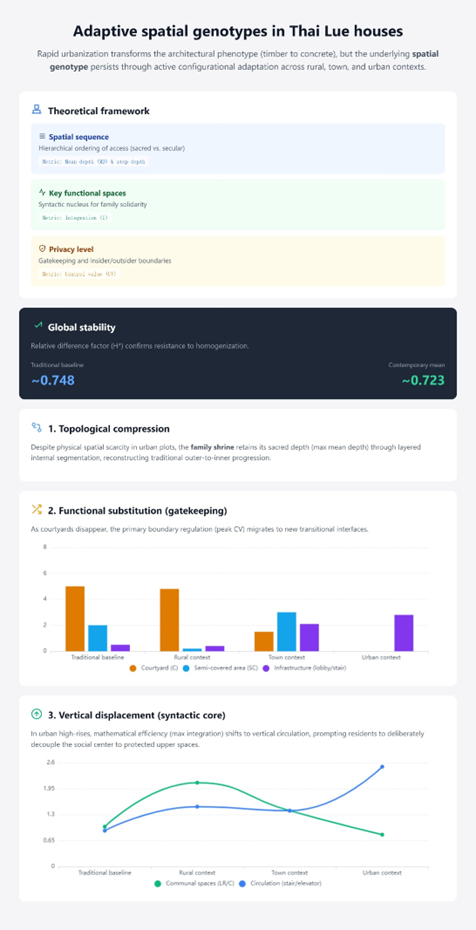
Rapid urbanization in Xishuangbanna has transformed Thai Lue dwellings from traditional timber stilt houses to reinforced concrete structures, raising questions about the continuity of cultural identity. This study investigates the possibility of persistence of the spatial genotype, the deep social logic governing space, by analyzing 24 contemporary houses distributed across rural, town, and urban contexts relative to two traditional prototypes. Using space syntax methodology to quantify spatial sequence, functional integration, and privacy levels, the research reveals that while the architectural phenotype has shifted, the underlying configurational order remains resilient. Analysis of the relative difference factor demonstrates that contemporary dwellings maintain a degree of structural differentiation comparable to the traditional baseline. Furthermore, the study identifies three specific adaptation mechanisms that sustain this logic: topological compression, where the family shrine retains sacred depth through layered segmentation despite morphological compression; functional substitution, where the gatekeeping role shifts from traditional courtyards to transitional interfaces; and vertical displacement, where the social center in urban high-rises decouples from the infrastructure-dominated syntactic core to be re-established in rooftop spaces. These findings suggest that Thai Lue identity persists through a dynamic topological logic capable of inhabiting new typologies, offering a new perspective for assessing vernacular continuity beyond material preservation.
Abdelwahab, S., Kent, M. G., & Mayhoub, M. (2023). Users’ window preferences and motivations of shading control: Influence of cultural characteristics. Building and Environment, 240, 110455. https://doi.org/10.1016/j.buildenv.2023.110455
Ai, J. (2016). The structure of residential spaces of Dai Lue people in Xishuangbanna and its cognitive logic. Ethno-National Studies, (1), 65-74. [in Chinese]
Bafna, S. (2012). Rethinking genotype: Comments on the sources of type in architecture. The Journal of Space Syntax, 3(1), 69–80. Available from: https://www.researchgate.net/ publication/277066702_Rethinking_genotype_Comments_ on_the_sources_of_type_in_architecture [Last accessed on April 28, 2026].
Chen, L. (2014). Cultural impact of modernization and tourism on Dai villages in Xishuangbanna, China. Tourism Geographies, 16(5), 757–771. https://doi.org/10.1080/14616688.2014.948044
Chen, Y., & Yu, M. (2009). The space metaphor of the Dai ethnic culture in Xishuangbanna. Academic Exploration, (1), 90–92. [in Chinese]
Das, S., Rahman, M. A., & Hossain, M. S. (2021). Change in adaptability of residential architecture: Spatial analysis on traditional and contemporary houses of Bangladesh. Journal of Architectural Environment & Structural Engineering Research, 4(4), 31–47. https://doi.org/10.30564/jaeser.v4i4.3865
Fan, Y. (2008). The concept of space and layout in Thai people’s architecture. Journal of Anhui Institute of Architecture & Industry, 16(2), 46–48. [in Chinese]
Guo, J. (2025). Dai vernacular architecture: Adaptation characteristics and cultural origins—A case study of Xishuangbanna [傣族风土建筑因应特征及文化探源: 以西双版纳地区为例]. Beijing: China Textile Press. ISBN: 978-7-5229-2166-2. [in Chinese]
Guo, J., & Zhang, L. (2020). A study on the spatial characteristics of “Double Centers” in ethnic Dai’s vernacular settlement and architecture as exemplified in traditional villages in Xishuangbanna, Southwest China. Architectural Journal, (8), 114–121. https://doi.org/10.19819/j.cnki.ISSN0529-1399.202008020 [in Chinese]
Guo, J., & Zhang, L. (2024). Vernacular harmony: A study of Dai traditional architecture in terms of ideas, space, and archetypes from the perspective of structural linguistics. Architectural Journal, (S2), 58–65. [in Chinese]
Hanson, J. (1998). Decoding homes and houses. Cambridge University Press. https://doi.org/10.1017/CBO9780511518294.001
Hillier, B., & Hanson, J. (1984). The social logic of space. Cambridge University Press. https://doi.org/10.1017/CBO9780511597237.002
Lei, Z., & Li, J. (2025). Genotype extraction of traditional dwellings using space syntax: a case study of Tibetan rural houses in Ganzi County, China. npj Heritage Science, 13(1). https://doi.org/10.1038/s40494-025-01590-5
Madanipour, A. (2003). Public and private spaces of the city. Routledge. https://doi.org/10.4324/9780203402856-14
Oranratmanee, R. (2018). Vernacular houses of the Shan in Myanmar in the South-East Asian context. Vernacular Architecture, 49(1), 99–120. https://doi.org/10.1080/03055477.2018.1524217
Ostwald, M. J. (2011). The mathematics of spatial configuration: Revisiting, revising and critiquing justified plan graph theory. Nexus Network Journal, 13(2), 445–470. https://doi.org/10.1007/s00004-011-0075-3
Song, J., Zhao, S., & Kong, J. (2023). Residential space organization of the Inner Mongolia earth dwellings around the Yellow River Basin. Sustainability, 15(20), 15027. https://doi.org/10.3390/su152015027
State Council of the People’s Republic of China. (2014). National new-type urbanization plan (2014–2020) [国家新型城镇化规划 (2014–2020年)]. The State Council of the People’s Republic of China. Available from: https://www.gov.cn/ zhengce/2014-03/16/content_2640075.htm [Last accessed on April 5, 2026].
Sun, F. (2013). Chinese climate and vernacular dwellings. Buildings, 3(1), 143–172. https://doi.org/10.3390/buildings3010143
Tabatabaei Malazi, F., Malakavarzamani, A., & Sabernejad, J. (2020). Social logic of kitchen space in vernacular architecture (Case study: Qeshm housing) – Examination and analysis. Space Ontology International Journal, 9(3), 61–73.
Xian, G. E., Novianto, D., & Defiana, I. (2024). Investigate sustainability aspect in spatial configurations of Javanese vernacular architecture: Case study of Joglo House. IOP Conference Series: Earth and Environmental Science, 1404, 012018. https://doi.org/10.1088/1755-1315/1404/1/012018
Yin, R. K. (2018). Case study research and applications: Design and methods (6th ed.). SAGE Publications.
Yunnan Provincial Design Institute. (2018). Yunnan Minju [Yunnan Vernacular Dwellings]. China Architecture & Building Press. [in Chinese]
Zhu, L. (1992). The Dai or the Tai and their architecture & customs in South China. D D Books.
Zhu, L. (2020). Reconsideration of traditional villages under the rural revitalization strategy. South Architecture, 2020(2), 1–11. [in Chinese]