
Epigenetic and Transcriptional Rewiring of Circadian Clock Genes by Polycyclic Aromatic Hydrocarbons: Implications for Lung and Breast Cancer Initiation and Progression

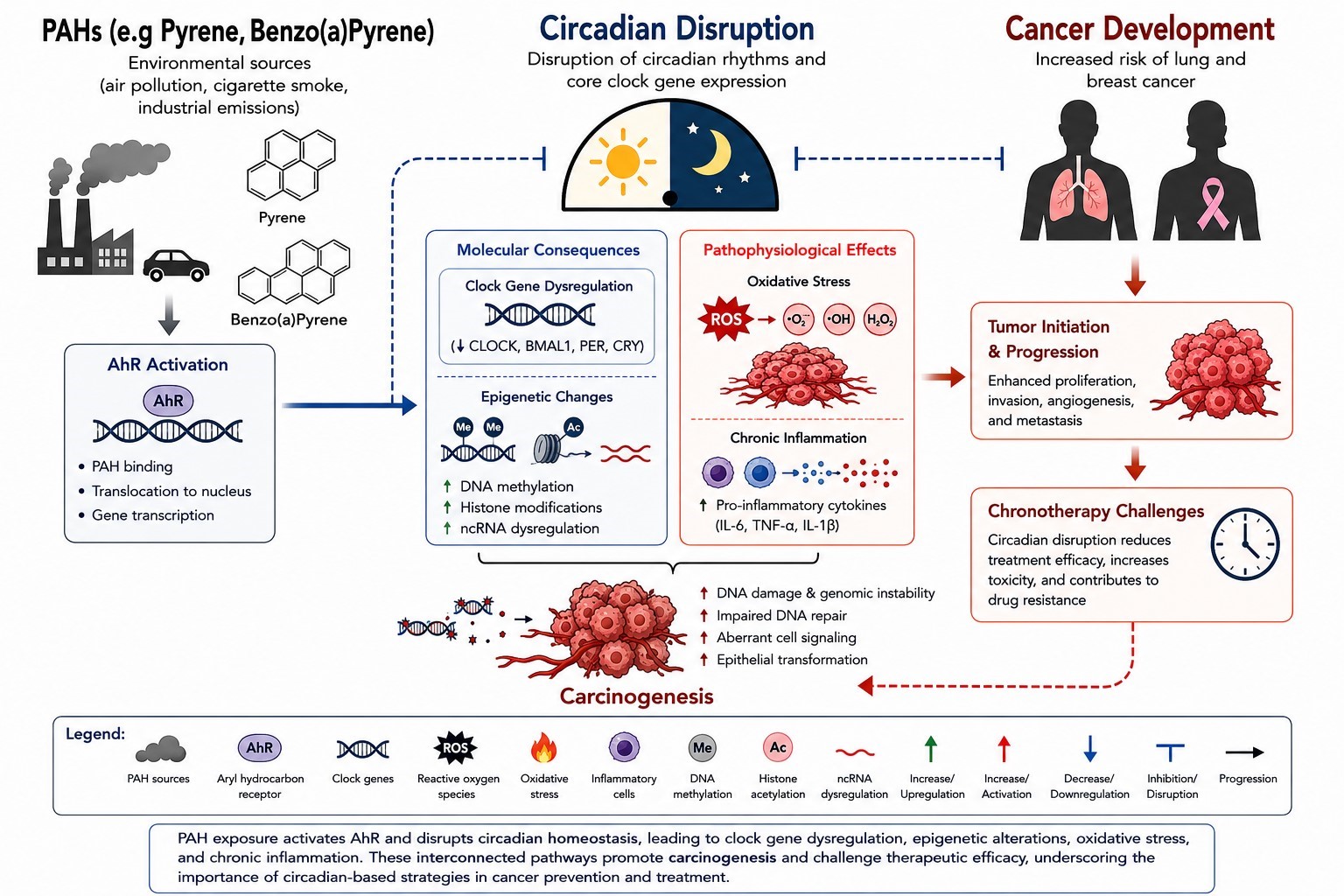
Polycyclic aromatic hydrocarbons (PAHs) are widespread environmental pollutants with established carcinogenic properties traditionally linked to genotoxicity, oxidative stress, and DNA adduct formation. Emerging evidence indicates that PAHs also function as chronotoxic agents, disrupting circadian homeostasis through transcriptional and epigenetic reprogramming of core clock genes. This review critically examines the molecular interplay between PAH exposure, circadian clock dysregulation, and the initiation and progression of lung and breast cancers. Central to this interaction is the activation of the aryl hydrocarbon receptor (AhR), which exhibits bidirectional crosstalk with core circadian regulators including CLOCK and BMAL1. Sustained AhR activation, coupled with oxidative stress, inflammatory signaling, and epigenetic modifications including DNA methylation, histone remodeling, and non-coding RNA dysregulation, alters rhythmic expression of key circadian genes (PER, CRY, BMAL1, and CLOCK). These molecular alterations impair DNA repair, cell-cycle regulation, apoptosis, xenobiotic metabolism and metabolic homeostasis, thereby creating a permissive environment for tumorigenesis. The review synthesizes current evidence on tissue-specific mechanisms underlying PAH-induced chronodisruption in lung and breast tissues, highlighting how organ-specific physiology influences carcinogenic susceptibility and discussing the translational relevance of circadian biomarkers in cancer prognosis and therapy. Finally, emerging therapeutic and translational strategies including chronotherapy, circadian-targeted interventions, epigenetic modulation and integrative multi-omics systems biology are explored as potential approaches for refining precision oncology and mitigating environmentally induced carcinogenesis. Collectively, this review establishes environmental chronotoxicology as a critical framework for understanding the temporal dimension of cancer development associated with PAHs exposure.
- Ajayi RO, Ogunjobi TT. Environmental exposures and cancer risk: a comprehensive review. Medinformatics. 2025;2(2):80-92. doi: 10.47852/bonviewMEDIN42023598
- Rengarajan T, Rajendran P, Nandakumar N, Lokeshkumar B, Rajendran P, Nishigaki I. Exposure to polycyclic aromatic hydrocarbons with special focus on cancer. Asian Pac J Trop Biomed. 2015;5(3):182-189. doi: 10.1016/S2221-1691(15)30003-4
- Awolesi AB. 1-Hydroxypyrene glucuronide and 8-hydroxy-2’-deoxyguanosine as complementary biomarkers bridging polycyclic aromatic hydrocarbon exposure to carcinogenic risk: Mechanistic and epidemiological perspectives. J Clin Transl Res. 2026. doi: 10.36922/JCTR026240054
- Surti M, Gupta A, Janiyani K, Adnan M, Patel M. The role of circadian disruption, sleep dysregulation, lifestyle factors, and metabolic reprogramming in the pathogenesis and progression of ovarian cancer. J Natl Cancer Cent. 2026;6(2):189-203. doi: 10.1016/j.jncc.2026.01.009
- Haus EL, Smolensky MH. Shift work and cancer risk: Potential mechanistic roles of circadian disruption, light at night, and sleep deprivation. Sleep Med Rev. 2013;17(4):273-284. doi: 10.1016/j.smrv.2012.08.003
- Fu L, Kettner NM. The circadian clock in cancer development and therapy. Prog Mol Biol Transl Sci. 2013;119:221-282. doi: 10.1016/B978-0-12-396971-2.00009-9
- Alvarado-Cruz I, Alegría-Torres JA, Montes-Castro N, Jiménez-Garza O, Quintanilla-Vega B. Environmental epigenetic changes, as risk factors for the development of diseases in children: a systematic review. Ann Glob Health. 2018;84(2):212. doi: 10.29024/aogh.909
- Bock KW. Aryl hydrocarbon receptor (AHR): From selected human target genes and crosstalk with transcription factors to multiple AHR functions. Biochem Pharmacol. 2019;168:65-70. doi: 10.1016/j.bcp.2019.06.015
- Nebert DW, Dalton TP, Okey AB, Gonzalez FJ. Role of aryl hydrocarbon receptor-mediated induction of the CYP1 enzymes in environmental toxicity and cancer. J Biol Chem. 2004;279(23):23847-23850. doi: 10.1074/jbc.R400004200
- Pekovic-Vaughan V, Gibbs J, Yoshitane H, et al. The circadian clock regulates rhythmic activation of the NRF2/glutathione-mediated antioxidant defense pathway to modulate pulmonary fibrosis. Genes Dev. 2014;28(6):548-560. doi: doi: 10.1101/gad.237081.113
- Ruiz-Hernandez A, Kuo CC, Rentero-Garrido P, et al. Environmental chemicals and DNA methylation in adults: a systematic review of the epidemiologic evidence. Clin Epigenetics. 2015;7(1):55. doi: 10.1186/s13148-015-0055-7
- Salminen A. Aryl hydrocarbon receptor (AhR) impairs circadian regulation: Impact on the aging process. Ageing Res Rev. 2023;87:101928. doi: 10.1016/j.arr.2023.101928
- Shimada T, Fujii-Kuriyama Y. Metabolic activation of polycyclic aromatic hydrocarbons to carcinogens by cytochromes P450 1A1 and1B1. Cancer Sci. 2004;95(1):1-6. doi: 10.1111/j.1349-7006.2004.tb03162.x
- Stockinger B, Meglio PD, Gialitakis M, Duarte JH. The Aryl Hydrocarbon Receptor: Multitasking in the Immune System. Annu. Rev Immunol. 2014;32(1):403-432. doi: 10.1146/annurev-immunol-032713-120245
- Teglas T, Marcos AC, Torices S, Toborek M. Circadian control of polycyclic aromatic hydrocarbon-induced dysregulation of endothelial tight junctions and mitochondrial bioenergetics. Sci Total Environ. 2024;952:175886. doi: 10.1016/j.scitotenv.2024.175886
- Wright EJ, De Castro KP, Joshi AD, Elferink CJ. Canonical and non-canonical aryl hydrocarbon receptor signaling pathways. Curr Opin Toxicol. 2017;2:87-92. doi: 10.1016/j.cotox.2017.01.001
- Zhu W, Chen Y, Hong X, et al. Assessment of the toxicity of different PAHs and their derivatives via their binding ability to AhR in molecular details. Toxicol Environ Health Sci. 2026;18(2):303-318. doi: 10.1007/s13530-026-00309-8
- Patel AB, Shaikh S, Jain KR, Desai C, Madamwar D. Polycyclic Aromatic Hydrocarbons: Sources, Toxicity, and Remediation Approaches. Front Microbiol. 2020;11:562813. doi: 10.3389/fmicb.2020.562813
- International Agency for Research on Cancer (IARC). IARC monographs on the evaluation of carcinogenic risks to humans. Chemical agents and related occupations. IARC Monogr Eval Carcinog Risks Hum F. 2012;100. Accessed July 26, 2026. https://publications.iarc.who.int/Book-And-Report-Series/Iarc-Monographs-On-The-Identification-Of-Carcinogenic-Hazards-To-Humans/Chemical-Agents-And-Related-Occupations-2012
- Boström CE, Gerde P, Hanberg A, et al. Cancer risk assessment, indicators, and guidelines for polycyclic aromatic hydrocarbons in the ambient air. Environ Health Perspect. 2002;110(Suppl 3):451. doi: 10.1289/ehp.110-1241197
- Kim KH, Jahan SA, Kabir E, Brown RJ. A review of airborne polycyclic aromatic hydrocarbons (PAHs) and their human health effects. Environ Int. 2013;60:71-80. doi: 10.1016/j.envint.2013.07.019
- Ramesh A, Walker SA, Hood DB, Guillén MD, Schneider K, Weyand EH. Bioavailability and Risk Assessment of Orally Ingested Polycyclic Aromatic Hydrocarbons. Int J Toxicol. 2004;23(5):301-333. doi: 10.1080/10915810490517063
- Gao P, da Silva E, Hou L, Denslow ND, Xiang P, Ma LQ. Human exposure to polycyclic aromatic hydrocarbons: Metabolomics perspective. Environ Int. 2018;119:466-477. doi: 10.1016/j.envint.2018.07.017
- Venkatraman G, Giribabu N, Mohan PS, et al. Environmental impact and human health effects of polycyclic aromatic hydrocarbons and remedial strategies: A detailed review. Chemosphere. 2024;351:141227. doi: 10.1016/j.chemosphere.2024.141227
- Barbosa F, Rocha BA, Souza MCO, et al. Polycyclic aromatic hydrocarbons (PAHs): Updated aspects of their determination, kinetics in the human body, and toxicity. J Toxicol Environ Health Part B 2023;26(1):28-65. doi: 10.1080/10937404.2022.2164390
- Duan X, Shen G, Yang H, et al. Dietary intake polycyclic aromatic hydrocarbons (PAHs) and associated cancer risk in a cohort of Chinese urban adults: Inter- and intra-individual variability. Chemosphere. 2016;144:2469-2475. doi: 10.1016/j.chemosphere.2015.11.019
- Jaeger C, Tischkau SA. Role of Aryl Hydrocarbon Receptor in Circadian Clock Disruption and Metabolic Dysfunction. Environ Health Insights. 2016;10:EHI.S38343. doi: 10.4137/EHI.S38343
- Larigot L, Juricek L, Dairou J, Coumoul X. AhR signaling pathways and regulatory functions. Biochim Open. 2018;7:1-9. doi: 10.1016/j.biopen.2018.05.001
- Abdel-Shafy HI, Mansour MSM. A review on polycyclic aromatic hydrocarbons: Source, environmental impact, effect on human health and remediation. Egypt J Pet. 2016;25(1):107-123. doi: 10.1016/j.ejpe.2015.03.011
- Tudi M, Li H, Li H, et al. Exposure routes and health risks associated with pesticide application. Toxics. 2022;10(6):335. doi: 10.3390/toxics10060335
- Zhang Y, Tao S, Shen H, Ma J. Inhalation exposure to ambient polycyclic aromatic hydrocarbons and lung cancer risk of Chinese population. Proc Natl Acad Sci USA. 2009;106(50):21063-21067. doi: 10.1073/pnas.0905756106
- Qin N, He W, Liu W, Kong X, Xu F, Giesy JP. Tissue distribution, bioaccumulation, and carcinogenic risk of polycyclic aromatic hydrocarbons in aquatic organisms from Lake Chaohu, China. Sci Total Environ. 2020;749:141577. doi: 10.1016/j.scitotenv.2020.141577
- Koh YC, Pan MH. Food-Borne Polycyclic Aromatic Hydrocarbons and Circadian Disruption. ACS Omega. 2024;9(29):31298-31312. doi: 10.1021/acsomega.4c04120
- Jeng HA, Pan CH, Diawara N, et al. Polycyclic aromatic hydrocarbon-induced oxidative stress and lipid peroxidation in relation to immunological alteration. Occup Environ Med. 2011;68(9):653-658. doi: 10.1136/oem.2010.055020
- Fortin BM, Mahieu AL, Fellows RC, et al. The diverse roles of the circadian clock in cancer. Nat Cancer 2025;6(5):753-767. doi: 10.1038/s43018-025-00981-8
- Lee Y. Roles of circadian clocks in cancer pathogenesis and treatment. Exp Mol Med. 2021;53(10):1529-1538. doi: 10.1038/s12276-021-00681-0
- Grillo MP. Bioactivation by Phase-II-Enzyme-Catalyzed Conjugation of Xenobiotics. Vol 6. 1st ed. Hoboken, NJ, USA: John Wiley & Sons, Inc; 2012. Accessed July 24, 2026. https://www.researchgate.net/profile/Mark-Grillo-3/publication/289729783_Bioactivation_by_Phase-II-Enzyme-Catalyzed_Conjugation_of_Xenobiotics/links/683f1df6c33afe388ac9dd44/Bioactivation-by-Phase-II-Enzyme-Catalyzed-Conjugation-of-Xenobiotics.pdf
- Kohalmy K, Vrzal R. Regulation of phase II biotransformation enzymes by steroid hormones. Curr Drug Metab. 2011;12(2):104-123. doi: 10.2174/138920011795016872
- Robles-Piedras AL, Bautista-Sánchez U, Olvera-Hernández EG, Chehue-Romero A. Chronopharmacokinetics: A Brief Analysis of the Influence of Circadian Rhythm on the Absorption, Distribution, Metabolism, and Elimination of Drugs. Biomed Pharmacol J. 2024;17(3):2011-2017. doi: 10.13005/bpj/3003
- Alves TC, Musílek K, Monti B. Interplay between circadian rhythms and epigenetics in neural stem cells and Alzheimer’s disease. Prog Neurobiol. 2025;252:102808. doi: 10.1016/j.pneurobio.2025.102808
- International Agency for Research on Cancer (IARC). Definition and Occurrence of Exposure: Working Group on the Evaluation of Carcinogenic Risks to Humans. In: Painting, Firefighting, and Shiftwork. Vol 98. Lyon, France: International Agency for Research on Cancer; 2010. Accessed May 5, 2026. https://www.ncbi.nlm.nih.gov/books/NBK326824/
- Kochan DZ, Kovalchuk O. Circadian disruption and breast cancer: An epigenetic link? Oncotarget. 2015;6(19):16866-16882. doi: 10.18632/oncotarget.4343
- Orozco-Solis R, Sassone-Corsi P. Epigenetic control and the circadian clock: linking metabolism to neuronal responses. Neuroscience. 2014;264:76-87. doi: 10.1016/j.neuroscience.2014.01.043
- Panda S. Circadian physiology of metabolism. Science. 2016;354(6315):1008-1015. doi: 10.1126/science.aah4967
- Safe S, Lee SO, Jin UH. Role of the aryl hydrocarbon receptor in carcinogenesis and potential as a drug target. Toxicol Sci. 2013;135(1):1-16. doi: 10.1093/toxsci/kft128
- Sancar A, Lindsey-Boltz LA, Kang TH, Reardon JT, Lee JH, Ozturk N. Circadian clock control of the cellular response to DNA damage. FEBS Lett. 2010;584(12):2618-2625. doi: 10.1016/j.febslet.2010.03.017
- White AJ, Bradshaw PT, Herring AH, et al. Exposure to multiple sources of polycyclic aromatic hydrocarbons and breast cancer incidence. Environ Int. 2016;89-90:185-192. doi: 10.1016/j.envint.2016.02.009
- Yerushalmi S, Green RM. Evidence for the adaptive significance of circadian rhythms. Ecol Lett. 2009;12(9):970-981. doi: 10.1111/j.1461-0248.2009.01343.x
- Takahashi JS. Transcriptional architecture of the mammalian circadian clock. Nat Rev Genet. 2017;18(3):164-179. doi: 10.1038/nrg.2016.150
- Dibner C, Schibler U, Albrecht U. The Mammalian Circadian Timing System: Organization and Coordination of Central and Peripheral Clocks. Annu Rev Physiol. 2010;72(1):517-549. doi: 10.1146/annurev-physiol-021909-135821
- Bass J, Lazar MA. Circadian time signatures of fitness and disease. Science. 2016;354(6315):994-999. doi: 10.1126/science.aah4965
- Jonathan SY, Díaz NM, D’Souza S, Buhr ED. The molecular clockwork of mammalian cells. In: Seminars in Cell & Developmental Biology. Vol 126. Amsterdam, The Netherlands: Elsevier; 2022:87-96. doi: 10.1016/j.semcdb.2021.03.012
- Cox KH, Takahashi JS. Circadian clock genes and the transcriptional architecture of the clock mechanism. J Mol Endocrinol. 2019;63(4):R93-R102. doi: 10.1530/JME-19-0153
- Partch CL, Green CB, Takahashi JS. Molecular architecture of the mammalian circadian clock. Trends Cell Biol. 2014;24(2):90-99. doi: 10.1016/j.tcb.2013.07.002
- Dallmann R, Okyar A, Lévi F. Dosing-time makes the poison: circadian regulation and pharmacotherapy. Trends Mol Med. 2016;22(5):430-445. doi: 10.1016/j.molmed.2016.03.004
- Guan D, Lazar MA. Interconnections between circadian clocks and metabolism. J Clin Investig. 2021;131(15):e148278. doi: 10.1172/JCI148278
- Guan D, Lazar MA. Circadian Regulation of Gene Expression and Metabolism in the Liver. Semin Liver Dis. 2022;42(02):113-121. doi: 10.1055/a-1792-4240
- Li DD, Zhou T, Gao J, Wu GL, Yang GR. Circadian rhythms and breast cancer: from molecular level to therapeutic advancements. J Cancer Res Clin Oncol. 2024;150(9):419. doi: 10.1007/s00432-024-05917-w
- Papagiannakopoulos T, Bauer MR, Davidson SM, et al. Circadian Rhythm Disruption Promotes Lung Tumorigenesis. Cell Metab. 2016;24(2):324-331. doi: 10.1016/j.cmet.2016.07.001
- El-Tanani M, Rabbani SA, Ali AA, et al. Circadian rhythms and cancer: implications for timing in therapy. Discov Oncol. 2024;15:767. doi: 10.1007/s12672-024-01643-4
- Kojetin DJ, Burris TP. REV-ERB and ROR nuclear receptors as drug targets. Nat Rev Drug Discov. 2014;13(3):197-216. doi: 10.1038/nrd4100
- Wang C, Yang J, Yuan J, et al. Role of circadian transcription factor REV-ERB in cardiovascular diseases: a review. Front Cardiovasc Med. 2025;12:1516279. doi: 10.3389/fcvm.2025.1516279
- Leya M, Phan Van T, Kim JW, Kim B. Casein kinase 1 epsilon (CK1ε) as a potential therapeutic target in chronic liver disease. J Vet Sci. 2025;26(3):e30. doi: 10.4142/jvs.24321
- Narasimamurthy R, Virshup DM. The phosphorylation switch that regulates ticking of the circadian clock. Mol Cell. 2021;81(6):1133-1146. doi: 10.1016/j.molcel.2021.01.006
- Bozek K, Relógio A, Kielbasa SM, et al. Regulation of Clock-Controlled Genes in Mammals. PLoS ONE. 2009;4(3):e4882. doi: 10.1371/journal.pone.0004882
- Korenčič A, Košir R, Bordyugov G, Lehmann R, Rozman D, Herzel H. Timing of circadian genes in mammalian tissues. Sci Rep. 2014;4(1):5782. doi: 10.1038/srep05782
- Sancar G, Brunner M. Circadian clocks and energy metabolism. Cell Mol Life Sci. 2014;71(14):2667-2680. doi: 10.1007/s00018-014-1574-7
- Hattar S, Liao HW, Takao M, Berson DM, Yau KW. Melanopsin-Containing Retinal Ganglion Cells: Architecture, Projections, and Intrinsic Photosensitivity. Science. 2002;295(5557):1065-1070. doi: 10.1126/science.1069609
- Reppert SM, Weaver DR. Coordination of circadian timing in mammals. Nature. 2002;418(6901):935-941. doi: 10.1038/nature00965
- Zhao RJ, Xiao YX, Fan X xing. Circadian Rhythms in the Tumor Microenvironment: Spatiotemporal Immune Regulation and Chronotherapeutic Opportunities. Front Immunol. 2026;17:1878388. doi: 10.3389/fimmu.2026.1878388
- Erren TC, Reiter RJ. Defining chronodisruption. J Pineal Res. 2009;46(3):245-247. doi: 10.1111/j.1600-079X.2009.00665.x
- Hooven LA, Sherman KA, Butcher S, Giebultowicz JM. Does the clock make the poison? Circadian variation in response to pesticides. PloS ONE. 2009;4(7):e6469. doi: 10.1371/journal.pone.0006469
- Smolensky MH, Hermida RC, Reinberg A, Sackett-Lundeen L, Portaluppi F. Circadian disruption: New clinical perspective of disease pathology and basis for chronotherapeutic intervention. Chronobiol Int. 2016;33(8):1101-1119. doi: 10.1080/07420528.2016.1184678
- Sondermann NC, Faßbender S, Hartung F, et al. Functions of the aryl hydrocarbon receptor (AHR) beyond the canonical AHR/ARNT signaling pathway. Biochem Pharmacol. 2023;208:115371. doi: 10.1016/j.bcp.2022.115371
- Tian J, Feng Y, Fu H, Xie HQ, Jiang JX, Zhao B. The Aryl Hydrocarbon Receptor: A Key Bridging Molecule of External and Internal Chemical Signals. Environ Sci Technol. 2015;49(16):9518-9531. doi: 10.1021/acs.est.5b00385
- Kisamore CO, Kisamore CA, Walker WH. Circadian Rhythm Disruption in Cancer Survivors: From Oncogenesis to Quality of Life. Cancer Med. 2024;13(20):e70353. doi: 10.1002/cam4.70353
- Robinson AS, Bennett S, Sato S. When Clocks Go Rogue: Circadian Rhythms and the Rise of Cancer. J Biol Rhythms. 2026;41(2):155-177. doi: 10.1177/07487304251391270
- Fagiani F, Di Marino D, Romagnoli A, et al. Molecular regulations of circadian rhythm and implications for physiology and diseases. Sig Transduct Target Ther. 2022;7(1):41. doi: 10.1038/s41392-022-00899-y
- Zeng Y, Guo Z, Wu M, Chen F, Chen L. Circadian rhythm regulates the function of immune cells and participates in the development of tumors. Cell Death Discov. 2024;10(1):199. doi: 10.1038/s41420-024-01960-1
- Hanahan D. Hallmarks of cancer: new dimensions. Cancer Discov. 2022;12(1):31-46. doi: 10.1158/2159-8290.CD-21-1059
- Umer H, Mumtaz T. The Role of Circadian Rhythm Disruption in Cancer Progression: Molecular Mechanisms, Impact on Tumor Biology, and Therapeutic Insights. Asian Pac J Cancer Nurs. 2025:20250806-20250806. doi: 10.31557/apjcn.1988.20250806
- Dun A, Zhao X, Jin X, et al. Association between night-shift work and cancer risk: updated systematic review and meta-analysis. Front Oncol. 2020;10:1006. doi: 10.3389/fonc.2020.01006
- Erren TC, Falaturi P, Morfeld P, Knauth P, Reiter RJ, Piekarski C. Shift Work and Cancer. Dtsch Arztebl Int. 2010;107(38):657-662. doi: 10.3238/arztebl.2010.0657
- Gehlert S, Clanton M, Group on behalf of the SW and BCSA. Shift Work and Breast Cancer. Int J Environ Res Public Health. 2020;17(24):9544. doi: 10.3390/ijerph17249544
- Hansen J. Night Shift Work and Risk of Breast Cancer. Curr Envir Health Rpt. 2017;4(3):325-339. doi: 10.1007/s40572-017-0155-y
- IARC Working Group on the Evaluation of Carcinogenic Risks to Humans. Some Non-heterocyclic Polycyclic Aromatic Hydrocarbons and Some Related Exposures. (IARC Monographs on the Evaluation of Carcinogenic Risks to Humans; vol 92.) Lyon, France: International Agency for Research on Cancer; 2010. Accessed July 26, 2026. https://www.ncbi.nlm.nih.gov/books/NBK321712/
- Kamdar BB, Tergas AI, Mateen FJ, Bhayani NH, Oh J. Night-shift work and risk of breast cancer: a systematic review and meta-analysis. Breast Cancer Res Treat. 2013;138(1):291-301. doi: 10.1007/s10549-013-2433-1
- Stevens RG, Hansen J, Costa G, et al. Considerations of circadian impact for defining ‘shift work’ in cancer studies: IARC Working Group Report. Occup Environ Med. 2011;68(2):154-162. doi: 10.1136/oem.2009.053512
- Curtis AM, Bellet MM, Sassone-Corsi P, O’Neill LA. Circadian clock proteins and immunity. Immunity. 2014;40(2):178-186. doi: 10.1016/j.immuni.2014.02.002
- Gibbs J, Ince L, Matthews L, et al. An epithelial circadian clock controls pulmonary inflammation and glucocorticoid action. Nat Med. 2014;20(8):919-926. doi: 10.1038/nm.3599
- Gery S, Virk RK, Chumakov K, Yu A, Koeffler HP. The clock gene Per2 links the circadian system to the estrogen receptor. Oncogene. 2007;26(57):7916-7920. doi: 10.1038/sj.onc.1210585
- Rossetti S, Corlazzoli F, Gregorski A, Azmi NHA, Sacchi N. Identification of an estrogen-regulated circadian mechanism necessary for breast acinar morphogenesis. Cell Cycle. 2012;11(19):3691-3700. doi: 10.4161/cc.21946
- Blakeman V, Williams JL, Meng QJ, Streuli CH. Circadian clocks and breast cancer. Breast Cancer Res. 2016;18(1):89. doi: 10.1186/s13058-016-0743-z
- Schmitt EE, Barhoumi R, Metz RP, Porter WW. Circadian regulation of benzo [a] pyrene metabolism and DNA adduct formation in breast cells and the mouse mammary gland. Mol Pharmacol. 2017;91(3):178-188. doi: 10.1124/mol.116.106740
- Tischkau SA. Mechanisms of circadian clock interactions with aryl hydrocarbon receptor signalling. Eur J of Neurosci. 2020;51(1):379-395. doi: 10.1111/ejn.14361
- Xu CX, Krager SL, Liao DF, Tischkau SA. Disruption of CLOCK-BMAL1 Transcriptional Activity Is Responsible for Aryl Hydrocarbon Receptor–Mediated Regulation of Period1 Gene. Toxicol Sci. 2010;115(1):98-108. doi: 10.1093/toxsci/kfq022
- Gu YZ, Hogenesch JB, Bradfield CA. The PAS Superfamily: Sensors of Environmental and Developmental Signals. Annu Rev Pharmacol Toxicol. 2000;40(1):519-561. doi: 10.1146/annurev.pharmtox.40.1.519
- McIntosh BE, Hogenesch JB, Bradfield CA. Mammalian Per-Arnt-Sim Proteins in Environmental Adaptation. Annu Rev Physiol. 2010;72(1):625-645. doi: 10.1146/annurev-physiol-021909-135922
- Rakateli L, Huchzermeier R, van der Vorst EPC. AhR, PXR and CAR: From Xenobiotic Receptors to Metabolic Sensors. Cells. 2023;12(23):2752. doi: 10.3390/cells12232752
- Ko CH, Takahashi JS. Molecular components of the mammalian circadian clock. Hum. Mol Genet. 2006;15(suppl_2):R271-R277. doi: 10.1093/hmg/ddl207
- Kondratov RV, Kondratova AA, Gorbacheva VY, Vykhovanets OV, Antoch MP. Early aging and age-related pathologies in mice deficient in BMAL1, the core componentof the circadian clock. Genes Dev. 2006;20(14):1868-1873. doi: 10.1101/gad.1432206
- Shimba S, Watabe Y. Crosstalk between the AHR signaling pathway and circadian rhythm. Biochem Pharmacol. 2009;77(4):560-565. doi: 10.1016/j.bcp.2008.09.040
- Fu L, Lee CC. The circadian clock: pacemaker and tumour suppressor. Nat Rev Cancer. 2003;3(5):350-361. doi: 10.1038/nrc1072
- Zhang H, Liu R, Zhang B, Huo H, Song Z. Advances in the Study of Circadian Genes in Non-Small Cell Lung Cancer. Integr Cancer Ther. 2022;21:15347354221096080. doi: 10.1177/15347354221096080
- Khazaal AQ, Jaeger CD, Bottum KM, Tischkau SA. Environmental factors act through aryl hydrocarbon receptor activation and circadian rhythm disruption to regulate energy metabolism. J Recept Ligand Channel Res. 2018;10:13-24. doi: 10.2147/JRLCR.S133886
- Akyel YK, Arslan K, Kose C, Sancar A. Circadian Controlled Transcription in Brain and Peripheral Organs of Juvenile and Adult Mice. Int J Mol Sci. 2026;27(8):3408. doi: 10.3390/ijms27083408
- Albrecht U. Timing to perfection: the biology of central and peripheral circadian clocks. Neuron. 2012;74(2):246-260. doi: 10.1016/j.neuron.2012.04.006
- Stading R, Chu C, Couroucli X, Lingappan K, Moorthy B. Molecular role of cytochrome P4501A enzymes in oxidative stress. Curr Opin Toxicol. 2020;20:77-84. doi: 10.1016/j.cotox.2020.07.001
- O’Siorain JR, Curtis AM. Circadian Control of Redox Reactions in the Macrophage Inflammatory Response. Antioxid Redox Signal. 2022;37(10-12):664-678. doi: 10.1089/ars.2022.0014
- Sutton E, Pekovic-Vaughan V. Time to Reset: The Interplay Between Circadian Rhythms and Redox Homeostasis in Skeletal Muscle Ageing and Systemic Health. Antioxidants. 2025;14(9). doi: 10.3390/antiox14091132
- Early JO, Menon D, Wyse CA, et al. Circadian clock protein BMAL1 regulates IL-1β in macrophages via NRF2. Proc Natl Acad Sci USA. 2018;115(36):E8460-E8468. doi: 10.1073/pnas.1800431115
- Bevinakoppamath S, Ramachandra SC, Yadav AK, Basavaraj V, Vishwanath P, Prashant A. Understanding the Emerging Link Between Circadian Rhythm, Nrf2 Pathway, and Breast Cancer to Overcome Drug Resistance. Front Pharmacol. 2022;12. doi: 10.3389/fphar.2021.719631
- Cavadini G, Petrzilka S, Kohler P, et al. TNF-α suppresses the expression of clock genes by interfering with E-box-mediated transcription. Proc Natl Acad Sci USA. 2007;104(31):12843-12848. doi: 10.1073/pnas.0701466104
- Musiek ES, Lim MM, Yang G, et al. Circadian clock proteins regulate neuronal redox homeostasis and neurodegeneration. J Clin Invest. 2013;123(12). doi: 10.1172/JCI70317
- Putker M, O’Neill JS. Reciprocal control of the circadian clock and cellular redox state-a critical appraisal. Mol Cells 2016;39(1):6-19. doi: 10.14348/molcells.2016.2323
- Morena Da Silva F, Esser KA, Murach KA, Greene NP. Inflammation o’clock: interactions of circadian rhythms with inflammation‐induced skeletal muscle atrophy. J Physiol. 2024;602(23):6587-6607. doi: 10.1113/JP284808
- Yoshida K, Hashimoto T, Sakai Y, Hashiramoto A. Involvement of the Circadian Rhythm and Inflammatory Cytokines in the Pathogenesis of Rheumatoid Arthritis. J Immunol Res. 2014;2014:1-6. doi: 10.1155/2014/282495
- Xuan W, Khan F, James CD, Heimberger AB, Lesniak MS, Chen P. Circadian regulation of cancer cell and tumor microenvironment crosstalk. Trends Cell Biol. 2021;31(11):940-950. doi: 10.1016/j.tcb.2021.06.008
- Xuan W, Hsu WH, Khan F, et al. Circadian regulator CLOCK drives immunosuppression in glioblastoma. Cancer Immunol Res. 2022;10(6):770-784. doi: 10.1158/2326-6066.CIR-21-0559
- Zhu Y, Zheng Y, Dai R, Gu X. Crosstalk between circadian rhythm dysregulation and tumorigenesis, tumor metabolism and tumor immune response. Aging Dis. 2024;16(4):2073. doi: 10.14336/AD.2024.0533
- Konakchieva R, Mladenov M, Konaktchieva M, Sazdova I, Gagov H, Nikolaev G. Circadian Clock Deregulation and Metabolic Reprogramming: A System Biology Approach to Tissue-Specific Redox Signaling and Disease Development. Int J Mol Sci. 2025;26(13):6267. doi: 10.3390/ijms26136267
- Giri A, Wang Q, Rahman I, Sundar IK. Circadian molecular clock disruption in chronic pulmonary diseases. Trends Mol Med. 2022;28(6):513-527. doi: 10.1016/j.molmed.2022.04.002
- Joshi A, Sundar IK. Circadian Disruption in Night Shift Work and Its Association with Chronic Pulmonary Diseases. Adv Biol. 2023;7(11):2200292. doi: 10.1002/adbi.202200292
- Makrinioti H, Chun S. Circadian clock gene expression: a key player in inflammation underlying chronic lung disease? ERJ Open Res. 2025;11(3). doi: 10.1183/23120541.01066-2024
- Ashok Kumar PV, Dakup PP, Sarkar S, Modasia JB, Motzner MS, Gaddameedhi S. It’s About Time: Advances in Understanding the Circadian Regulation of DNA Damage and Repair in Carcinogenesis and Cancer Treatment Outcomes. Yale J Biol Med. 2019;92(2):305-316.
- Haspel JA, Anafi R, Brown MK, et al. Perfect timing: circadian rhythms, sleep, and immunity—an NIH workshop summary. JCI Insight. 2020;5(1):e131487. doi: 10.1172/jci.insight.131487
- Blask DE, Dauchy RT, Dauchy EM, et al. Light exposure at night disrupts host/cancer circadian regulatory dynamics: impact on the Warburg effect, lipid signaling and tumor growth prevention. PLoS ONE. 2014;9(8):e102776. doi: 10.1371/journal.pone.0102776
- Dauchy RT, Xiang S, Mao L, et al. Circadian and melatonin disruption by exposure to light at night drives intrinsic resistance to tamoxifen therapy in breast cancer. Cancer Res. 2014;74(15):4099-4110. doi: 10.1158/0008-5472.CAN-13-3156
- Gery S, Komatsu N, Kawamata N, et al. Epigenetic silencing of the candidate tumor suppressor gene Per1 in non–small cell lung cancer. Clin Cancer Res. 2007;13(5):1399-1404. doi: 10.1158/1078-0432.CCR-06-1730
- Straif K, Baan R, Grosse Y, Secretan B, El Ghissassi F, Cogliano V. Carcinogenicity of polycyclic aromatic hydrocarbons. Lancet Oncol. 2005;6(12):931-932. doi: 10.1016/s1470-2045(05)70458-7
- Mao W, Ge X, Chen Q, Li JD. Epigenetic Mechanisms in the Transcriptional Regulation of Circadian Rhythm in Mammals. Biology. 2025;14(1). doi: 10.3390/biology14010042
- Ho SM, Johnson A, Tarapore P, Janakiram V, Zhang X, Leung YK. Environmental epigenetics and its implication on disease risk and health outcomes. ILAR J. 2012;53(3-4):289-305. doi: 10.1093/ilar.53.3-4.289
- Jirtle RL, Skinner MK. Environmental epigenomics and disease susceptibility. Nat Rev Genet. 2007;8(4):253-262. doi: 10.1038/nrg2045
- Kalkan R, Reinach PS, Harvanek Z, Yan D. Editorial: Epigenetic basis of circadian rhythm and metabolism. Front. Epigenet Epigenom. 2025;3:1736716. doi: 10.3389/freae.2025.1736716
- Kim M, Bae M, Na H, Yang M. Environmental Toxicants—Induced Epigenetic Alterations and Their Reversers. J Environ Sci Health Part C. 2012;30(4):323-367. doi: 10.1080/10590501.2012.731959
- Svoboda LK, Perera BPU, Morgan RK, Polemi KM, Pan J, Dolinoy DC. Toxicoepigenetics and Environmental Health: Challenges and Opportunities. Chem Res Toxicol. 2022;35(8):1293-1311. doi: 10.1021/acs.chemrestox.1c00445
- Lim DHK, Maher ER. DNA methylation: a form of epigenetic control of gene expression. Obstet Amp Gynaecol. 2010;12(1):37-42. doi: 10.1576/toag.12.1.037.27556
- Miller JL, Grant PA. The Role of DNA Methylation and Histone Modifications in Transcriptional Regulation in Humans. In: Kundu TK, ed. Epigenetics: Development and Disease. Vol 61. Subcellular Biochemistry. Dordrecht: Springer Netherlands; 2013:289-317. doi: 10.1007/978-94-007-4525-4_13
- Lanata CM, Chung SA, Criswell LA. DNA methylation 101: what is important to know about DNA methylation and its role in SLE risk and disease heterogeneity. Lupus Sci Med. 2018;5(1):e000285. doi: 10.1136/lupus-2018-000285
- Etchegaray JP, Lee C, Wade PA, Reppert SM. Rhythmic histone acetylation underlies transcription in the mammalian circadian clock. Nature. 2003;421(6919):177-182. doi: 10.1038/nature01314
- Masri S, Sassone-Corsi P. The circadian clock: a framework linking metabolism, epigenetics and neuronal function. Nat Rev Neurosci. 2013;14(1):69-75. doi: 10.1038/nrn3393
- Feil R, Fraga MF. Epigenetics and the environment: emerging patterns and implications. Nat Rev Genet. 2012;13(2):97-109. doi: 10.1038/nrg3142
- Sen P, Shah PP, Nativio R, Berger SL. Epigenetic mechanisms of longevity and aging. Cell. 2016;166(4):822-839. doi: 10.1016/j.cell.2016.07.050
- Kolady AJ, Wang S. The role of histone modifications in transcription regulation upon DNA damage. FEBS Lett. 2026;600(4):418-438. doi: 10.1002/1873-3468.70241
- Liu R, Wu J, Guo H, et al. Post‐translational modifications of histones: Mechanisms, biological functions, and therapeutic targets. MedComm. 2023;4(3):e292. doi: 10.1002/mco2.292
- Katada S, Sassone-Corsi P. The histone methyltransferase MLL1 permits the oscillation of circadian gene expression. Nat Struct Mol Biol. 2010;17(12):1414-1421. doi: 10.1038/nsmb.1961
- Sahar S, Sassone-Corsi P. Circadian rhythms and memory formation: regulation by chromatin remodeling. Front Mol Neurosci. 2012;5:37. doi: 10.3389/fnmol.2012.00037
- Sahar S, Sassone-Corsi P. Regulation of metabolism: the circadian clock dictates the time. Trends Endocrinol Metab. 2012;23(1):1-8. doi: 10.1016/j.tem.2011.10.005
- Beischlag TV, Morales JL, Hollingshead BD, Perdew GH. The aryl hydrocarbon receptor complex and the control of gene expression. Crit Rev Eukaryot Gene Expr. 2008;18(3):207-250. doi: 10.1615/CritRevEukarGeneExpr.v18.i3.20
- Mehta N, Cheng HYM. Micro-managing the circadian clock: The role of microRNAs in biological timekeeping. J Mol Biol. 2013;425(19):3609-3624. doi: 10.1016/j.jmb.2012.10.022
- Abdelmawla MA, Ghaiad HR, Aborehab NM, et al. Circadian rhythms and non-coding RNAs: mechanistic insights, clinical impact, and future opportunities for personalized medicine. Cancer Cell Int. 2026;26(1). doi: 10.1186/s12935-026-04369-1
- Anna G, Kannan NN. Post-transcriptional modulators and mediators of the circadian clock. Chronobiol Int. 2021;38(9):1244-1261. doi: 10.1080/07420528.2021.1928159
- Cheng HYM, Papp JW, Varlamova O, et al. microRNA modulation of circadian-clock period and entrainment. Neuron. 2007;54(5):813-829. doi: 10.1016/j.neuron.2007.05.017
- Pegoraro M, Tauber E. The role of microRNAs (miRNA) in circadian rhythmicity. J Genet. 2008;87(5):505-511. doi: 10.1007/s12041-008-0073-8
- Catalanotto C, Cogoni C, Zardo G. MicroRNA in Control of Gene Expression: An Overview of Nuclear Functions. Int J Mol Sci. 2016;17(10):1712. doi: 10.3390/ijms17101712
- Letelier P, Saldías R, Loren P, Riquelme I, Guzmán N. MicroRNAs as Potential Biomarkers of Environmental Exposure to Polycyclic Aromatic Hydrocarbons and Their Link with Inflammation and Lung Cancer. Int J Mol Sci. 2023;24(23):16984. doi: 10.3390/ijms242316984
- Chinnapaiyan S, Dutta RK, Devadoss D, Chand HS, Rahman I, Unwalla HJ. Role of Non-Coding RNAs in Lung Circadian Clock Related Diseases. Int J Mol Sci. 2020;21(8):3013. doi: 10.3390/ijms21083013
- Kyung J, Kim M, Shin HR, Kim E, Oh HJ. Multi-layered gene regulation by long non-coding RNAs: from chromatin to genome architecture. BMB Rep. 2026;59(2):112. doi: 10.5483/BMBRep.2025-0176
- Mosig RA, Kojima S. Timing without coding: How do long non-coding RNAs regulate circadian rhythms? Semin Cell Dev Biol. 2022;126:79-86. doi: 10.1016/j.semcdb.2021.04.020
- Hansen TB, Jensen TI, Clausen BH, et al. Natural RNA circles function as efficient microRNA sponges. Nature. 2013;495(7441):384-388. doi: 10.1038/nature11993
- Kristensen LS, Andersen MS, Stagsted LV, Ebbesen KK, Hansen TB, Kjems J. The biogenesis, biology and characterization of circular RNAs. Nat Rev Genet. 2019;20(11):675-691. doi: 10.1038/s41576-019-0158-7
- Saad L, Zwiller J, Kalsbeek A, Anglard P. Epigenetic Regulation of Circadian Clocks and Its Involvement in Drug Addiction. Genes. 2021;12(8):1263. doi: 10.3390/genes12081263
- Ozburn AR, Purohit K, Parekh PK, et al. Functional implications of the CLOCK 3111T/C single-nucleotide polymorphism. Front Psychiatry 2016;7:67. doi: 10.3389/fpsyt.2016.00067
- Ren Q, Gu M, Fan X. Circadian clock genes and insomnia: molecular mechanisms and therapeutic implications. Ann Med. 2025;57(1):2576643. doi: 10.1080/07853890.2025.2576643
- Taniguchi H, Fernández AF, Setién F, et al. Epigenetic inactivation of the circadian clock gene BMAL1 in hematologic malignancies. Cancer Res. 2009;69(21):8447-8454. doi: 10.1158/0008-5472.CAN-09-0551
- Sukumaran S, Almon RR, DuBois DC, Jusko WJ. Circadian rhythms in gene expression: Relationship to physiology, disease, drug disposition and drug action. Adv Drug Deliv Rev. 2010;62(9-10):904-917. doi: 10.1016/j.addr.2010.05.009
- Hasin Y, Seldin M, Lusis A. Multi-omics approaches to disease. Genome Biol. 2017;18(1):83. doi: 10.1186/s13059-017-1215-1
- Stuart T, Satija R. Integrative single-cell analysis. Nat Rev Genet. 2019;20(5):257-272. doi: 10.1038/s41576-019-0093-7
- Aguilar-Arnal L, Sassone-Corsi P. The circadian epigenome: how metabolism talks to chromatin remodeling. Curr Opin Cell Biol. 2013;25(2):170-176. doi: 10.1016/j.ceb.2013.01.003
- Hernández-Rosas F, López-Rosas CA, Saavedra-Vélez MV. Disruption of the Molecular Circadian Clock and Cancer: An Epigenetic Link. Biochem Genet. 2020;58(1):189-209. doi: 10.1007/s10528-019-09938-w
- Joska TM, Zaman R, Belden WJ. Regulated DNA Methylation and the Circadian Clock: Implications in Cancer. Biology. 2014;3(3):560-577. doi: 10.3390/biology3030560
- Wang H, Liu B, Chen H, Xu P, Xue H, Yuan J. Dynamic changes of DNA methylation induced by benzo(a)pyrene in cancer. Genes Environ. 2023;45(1):21. doi: 10.1186/s41021-023-00278-1
- Wang Y, Guo H, He F. Circadian disruption: from mouse models to molecular mechanisms and cancer therapeutic targets. Cancer Metastasis Rev. 2023;42(1):297-322. doi: 10.1007/s10555-022-10072-0
- Hudec M, Dankova P, Solc R, Bettazova N, Cerna M. Epigenetic Regulation of Circadian Rhythm and Its Possible Role in Diabetes Mellitus. Int J Mol Sci. 2020;21(8):3005. doi: 10.3390/ijms21083005
- Qureshi IA, Mehler MF. Epigenetics of Sleep and Chronobiology. Curr Neurol Neurosci Rep. 2014;14(3):432. doi: 10.1007/s11910-013-0432-6
- Zha K, Mi B, Xiong Y, et al. Circadian Rhythm: Biological Functions, Diseases, and Therapeutic Targets. MedComm. 2025;6(11):e70435. doi: 10.1002/mco2.70435
- Koronowski KB, Sassone-Corsi P. Communicating clocks shape circadian homeostasis. Science. 2021;371(6530):eabd0951. doi: 10.1126/science.abd0951
- Zhang Y, Zhang Q, Liu R, Zhang D, Hu G, Chen X. Circadian disruption in cancer and regulation of cancer stem cells by circadian clock genes: An updated review. Cancer Lett. 2025;611:217391. doi: 10.1016/j.canlet.2024.217391
- Cadenas C, Van De Sandt L, Edlund K, et al. Loss of circadian clock gene expression is associated with tumor progression in breast cancer. Cell Cycle. 2014;13(20):3282-3291. doi: 10.4161/15384101.2014.954454
- Hlady RA, Robertson KD. Epigenetic memory of environmental exposures as a mediator of liver disease. Hepatology. 2024;80(2):451-464. doi: 10.1097/HEP.0000000000000414
- Yin L, Liu W, Xia H, Jia X, Leavesley D. Down-Regulation of PER2 Increases Apoptosis of Gliomas after X-Ray Irradiation. Chemotherapy. 2017;06(02). doi: 10.4172/2167-7700.1000228
- Zheng H, Lin Z, Wang D, et al. BMAL1-depletion remodels ceramide metabolism to regulate ferroptosis and sorafenib chemosensitivity in acute myeloid leukemia. iScience. 2025;28(4):112054. doi: 10.1016/j.isci.2025.112054
- Sulli G, Lam MTY, Panda S. Interplay between circadian clock and cancer: new frontiers for cancer treatment. Trends Cancer. 2019;5(8):475-494. doi: 10.1016/j.trecan.2019.07.002
- Hagemann S, Heil O, Lyko F, Brueckner B. Azacytidine and decitabine induce gene-specific and non-random DNA demethylation in human cancer cell lines. PloS ONE. 2011;6(3):e17388. doi: 10.1371/journal.pone.0017388
- Tomita T, Kurita R, Onishi Y. Epigenetic regulation of the circadian clock: role of 5-aza-2′-deoxycytidine. Biosci Rep. 2017;37(3):BSR20170053. doi: 10.1042/BSR20170053
- Bellet MM, Sassone-Corsi P. Mammalian circadian clock and metabolism – the epigenetic link. J Cell Sci. 2010;123(22):3837-3848. doi: 10.1242/jcs.051649
- Guo M, Liu Y, Zhou J, Lei Y. The epigenetic mechanism of sleep disorders related cognitive impairment. Neurochem Int. 2025;191:106079. doi: 10.1016/j.neuint.2025.106079
- Sombiri S, Balhara N, Attri D, Kharb I, Giri A. An overview on occurrence of polycyclic aromatic hydrocarbons in food chain with special emphasis on human health ailments. Discov Environ. 2024;2(1):87. doi: 10.1007/s44274-024-00121-6
- Pirsaheb M, Amini J, Goftari S, et al. Polycyclic Aromatic Hydrocarbons in Breast Adipose Tissue and Their Association with Breast Cancer and Demographic Factors: A Case-Control Study in Iranian Women. Results Eng. 2025;28:107860. doi: 10.1016/j.rineng.2025.107860
- Li S, Ao X, Wu H. The role of circadian rhythm in breast cancer. Chin J Cancer Res. 2013;25(4):442-450. doi: 10.3978/j.issn.1000-9604.2013.08.19
- Lin HH, Farkas ME. Altered circadian rhythms and breast cancer: from the human to the molecular level. Front Endocrinol. 2018;9:219. doi: 10.3389/fendo.2018.00219
- Xiao L, Chang AK, Zang MX, et al. Induction of the CLOCK gene by E2-ERα signaling promotes the proliferation of breast cancer cells. PloS ONE. 2014;9(5):e95878. doi: 10.1371/journal.pone.0095878
- Lee S, Hong S, Liu X, et al. Endocrine disrupting potential of PAHs and their alkylated analogues associated with oil spills. Environ Sci Processes Impacts. 2017;19(9):1117-1125. doi: 10.1039/C7EM00125H
- Vondráček J, Pivnička J, Machala M. Polycyclic aromatic hydrocarbons and disruption of steroid signaling. Curr Opin Toxicol. 2018;11:27-34. doi: 10.1016/j.cotox.2018.12.003
- Korsh J, Shen A, Aliano K, Davenport T. Polycyclic aromatic hydrocarbons and breast cancer: a review of the literature. Breast Care. 2015;10(5):316-318. doi: 10.1159/000436956
- Niehoff N, White AJ, McCullough LE, et al. Polycyclic aromatic hydrocarbons and postmenopausal breast cancer: an evaluation of effect measure modification by body mass index and weight change. Environ Res. 2017;152:17-25. doi: 10.1016/j.envres.2016.09.022
- Afthab M, Hambo S, Kim H, Alhamad A, Harb H. Particulate matter-induced epigenetic modifications and lung complications. Eur Respir Rev. 2024;33(174):240129. doi: 10.1183/16000617.0129-2024
- Schernhammer ES, Laden F, Speizer FE, et al. Rotating night shifts and risk of breast cancer in women participating in the nurses’ health study. J Natl Cancer Inst. 2001;93(20):1563-1568. doi: 10.1093/jnci/93.20.1563
- Su Z, Hu Q, Li X, Wang Z, Xie Y. The influence of circadian rhythms on DNA damage repair in skin Photoaging. Int J Mol Sci. 2024;25(20):10926. doi: 10.3390/ijms252010926
- Tan XM, Ye H, Yang K, et al. Circadian variations of clock gene Per2 and cell cycle genes in different stages of carcinogenesis in golden hamster buccal mucosa. Sci Rep. 2015;5(1):9997. doi: 10.1038/srep09997
- Gréchez-Cassiau A, Rayet B, Guillaumond F, Teboul M, Delaunay F. The circadian clock component BMAL1 is a critical regulator of p21WAF1/CIP1 expression and hepatocyte proliferation. J Biol Chem. 2008;283(8):4535-4542. doi: 10.1074/jbc.M705576200
- Matsuo T, Yamaguchi S, Mitsui S, Emi A, Shimoda F, Okamura H. Control Mechanism of the Circadian Clock for Timing of Cell Division in Vivo. Science. 2003;302(5643):255-259. doi: 10.1126/science.1086271
- Kang TH, Reardon JT, Kemp M, Sancar A. Circadian oscillation of nucleotide excision repair in mammalian brain. Proc Natl Acad Sci USA. 2009;106(8):2864-2867. doi: 10.1073/pnas.0812638106
- Gery S, Komatsu N, Baldjyan L, Yu A, Koo D, Koeffler HP. The Circadian Gene Per1 Plays an Important Role in Cell Growth and DNA Damage Control in Human Cancer Cells. Molecular Cell. 2006;22(3):375-382. doi: 10.1016/j.molcel.2006.03.038
- Gotoh T, Vila-Caballer M, Liu J, Schifhauer S, Finkielstein CV. Association of the circadian factor Period 2 to p53 influences p53’s function in DNA-damage signaling. Mol Biol Cell. 2014. doi: 10.1091/mbc.E14-05-0994
- Savvidis C, Koutsilieris M. Circadian rhythm disruption in cancer biology. Mol Med. 2012;18(9):1249-1260. doi: 10.2119/molmed.2012.00077
- Granda TG, Liu XH, Smaaland R, et al. Circadian regulation of cell cycle and apoptosis proteins in mouse bone marrow and tumor. FASEB J. 2004;19(2):1-22. doi: 10.1096/fj.04-2665fje
- Wang L yi, Xu X han, Xuan W jing, Bi X yue, Zhou Q. BMAL1 silencing as a promising chemosensitizing strategy for triple-negative breast cancer. Acta Pharmacol Sin. 2026:1-13. doi: 10.1038/s41401-026-01788-8
- Yan Y, Su L, Huang S, et al. Circadian rhythms and breast cancer: unraveling the biological clock’s role in tumor microenvironment and ageing. Front Immunol. 2024;15:1444426. doi: 10.3389/fimmu.2024.1444426
- Mocellin S, Tropea S, Benna C, Rossi CR. Circadian pathway genetic variation and cancer risk: evidence from genome-wide association studies. BMC Med. 2018;16(1):20. doi: 10.1186/s12916-018-1010-1
- Rashed N, Liu W, Zhou X, Bode AM, Luo X. The role of circadian gene CLOCK in cancer. Biochim et Biophys Acta (BBA)-Mol Cell Res. 2024;1871(7):119782. doi: 10.1016/j.bbamcr.2024.119782
- Chen K, Wang Y, Li D, et al. Biological clock regulation by the PER gene family: a new perspective on tumor development. Front Cell Dev Biol. 2024;12:1332506. doi: 10.3389/fcell.2024.1332506
- Fu L, Pelicano H, Liu J, Huang P, Lee CC. The circadian gene Period2 plays an important role in tumor suppression and DNA damage response in vivo. Cell. 2002;111(1):41-50. doi: 10.1016/S0092-8674(02)00961-3
- Li R, Gao Q, Huang Y, Pan JA, Du L, Peng X. The PER Gene Family: Pivotal Regulators Bridging Circadian Clock Disruption to Multifactorial Pathologies. EMJ. 2026;11(2):128-140. doi: 10.33590/emj/V98IW0SO
- Lesicka M, Jabłońska E, Wieczorek E, et al. Altered circadian genes expression in breast cancer tissue according to the clinical characteristics. PLoS ONE. 2018;13(6):e0199622. doi: 10.1371/journal.pone.0199622
- Xia K, Li S, Yang Y, et al. Cryptochrome 2 acetylation attenuates its antiproliferative effect in breast cancer. Cell Death Dis. 2023;14(4):250. doi: 10.1038/s41419-023-05762-8
- Ka NL, Park MK, Kim SS, et al. NR1D1 stimulates antitumor immune responses in breast cancer by activating cGAS-STING signaling. Cancer Res. 2023;83(18):3045-3058. doi: 10.1158/0008-5472.CAN-23-0329
- Lv Z, Yang R, Wu J, et al. NR1D1 in tumorigenesis: dual roles, mechanisms, and therapeutic targeting. Gene. 2026;977:149889. doi: 10.1016/j.gene.2025.149889
- Sulli G, Rommel A, Wang X, et al. Pharmacological activation of REV-ERBs is lethal in cancer and oncogene-induced senescence. Nature. 2018;553(7688):351-355. doi: 10.1038/nature25170
- Yamada-Hara M, Amaya L, Wang Z, et al. RORγt Inhibition Reduces Protumor Inflammation and Decreases Tumor Growth in Experimental Models of Lung Cancer. Cancer Immunol Res. 2025;13(9):1418-1434. doi: 10.1158/2326-6066.CIR-24-1128
- Liu Y, Li Y, Zhai X, Yang L, Li J, Han Y. The oncogenic role of BMAL2 in non-small cell lung cancer: MRPL15-mediated regulation of apoptosis and ferroptosis. Transl Oncol. 2025;62:102560. doi: 10.1016/j.tranon.2025.102560
- Hoffman AE, Zheng T, Ba Y, Zhu Y. The circadian gene NPAS2, a putative tumor suppressor, is involved in DNA damage response. Mol Cancer Res. 2008;6(9):1461-1468. doi: 10.1158/1541-7786.MCR-07-2094
- Peng L u, Bai G, Pang Y. Roles of NPAS2 in circadian rhythm and disease. Acta Biochim et Biophys Sin. 2021;53(10):1257-1265. doi: 10.1093/abbs/gmab105
- Yi C, Mu L, De La Longrais IAR, et al. The circadian gene NPAS2 is a novel prognostic biomarker for breast cancer. Breast Cancer Res Treat. 2010;120(3):663-669. doi: 10.1007/s10549-009-0484-0
- Furukawa T, Mimami K, Nagata T, Yamamoto M, Sato M, Tanimoto A. Approach to functions of BHLHE41/DEC2 in non-small lung cancer development. Int J Mol Sci. 2023;24(14):11731. doi: 10.3390/ijms241411731
- Nagata T, Minami K, Yamamoto M, et al. BHLHE41/DEC2 expression induces autophagic cell death in lung cancer cells and is associated with favorable prognosis for patients with lung adenocarcinoma. Int J Mol Sci. 2021;22(21):11509. doi: 10.3390/ijms222111509
- Perez-Villa A, Echeverria-Garces G, Ramos-Medina MJ, et al. Integrated multi-omics analysis reveals the molecular interplay between circadian clocks and cancer pathogenesis. Sci Rep. 2023;13(1):14198. doi: 10.1038/s41598-023-39401-1
- Sarkar M, Ogunlusi O, Stewart T, Muller E, Seeley EH, Sarkar TR. Metabolome-microbiome convergence under circadian disruption accelerates mammary tumorigenesis: multi-omics integration insights. BMC Cancer. 2026. doi: 10.1186/s12885-026-16546-6
- Yang Y, Tang X, Lin Z, et al. An integrative evaluation of circadian gene TIMELESS as a pan-cancer immunological and predictive biomarker. Eur J Med Res. 2023;28:563. doi: 10.1186/s40001-023-01519-3
- Yoon G, Roh J, Jang W, Kim W. Circadian genes and non-coding RNAs: interactions and implications in cancer. Anim Cells Syst. 2025;29(1):135-148. doi: 10.1080/19768354.2025.2459622
- Zhang S, Huang P, Dai H, et al. TIMELESS regulates sphingolipid metabolism and tumor cell growth through Sp1/ACER2/S1P axis in ER-positive breast cancer. Cell Death Dis. 2020;11(10):892. doi: 10.1038/s41419-020-03106-4
- Pratt MM, John K, MacLean AB, Afework S, Phillips DH, Poirier MC. Polycyclic Aromatic Hydrocarbon (PAH) Exposure and DNA Adduct Semi-Quantitation in Archived Human Tissues. Int J Environ Res Public Health. 2011;8(7):2675-2691. doi: 10.3390/ijerph8072675
- Xia G, Zhou G, Jiang W, Chu C, Wang L, Moorthy B. Attenuation of Polycyclic Aromatic Hydrocarbon (PAH)-Induced Carcinogenesis and Tumorigenesis by Omega-3 Fatty Acids in Mice In Vivo. Int J Mol Sci. 2024;25(7):3781. doi: 10.3390/ijms25073781
- Stading R, Gastelum G, Chu C, Jiang W, Moorthy B. Molecular mechanisms of pulmonary carcinogenesis by polycyclic aromatic hydrocarbons (PAHs): Implications for human lung cancer. Semin Cancer Biol. 2021:3-16. doi: 10.1016/j.semcancer.2021.07.001
- Lee CC. The Circadian Clock and Tumor Suppression by Mammalian Period Genes. In: Young MW, ed. Circadian Rhythms. Vol 393. Methods in Enzymology. San Diego, CA, USA: Academic Press; 2005:852-861. doi: 10.1016/S0076-6879(05)93045-0
- Zhao B, Nepovimova E, Wu Q. The role of circadian rhythm regulator PERs in oxidative stress, immunity, and cancer development. Cell Commun Signal. 2025;23(1):30. doi: 10.1186/s12964-025-02040-2
- Albaqami A. Unravelling the link between circadian clock genes and brain tumors: From pathological disruptions to potential therapeutic interventions. Front Pharmacol. 2025;16:1617713.
- Gomatou G, Karachaliou A, Veloudiou OZ, Karvela A, Syrigos N, Kotteas E. The Role of REV-ERB Receptors in Cancer Pathogenesis. Int J Mol Sci. 2023;24(10):8980. doi: 10.3390/ijms24108980
- Sun X, Qin L, Liang X, Wang D. Circadian rhythm in immunotherapy and cellular therapy: impacts on the tumor microenvironment. Acta Biochim Biophys Sin. 2026;58(1):90-105. doi: 10.3724/abbs.2025203
- Wang J, Pan H, Wang X, et al. Circadian-driven transcriptional programs govern metastatic progression. Cancer Biol Med. 2026:1-17. doi: 10.20892/j.issn.2095-3941.2025.0491
- Logan RW, Sarkar DK. Circadian nature of immune function. Mol Cell Endocrinol. 2012;349(1):82-90. doi: 10.1016/j.mce.2011.06.039
- Scheiermann C, Kunisaki Y, Frenette PS. Circadian control of the immune system. Nat Rev Immunol. 2013;13(3):190-198. doi: 10.1038/nri3386
- Masri S, Sassone-Corsi P. The emerging link between cancer, metabolism, and circadian rhythms. Nat Med. 2018;24(12):1795-1803. doi: 10.1038/s41591-018-0271-8
- Chappell G, Pogribny IP, Guyton KZ, Rusyn I. Epigenetic alterations induced by genotoxic occupational and environmental human chemical carcinogens: A systematic literature review. Mutat Res Rev Mutat Res. 2016;768:27-45. doi: 10.1016/j.mrrev.2016.03.004
- Dallmann R, Brown SA, Gachon F. Chronopharmacology: New Insights and Therapeutic Implications. Annu Rev Pharmacol Toxicol. 2014;54(1):339-361. doi: 10.1146/annurev-pharmtox-011613-135923
- Shivshankar P, Fekry B, Eckel-Mahan K, Wetsel RA. Circadian clock and complement immune system—complementary control of physiology and pathology? Front Cell Infect Microbiol. 2020;10:418. doi: 10.3389/fcimb.2020.00418
- Gearhart-Serna LM, Davis JB, Jolly MK, et al. A polycyclic aromatic hydrocarbon-enriched environmental chemical mixture enhances AhR, antiapoptotic signaling and a proliferative phenotype in breast cancer cells. Carcinogenesis. 2020;41(12):1648-1659. doi: 10.1093/carcin/bgaa047
- Safe S, Wormke M. Inhibitory Aryl Hydrocarbon Receptor−Estrogen Receptor α Cross-Talk and Mechanisms of Action. Chem Res Toxicol. 2003;16(7):807-816. doi: 10.1021/tx034036r
- Liu H, Liu Y, Hai R, Liao W, Luo X. The role of circadian clocks in cancer: Mechanisms and clinical implications. Genes Dis. 2023;10(4):1279-1290. doi: 10.1016/j.gendis.2022.05.014
- Duan Y, Zhang H, Zhang H, et al. Lack of circadian regulator PER2 enhances breast cancer susceptibility and progression via immunosuppression. Cancer Res. 2026;86(7_Supplement):610-610. doi: 10.1158/1538-7445.AM2026-610
- Dose B, Yalçin M, Dries SP, Relógio A. TimeTeller for timing health: the potential of circadian medicine to improve performance, prevent disease and optimize treatment. Front Digit Health. 2023;5:1157654. doi: 10.3389/fdgth.2023.1157654
- Zhou J, Wang J, Zhang X, Tang Q. New insights into cancer chronotherapies. Front Pharmacol. 2021;12:741295. doi: 10.3389/fphar.2021.741295
- Cederroth CR, Albrecht U, Bass J, et al. Medicine in the fourth dimension. Cell Metab. 2019;30(2):238-250. doi: 10.1016/j.cmet.2019.06.019
- Chen PM, Huang YH, Li CY. Lung Cancer in Never-Smokers: Risk Factors, Driver Mutations, and Therapeutic Advances. Diagnostics. 2026;16(2). doi: 10.3390/diagnostics16020245
- Hamouchene H, Arlt VM, Giddings I, Phillips DH. Influence of cell cycle on responses of MCF-7 cells to benzo[a]pyrene. BMC Genom. 2011;12(1):333. doi: 10.1186/1471-2164-12-333
- Haberzettl P. Circadian toxicity of environmental pollution. Inhalation of polluted air to give a precedent. Curr Opin Physiol. 2018;5:16-24. doi: 10.1016/j.cophys.2018.05.002
- Xu S, Li J, Yang S, et al. Effects of Benzo [a] Pyrene Exposure on Lung Cancer: A Mechanistic Study of Epigenetic m6A Levels and YTHDF1. Toxics. 2025;13(4):280. doi: 10.3390/toxics13040280
- Abdul Bari AB, Samuel PJ. The Link Between Circadian Rhythm and ROS-Induced Cancer. In: Handbook of Oxidative Stress in Cancer: Therapeutic Aspects. Singapore: Springer; 2022:3839-3856. doi: 10.1007/978-981-16-5422-0_215
- Gao X, Tang M, Tian S, Li J, Liu W. Identification of a circadian gene signature that predicts overall survival in lung adenocarcinoma. PeerJ. 2021;9:e11733. doi: 10.7717/peerj.11733
- Zhang J, Lv H, Ji M, Wang Z, Wu W. Low circadian clock genes expression in cancers: A meta-analysis of its association with clinicopathological features and prognosis. PLoS ONE. 2020;15(5):e0233508. doi: 10.1371/journal.pone.0233508
- Filipski E, King VM, Li X, et al. Host circadian clock as a control point in tumor progression. J Natl Cancer Inst. 2002;94(9):690-697. doi: 10.1093/jnci/94.9.690
- Yoshida K, Sato M, Hase T, et al. TIMELESS is overexpressed in lung cancer and its expression correlates with poor patient survival. Cancer Sci. 2013;104(2):171-177. doi: 10.1111/cas.12068
- Brady JJ, Chuang CH, Greenside PG, et al. An Arntl2-driven secretome enables lung adenocarcinoma metastatic self-sufficiency. Cancer Cell. 2016;29(5):697-710. doi: 10.1016/j.ccell.2016.03.003
- Sahar S, Sassone-Corsi P. Metabolism and cancer: the circadian clock connection. Nat Rev Cancer 2009;9(12):886-896. doi: 10.1038/nrc2747
- Savvidis C, Kallistrou E, Kouroglou E, et al. Circadian rhythm disruption and endocrine-related tumors. World J Clin Oncol. 2024;15(7):818-834. doi: 10.5306/wjco.v15.i7.818
- Giatromanolaki A, Koukourakis MI, Sivridis E, et al. DEC1 (STRA13) protein expression relates to hypoxia-inducible factor 1-alpha and carbonic anhydrase-9 overexpression in non-small cell lung cancer. J Pathol. 2003;200(2):222-228. doi: 10.1002/path.1330
- Thorp KE. Energy dynamics in breast cancer: fields, hormones & the menstrual cycle. G Med Sci. 2024;5(1):169-249. doi: 10.46766/thegms.oncol.24111101
- Mitchell MI, Engelbrecht AM. Circadian Rhythms and Breast Cancer: The Role of Per2 in Doxorubicin-Induced Cell Death. J Toxicol. 2015;2015:1-11. doi: 10.1155/2015/392360
- Xiang R, Cui Y, Wang Y, et al. Circadian clock gene Per2 downregulation in non-small cell lung cancer is associated with tumour progression and metastasis. Oncol Rep. 2018;40(5):3040-3048. doi: 10.3892/or.2018.6704
- Lesicka M, Jabłońska E, Wieczorek E, et al. Circadian gene polymorphisms associated with breast cancer susceptibility. Int J Mol Sci. 2019;20(22):5704. doi: 10.3390/ijms20225704
- Zienolddiny S, Haugen A, Lie JAS, Kjuus H, Anmarkrud KH, Kjærheim K. Analysis of polymorphisms in the circadian-related genes and breast cancer risk in Norwegian nurses working night shifts. Breast Cancer Res. 2013;15(4):R53. doi: 10.1186/bcr3445
- Matsumoto CS, Almeida LO, Guimarães DM, et al. PI3K-PTEN dysregulation leads to mTOR-driven upregulation of the core clock gene BMAL1 in normal and malignant epithelial cells. Oncotarget. 2016;7(27):42393. doi: 10.18632/oncotarget.9877
- Rabstein S, Harth V, Justenhoven C, et al. Polymorphisms in circadian genes, night work and breast cancer: Results from the GENICA study. Chronobiol Int. 2014;31(10):1115-1122. doi: 10.3109/07420528.2014.957301
- Lin P, Chang H, Tsai WT, et al. Overexpression of Aryl Hydrocarbon Receptor in Human Lung Carcinomas. Toxicol Pathol. 2003;31(1):22-30. doi: 10.1080/01926230390173824
- Mihelakis M, Flore T, Schönfelder G, Oelgeschläger M, Ertych N. SP1 and p23 play a crucial role in the circadian target gene induction of activated aryl hydrocarbon receptor in human breast cells. Cell Biol Toxicol. 2025;41(1):130. doi: 10.1007/s10565-025-10080-0
- Huang P, Ceccatelli S, Rannug A. A study on diurnal mRNA expression of CYP1A1, AHR, ARNT, and PER2 in rat pituitary and liver. Environ Toxicol Pharmacol. 2002;11(2):119-126. doi: 10.1016/S1382-6689(01)00111-9
- Ha NH, Long J, Cai Q, Shu XO, Hunter KW. The circadian rhythm gene Arntl2 is a metastasis susceptibility gene for estrogen receptor-negative breast cancer. PLoS Genet. 2016;12(9):e1006267. doi: 10.1371/journal.pgen.1006267
- Albuquerque T, Neves AR, Quintela T, Costa D. Exploring the link between chronobiology and drug delivery: effects on cancer therapy. J Mol Med. 2021;99(10):1349-1371. doi: 10.1007/s00109-021-02106-x
- Ballesta A, Innominato PF, Dallmann R, Rand DA, Lévi FA. Systems chronotherapeutics. Pharmacol Rev. 2017;69(2):161-199. doi: 10.1124/pr.116.013441
- Cardinali DP, Brown GM, Pandi-Perumal SR. Chronotherapy. In: Handbook of Clinical Neurology. Amsterdam, The Netherlands: Elsevier; 2021:357-370. doi: 10.1016/b978-0-12-819975-6.00023-6
- Musiek ES, FitzGerald GA. Molecular Clocks in Pharmacology. In: Kramer A, Merrow M, eds. Circadian Clocks. Vol 217. Handbook of Experimental Pharmacology. Berlin Heidelberg: Springer; 2013:243-260. doi: 10.1007/978-3-642-25950-0_10
- Nahmias Y, Androulakis IP. Circadian Effects of Drug Responses. Annu Rev Biomed Eng. 2021;23(1):203-224. doi: 10.1146/annurev-bioeng-082120-034725
- Lévi F, Okyar A, Dulong S, Innominato PF, Clairambault J. Circadian Timing in Cancer Treatments. Annu Rev Pharmacol Toxicol. 2010;50(1):377-421. doi: 10.1146/annurev.pharmtox.48.113006.094626
- Sancar A, Van Gelder RN. Clocks, cancer, and chronochemotherapy. Science. 2021;371(6524):eabb0738. doi: 10.1126/science.abb0738
- Masaki T, Okazawa M, Asano R, et al. Aryl hydrocarbon receptor is essential for the pathogenesis of pulmonary arterial hypertension. Proc Natl Acad Sci USA. 2021;118(11):e2023899118. doi: 10.1073/pnas.2023899118
- Jones PA, Issa JPJ, Baylin S. Targeting the cancer epigenome for therapy. Nat Rev Genet. 2016;17(10):630-641. doi: 10.1038/nrg.2016.93
- Kim DJ. The role of the DNA methyltransferase family and the therapeutic potential of DNMT inhibitors in tumor treatment. Curr Oncol. 2025;32(2):88. doi: 10.3390/curroncol32020088
- Liu XL, Duan Z, Yu M, Liu X. Epigenetic control of circadian clocks by environmental signals. Trends Cell Biol. 2024;34(12):992-1006. doi: 10.1016/j.tcb.2024.02.005
- Eckschlager T, Plch J, Stiborova M, Hrabeta J. Histone Deacetylase Inhibitors as Anticancer Drugs. Int J Mol Sci. 2017;18(7). doi: 10.3390/ijms18071414
- Feng J, Meng X. Histone modification and histone modification-targeted anti-cancer drugs in breast cancer: Fundamentals and beyond. Front pharmacol. 2022;13:946811.
- Ruben MD, Smith DF, FitzGerald GA, Hogenesch JB. Dosing time matters. Science. 2019;365(6453):547-549. doi: 10.1126/science.aax7621
- Namgyal D, Lim CS. Circadian Rhythm Dysfunction in Neurodegenerative Diseases: A Bidirectional Perspective and Therapeutic Potential. Nat Sci Sleep 2025;17:2969-2989. doi: 10.2147/NSS.S561326
- De Zambotti M, Goldstein C, Cook J, et al. State of the science and recommendations for using wearable technology in sleep and circadian research. Sleep. 2024;47(4):zsad325. doi: 10.1093/sleep/zsad325
- Gubin D, Weinert D, Stefani O, Otsuka K, Borisenkov M, Cornelissen G. Wearables in Chronomedicine and Interpretation of Circadian Health. Diagnostics. 2025;15(3):327. doi: 10.3390/diagnostics15030327
- Kim B, Chae M, Seo H, et al. Week-ahead prediction of depressive episodes using wearable-derived circadian biomarkers: A multicenter deep learning study with risk-based operating thresholds. J Affect Disord. 2026;412:122076. doi: 10.1016/j.jad.2026.122076
- Zhang F, Chen M, Hu S, Pang K, Jin W. Circadian Rhythms in Cancer: Mechanistic Insights, Chronotherapeutic Strategies, and Translational Challenges. Ann Surg Oncol. 2026;33(1):296-308. doi: 10.1245/s10434-025-18315-4
- Battaglin F, Chan P, Pan Y, et al. Clocking cancer: the circadian clock as a target in cancer therapy. Oncogene. 2021;40(18):3187-3200. doi: 10.1038/s41388-021-01778-6