
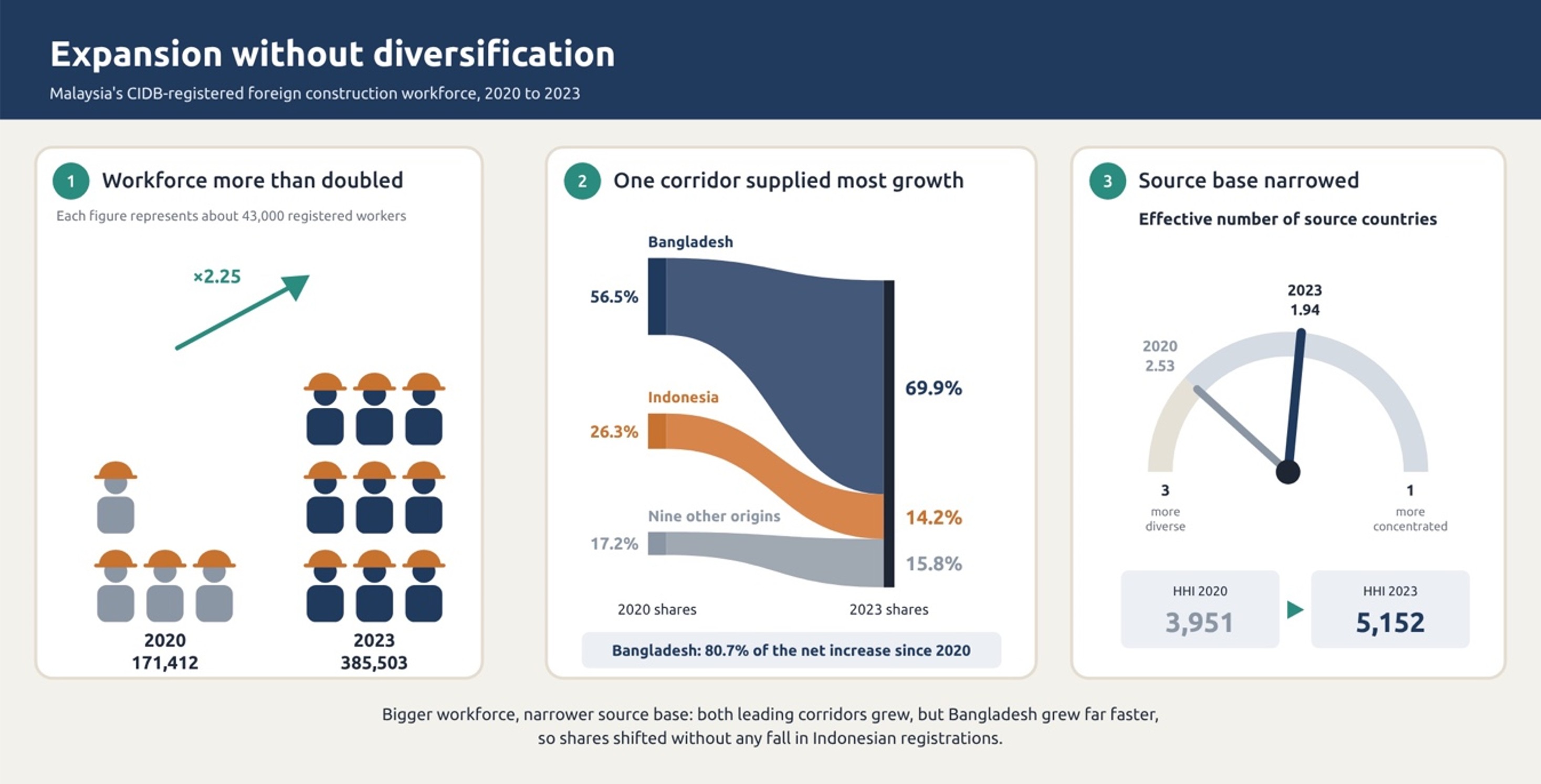
Expansion without diversification: Growth and rising concentration by source country in Malaysia’s registered foreign construction workforce, 2020–2023

Malaysia’s total fertility rate has been below the replacement level since 2013; its population is aging, and non-citizens made up 8.9% of residents in 2023. Construction is one of the sectors that is most dependent on migrant workers. This study examines whether the growth in the foreign construction workforce registered with the Construction Industry Development Board (CIDB) broadened or narrowed its distribution across source countries. Using unpublished country-by-year counts for 11 origin categories supplied by the CIDB, we calculated the annual and compound growth rates, country shares, concentration ratios (CR1 to CR4), Herfindahl–Hirschman index (HHI), entropy-based diversity measures, and a proportional-growth counterfactual. The number of registered workers fell by 17.6% in 2021 and then rose to 385,503 in 2023, which is 2.25 times the 2020 level of 171,412. Bangladesh accounted for 80.7% of the total net increase. The HHI rose from 3,950.7 to 5,151.8, and the effective number of source countries fell from 2.53 to 1.94. Bangladesh’s share rose by 13.4 percentage points, and Indonesia’s fell by 12.1 points; thus, the combined share of the two largest origins (CR2) moved only from 82.8% to 84.2%. The near-constant CR2 concealed a large shift in shares within the leading pair, which arose from differential growth rather than a decline in Indonesian registrations. This pattern holds when the 2021 trough is used as the base year and when the residual category is excluded, and growth is not reliably associated with initial size. In conclusion, the registered workforce expanded without any diversification. Registry counts cannot identify the recruitment, policy, or sending-country processes behind this pattern, and concentration measures do not indicate anticompetitive conduct.
Abdul-Aziz, A.-R. (2001). Foreign workers and labour segmentation in Malaysia’s construction industry. Construction Management and Economics, 19(8), 789–798. https://doi.org/10.1080/01446190110072022
Abdul-Rahman, H., Wang, C., Wood, L. C., & Low, S. F. (2012). Negative impact induced by foreign workers: Evidence in Malaysian construction sector. Habitat International, 36(4), 433–443. https://doi.org/10.1016/j.habitatint.2012.03.002
Adelman, M. A. (1969). Comment on the “H” concentration measure as a numbers-equivalent. The Review of Economics and Statistics, 51(1), 99–101. https://doi.org/10.2307/1926955
Alshboul, O., & Shehadeh, A. (2025). Integrating labor and insurance regulations for enhanced safety and security of construction workers. Journal of Legal Affairs and Dispute Resolution in Engineering and Construction, 17(3), Article 04525021. https://doi.org/10.1061/JLADAH.LADR-1259
Ambulkar, S., Blackhurst, J., & Grawe, S. (2015). Firm’s resilience to supply chain disruptions: Scale development and empirical examination. Journal of Operations Management, 33-34, 111–122. https://doi.org/10.1016/j.jom.2014.11.002
Anderson, B., Khadka, U., & Ruhs, M. (2024). Demand for migrant workers: Institutional system effects beyond national borders. Journal of Ethnic and Migration Studies, 50(5), 1202–1225. https://doi.org/10.1080/1369183X.2023.2279741
Anderson, J. T. (2021). Managing labour migration in Malaysia: Foreign workers and the challenges of ‘control’ beyond liberal democracies. Third World Quarterly, 42(1), 86–104. https://doi.org/10.1080/01436597.2020.1784003
Athukorala, P.-C., & Devadason, E. S. (2012). The impact of foreign labor on host country wages: The experience of a Southern host, Malaysia. World Development, 40(8), 1497–1510. https://doi.org/10.1016/j.worlddev.2012.04.025
Azar, J., Marinescu, I., & Steinbaum, M. (2022). Labor market concentration. Journal of Human Resources, 57(S), S167–S199. https://doi.org/10.3368/jhr.monopsony.1218-9914R1
Bakewell, O. (2014). Relaunching migration systems. Migration Studies, 2(3), 300–318. https://doi.org/10.1093/migration/mnt023
Bollyky, T. J., Graetz, N., Dieleman, J., Miller-Petrie, M. K., Schoder, D., Joyce, S., Guillot, M., & Hay, S. I. (2022). Growing up and moving out: Migration and the demographic transition in low- and middle-income nations. Population Studies, 76(1), 63–80. https://doi.org/10.1080/00324728.2022.2034919
Buckley, P., Pietropaoli, L., Rosada, A., Harguth, B., & Broom, J. (2022). How has COVID-19 affected migrant workers’ vulnerability to human trafficking for forced labour in Southeast Asia? A narrative review. Journal of Public Health and Emergency, 6, Article 19. https://doi.org/10.21037/jphe-21-108
Castles, S. (2004). Why migration policies fail. Ethnic and Racial Studies, 27(2), 205–227. https://doi.org/10.1080/0141987042000177306
Cavalcanti, M., Lessa, L., & Vasconcelos, B. M. (2023). Construction accident prevention: A systematic review of machine learning approaches. Work, 76(2), 507–519. https://doi.org/10.3233/WOR-220533
Chang, H. C., Wang, M. C., Liao, H. C., Cheng, S. F., & Wang, Y. H. (2016). Hazard prevention regarding occupational accidents involving blue-collar foreign workers: A perspective of Taiwanese manpower agencies. International Journal of Environmental Research and Public Health, 13(7), Article 706. https://doi.org/10.3390/ijerph13070706
Chin, C. B. N. (2002). The ‘host’ state and the ‘guest’ worker in Malaysia: Public management and migrant labour in times of economic prosperity and crisis. Asia Pacific Business Review, 8(4), 19–40. https://doi.org/10.1080/713999163
Construction Industry Development Board Malaysia. (n.d.). Construction personnel registration. Retrieved September 25, 2026, from https://www.cidb.gov.my/eng/construction-personnel-registration/
Construction Industry Development Board Malaysia. (2024, August 30). Implementation of the whitening programme for foreign workers in the construction sector. Accessed November 4, 2026. https://www.cidb.gov.my/eng/implementation-of-the-whitening-programme-for-foreign-workers-in-the-construction-sector/
Construction Industry Development Board Malaysia. (2025). Active registered foreign construction personnel by nationality, 2020¨C2023 [Unpublished raw data, supplied on request on January 21, 2025]. Contractor and Construction Personnel Registration Division.
Czaika, M., & de Haas, H. (2014). The globalization of migration: Has the world become more migratory? International Migration Review, 48(2), 283–323. https://doi.org/10.1111/imre.12095
Data Sharing Act 2025, Act 864 (Malaysia). Accessed November 4, 2026. https://www.jdn.gov.my/wp-content/uploads/2025/06/Act-864.pdf
de Haas, H. (2010). The internal dynamics of migration processes: A theoretical inquiry. Journal of Ethnic and Migration Studies, 36(10), 1587–1617. https://doi.org/10.1080/1369183X.2010.489361
de Haas, H. (2021). A theory of migration: The aspirations-capabilities framework. Comparative Migration Studies, 9, Article 8. https://doi.org/10.1186/s40878-020-00210-4
Department of Statistics Malaysia. (2022, July 29). Current population estimates, Malaysia, 2022. Accessed November 4, 2026. https://www.dosm.gov.my/portal-main/release-content/current-population-estimates-malaysia-2022
Department of Statistics Malaysia. (2023, July 31). Current population estimates, Malaysia, 2023. Accessed November 4, 2026. https://www.dosm.gov.my/portal-main/release-content/current-population-estimates-malaysia----2023
Department of Statistics Malaysia. (2025a, July 31). Current population estimates, 2025. Accessed November 4, 2026. https://www.dosm.gov.my/portal-main/release-content/current-population-estimates-2025
Department of Statistics Malaysia. (2025b, October 16). Vital statistics, Malaysia, 2025. Accessed November 4, 2026. https://dosm.gov.my/portal-main/release-content/vital-statistics-malaysia-2025
Department of Statistics Malaysia. (2025c, December 24). International migration statistics, Malaysia, 2025. Accessed November 4, 2026. https://www.dosm.gov.my/portal-main/release-content/international-migration-statistics-malaysia-2025
Devadason, E. S., & Chan, W. M. (2014). Policies and laws regulating migrant workers in Malaysia: A critical appraisal. Journal of Contemporary Asia, 44(1), 19–35. https://doi.org/10.1080/00472336.2013.826420
Duncan, O. D., & Duncan, B. (1955). A methodological analysis of segregation indexes. American Sociological Review, 20(2), 210–217. https://doi.org/10.2307/2088328
Efron, B., & Tibshirani, R. J. (1993). An introduction to the bootstrap. Chapman & Hall. https://doi.org/10.1201/9780429246593
Good, P. I. (2005). Permutation, parametric, and bootstrap tests of hypotheses (3rd ed.). Springer. https://doi.org/10.1007/b138696
Hii, N. L., & Lau, E. (2025). Asymmetric effects of foreign worker employment on sectoral labor productivity: A Malaysian perspective. Economies, 13(5), Article 127. https://doi.org/10.3390/economies13050127
Hirschman, A. O. (1964). The paternity of an index. American Economic Review, 54(5), 761. Accessed November 4, 2026. https://www.jstor.org/stable/1818582
Hugo, G. (1993). Indonesian labour migration to Malaysia: Trends and policy implications. Southeast Asian Journal of Social Science, 21(1), 36–70. https://doi.org/10.1163/030382493X00035
Ibrahim, M. S., & Razali, R. M. (2023). Perceptions of the rights and welfare of foreign workers in Peninsular Malaysia. Pertanika Journal of Social Sciences and Humanities, 31(2), 765–786. https://doi.org/10.47836/pjssh.31.2.15
International Labour Organization. (2024). ILO global estimates on international migrant workers: International migrants in the labour force (4th ed.). https://doi.org/10.54394/ESKI5420
Ivanov, D., & Dolgui, A. (2020). Viability of intertwined supply networks: Extending the supply chain resilience angles towards survivability. A position paper motivated by COVID-19 outbreak. International Journal of Production Research, 58(10), 2904–2915. https://doi.org/10.1080/00207543.2020.1750727
Jiang, H., Luo, Y., Xia, J., Hitt, M., & Shen, J. (2023). Resource dependence theory in international business: Progress and prospects. Global Strategy Journal, 13(1), 3–57. https://doi.org/10.1002/gsj.1467
Jiang, S., Yeung, A. C. L., Han, Z., & Huo, B. (2023). The effect of customer and supplier concentrations on firm resilience during the COVID-19 pandemic: Resource dependence and power balancing. Journal of Operations Management, 69(3), 497–518. https://doi.org/10.1002/joom.1236
Jones, K., Ghimire, A., & Khor, Y. (2024). Living at work: Migrant worker dormitories in Malaysia. Work in the Global Economy, 4(1), 89–108. https://doi.org/10.1332/27324176Y2024D000000018
Jost, L. (2006). Entropy and diversity. Oikos, 113(2), 363–375. https://doi.org/10.1111/j.2006.0030-1299.14714.x
Kaos, J. (2022, March 8). Malaysia will reopen its borders to international travellers on April 1, says PM. The Star. Accessed November 4, 2026. https://www.thestar.com.my/news/nation/2022/03/08/malaysia-will-reopen-its-borders-to-international-travellers-on-april-1-says-pm
Kaur, A. (2010). Labour migration in Southeast Asia: Migration policies, labour exploitation and regulation. Journal of the Asia Pacific Economy, 15(1), 6–19. https://doi.org/10.1080/13547860903488195
Koczan, Z., Pinat, M., & Rozhkov, D. (2021). The impact of international migration on inclusive growth: A review (IMF Working Paper No. 2021/088). International Monetary Fund. https://doi.org/10.5089/9781513571966.001
Korkmaz, S., & Park, D. J. (2018). Comparison of safety perception between foreign and local workers in the construction industry in Republic of Korea. Safety and Health at Work, 9(1), 53–58. https://doi.org/10.1016/j.shaw.2017.07.002
Kumari, A., & Tiwari, M. (2026). Evolution of research on resource dependency theory: A bibliometric exploration of its correlation with the firm’s performance. Kybernetes, 55(9), 4094–4122. https://doi.org/10.1108/K-12-2024-3239
Loganathan, T., Rui, D., & Pocock, N. S. (2020). Healthcare for migrant workers in destination countries: A comparative qualitative study of China and Malaysia. BMJ Open, 10(12), Article e039800. https://doi.org/10.1136/bmjopen-2020-039800
Massey, D. S., Arango, J., Hugo, G., Kouaouci, A., Pellegrino, A., & Taylor, J. E. (1993). Theories of international migration: A review and appraisal. Population and Development Review, 19(3), 431–466. https://doi.org/10.2307/2938462
Mohd Fateh, M. A., Mohamed, M. R., & Omar, S. A. (2022). The involvement of local skilled labour in Malaysia’s construction industry. Frontiers in Built Environment, 8, Article 861018. https://doi.org/10.3389/fbuil.2022.861018
Pettit, T. J., Fiksel, J., & Croxton, K. L. (2010). Ensuring supply chain resilience: Development of a conceptual framework. Journal of Business Logistics, 31(1), 1–21. https://doi.org/10.1002/j.2158-1592.2010.tb00125.x
Pfeffer, J., & Salancik, G. R. (1978). The external control of organizations: A resource dependence perspective. Harper & Row.
Qiu, Y., & Sojourner, A. (2023). Labor-market concentration and labor compensation. ILR Review, 76(3), 475–503. https://doi.org/10.1177/00197939221138759
Radio Televisyen Malaysia. (2023, January 18). Permohonan RTK 2.0 dibuka semula 27 Januari ini. Berita RTM. Accessed November 4, 2026. https://berita.rtm.gov.my/nasional/senarai-berita-nasional/senarai-artikel/permohonan-rtk-2-0-dibuka-semula-27-januari-ini/
Radio Televisyen Malaysia. (2025, January 11). Imigresen nafi pelaksanaan program RTK 3.0. Berita RTM. Accessed November 4, 2026. https://berita.rtm.gov.my/nasional/senarai-berita-nasional/senarai-artikel/imigresen-nafi-pelaksanaan-program-rtk-3-0/
Rajan, S. I., & Arcand, J.-L. (2023). COVID-19 return migration phenomena: Experiences from South and Southeast Asia. Journal of Ethnic and Migration Studies, 49(20), 5133–5152. https://doi.org/10.1080/1369183X.2024.2268963
Rani, H. A., Farouk, A. M., Anandh, K. S., Almutairi, S., & Rahman, R. A. (2022). Impact of COVID-19 on construction projects: The case of India. Buildings, 12(6), Article 762. https://doi.org/10.3390/buildings12060762
Rhoades, S. A. (1993). The Herfindahl-Hirschman index. Federal Reserve Bulletin, 79(3), 188-189. Accessed November 4, 2026. https://fraser.stlouisfed.org/files/docs/publications/FRB/pages/1990-1994/33101_1990-1994.pdf
Ruhs, M., & Chang, H.-J. (2004). The ethics of labor immigration policy. International Organization, 58(1), 69–102. https://doi.org/10.1017/S0020818304581031
Ruhs, M., & Martin, P. (2008). Numbers vs. rights: Trade-offs and guest worker programs. International Migration Review, 42(1), 249–265. https://doi.org/10.1111/j.1747-7379.2007.00120.x
Sha, H., & Khor, Y. (2024). Cross-border mobility, inequality and migration intermediaries: Labour migration from Nepal to Malaysia. International Migration, 62(2), 93–109. https://doi.org/10.1111/imig.13232
Shehadeh, A., & Alshboul, O. (2025). Enhancing occupational safety in construction: Predictive analytics using advanced ensemble machine learning algorithms. Engineering Applications of Artificial Intelligence, 159, Article 111761. https://doi.org/10.1016/j.engappai.2025.111761
Shivakoti, R. (2026). Preparedness and post-pandemic return to Nepal and the Philippines. International Migration, 64(4), Article e70196. https://doi.org/10.1111/imig.70196
Sofiah, A. (2024, October 15). Malaysia’s CIDB launches system to improve management of foreign workers in the construction industry. Human Resources Online. Accessed November 4, 2026. https://www.humanresourcesonline.net/malaysia-s-cidb-launches-system-to-improve-management-of-foreign-workers-in-the-construction-industry
Spaan, E., & van Naerssen, T. (2018). Migration decision-making and migration industry in the Indonesia–Malaysia corridor. Journal of Ethnic and Migration Studies, 44(4), 680–695. https://doi.org/10.1080/1369183X.2017.1315523
Subramaniam, C., Ismail, S., Durdyev, S., Wan Mohd Rani, W. N. M., Abu Bakar, N. F. S., & Banaitis, A. (2021). Overcoming the project communications management breakdown amongst foreign workers during the COVID-19 pandemic in biophilia inveigled construction projects in Malaysia. Energies, 14(16), Article 4790. https://doi.org/10.3390/en14164790
Tan, C. K. L., & Abdul-Samad, Z. (2023). A study of the impact of COVID-19 on construction workforce productivity in Malaysia. International Journal of Productivity and Performance Management, 72(8), 2376–2396. https://doi.org/10.1108/IJPPM-07-2021-0421
The Daily Star. (2024, April 1). Malaysia¡¯s freeze on hiring foreign workers: Big blow for Bangladesh¡¯s aspiring migrant workers. Accessed November 4, 2026. https://www.thedailystar.net/nrb/migration/news/malaysias-freeze-hiring-foreign-workers-big-blow-bangladeshs-aspiring-migrant-workers-3580026
Wahab, A., & Hamidi, M. (2022). COVID-19 pandemic and the changing views of mobility: The case of the Nepal–Malaysia migration corridor. Comparative Migration Studies, 10(1), Article 44. https://doi.org/10.1186/s40878-022-00320-1
World Bank. (n.d.). World Bank country and lending groups. Retrieved September 25, 2026, from https://datahelpdesk.worldbank.org/knowledgebase/articles/906519-world-bank-country-and-lending-groups
Zaidun, N. H., Ayob, N. H., Aziz, M. A., & Samsuil Fuad, M. I. (2023). The practice of collaborative governance in Malaysia’s foreign worker policy. International Journal of Interdisciplinary Civic and Political Studies, 18(2), 79–102. https://doi.org/10.18848/2327-0071/CGP/v18i02/79-102