
Vertical education–job mismatch and worker welfare: Evidence from secondary school graduates in Indonesia

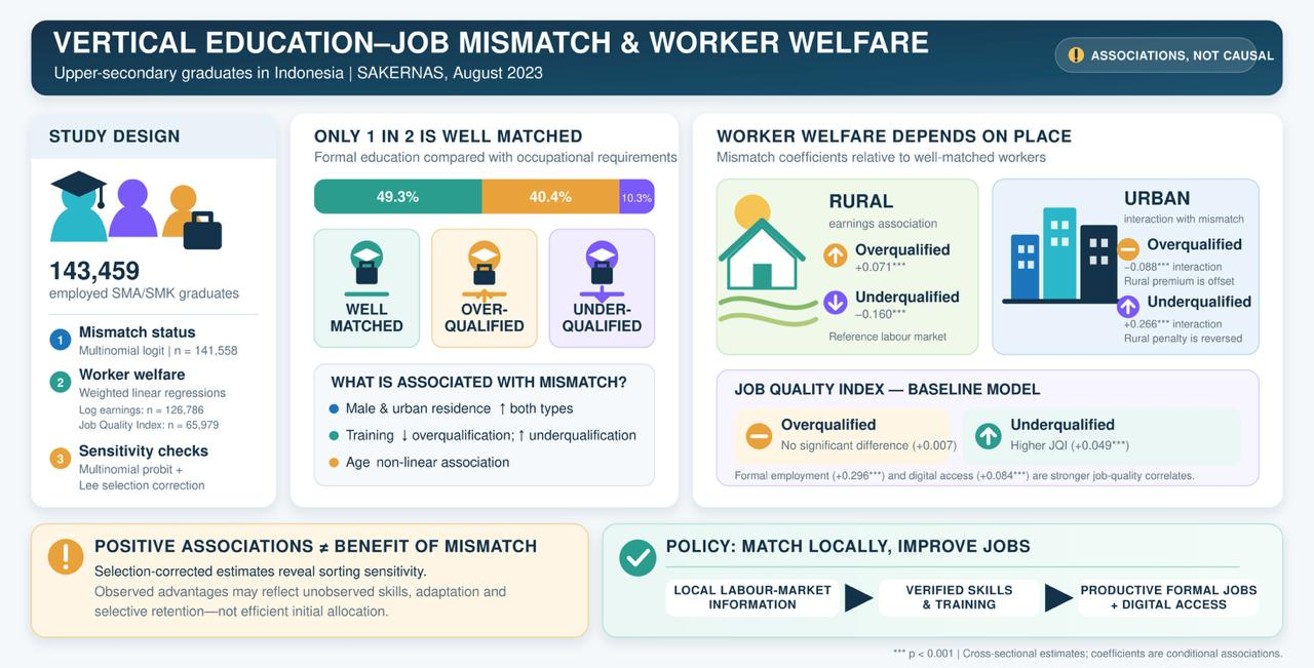
Education–job mismatch is an important labor market concern in developing countries, particularly among upper-secondary graduates navigating heterogeneous urban and rural employment opportunities. This study examines the factors associated with vertical education–job mismatch and the associations between mismatch and worker welfare among graduates of general and vocational upper-secondary schools in Indonesia, with particular attention to urban–rural differences. Using the August 2023 National Labor Force Survey (SAKERNAS), we estimate multinomial logit models for mismatch status and weighted linear regression models for worker welfare outcomes. Results indicate that only 49.3% of workers are well matched; 40.4% are educationally overqualified, and 10.3% are educationally underqualified. Age, gender, training participation, and urban residence are systematically associated with mismatch status. Educational underqualification is positively associated with the Job Quality Index in the baseline model, whereas educational overqualification is not statistically significant. The associations between mismatch and earnings vary across spatial contexts. Educational overqualification is positively associated with earnings in the rural reference group, although this association is offset in urban areas, whereas educational underqualification is negatively associated with rural earnings but positively associated with earnings in urban areas. Multinomial probit estimates are broadly consistent with the multinomial logit results, whereas selection-corrected analyses indicate that the welfare associations are sensitive to non-random sorting across mismatch categories. Favorable outcomes among some mismatched workers may therefore reflect unobserved skills, selective retention, and labor market adaptation rather than efficient initial allocation. The findings suggest that policies should combine locally differentiated worker–job matching systems with measures to improve job quality and expand productive employment opportunities.
Allen, J., & De Weert, E. (2007). What do educational mismatches tell us about skill mismatches? A cross-country analysis. European Journal of Education, 42(1), 59-73. https://doi.org/10.1111/j.1465-3435.2007.00283.x
Allen, J., & van der Velden, R. (2001). Educational Mismatches versus Skill Mismatches: Effects on Wages, Job Satisfaction, and On-the-Job Search. Oxford Economic Papers, 53(3), 434-452. https://doi.org/10.1093/oep/53.3.434
Altonji, J. G., & Pierret, C. R. (2001). Employer learning and statistical discrimination. Quarterly Journal of Economics, 116(1), 313-350. https://doi.org/10.1162/003355301556329
Ananian, S., & Dellaferrera, G. (2024). A study on the employment and wage outcomes of people with disabilities. ILO Working Paper No. 124. International Labour Organization.
Ariansyah, K., Wismayanti, Y. F., Savitri, R., Listanto, V., Aswin, A., Ahad, M. P. Y., & Cahyarini, B. R. (2024). Comparing labour market performance of vocational and general school graduates in Indonesia: insights from stable and crisis conditions. Empirical Research in Vocational Education and Training, 16(1). https://doi.org/10.1186/s40461-024-00160-6
Becker, G. S. (1964). Human capital: A theoretical and empirical analysis, with special reference to education. Columbia University Press.
Blanck, J. M., Brzinsky-Fay, C., & Powell, J. J. W. (2025). Special NEETs: Institutional Influences on School-to-Work Transitions of Young People with Disabilities in Europe. Work, Employment and Society. https://doi.org/10.1177/09500170251361814
Blázquez Cuesta, M., Pérez Navarro, M. A., & Sánchez-Mangas, R. (2025). Overeducation under different macroeconomic conditions: How Spanish university graduates fit in the labor market? Journal of Policy Modeling, 47(2), 448-470. https://doi.org/10.1016/j.jpolmod.2024.10.001
Botezat, A., Incaltarau, C., Diac, S. A., & Grosu, A. C. (2024). Having your career path decided too early: the effects of high school track on education-occupation mismatch. International Journal of Manpower, 45(6), 1171-1190. https://doi.org/10.1108/IJM-03-2023-0123
Capsada‐Munsech, Q. (2017). Overeducation: Concept, theories, and empirical evidence. Sociology Compass, 11(10), e12518. https://doi.org/10.1111/soc4.12518
Choi, S., Li, H., Ogawa, K., & Tanaka, Y. (2024). Secondary vocational education and decent work in Indonesia: differences between urban and rural areas. International Journal of Training Research, 22(2), 125-146. https://doi.org/10.1080/14480220.2023.2222939
Cortadas-Guasch, P. (2024). Analysis of the factors determining educational mismatches: Evidence from the Catalonian employment insertion surveys. International Journal of Manpower, 45(10), 77-95. https://doi.org/10.1108/IJM-09-2023-0540
Di Stasio, V. (2017). Who Is Ahead in the Labour Queue? Institutions’ and Employers’ Perspective on Overeducation, Undereducation, and Horizontal Mismatches. Sociology of Education, 90(2), 109-126. https://doi.org/10.1177/0038040717694877
Farber, H. S., & Gibbons, R. (1996). Learning and wage dynamics. Quarterly Journal of Economics, 111(4), 1007-1047. https://doi.org/10.2307/2946706
Green, F., & McIntosh, S. (2007). Is there a genuine under-utilization of skills amongst the over-qualified? Applied Economics, 39(4), 427-439. https://doi.org/10.1080/00036840500427700
Green, F., & Zhu, Y. (2010). Overqualification, job dissatisfaction, and increasing dispersion in the returns to graduate education. Oxford Economic Papers, 62(4), 740-763, https://doi.org/10.1093/oep/gpq002
Hakim, D. R., & Rosini, I. (2026). The Effect of Vertical Educational Mismatch on Wages: Evidence from Indonesia’s Waged Sector. Thailand and the World Economy, 44(1), 176-215. https://so05.tci-thaijo.org/index.php/TER/article/view/272532
Hartog, J. (2000). Over-education and earnings: Where are we, where should we go? Economics of Education Review, 19(2), 131-147. https://doi.org/10.1016/S0272-7757(99)00050-3
Indrawati, S. M., & Kuncoro, A. (2021). Improving Competitiveness Through Vocational and Higher Education: Indonesia’s Vision For Human Capital Development In 2019–2024. Bulletin of Indonesian Economic Studies, 57(1), 29-59. https://doi.org/10.1080/00074918.2021.1909692
Jerez-Gómez, M. P., Bojica, A., Martínez-del-Río, J., & Karaja, R. (2023). Designing successful internships: Exploring the role of duration, formalization and motivational practices. Education + Training, 65(3), 433-453. https://doi.org/10.1108/ET-12-2021-0480
Kang, C., & Hong, S. (2025). Educational mismatch, skills, and wage penalty: Evidence from US heterogeneous labor. SAGE Open, 15(4), 21582440251383620. https://doi.org/10.1177/21582440251383620
Khoiruddin, M. A., Setyanti, A. M., Suman, A., Prasetyia, F., & Susilo, S. (2024). Exploring determinants of education-job mismatch among educated workers in Indonesia. Jurnal Ekonomi Pembangunan: Kajian Masalah Ekonomi dan Pembangunan, 25(2), 263-281. https://doi.org/10.23917/jep.v25i2.23994
Kim, S.-J., & Choi, S. O. (2018). The effects of job mismatch on pay, job satisfaction, and performance. Journal of Open Innovation: Technology, Market, and Complexity, 4(4). https://doi.org/10.3390/joitmc4040049
Lu, Y., Li, X., & Ciocca Eller, C. (2026). Underemployed and Penalized: Education–Occupation Mismatch and Racial/Ethnic Inequality among Highly Educated Workers. Sociology of Education, 99(1), 59-81. https://doi.org/10.1177/00380407251356275
McGowan, M. A., & Andrews, D. (2017). labour market mismatch and labour productivity: Evidence from piaac data. Research in labor Economics, 45, 199-241. https://doi.org/10.1108/S0147-912120170000045006
McGuinness, S. (2006). Overeducation in the labour market. Journal of Economic Surveys, 20(3), 387-418. https://doi.org/10.1111/j.0950-0804.2006.00284.x
McGuinness, S., Pouliakas, K., & Redmond, P. (2018). Skills mismatch: Concepts, measurement and policy approaches. Journal of Economic Surveys, 32(4), 985-1015. https://doi.org/10.1111/joes.12254
Mimani, P. (2025). Essays on the role of information frictions in labour market dynamics: A search and matching model perspective (Doctoral dissertation, European University Institute). European University Institute Research Repository. https://cadmus.eui.eu/bitstreams/f34854f7-7afd-4306-9d94-10a5561fdc13/download
Mortensen, D. T., & Pissarides, C. A. (1999). New developments in models of search in the labor market. Handbook of Labor Economics, 3, 2567-2627. https://doi.org/10.1016/S1573-4463(99)30025-0
Putranto, F. G. F., Pratomo, D. S., & Pudjihardjo, M. (2024). Where Did Young Workers Go? The Increase of Youth NEET in Indonesia During Pandemic. Jurnal Ekonomi Kependudukan dan Keluarga, 1(2), 143-155, https://doi.org/10.7454/jekk.v1i2.1039
Rocha, A. B., Figueiredo, H., Sá, C., & Portela, M. (2025). Mismatch matters: education and productivity in laggard and frontier firms. Journal of Productivity Analysis, 64(2), 189-208. https://doi.org/10.1007/s11123-025-00772-4
Santoso, R. P., Sahadewo, G. A., Sugiyanto, C., & Setiastuti, S. U. (2022). Informal and Formal Wage Differences Based on Cohorts in Indonesia. Economies, 10(12), 317. https://doi.org/10.3390/economies10120317
Sattinger, M. (2012). Assignment models and quantitative mismatches. In Prepared for the Expert Workshop” Skill Mismatch and Firm Dynamics: Integrating Skills with the World of Work,” April (Vol. 27). https://melbourneinstitute.unimelb.edu.au/assets/documents/hilda-bibliography/conference-papers-lectures/2012/Sattinger_Assignment_Models_and_Quantitative_Mismatches.pdf
Spence, M. (1973). Job market signaling. Quarterly Journal of Economics, 87(3), 355-374. https://doi.org/10.2307/1882010
Tobback, I., Verhaest, D., & Baert, S. (2024). Internships, hiring outcomes and underlying mechanisms: A stated preferences experiment. De Economist, 172(1), 25-48. https://doi.org/10.1007/s10645-023-09432-0
Wardani, L. M. I., Syaputra, R. D., Malek, M. D. A., Risnawati, E., Kartikawati, M. S., Sekarini, D. A., Dawanti, R., Putri, P. K., Aprianti, M., & Irmawan, D. (2024). I Am Mismatched, I Am Doing Well: Horizontal Job-Education Mismatches and Workers’ Well-Being. Dirasat: Human and Social Sciences, 51(3), 128-142. https://doi.org/10.35516/hum.v51i3.408
Xiao, W., Wei, Y. D., & Chen, W. (2023). Skills mismatch, jobs-housing relationship and urban commuting. Travel Behaviour and Society, 33, 100610. https://doi.org/10.1016/j.tbs.2023.100610
Yin, Y., & Wang, C. (2026). Overeducation, vertical skill mismatch, and employment outcomes among Chinese university graduates: The mediating role of skill utilization. Frontiers in Psychology, 17, 1859874. https://doi.org/10.3389/fpsyg.2026.1859874