
Physics-informed machine learning for material characterization: A perspective on data-efficient discovery through physics-informed neural networks

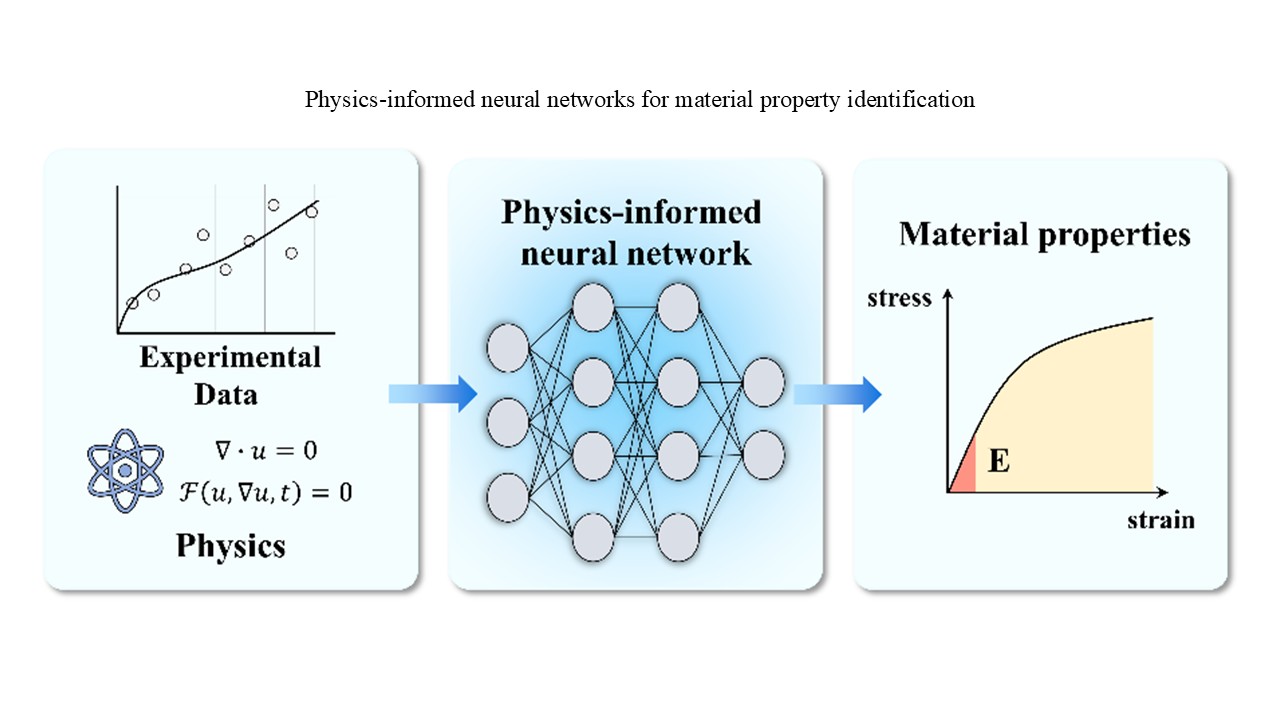
Accurate characterization of material properties is critical for modeling and optimizing advanced systems, yet conventional experimental and simulation-based approaches remain costly and data-intensive. As artificial intelligence evolves from data-driven modeling to physics-informed and knowledge-guided paradigms, this perspective article highlights the role of physics-informed machine learning (PIML), specifically physics-informed neural networks (PINNs), as a key enabler of data-efficient, physically consistent inference. PINNs embed governing equations into the learning process and have demonstrated strong capability in recovering constitutive and transport parameters from sparse or noisy data while preserving physical fidelity. This paper examines the fundamental structure, workflow integration, and recent advances of PINNs in the context of inverse material characterization. It also discusses open challenges in computational cost, training stability, and uncertainty quantification. Looking forward, integration with digital twins, generative modeling, and autonomous experimentation presents a pathway toward interpretable, adaptive, and automated characterization for next-generation intelligent manufacturing.
- Lee H, Moon H, Lee J, Ryu S. Toward knowledge-guided AI for inverse design in manufacturing: A perspective on domain, physics, and human-AI synergy. Adv Intell Discov. 2025:e202500107. doi: 10.1002/aidi.202500107.
- Lee J, Park D, Lee M, et al. Machine learning-based inverse design methods considering data characteristics and design space size in materials design and manufacturing: A review. Mater Horiz. 2023;10(12):5436-5456. doi: 10.1039/d3mh00039g
- Bommasani R, Hudson DA, Adeli A, et al. On the Opportunities and Risks of Foundation Models. arXiv [Preprint]; 2021. doi: 10.48550/arXiv.2108.07258
- Karpatne A, Atluri G, Faghmous JH, et al. Theory-guided data science: A new paradigm for scientific discovery from data. IEEE Trans Knowl Data Eng. 2017;29(10):2318-2331. doi: 10.1109/tkde.2017.2720168
- Fuhg JN, Padmanabha GA, Bouklas N, et al. A review on data-driven constitutive laws for solids. Arch Comput Methods Eng. 2025;32:1841-1883. doi: 10.1007/s11831-024-10196-2
- Kirchdoerfer T, Ortiz M. Data-driven computational mechanics. Comput Methods Appl Mech Eng. 2016;304: 81-101. doi: 10.1016/j.cma.2016.02.001
- Zheng X, Zhang X, Chen TT, Watanabe I. Deep learning in mechanical metamaterials: From prediction and generation to inverse design. Adv Mater. 2023;35(45):e2302530. doi: 10.1002/adma.202302530
- Zeni C, Pinsler R, Zügner D, et al. A generative model for inorganic materials design. Nature. 2025;639(8055):624-632. doi: 10.1038/s41586-025-08628-5
- Karniadakis GE, Kevrekidis IG, Lu L, Perdikaris P, Wang S, Yang L. Physics-informed machine learning. Nat Rev Phys. 2021;3(6):422-440. doi: 10.1038/s42254-021-00314-5
- Meng C, Griesemer S, Cao D, Seo S, Liu Y. When physics meets machine learning: A survey of physics-informed machine learning. Mach Learn Comput Sci Eng. 2025;1(1):1-23. doi: 10.1007/s44379-025-00016-0
- Achiam J, Adler S, Agarwal S, et al. GPT-4 Technical Report. arXiv [Preprint]; 2023. doi: 10.48550/arxiv.2303.08774
- Lee J, Kim JY, Kim H, Lee I, Ryu S. IM-Chat: A Multi-Agent LLM Framework Integrating Tool-Calling and Diffusion Modeling for Knowledge Transfer in Injection Molding Industry. arXiv [Preprint]; 2025. doi: 10.48550/arXiv.2507.15268
- Park D, Moon H, Ryu S. A Self-Correcting Multi-Agent Framework for Language-based Physics Simulation and Explanation. engrXiv [Preprint]; 2025. doi: 10.31224/4723
- Batzner S, Musaelian A, Sun L, et al. E(3)-equivariant graph neural networks for data-efficient and accurate interatomic potentials. Nat Commun. 2022;13(1):2453. doi: 10.1038/s41467-022-29939-5
- Lu L, Jin P, Pang G, Zhang Z, Karniadakis GE. Learning nonlinear operators via DeepONet based on the universal approximation theorem of operators. Nat Mach Intell. 2021;3(3):218-229. doi: 10.1038/s42256-021-00302-5
- Carlsson LA, Adams DF, Pipes RB. Experimental Characterization of Advanced Composite Materials. Boca Raton: CRC Press; 2014. doi: 10.1201/b16618
- Kefal A, Oterkus E. Displacement and stress monitoring of a Panamax containership using inverse finite element method. Ocean Eng. 2016;119:16-29. doi: 10.1016/j.oceaneng.2016.04.025
- Nyshadham C, Rupp M, Bekker B, et al. Machine-learned multi-system surrogate models for materials prediction. NPJ Comput Mater. 2019;5(1):51. doi: 10.1038/s41524-019-0189-9
- Willard J, Jia X, Xu S, Steinbach M, Kumar V. Integrating Physics-based Modeling with Machine Learning: A Survey. arXiv [Preprint]; 2020. doi: 10.48550/arXiv.2003.04919
- Zhong X, Gallagher B, Liu S, Kailkhura B, Hiszpanski A, Han TYJ. Explainable machine learning in materials science. NPJ Comput Mater. 2022;8(1):204. doi: 10.1038/s41524-022-00884-7
- Sun L, Gao H, Pan S, Wang JX. Surrogate modeling for fluid flows based on physics-constrained deep learning without simulation data. Comput Methods Appl Mech Eng. 2020;361:112732. doi: 10.1016/j.cma.2019.112732
- Gültekin O, Moeineddin A, Cansız B, Sveric K, Linke A, Kaliske M. A physics-informed neural network model for the anisotropic hyperelasticity of the human passive myocardium. Int J Numer Methods Eng. 2025;126(14):e70067. doi: 10.1002/nme.70067
- Yu J, Lu L, Meng X, Karniadakis GE. Gradient-enhanced physics-informed neural networks for forward and inverse PDE problems. Comput Methods Appl Mech Eng. 2022;393:114823. doi: 10.1016/j.cma.2022.114823
- Moon H, Cho H, Demeke W, Ryu B, Ryu S. Thermal Conductivity Estimation of Thermoelectric Materials with Uncertainty Quantification using Bayesian Physics-Informed Neural Networks. arXiv [Preprint]; 2025. doi: 10.48550/arxiv.2510.16723
- Moon H, Park D, Yeo J, Ryu S. Physics-Informed Neural Network Framework for Solving Forward and Inverse Flexoelectric Problems. arXiv [Preprint]; 2025. doi: 10.48550/arXiv.2506.21810
- Moon H, Park D, Cho H, Noh HK, Ryu S. Physics-informed neural network-based discovery of hyperelastic constitutive models from extremely scarce data. Comput Methods Appl Mech Eng. 2025;439:118258. doi: 10.1016/j.cma.2025.118258
- Moon H, Lee S, Demeke W, Ryu B, Ryu S. Physics-informed neural operators for generalizable and label-free inference of temperature-dependent thermoelectric properties. NPJ Comput Mater. 2025;11(1):272. doi: 10.1038/s41524-025-01769-1
- Li P, Grana D, Liu M. Bayesian neural network and Bayesian physics-informed neural network via variational inference for seismic petrophysical inversion. Geophysics. 2024;89(6):M185-M196. doi: 10.1190/geo2023-0737.1
- Wang R, Kong W, Liu X, et al. A physics-informed Bayesian neural network model for probabilistic prediction of fatigue crack growth rate at different temperatures. Int J Fatigue. 2025;201:109184. doi: 10.1016/j.ijfatigue.2025.109184
- Bastek JH, Sun W, Kochmann DM. Physics-Informed Diffusion Models. arXiv [Preprint]; 2024. doi: 10.48550/arXiv.2403.14404
- Wang F, Zhai W, Zhao S, Man J. A novel unsupervised PINN framework with dynamically self-adaptive strategy for solid mechanics. J Comput Phys. 2025;542:114373. doi: 10.1016/j.jcp.2025.114373
- Rathore P, Lei W, Frangella Z, Lu L, Udell M. Challenges in Training PINNs: A Loss Landscape Perspective. arXiv [Preprint]; 2024. doi: 10.48550/arXiv.2402.01868
- Lardy M, Tlili S, Gsell S. Inferring viscoplastic models from velocity fields: A physics-informed neural network approach. J Non Newton Fluid Mech. 2025;346:105512. doi: 10.1016/j.jnnfm.2025.105512
- Liu Y, Chen M, Zeng Q. Physics-informed identification of stress fields and thermo-viscoplastic model parameters for metals from full-field data under impact loading. Comput Methods Appl Mech Eng. 2026;449:118568. doi: 10.1016/j.cma.2025.118568
- He X, You L, Tian H, Han B, Tsang I, Ong YS. Lang-PINN: From Language to Physics-Informed Neural Networks Via a Multi-Agent Framework. arXiv [Preprint]; 2025. doi: 10.48550/arXiv.2510.05158
- Qi Y, Xu R, Chu X. FeaGPT: An End-to-End Agentic-AI for Finite Element Analysis. arXiv [Preprint]; 2025. doi: 10.48550/arxiv.2510.21993
- Jiang Q, Karniadakis G. AgenticSciML: Collaborative Multi- Agent Systems for Emergent Discovery in Scientific Machine Learning. arXiv [Preprint]; 2025. doi: 10.48550/arXiv.2511.07262