
Design of speculative artifacts: Integrating generative artificial intelligence, biomaterials, and digital fabrication in co-creative and participatory design

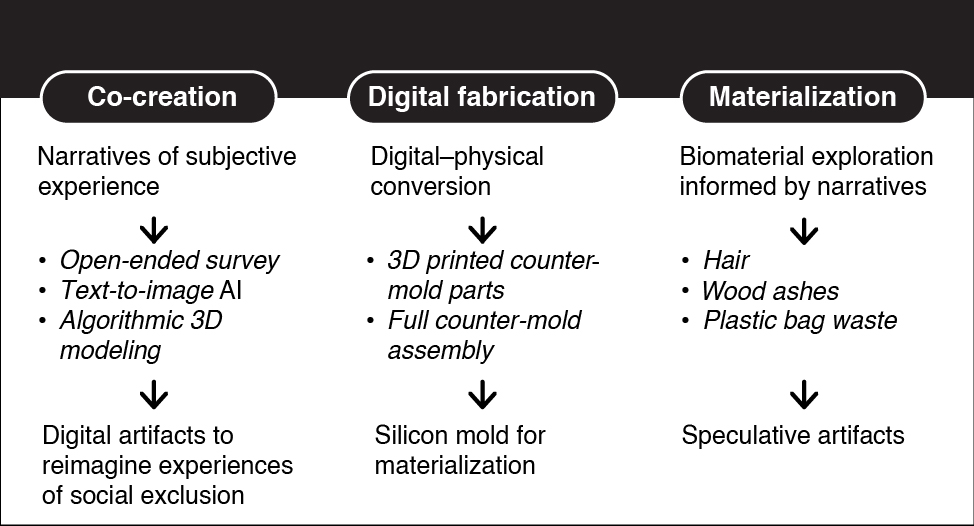
This study explores artificial intelligence (AI)-mediated participatory design integrating biomaterials and digital fabrication to co-create speculative artifacts grounded in lived experiences. The present study involves experimentation with biomaterials, exploring the intersection of image-based generative AI, participatory, and co-creative methodologies within a design framework that reimagines lived experiences shaped by identity-based exclusionary processes. Rather than pursuing AI-driven discovery of new materials, this study positions design as a mediating process among human experience, critical reflection, biomaterial exploration, and digital fabrication. The research introduces a three-stage workflow (co-creation, fabrication, and materialization) that employs AI as a mediating tool between subjective narratives and tangible speculative artifacts. During the co-creation stage, participants shared their personal experiences through open-ended surveys, text-to-image generative AI visualization, and algorithmic three-dimensional (3D) modeling. This process enabled participants to speculatively reimagine lived experiences of social exclusion, demonstrating how AI can support new modes of participatory and social engagement. During the fabrication stage, digital models were translated into physical counter-molds through 3D printing and subsequently cast in silicon, reaffirming the reciprocal relationship between digital and craft-based production. The materialization stage explored biomaterial compositions informed by participants’ narratives and materialities, incorporating hair, wood ash, and plastic waste into biomaterial compositions grounded in circular economy principles. The resulting artifacts function as speculative objects that incite interpretation beyond fixed symbolic representation. This study contributes to ongoing discussions in digital fabrication, material design, and critical craft by demonstrating how AI-mediated participatory co-creation can foster ethically conscious, socially engaged, and materially grounded design practices. Future work may extend this approach to larger collective settings and further explore the integration of biomaterials and AI within ecological and inclusive design frameworks.
- Ng WL, Goh GL, Goh GD, Ten JSJ, Yeong WY. Progress and opportunities for machine learning in materials and processes of additive manufacturing. Adv Mater. 2024;36(34):2310006. doi: 10.1002/adma.202310006
- Friedrich J, Brückner A, Mayan J, Schumann S, Kirschenbaum A, Zinke-Wehlmann C. Human-centered AI development in practice-insights from a multidisciplinary approach. Z Arb Wiss. 2024;78(3):359-376. doi: 10.1007/s41449-024-00434-5
- Guo K, Yang Z, Yu CH, Buehler MJ. Artificial intelligence and machine learning in design of mechanical materials. Mater Horiz. 2021;8(4):1153-1172. doi: 10.1039/D0MH01451F
- Bai X, Zhang X. Artificial intelligence-powered materials science. NanoMicro Lett. 2025;17(1):135. doi: 10.1007/s40820-024-01634-8
- Hang R, Yao X, Bai L, Hang R. Evolving biomaterials design from trial and error to intelligent innovation. Acta Biomater. 2025;197:29-47. doi: 10.1016/j.actbio.2025.03.013
- Bryan-Kinns N, Liu Y, Zhang D, Tan Z, Tan H. The role of digital technologies in contemporary craft practice from UK-China insights. J Contemp Chin Art. 2024;11(1):75-93. doi: 10.1386/jcca_00093_1
- Sanoff H. Participatory design. J Des Plan Aesthet Res. 2022;1(2):1-12. doi: 10.55755/DepArch.2022.8
- Gautam A. Reconfiguring participatory design to resist AI realism. Assoc Comp Mach. 2024;2:31-36. doi: 10.1145/3661455.3669867
- Buš P, Dong Z. DeepCraft: Imitation learning method in a cointelligent design to production process to deliver architectural scenarios. Archit Intell. 2024;3(1):12. doi: 10.1007/s44223-024-00055-2
- Buš P. DeepCraft: Co-intelligent architecture and human and ai-driven craftsmanship in design-to-production pipelines. In: Yan C, Chai H, Sun T, Yuan PF, editors. Phygital Intelligence. Singapore: Springer Nature; 2024. p. 368-378. doi: 10.1007/978-981-99-8405-3_31
- Song MJ. Craftspeople’s new identity: The impact of digital fabrication technologies on craft practices. Int J Technol Des Educ. 2022;32(4):2365-2383. doi: 10.1007/s10798-021-09687-1
- Vartiainen H, Tedre M. Using artificial intelligence in craft education: Crafting with text-to-image generative models. Digit Creat. 2023;34(1):1-21. doi: 10.1080/14626268.2023.2174557
- Messer U. Co-creating art with generative artificial intelligence: Implications for artworks and artists. Comput Hum Behav Artif Hum. 2024;2(1):100056. doi: 10.1016/j.chbah.2024.100056
- Gokcekuyu Y, Ekinci F, Guzel MS, Acici K, Aydin S, Asuroglu T. Artificial intelligence in biomaterials: A comprehensive review. Appl Sci. 2024;14(15):6590. doi: 10.3390/app14156590
- Chandrasekaran S, Stojcevski A, Littlefair G, Joordens M. Project-oriented design-based learning: Aligning students’ views with industry needs. Int J Eng Educ. 2013;29(5):1109-1118.
- Gomes Â, Rangel B, Carneiro V, Lino J. “Learning by Doing” integrated project design in a master program on product and industrial design. In: Nascimento MM, Alves GR, Morais EVA, editor. Contributions to Higher Engineering Education. Singapore: Springer; 2018. p. 105-134. doi: 10.1007/978-981-10-8917-6_5
- Schoch K, Bickel M, Liedtke C, Hemmert F. Circular economy from scratch: A novel project-based learning method to increase motivation in metal recycling among industrial design students. MethodsX. 2025;14:103137. doi: 10.1016/j.mex.2024.103137
- Den Hollander MC, Bakker CA, Hultink EJ. Product design in a circular economy: Development of a typology of key concepts and terms. J Ind Ecol. 2017;21(3):517-525. doi: 10.1111/jiec.12610
- Alves JL, Alexandre R, Lopes L. Competencias convergentes de los estudiantes: Experiencia educativa con futuros diseñadores industriales e ingenieros mecánicos [Students’ converging skills: Educational experience with future industrial designers and mechanical engineers]. Cuad Cent Estud En Diseño Comun Ens. 2022;(166):231-238. doi: 10.18682/cdc.vi166.7055
- Alves JL, Facca CA, Fernandes AP, Rangel B, Barbosa AM. Interdisciplinariedad entre diseño e ingeniería: Nuevas competencias en la docencia de proyectos para la innovación circular [Interdisciplinarity between design and engineering: New skills in teaching projects for circular innovation]. Cuad Cent Estud En Diseño Comun Ens. 2020;(114):179-203. doi: 10.18682/cdc.vi114.4121
- Guo X, Xiao Y, Wang J, Ji T. Rethinking designer agency: A case study of co-creation between designers and AI. Int Assoc Soc Des Res. 2023;170:1-18. doi: 10.21606/iasdr.2023.478
- Simonsen J, Robertson T. Routledge International Handbook of Participatory Design. 1st ed. Routledge; 2013. Available from: https:// www.taylorfrancis.com/books/edit/10.4324/9780203108543/routledge-international-handbook-participatory-design-jesper-simonsen-toni-robertson [Last accessed on 2025 Aug 22].
- Bossen C, Dindler C, Iversen OS. Evaluation in participatory design: A literature survey. Assoc Comp Mach. 2016;1:151-160. doi: 10.1145/2940299.2940303
- Smith RC, Bossen C, Kanstrup AM. Participatory design in an era of participation. Int J CoCreat Des Arts. 2017;13(2):65-69. doi: 10.1080/15710882.2017.1310466
- Sanders EBN, Stappers PJ. Co-creation and the new landscapes of design. Int J CoCreat Des Arts. 2008;4(1):5-18. doi: 10.1080/15710880701875068
- Roberts DL, Darler W. Consumer co-creation: An opportunity to humanise the new product development process. Int J Mark Res. 2017;59(1):13-33. doi: 10.2501/IJMR-2017-003
- Ramaswamy V, Ozcan K. What is co-creation? An interactional creation framework and its implications for value creation. J Bus Res. 2018;84:196-205. doi: 10.1016/j.jbusres.2017.11.027
- Hyysalo S, Dorta T. Design participation and codesign: New forms, application domains, and representational systems. Designing. 2025;1(1):24-31. doi: 10.1177/30497671251392167
- Oppenlaender J. The Creativity of Text-to-Image Generation. New York: Association for Computing Machinery; 2022. p. 192-202. doi: 10.1145/3569219.3569352
- Heidegger M. The Question Concerning Technology and Other Essays. New York: Garland Publishing; 1977. Available from: https://monoskop.org/images/4/44/Heidegger_ Martin_The_Question_Concerning_Technology_and_Other_Essays.pdf [Last accessed on 2025 Dec 08].
- Thomson, ID. Heidegger on technology’s danger and promise in the age of AI. In: Elements in the Philosophy of Martin Heidegger. United Kingdom: Cambridge University Press; 2025. doi: 10.1017/9781009629423
- Afonso JA, Alves JL, Caldas G, Gouveia BP, Santana L, Belinha J. Influence of 3D printing process parameters on the mechanical properties and mass of PLA parts and predictive models. Rapid Prototyp J. 2021;27(3):487-495. doi: 10.1108/RPJ-03-2020-0043
- Alves JL, São Simão M, Neto RJL, Duarte TMGP. PROTOCLICK - Pro totipagem Rápida. Protoclick; 2001.
- Liravi F, Toyserkani E. Additive manufacturing of silicone structures: A review and prospective. Addit Manuf. 2018;24:232-242. doi: 10.1016/j.addma.2018.10.002
- Giantini G, Lopes L, Alves JL. Biotextiles de residuos de la industria alimenticia: Una experiencia de Biodiseño para tote bags sostenibles [Biotextiles from the waste of the food industry: A biodesign experience for sustainable tote bags]. Base Diseño E Innov. 2022;7(7):71-88. doi: 10.52611/bdi.num7.2022.792
- Heidegger M. Off the Beaten Track; 2002. Available from: https://www.cambridge.org/ag/universitypress/subjects/philosophy/philosophy-texts/heidegger-beaten-track?format=PB [Last accessed on 2025 Nov 17].
- Merleau-Ponty M. Phénoménologie de La Perception [Phenomenology of Perception]. 3rd ed., Vol. 10. Gallimard; 1945.