
Effects of the multicomponent nutraceutical (Reverse®) in Wistar rats with atherogenic obesity induced by saturated fat from Cocos nucifera L.: A preclinical cardiometabolic evaluation

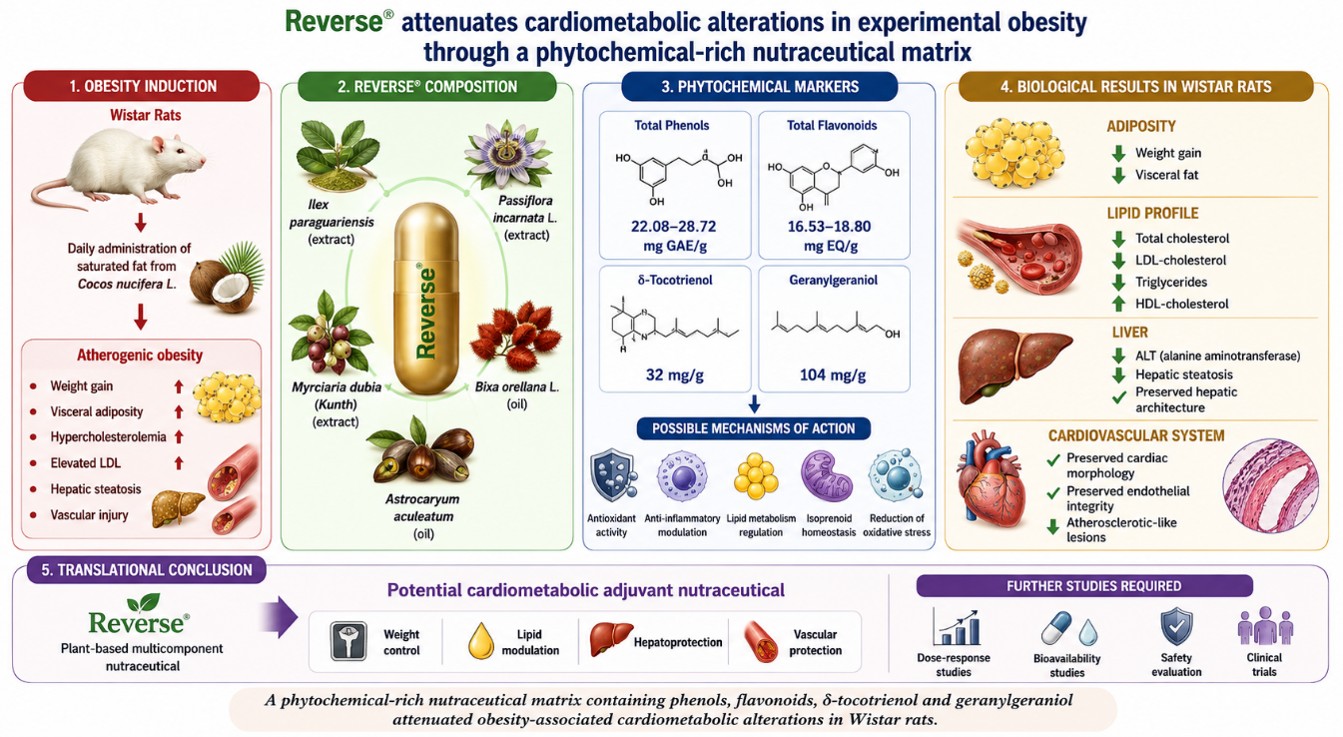
Obesity is a chronic, multifactorial, and relapsing disease associated with inflammation, oxidative stress, dyslipidemia, insulin resistance, and increased cardiovascular risk, prompting investigation of safe plant-based nutraceutical formulations containing phenolic compounds, flavonoids, and isoprenoids as complementary strategies to modulate metabolic alterations associated with excess adiposity. This study evaluates the phytochemical profile of the multicomponent nutraceutical Reverse® and its therapeutic effects on male Wistar rats subjected to a short-term dietary challenge model with saturated fat from Cocos nucifera L., which induces acute metabolic stress and dyslipidemia. The formulation was characterized by spectrophotometric determination of total phenols and total flavonoid contents and by gas chromatography–mass spectrometry determination of δ-tocotrienol and geranylgeraniol. The animals were divided into six experimental groups (n = 5/group): negative control (CNE), metformin (MET), Reverse® with Bixa orellana at 300 mg/kg (CBA) and 600 mg/kg (CBB), and Reverse® without B. orellana at 300 mg/kg (SBA) and 600 mg/kg (SBB). We evaluated weight gain, abdominal fat, organ weights, biochemical parameters (lipid profile, alanine aminotransferase [ALT], aspartate aminotransferase), histopathologic findings, and aortic scanning electron microscopy findings. Reverse® presented 22.08–28.72 mg GAE/g of total phenols, 16.53–18.80 mg EQ/g of total flavonoids, 32.0 mg/g of δ-tocotrienol, and 104.0 mg/g of geranylgeraniol. In the treated groups, weight gain, abdominal fat, total and LDL cholesterol levels, and ALT were reduced; triglyceride levels were modulated; and hepatic, cardiac, and vascular histomorphology was preserved compared with CNE. The findings demonstrate that Reverse® has a phytochemical composition consistent with cardiometabolic protective activity and exhibits significant potential as an adjuvant nutraceutical to modulate diet-induced acute metabolic dysfunctions by improving lipid profiles, reducing adiposity, and preserving organ morphology. However, due to limited sample size, further dose–response curve, bioavailability, safety, and clinical validation studies are needed before making therapeutic inferences in humans.
- Blüher M. Obesity: global epidemiology and pathogenesis. Nat Rev Endocrinol. 2019;15(5):288-298. doi: 10.1038/s41574-019-0176-8
- World Health Organization. Obesity and overweight. Posted December 8, 2025. Accessed August 4, 2026. https://www.who.int/news-room/fact-sheets/detail/obesity-and-overweight
- Parums DV. Editorial: global obesity rates continue to rise with challenges for new drug treatments, including GLP-1 receptor agonists. Med Sci Monit. 2025;31:e950816. doi: 10.12659/MSM.950816
- Ellulu MS, Patimah I, Khaza'ai H, Rahmat A, Abed Y. Obesity and inflammation: the linking mechanism and the complications. Arch Med Sci. 2017;13(4):851-863. doi: 10.5114/aoms.2016.58928
- Klisic A, Patoulias D, Isenovic ER. Editorial: oxidative stress and inflammation in cardiometabolic disorders. Front Endocrinol (Lausanne). 2024;15:1397836. doi: 10.3389/fendo.2024.1397836
- Ministry of Health, Brazil. Clinical Protocol and Therapeutic Guidelines for the Comprehensive Care of Overweight and Obese Adults. Brasília, Brazil: Ministry of Health; 2020. Accessed August 4, 2026. https://www.gov.br/conitec/pt-br/midias/protocolos/20201113_pcdt_sobrepeso_e_obesidade_em_adultos_29_10_2020_final.pdf
- Dias BP, Dantas HVP, Barros Neto J, et al. From the Amazon to modern pharmacology: medicinal plants as metabolic and cardiovascular modulators in cardiodiabesity. Inflammopharmacology. 2025;33(8):4355-4368. doi: 10.1007/s10787-025-01879-8
- He L, Su Z, Wang S. The anti-obesity effects of polyphenols: a comprehensive review of molecular mechanisms and signal pathways in regulating adipocytes. Front Nutr. 2024;11:1393575. doi: 10.3389/fnut.2024.1393575
- Rao PP. Phytochemicals in obesity management: mechanisms and clinical perspectives. Curr Nutr Rep. 2025;14:17. doi: 10.1007/s13668-025-00611-w
- Ashrafpour S, Ashrafpour MA. The double-edged sword of nutraceuticals: comprehensive review of protective agents and their hidden risks. Front Nutr. 2025;12:1524627. doi: 10.3389/fnut.2025.1524627
- Ciupei D, Colişar A, Leopold L, Stănilă A, Diaconeasa ZM. Polyphenols: from classification to therapeutic potential and bioavailability. Foods. 2024;13(24):4131. doi: 10.3390/foods13244131
- Palavicini SMS, Puton BMS, Jacques RA, et al. Bioactive compounds of Ilex paraguariensis: a critical update on extraction, gastrointestinal stability, and technological applications. J Food Sci. 2025;90(11):e70679. doi: 10.1111/1750-3841.70679
- Gadioli IL, da Cunha MSB, de Carvalho MVO, Costa AM, Pineli LLO. A systematic review on phenolic compounds in Passiflora plants: exploring biodiversity for food, nutrition, and popular medicine. Crit Rev Food Sci Nutr. 2018;58(5):785-807. doi: 10.1080/10408398.2016.1224805
- García-Chacón JM, Marín-Loaiza JC, Osorio C. Camu camu (Myrciaria dubia (Kunth) McVaugh): an Amazonian fruit with biofunctional properties—a review. ACS Omega. 2023;8(6):5169-5183. doi: 10.1021/acsomega.2c07245
- Clemente-Suárez VJ, Martín-Rodríguez A, Beltrán-Velasco AI, et al. Functional and therapeutic roles of plant-derived antioxidants in type 2 diabetes mellitus: mechanisms, challenges, and considerations for special populations. Antioxidants (Basel). 2025;14(6):725. doi: 10.3390/antiox14060725
- Marie OM, Abu-Elsaoud A. Obesity and natural products: mechanisms, therapeutic potential, and future directions. Food Sci Nutr. 2026;14(3):e71575. doi: 10.1002/fsn3.71575
- Khor BH, Tiong HC, Tan SC, et al. Effects of tocotrienols supplementation on markers of inflammation and oxidative stress: a systematic review and meta-analysis of randomized controlled trials. PLoS One. 2021;16(7):e0255205. doi: 10.1371/journal.pone.0255205
- Pang KL, Chin KY. The role of tocotrienol in protecting against metabolic diseases. Molecules. 2019;24(5):923. doi: 10.3390/molecules24050923
- Shen CL, Ramamoorthy S, Kaur G, et al. Dietary annatto-extracted tocotrienol reduces inflammation and oxidative stress, and improves macronutrient metabolism in obese mice: a metabolic profiling study. Nutrients. 2021;13(4):1267. doi: 10.3390/nu13041267
- Verdaguer IB, Crispim M, Hernández A, Katzin AM. The biomedical importance of the missing pathway for farnesol and geranylgeraniol salvage. Molecules. 2022;27(24):8691. doi: 10.3390/molecules27248691
- Chung E, Elmassry MM, Cao JJ, et al. Beneficial effect of dietary geranylgeraniol on glucose homeostasis and bone microstructure in obese mice is associated with suppression of proinflammation and modification of gut microbiome. Nutr Res. 2021;93:27-37. doi: 10.1016/j.nutres.2021.07.001
- Pérez M, Domínguez-López I, Lamuela-Raventós RM. The chemistry behind the Folin-Ciocalteu method for the estimation of (poly)phenol content in food: total phenolic intake in a Mediterranean dietary pattern. J Agric Food Chem. 2023;71(46):17543-17553. doi: 10.1021/acs.jafc.3c04022
- Singleton VL, Orthofer R, Lamuela-Raventós RM. Analysis of total phenols and other oxidation substrates and antioxidants by means of Folin-Ciocalteu reagent. Methods Enzymol. 1999;299:152-178. doi: 10.1016/S0076-6879(99)99017-1
- Chang CC, Yang MH, Wen HM, Chern JC. Estimation of total flavonoid content in propolis by two complementary colorimetric methods. J Food Drug Anal. 2002;10(3):178-182. doi: 10.38212/2224-6614.2748
- Peixoto Sobrinho TJS, da Silva CHP, do Nascimento JE, Monteiro JM, Albuquerque UP, Amorim ELC. Validação de metodologia espectrofotométrica para quantificação dos flavonoides de Bauhinia cheilantha (Bongard) Steudel. Rev Bras Cienc Farm. 2008;44(4):683-689. doi: 10.1590/S1516-93322008000400015
- da Rocha CF, Flexa CNN, de Souza GC, et al. Acute and reproductive toxicity evaluation of Ormona® SI and Ormona® RC—two new nutraceuticals with geranylgeraniol, tocotrienols, anthocyanins, and isoflavones—in adult zebrafish. Pharmaceuticals (Basel). 2022;15(11):1434. doi: 10.3390/ph15111434
- Ströher DJ, de Oliveira MF, Martinez-Oliveira P, et al. Virgin coconut oil associated with high-fat diet induces metabolic dysfunctions, adipose inflammation, and hepatic lipid accumulation. J Med Food. 2020;23(7):689-698. doi: 10.1089/jmf.2019.0172
- Vasconcelos MHA, Tavares RL, Dutra MLV, et al. Extra virgin coconut oil (Cocos nucifera L.) intake shows neurobehavioural and intestinal health effects in obesity-induced rats. Food Funct. 2023;14(14):8907-8921. doi: 10.1039/D3FO00850A
- Davies PF, Reidy MA, Goode TB, Bowyer DE. Scanning electron microscopy in the evaluation of endothelial integrity of the fatty lesion in atherosclerosis. Atherosclerosis. 1976;25(1):125-130. doi: 10.1016/0021-9150(76)90054-X
- Goode TB, Davies PF, Reidy MA, Bowyer DE. Aortic endothelial cell morphology observed in situ by scanning electron microscopy during atherogenesis in the rabbit. Atherosclerosis. 1977;27(2):235-251. doi: 10.1016/0021-9150(77)90061-2
- Reidy MA, Bowyer DE. Scanning electron microscopy: morphology of aortic endothelium following injury by endotoxin and during subsequent repair. Atherosclerosis. 1977;26(3):319-328. doi: 10.1016/0021-9150(77)90084-3
- Serdar CC, Cihan M, Yücel D, Serdar MA. Sample size, power and effect size revisited: simplified and practical approaches in preclinical, clinical, and laboratory studies. Biochem Med (Zagreb). 2021;31(1):010502. doi: 10.11613/BM.2021.010502
- Charan J, Kantharia ND. How to calculate sample size in animal and human studies. J Pharmacol Pharmacother. 2013;4(4):303-306. doi: 10.4103/0976-500X.119726
- Hasan KMM, Tamanna N, Haque MA. Biochemical and histopathological profiling of Wistar rat treated with Brassica napus as a supplementary feed. Food Sci Hum Wellness. 2018;7(1):77-82. doi: 10.1016/j.fshw.2017.12.002
- Shahidi F, Danielski R. Review on the role of polyphenols in preventing and treating type 2 diabetes: evidence from in vitro and in vivo studies. Nutrients. 2024;16(18):3159. doi: 10.3390/nu16183159
- Libby P. The changing landscape of atherosclerosis. Nature. 2021;592(7855):524-533. doi: 10.1038/s41586-021-03392-8
- Feingold KR. Introduction to lipids and lipoproteins. In: Feingold KR, Adler RA, Ahmed SF, et al, eds. Endotext. South Dartmouth, MA: MDText.com, Inc.; January 14, 2024.
- Friedman SL, Neuschwander-Tetri BA, Rinella M, Sanyal AJ. Mechanisms of NAFLD development and therapeutic strategies. Nat Med. 2018;24(7):908-922. doi: 10.1038/s41591-018-0104-9
- Hintze KJ, Benninghoff AD, Cho CE, Ward RE. Modeling the Western diet for preclinical investigations. Adv Nutr. 2018;9(3):263-271. doi: 10.1093/advances/nmy002
- Wu L, Wang M, Maher S, et al. Effects of different diets used to induce obesity/metabolic syndrome on bladder function in rats. Am J Physiol Regul Integr Comp Physiol. 2023;324(1):R70-R81. doi: 10.1152/ajpregu.00218.2022