
Dual-wavelength photoinhibition-aided vat photopolymerization (PinVPP) of bio-based polymers and functional hydrogels

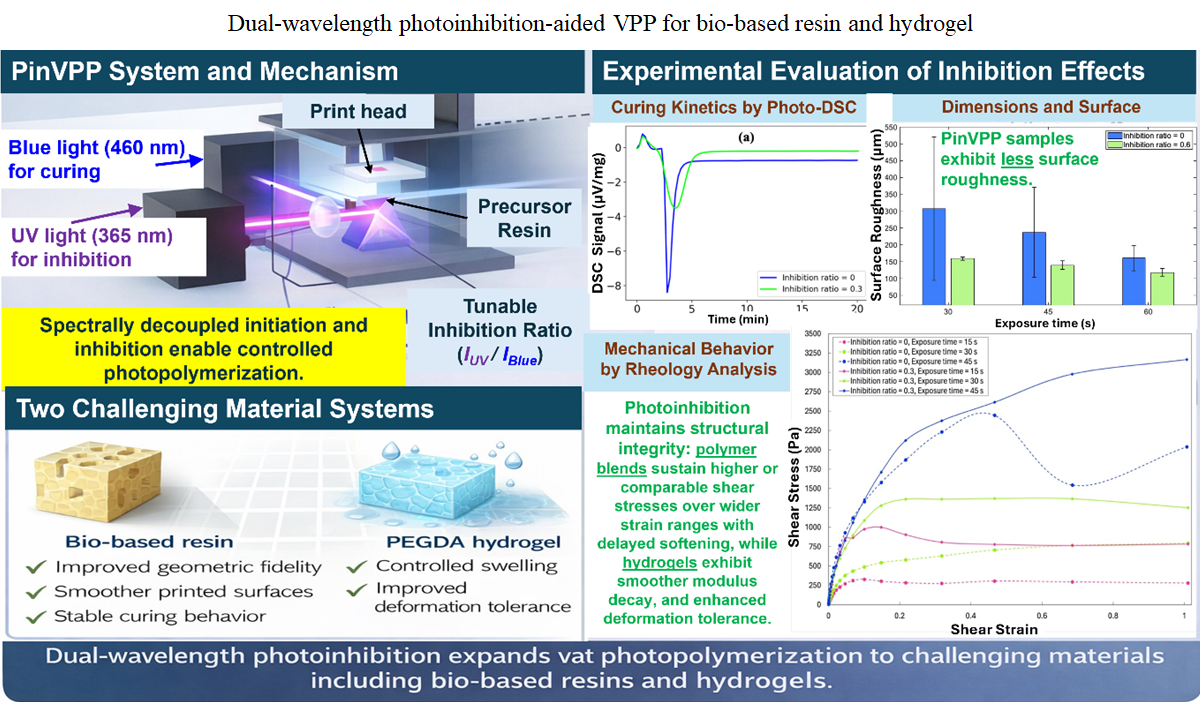
Despite the widespread adoption of vat photopolymerization (VPP) in additive manufacturing, extending it to bio-based polymers and hydrogels remains challenging due to limited control over photopolymerization kinetics, which often leads to overcuring, surface roughness, and mechanically fragile structures—particularly in optically complex or highly fluidic materials. These issues arise largely from the intrinsic coupling of initiation and propagation in conventional single-wavelength exposure schemes. This work evaluates, for the first time, the feasibility and potential of dual-wavelength photoinhibition-aided VPP (PinVPP) as a strategy for two representative, yet fundamentally different, material classes. By spectrally decoupling visible-light initiation from UV-triggered inhibition, PinVPP enables independent regulation of radical generation and spatial confinement of curing. Using a lab-developed PinVPP platform, a bio-based polylactic acid/polyurethane acrylate (PLA–PUA) resin is investigated under independently controlled inhibition ratios, demonstrating suppression of excessive cure thickness and improved control over polymerization kinetics without compromising bulk integrity. Photo-differential scanning calorimetry, optical profilometry, and rheological analysis reveal that photoinhibition temporally redistributes polymerization, enhancing surface quality and mechanical consistency in a resin system prone to slow and uneven curing. Furthermore, applied to polyethylene glycol diacrylate (PEGDA)-based hydrogels, PinVPP reduces overcuring and shape distortion while improving surface smoothness and mechanical robustness under hydrated conditions. Raman spectroscopy quantifies local chemical conversion, and swelling, water uptake, and dimensional stability measurements confirm improved resistance to hydration-induced deformation. Overall, these results demonstrate that PinVPP expands the VPP processing envelope by introducing tunable kinetic control effective for traditionally challenging material systems, offering a scalable pathway for additive manufacturing of sustainable polymers and functional hydrogels with enhanced process stability and material performance.
- Goh GD, Yap YL, Agarwala S, Yeong WY. Recent Progress in Additive Manufacturing of Fiber Reinforced Polymer Composite. Adv Mater Technol. 2018;4(1):1800271. doi: 10.1002/admt.201800271
- Voet VSD. Closed-Loop Additive Manufacturing: Dynamic Covalent Networks in Vat Photopolymerization. ACS Mater Au. 2022;3(1):18-23. doi: 10.1021/acsmaterialsau.2c00058
- Rasaki SA, Xiong D, Xiong S, Su F, Idrees M, Chen Z. Photopolymerization-based additive manufacturing of ceramics: A systematic review. J Adv Ceram. 2021;10(3):442-471. doi: 10.1007/s40145-021-0468-z
- Sampson KL, Deore B, Go A, et al. Multimaterial Vat Polymerization Additive Manufacturing. ACS Appl Polym Mater. 2021;3(9):4304-4324. doi: 10.1021/acsapm.1c00262
- Senthooran V, Weng Z, Wu L. Enhancing Mechanical and Thermal Properties of 3D-Printed Samples Using Mica-Epoxy Acrylate Resin Composites Via Digital Light Processing (DLP). Polymers. 2024;16(8):1148. doi: 10.3390/polym16081148
- Li W, Mille LS, Robledo JA, Uribe T, Huerta V, Zhang YS. Recent Advances in Formulating and Processing Biomaterial Inks for Vat Polymerization-Based 3D Printing. Adv Healthc Mater. 2020;9(15):e2000156. doi: 10.1002/adhm.202000156
- Pagac M, Hajnys J, Ma QP, et al. A Review of Vat Photopolymerization Technology: Materials, Applications, Challenges, and Future Trends of 3D Printing. Polymers. 2021;13(4):598. doi: 10.3390/polym13040598
- Weng Z, Zhou Y, Lin W, Senthil T, Wu L. Structure-property relationship of nano enhanced stereolithography resin for desktop SLA 3D printer. Compos Part A Appl Sci Manuf. 2016;88:234-242. doi: 10.1016/j.compositesa.2016.05.035
- Sealy MP, Avegnon KLM, Garrett A, Delbreilh L, Bapat S, Malshe AP. Understanding biomanufacturing of soy-based scaffolds for cell-cultured meat by vat polymerization. CIRP Ann. 2022;71(1):209-212. doi: 10.1016/j.cirp.2022.04.001
- Colucci G, Sacchi F, Bondioli F, Messori M. Fully Bio-Based Polymer Composites: Preparation, Characterization, and LCD 3D Printing. Polymers. 2024;16(9):1272. doi: 10.3390/polym16091272
- Ali W, Ali H, Gillani S, Zinck P, Souissi S. Polylactic acid synthesis, biodegradability, conversion to microplastics and toxicity: a review. Environ Chem Lett. 2023;21(3):1761-1786. doi: 10.1007/s10311-023-01564-8
- Tripathi N, Misra M, Mohanty AK. Durable Polylactic Acid (PLA)-Based Sustainable Engineered Blends and Biocomposites: Recent Developments, Challenges, and Opportunities. ACS Eng Au. 2021;1(1):7-38. doi: 10.1021/acsengineeringau.1c00011
- Balla E, Daniilidis V, Karlioti G, et al. Poly(lactic Acid): A Versatile Biobased Polymer for the Future with Multifunctional Properties-From Monomer Synthesis, Polymerization Techniques and Molecular Weight Increase to PLA Applications. Polymers. 2021;13(11):1822. doi: 10.3390/polym13111822
- Ortega F, Versino F, Lopez OV, Garcia MA. Biobased composites from agro-industrial wastes and by-products. Emergent Mater. 2022;5(3):873-921. doi: 10.1007/s42247-021-00319-x
- Li Y, Ren X, Zhu L, Li C. Biomass 3D Printing: Principles, Materials, Post-Processing and Applications. Polymers. 2023;15(12):2692. doi: 10.3390/polym15122692
- Ozaki T, Koto T, Nguyen TV, Nakanishi H, Norisuye T, Tran-Cong-Miyata Q. The roles of the Trommsdorff–Norrish effect in phase separation of binary polymer mixtures induced by photopolymerization. Polymer. 2014;55(7):1809-1816. doi: 10.1016/j.polymer.2014.02.041
- Joseph TM, Kallingal A, Suresh AM, et al. 3D printing of polylactic acid: recent advances and opportunities. Int J Adv Manuf Technol. 2023;125(3-4):1015-1035. doi: 10.1007/s00170-022-10795-y
- Román-Ramírez LA, Powders M, McKeown P, Jones MD, Wood J. Ethyl Lactate Production from the Catalytic Depolymerisation of Post-consumer Poly(lactic acid). J Polym Environ. 2020;28(11):2956-2964. doi: 10.1007/s10924-020-01824-6
- Ciriminna R, Pagliaro M. Biodegradable and Compostable Plastics: A Critical Perspective on the Dawn of their Global Adoption. ChemistryOpen. 2020;9(1):8-13. doi: 10.1002/open.201900272
- Duran MM, Moro G, Zhang Y, Islam A. 3D printing of silicone and polyurethane elastomers for medical device application: A review. Adv Ind Manuf Eng. 2023;7:100125. doi: 10.1016/j.aime.2023.100125
- Harris M, Potgieter J, Ray S, Archer R, Arif KM. Polylactic acid and high-density polyethylene blend: Characterization and application in additive manufacturing. J Appl Polym Sci. 2020;137(48):49602. doi: 10.1002/app.49602
- Van der Laan HL, Burns MA, Scott TF. Volumetric Photopolymerization Confinement through Dual-Wavelength Photoinitiation and Photoinhibition. ACS Macro Lett. 2019;8(8):899-904. doi: 10.1021/acsmacrolett.9b00412
- Bensouda Y, Zhang Y, Zhao X. Vat photopolymerization based Photoinhibition aided Ceramic additive manufacturing (PinCAM). J Eur Ceram Soc. 2024;44(13):7801-7824. doi: 10.1016/j.jeurceramsoc.2024.05.080
- Lu Z, Gao W, Liu F, et al. Vat photopolymerization based digital light processing 3D printing hydrogels in biomedical fields: Key parameters and perspective. Addit Manuf. 2024;94:104443. doi: 10.1016/j.addma.2024.104443
- Higgins CI, Killgore JP, DelRio FW, Bryant SJ, McLeod RR. Photo-tunable hydrogel mechanical heterogeneity informed by predictive transport kinetics model. Soft Matter. 2020;16(17):4131-4141. doi: 10.1039/D0SM00052C
- Fiedler CI, Aisenbrey EA, Wahlquist JA, et al. Enhanced mechanical properties of photo-clickable thiol-ene PEG hydrogels through repeated photopolymerization of in-swollen macromer. Soft Matter. 2016;12(44):9095-9104. doi: 10.1039/C6SM01768A
- Wendland RJ, Kolibaba TJ, Worthington KS, Killgore JP. A practical guide to hydrogel working curves for bioprinting. Addit Manuf Lett. 2025;14:100293. doi: 10.1016/j.addlet.2025.100293
- Madrid-Wolff J, Toombs J, Rizzo R, et al. A review of materials used in tomographic volumetric additive manufacturing. MRS Commun. 2023;13(5):764-785. doi: 10.1557/s43579-023-00447-x
- Soullard L, Schlepp A, Buret R, et al. Towards the 3D printing of innovative hydrogel scaffolds through vat polymerization techniques using methacrylated carboxymethylcellulose aqueous formulations. Prog Addit Manuf. 2025;10(4):2177-2189. doi: 10.1007/s40964-024-00744-4
- Wieckowski HS, Erb RM. Tuning depth of cure in resins with photoabsorbing fillers for vat photopolymerization. MRS Commun. 2025;15(3):308-319. doi: 10.1557/s43579-025-00713-0
- Schwab A, Levato R, D’Este M, Piluso S, Eglin D, Malda J. Printability and Shape Fidelity of Bioinks in 3D Bioprinting. Chem Rev. 2020;120(19):11028-11055. doi: 10.1021/acs.chemrev.0c00084
- Wang B, Safari WSH, Hedayati SK, et al. Lateral Contrast Enhancement in Tomographic Volumetric 3D-Printing via Binary Photoinhibition. arXiv. Preprint posted online March 24, 2023. doi: 10.48550/arXiv.2303.13941
- De Beer MP, van der Laan HL, Cole MA, Whelan RJ, Burns MA, Scott TF. Rapid, continuous additive manufacturing by volumetric polymerization inhibition patterning. Sci Adv. 2019;5(1):eaau8723. doi: 10.1126/sciadv.aau8723
- Zhang Y, Zhang H, Zhao X. Exploring three-dimensional photoinhibition to enhance vat photopolymerization: A preliminary study. Precis Eng. 2024;90:176-190. doi: 10.1016/j.precisioneng.2024.08.009
- Ma C, Li W, Li D, et al. Photoacoustic imaging of 3D-printed vascular networks. Biofabrication. 2022;14(2):025001. doi: 10.1088/1758-5090/ac49d5
- Zhang H, Maier A, Mathews M, Hu J, Zhao X. Development of open-architecture two-wavelength grayscale digital light processing for advanced vat photopolymerization. Addit Manuf. 2025;107:104818. doi: 10.1016/j.addma.2025.104818
- Feng Z, Li Y, Xin C, Tang D, Xiong W, Zhang H. Fabrication of Graphene-Reinforced Nanocomposites with Improved Fracture Toughness in Net Shape for Complex 3D Structures via Digital Light Processing. C. 2019;5(2):25. doi: 10.3390/c5020025
- Feng Z, Li Y, Hao L, et al. Graphene-Reinforced Biodegradable Resin Composites for Stereolithographic 3D Printing of Bone Structure Scaffolds. J Nanomater. 2019;2019:9710264. doi: 10.1155/2019/9710264
- Talrose V, Yermakov AN, Leskin AN, et al. UV/Vis Database User’s Guide. NIST Chemistry WebBook, SRD 69. Available from: https://webbook.nist.gov/chemistry/uv-vis/ [Last accessed on 2025 Oct 14].
- Bachmann J, Schmölzer S, Ruderer MA, Fruhmann G, Hinrichsen O. Photo-differential scanning calorimetry parameter study of photopolymers used in digital light synthesis. SPE Polym. 2021;3(1):41-53. doi: 10.1002/pls2.10063
- Lynch JM, Corniuk RN, Brignac KC, et al. Differential scanning calorimetry (DSC): An important tool for polymer identification and characterization of plastic marine debris. Environ Pollut. 2024;346:123607. doi: 10.1016/j.envpol.2024.123607
- Drzeżdżon J, Jacewicz D, Sielicka A, Chmurzyński L. Characterization of polymers based on differential scanning calorimetry based techniques. TrAC Trends Anal Chem. 2019;110:51-56. doi: 10.1016/j.trac.2018.10.037
- Gill P, Moghadam TT, Ranjbar B. Differential Scanning Calorimetry Techniques: Applications in Biology and Nanoscience. J Biomol Tech. 2010;21(4):167-193.
- Vallabh CKP, Zhang Y, Zhao X. In-situ ultrasonic monitoring for Vat Photopolymerization. Addit Manuf. 2022;55:102801. doi: 10.1016/j.addma.2022.102801
- Zhang Y, Zhang H, Zhao X. In-situ Interferometric Curing Monitoring for Digital Light Processing based Vat Photopolymerization Additive Manufacturing. Addit Manuf. 2024;81:104001. doi: 10.1016/j.addma.2024.104001
- Hoffmann GG. Raman Spectroscopy, Volume I: Principles and Applications in Chemistry, Physics, Materials Science, and Biology. Momentum Press; 2019.
- Tu AT. Raman Spectroscopy in Biology: Principles and Applications. Wiley; 1982.
- Lambrecht S, Biermann M, Kara S, Jopp S, Meyer J. A novel characterization technique for hydrogels – in situ rheology-Raman spectroscopy for gelation and polymerization tracking. Mater Adv. 2024;5(17):6957-6966. doi: 10.1039/D4MA00543K