

Bioinformatic identification of a fatty acid metabolism-related gene signature for prognosis prediction and drug sensitivity assessment in osteosarcoma

Introduction: Osteosarcoma is an aggressive malignancy with high metastatic potential, leading to poor prognosis in recurrent and metastatic cases.
Objectives: This study aimed to identify prognostic fatty acid metabolism-related genes (FAMRGs) in osteosarcoma and characterize the clinical and biological features of ACSF2.
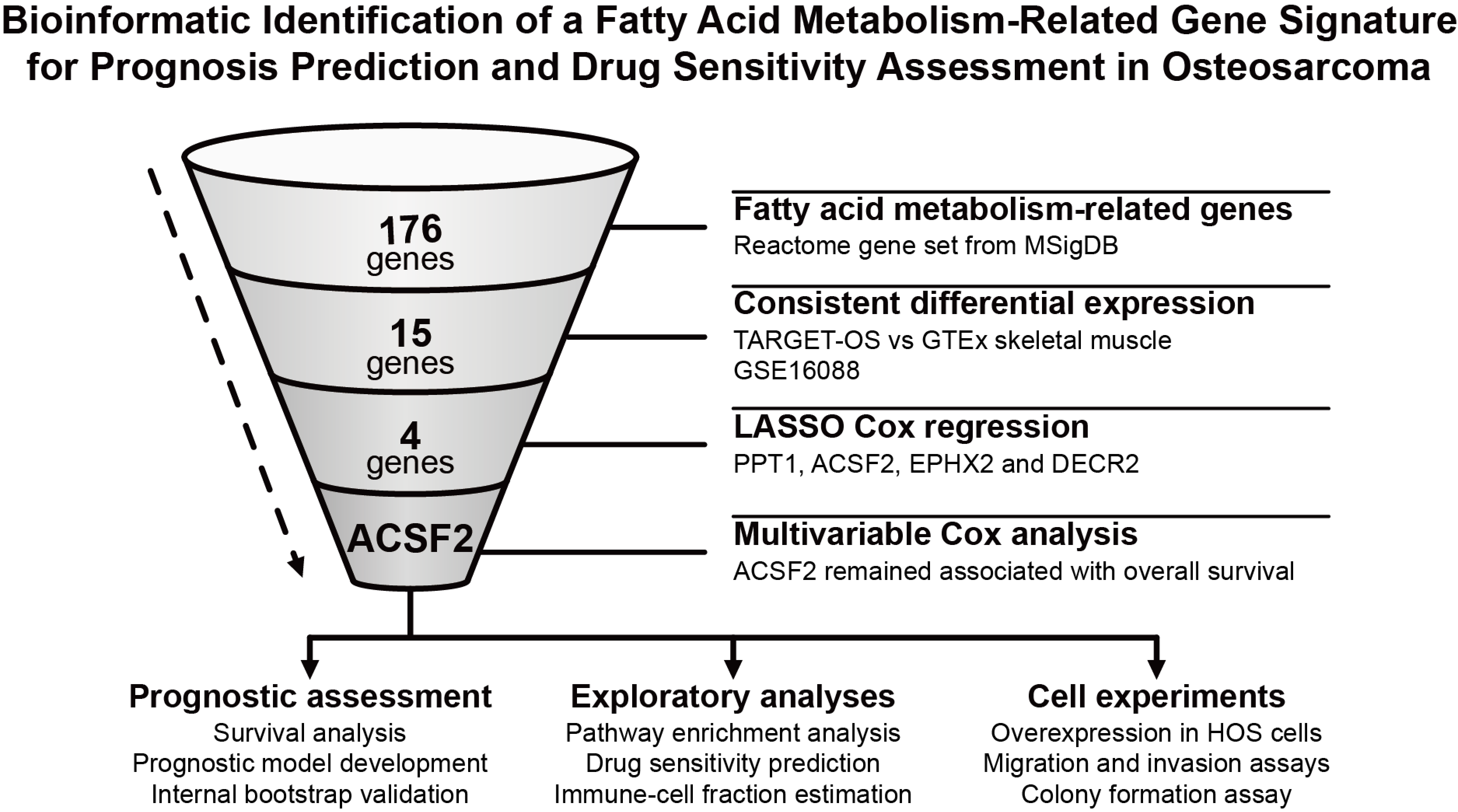
Methods: Transcriptomic and clinical data from Therapeutically Applicable Research to Generate Effective Treatments–Osteosarcoma, Genotype-Tissue Expression, and GSE16088 were analyzed. Consistently differentially expressed FAMRGs were screened via dual-cohort validation. Least absolute shrinkage and selection operator and Cox regression analyses were used to select prognostic genes, with overall survival (OS) as the primary endpoint and event-free survival (EFS) as the secondary endpoint. An ACSF2-based prognostic model combined with metastatic status was internally validated by bootstrap resampling. Gene Set Enrichment Analysis, OncoPredict, ESTIMATE, and CIBERSORT analyses were performed to explore ACSF2-associated pathways, drug sensitivity, and immune infiltration. In vitro functional assays were conducted to verify the biological function of acyl-CoA synthetase family member 2 (ACSF2).
Results: Four prognostic FAMRGs were screened from 15 consistently dysregulated genes. Low ACSF2 expression independently predicted inferior OS and EFS, without significant correlation with diagnostic metastasis. The optimized model yielded a corrected C-index of 0.729 and a calibration slope of 0.943. ACSF2 was closely associated with fatty acid and mitochondrial metabolism. The ACSF2-high subgroup showed higher predicted sensitivity to Uprosertib and MN-64 and exhibited distinct immune infiltration patterns. Functional experiments confirmed that elevated ACSF2 expression suppresses the migration and invasion of human osteosarcoma cells.
Conclusion: ACSF2 is a promising candidate prognostic biomarker for osteosarcoma. Its metabolic, pharmacological, and immune correlations are exploratory and require further experimental validation.
- Isakoff MS, Bielack SS, Meltzer P, Gorlick R. Osteosarcoma: current treatment and a collaborative pathway to success. J Clin Oncol. 2015;33(27):3029-3035. doi: 10.1200/JCO.2014.59.4895
- Meltzer PS, Helman LJ. New horizons in the treatment of osteosarcoma. N Engl J Med. 2021;385(22):2066-2076. doi: 10.1056/NEJMra2103423
- Sheng G, Gao Y, Yang Y, Wu H. Osteosarcoma and metastasis. Front Oncol. 2021;11:780264. doi: 10.3389/fonc.2021.780264
- Belayneh R, Fourman MS, Bhogal S, Weiss KR. Update on osteosarcoma. Curr Oncol Rep. 2021;23(6):71. doi: 10.1007/s11912-021-01053-7
- Panez-Toro I, Muñoz-García J, Vargas-Franco JW, et al. Advances in osteosarcoma. Curr Osteoporos Rep. 2023;21(4):330-343. doi: 10.1007/s11914-023-00803-9
- Hattinger CM, Patrizio MP, Fantoni L, Casotti C, Riganti C, Serra M. Drug resistance in osteosarcoma: emerging biomarkers, therapeutic targets and treatment strategies. Cancers (Basel). 2021;13(12):2878. doi: 10.3390/cancers13122878
- Hanahan D, Weinberg RA. Hallmarks of cancer: the next generation. Cell. 2011;144(5):646-674. doi: 10.1016/j.cell.2011.02.013
- Jin HR, Wang J, Wang ZJ, et al. Lipid metabolic reprogramming in tumor microenvironment: from mechanisms to therapeutics. J Hematol Oncol. 2023;16(1):103. doi: 10.1186/s13045-023-01498-2
- Dai CL, Qiu ZY, Wang AQ, Yan S, Zhang LJ, Luan X. Targeting cholesterol metabolism: a promising therapy strategy for cancer. Acta Pharmacol Sin. 2025;46(8):2093-2104. doi: 10.1038/s41401-025-01531-9
- Currie E, Schulze A, Zechner R, Walther TC, Farese RV Jr. Cellular fatty acid metabolism and cancer. Cell Metab. 2013;18(2):153-161. doi: 10.1016/j.cmet.2013.05.017
- Shi Y, Yue X, Luo Q. Metabolic reprogramming in osteosarcoma. Pediatr Discov. 2023;1(2):e18. doi: 10.1002/pdi3.18
- Wu Q, Chen H, Li J. Metabolic reprogramming-related drug resistance in osteosarcoma: from molecular mechanisms to therapeutic translation. Front Mol Biosci. 2026;13:1928880. doi: 10.3389/fmolb.2026.1928880
- Qian H, Lei T, Hu Y, Lei P. Expression of lipid-metabolism genes is correlated with immune microenvironment and predicts prognosis in osteosarcoma. Front Cell Dev Biol. 2021;9:673827. doi: 10.3389/fcell.2021.673827
- Zhang Y, He R, Lei X, et al. A novel pyroptosis-related signature for predicting prognosis and indicating immune microenvironment features in osteosarcoma. Front Genet. 2021;12:780780. doi: 10.3389/fgene.2021.780780
- Liu S, Wu B, Li X, Zhao L, Wu W, Ai S. Construction and validation of a potent epigenetic modification-related prognostic signature for osteosarcoma patients. J Oncol. 2021;2021(1):2719172. doi: 10.1155/2021/2719172
- Gul Mohammad A, Li D, He R, et al. Integrated analyses of an RNA-binding protein-based signature related to tumor immune microenvironment and candidate drugs in osteosarcoma. Am J Transl Res. 2022;14(4):2501-2526.
- Han J, Hu Y, Ding S, Liu S, Wang H. The analysis of the pyroptosis-related genes and hub gene TP63 ceRNA axis in osteosarcoma. Front Immunol. 2022;13:974916. doi: 10.3389/fimmu.2022.974916
- Henderson MX, Wirak GS, Zhang YQ, et al. Neuronal ceroid lipofuscinosis with DNAJC5/CSPα mutation has PPT1 pathology and exhibit aberrant protein palmitoylation. Acta Neuropathol. 2016;131(4):621-637. doi: 10.1007/s00401-015-1512-2
- Xu J, Su Z, Cheng X, et al. High PPT1 expression predicts poor clinical outcome and PPT1 inhibitor DC661 enhances sorafenib sensitivity in hepatocellular carcinoma. Cancer Cell Int. 2022;22(1):115. doi: 10.1186/s12935-022-02508-y
- Brun S, Bestion E, Raymond E, et al. GNS561, a clinical-stage PPT1 inhibitor, is efficient against hepatocellular carcinoma via modulation of lysosomal functions. Autophagy. 2022;18(3):678-694. doi: 10.1080/15548627.2021.1988357
- Shi H, Qi H, Xie D, et al. Inhibition of ACSF2 protects against renal ischemia/reperfusion injury via mediating mitophagy in proximal tubular cells. Free Radic Biol Med. 2023;198:68-82. doi: 10.1016/j.freeradbiomed.2023.02.003
- Luo L, Zhang S, Guo N, Li H, He S. ACSF2-mediated ferroptosis is involved in ulcerative colitis. Life Sci. 2023;313:121272. doi: 10.1016/j.lfs.2022.121272
- Zhang Y, Qiao Z, He M, Xia J. OGT promotes the ferroptosis of chondrocytes in osteoarthritis development via O-GlcNAcylation modification of ACSF2. Immunol Res. 2025;73(1):7. doi: 10.1007/s12026-024-09567-5
- Wang H, Cheng Q, Chang K, Bao L, Yi X. Integrated analysis of ferroptosis-related biomarker signatures to improve the diagnosis and prognosis prediction of ovarian cancer. Front Cell Dev Biol. 2022;9:807862. doi: 10.3389/fcell.2021.807862
- Peng X, Zhao H, Ye L, et al. Biomarker identification and risk prediction model development for differentiated thyroid carcinoma lung metastasis based on primary lesion proteomics. Clin Cancer Res. 2024;30(14):3059-3072. doi: 10.1158/1078-0432.CCR-23-3806
- Dumble M, Crouthamel MC, Zhang SY, et al. Discovery of novel AKT inhibitors with enhanced anti-tumor effects in combination with the MEK inhibitor. PLoS One. 2014;9(6):e100880. doi: 10.1371/journal.pone.0100880
- Narwal M, Koivunen J, Haikarainen T, et al. Discovery of tankyrase inhibiting flavones with increased potency and isoenzyme selectivity. J Med Chem. 2013;56(20):7880-7889. doi: 10.1021/jm401463y
- Chen C, Xie L, Ren T, Huang Y, Xu J, Guo W. Immunotherapy for osteosarcoma: fundamental mechanism, rationale, and recent breakthroughs. Cancer Lett. 2021;500:1-10. doi: 10.1016/j.canlet.2020.12.024
- Park JA, Cheung NV. Promise and challenges of T cell immunotherapy for osteosarcoma. Int J Mol Sci. 2023;24(15):12520. doi: 10.3390/ijms241512520
- Zhu J, Fan J, Xia Y, et al. Potential targets and applications of nanodrug targeting myeloid cells in osteosarcoma for the enhancement of immunotherapy. Front Pharmacol. 2023;14:1271321. doi: 10.3389/fphar.2023.1271321
- Wu CC, Beird HC, Livingston JA, et al. Immuno-genomic landscape of osteosarcoma. Nat Commun. 2020;11(1):1008. doi: 10.1038/s41467-020-14646-w
- Tawbi HA, Burgess M, Bolejack V, et al. Pembrolizumab in advanced soft-tissue sarcoma and bone sarcoma (SARC028): a multicentre, two-cohort, single-arm, open-label, phase 2 trial. Lancet Oncol. 2017;18(11):1493-1501. doi: 10.1016/S1470-2045(17)30624-1
- Marinoff AE, Nathrath M, Shulman DS, et al. An international framework for clinical translation of molecular classifiers in osteosarcoma. NPJ Precis Oncol. 2026;10(1). doi: 10.1038/s41698-026-01456-4
- Moquin-Beaudry G, Marques Da Costa ME, Khneisser P, et al. Spatial transcriptomic atlas of aggressive osteosarcomas reveals shared immune landscape and targetable surface markers. Nat Commun. 2026;17(1). doi: 10.1038/s41467-026-74603-x
- Lacinski RA, Dziadowicz SA, Melemai VK, et al. Spatial multiplexed immunofluorescence analysis reveals coordinated cellular networks associated with overall survival in metastatic osteosarcoma. Bone Res. 2024;12(1):55. doi: 10.1038/s41413-024-00359-z
- Riley RD, Ensor J, Snell KIE, et al. Calculating the sample size required for developing a clinical prediction model. BMJ. 2020;368:m441. doi: 10.1136/bmj.m441
- Polley MYC, Dignam JJ. Statistical considerations in the evaluation of continuous biomarkers. J Nucl Med. 2021;62(5):605-611. doi: 10.2967/jnumed.120.251520
- Avila Cobos F, Alquicira-Hernandez J, Powell JE, Mestdagh P, De Preter K. Benchmarking of cell type deconvolution pipelines for transcriptomics data. Nat Commun. 2020;11(1):5650. doi: 10.1038/s41467-020-19015-1
- White BS, de Reyniès A, Newman AM, et al. Community assessment of methods to deconvolve cellular composition from bulk gene expression. Nat Commun. 2024;15(1):7362. doi: 10.1038/s41467-024-50618-0
- Rahnenführer J, De Bin R, Benner A, et al. Statistical analysis of high-dimensional biomedical data: a gentle introduction to analytical goals, common approaches and challenges. BMC Med. 2023;21(1):182. doi: 10.1186/s12916-023-02858-y
- Chen F, Zhang Z, Shen R, Chen M, Li G, Zhu X. Generation and characterization of patient-derived xenografts from patients with osteosarcoma. Tissue Cell. 2022;79:101911. doi: 10.1016/j.tice.2022.101911
- He A, Huang Y, Cheng W, et al. Organoid culture system for patient-derived lung metastatic osteosarcoma. Med Oncol. 2020;37(11):105. doi: 10.1007/s12032-020-01429-y