

Oral adverse drug reactions in precision oncology: A phenotype-first framework for causality, triage, and treatment continuity

Introduction: Precision oncology has broadened the spectrum of oral adverse drug reactions (ADRs), while combination regimens and common oral diseases complicate their recognition and attribution.
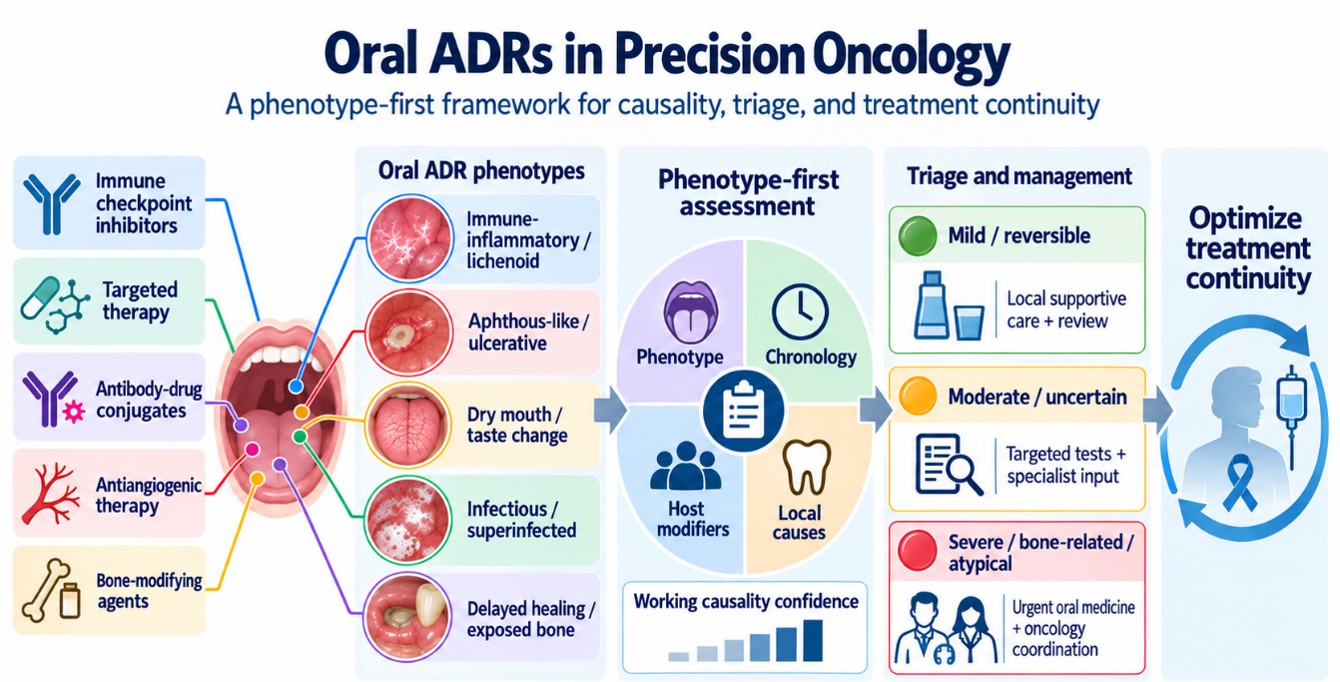
Objectives: To propose a phenotype-first framework for assessing suspected oral ADRs, guiding triage and management, and supporting anticancer treatment continuity.
Methods: A manual literature search was conducted in PubMed/MEDLINE and Google Scholar using combinations of keywords such as “oral adverse drug reactions,” “oral toxicity,” “precision oncology,” “immune checkpoint inhibitors,” “targeted therapy,” “oral mucositis,” “xerostomia,” “medication-related osteonecrosis of the jaw,” “oral lichenoid reactions,” and “supportive care.” Relevant studies and clinical guidelines were synthesized narratively to develop a phenotype-first framework.
Results: The framework considers lesion morphology and functional impact alongside treatment chronology, host factors, local dental conditions, targeted investigations, and response to intervention. It addresses immune-inflammatory and lichenoid disease, aphthous-like or mucositis-like ulceration, salivary and taste dysfunction, secondary infection, and impaired wound or bone healing. Combining phenotype with diagnostic certainty and clinical severity informs proportionate action, from local supportive care and reassessment to urgent specialist evaluation and oncology coordination. Structured documentation and patient-reported outcomes can support longitudinal assessment and pharmacovigilance.
Conclusion: Phenotype-first reasoning may help clinicians distinguish suspected treatment toxicity from competing or coexisting oral conditions and manage reversible symptoms without unnecessarily disrupting cancer therapy. Severe, persistent, atypical, or diagnostically uncertain findings require timely interdisciplinary assessment. Prospective evaluation is needed to establish the framework’s reproducibility and clinical utility.
- Yuan A, Woo SB. Adverse drug events in the oral cavity. Oral Surg Oral Med Oral Pathol Oral Radiol. 2015;119(1):35-47. doi: 10.1016/j.oooo.2014.09.009
- Epstein JB, Thariat J, Bensadoun RJ, et al. Oral complications of cancer and cancer therapy: from cancer treatment to survivorship. CA Cancer J Clin. 2012;62(6):400-422. doi: 10.3322/caac.21157
- Watters A, Epstein J, Agulnik M. Oral complications of targeted cancer therapies: a narrative literature review. Oral Oncol. 2011;47(6):441-448. doi: 10.1016/j.oraloncology.2011.03.028
- Vigarios E, Epstein JB, Sibaud V. Oral mucosal changes induced by anticancer targeted therapies and immune checkpoint inhibitors. Support Care Cancer. 2017;25(5):1713-1739. doi: 10.1007/s00520-017-3629-4
- Villa A, Epstein JB, Yarom N, et al. MASCC/ISOO Clinical Practice Statement: Management of oral complications of targeted therapy. Support Care Cancer. 2024;32(8):549. doi: 10.1007/s00520-024-08689-8
- Fregnani ER, Epstein JB, Blijlevens NM, et al. MASCC/ISOO clinical practice statement: management of oral complications of immunotherapy. Support Care Cancer. 2025;33(10):851. doi: 10.1007/s00520-025-09806-x
- Hong C, Jensen SB, Vissink A, et al. MASCC/ISOO clinical practice statement: management of salivary gland hypofunction and xerostomia in cancer patients. Support Care Cancer. 2024;32(8):548. doi: 10.1007/s00520-024-08688-9
- Yarom N, Shapiro CL, Peterson DE, et al. Medication-Related Osteonecrosis of the Jaw: MASCC/ISOO/ASCO Clinical Practice Guideline. J Clin Oncol. 2019;37(25):2270-2290. doi: 10.1200/jco.19.01186
- Basch E, Reeve BB, Mitchell SA, et al. Development of the National Cancer Institute’s patient-reported outcomes version of the common terminology criteria for adverse events (PRO-CTCAE). J. Natl. Cancer Inst. 2014;106(9):dju244. doi: 10.1093/jnci/dju244
- Dueck AC, Mendoza TR, Mitchell SA, et al. Validity and reliability of the US National Cancer Institute’s patient-reported outcomes version of the common terminology criteria for adverse events (PRO-CTCAE). JAMA Oncol. 2015;1(8):1051-1059. doi: 10.1001/jamaoncol.2015.2639
- Raber-Durlacher JE, Zadik Y, Treister NS, et al. MASCC/ISOO clinical practice statement: current understanding on controversies in basic oral care in hemato-oncology and hematopoietic cell transplantation. Support Care Cancer. 2024;32(8):550. doi: 10.1007/s00520-024-08690-1
- Pimolbutr K, Porter S, Fedele S. Osteonecrosis of the jaw associated with antiangiogenics in antiresorptive‐naïve patient: A comprehensive review of the literature. BioMed Res Int. 2018;2018(1):8071579. doi: 10.1155/2018/8071579
- Elad S, Cheng KKF, Lalla RV, et al. MASCC/ISOO clinical practice guidelines for the management of mucositis secondary to cancer therapy. Cancer. 2020;126(19):4423-4431. doi: 10.1002/cncr.33100
- Elad S, Yarom N, Zadik Y, et al. The broadening scope of oral mucositis and oral ulcerative mucosal toxicities of anticancer therapies. CA Cancer J Clin. 2022;72(1):57-77. doi: 10.3322/caac.21704
- Sonis ST. The pathobiology of mucositis. Nat Rev Cancer. 2004;4(4):277-284. doi: 10.1038/nrc1318
- De Oliveira MA, Martins FM, Wang Q, et al. Clinical presentation and management of mTOR inhibitor-associated stomatitis. Oral Oncol. 2011;47(10):998-1003. doi: 10.1016/j.oraloncology.2011.08.009
- Xu Y, Wen N, Sonis ST, Villa A. Oral side effects of immune checkpoint inhibitor therapy (ICIT): An analysis of 4683 patients receiving ICIT for malignancies at Massachusetts General Hospital, Brigham & Women’s Hospital, and the Dana‐Farber Cancer Institute, 2011 to 2019. Cancer. 2021;127(11):1796-1804. doi: 10.1002/cncr.33436
- Schneider BJ, Naidoo J, Santomasso BD, et al. Management of immune-related adverse events in patients treated with immune checkpoint inhibitor therapy: ASCO guideline update. J Clin Oncol. 2021;39(36):4073-4126. doi: 10.1200/JCO.21.01440
- Ruggiero SL, Dodson TB, Aghaloo T, Carlson ER, Ward BB, Kademani D. American Association of Oral and Maxillofacial Surgeons’ Position Paper on Medication-Related Osteonecrosis of the Jaws-2022 Update. J Oral Maxillofac Surg. 2022;80(5):920-943. doi: 10.1016/j.joms.2022.02.008
- Naranjo CA, Busto U, Sellers EM, et al. A method for estimating the probability of adverse drug reactions. Clin Pharmacol Ther. 1981;30(2):239-245. doi: 10.1038/clpt.1981.154
- Shazib MA, Woo SB, Sroussi H, et al. Oral immune‐related adverse events associated with PD‐1 inhibitor therapy: A case series. Oral Dis. 2020;26(2):325-333. doi: 10.1111/odi.13218
- Sibaud V, Eid C, Belum VR, et al. Oral lichenoid reactions associated with anti-PD-1/PD-L1 therapies: Clinicopathological findings. J Eur Acad Dermatol Venereol. 2017;31(10):e464-e469. doi: 10.1111/jdv.14284
- van Damme C, Denmols A, del Marmol V. Cutaneous, oral and genital lichenoid reactions associated with retifanlimab, a new PD-1 inhibitor. J Eur Acad Dermatol Venereol. 2023;37(3):e395-e396. doi: 10.1111/jdv.18785
- Klein BA, Alves FA, de Santana Rodrigues Velho J, et al. Oral manifestations of immune-related adverse events in cancer patients treated with immune checkpoint inhibitors. Oral Dis. 2022;28(1):9-22. doi: 10.1111/odi.13964
- Binnie R, Dobson ML, Chrystal A, Hijazi K. Oral lichen planus and lichenoid lesions-challenges and pitfalls for the general dental practitioner. Br. Dent J. 2024;236(4):285-292. doi: 10.1038/s41415-024-7063-y
- Warnakulasuriya S. Oral potentially malignant disorders: A comprehensive review on clinical aspects and management. Oral Oncol. 2020;102:104550. doi: 10.1016/j.oraloncology.2019.104550
- Warnakulasuriya S, Kujan O, Aguirre‐Urizar JM, et al. Oral potentially malignant disorders: A consensus report from an international seminar on nomenclature and classification, convened by the WHO Collaborating Centre for Oral Cancer. Oral Dis. 2021;27(8):1862-1880. doi: 10.1111/odi.13704
- Shi VJ, Rodic N, Gettinger S, et al. Clinical and histologic features of lichenoid mucocutaneous eruptions due to anti-programmed cell death 1 and anti-programmed cell death ligand 1 immunotherapy. JAMA Dermatol. 2016;152(10):1128-1136. doi: 10.1001/jamadermatol.2016.2226
- Martins F, de Oliveira MA, Wang Q, et al. A review of oral toxicity associated with mTOR inhibitor therapy in cancer patients. Oral Oncol. 2013;49(4):293-298. doi: 10.1016/j.oraloncology.2012.11.008
- Rugo HS, Seneviratne L, Beck JT, et al. Prevention of everolimus-related stomatitis in women with hormone receptor-positive, HER2-negative metastatic breast cancer using dexamethasone mouthwash (SWISH): a single-arm, phase 2 trial. Lancet Oncol. 2017;18(5):654-662. doi: 10.1016/S1470-2045(17)30109-2
- Ruddy KJ, Zahrieh D, He J, et al. Dexamethasone to prevent everolimus-induced stomatitis (Alliance MIST Trial: A221701). Semin Oncol. 2023;50(1-2):7-10. doi: 10.1053/j.seminoncol.2023.01.001
- Meric-Bernstam F, Bardia A, Bossi P, et al. Prophylaxis, clinical management, and monitoring of datopotamab deruxtecan-associated oral mucositis/stomatitis. The Oncologist. 2025;30(3):oyaf031. doi: 10.1093/oncolo/oyaf031
- Güneri P, Epstein JB, Bolukbasi G, Spielberger RT. Neutropenic ulcers in oncology: Terminology, diagnosis, and management. Support Care Cancer. 2023;31(12):716. doi: 10.1007/s00520-023-08187-3
- Lo Muzio L, Arena C, Troiano G, Villa A. Oral stomatitis and mTOR inhibitors: A review of current evidence in 20,915 patients. Oral Dis. 2018;24(1-2):144-171. doi: 10.1111/odi.12795
- Mercadante V, Jensen SB, Smith DK, et al. Salivary gland hypofunction and/or xerostomia induced by nonsurgical cancer therapies: ISOO/MASCC/ASCO guideline. J Clin Oncol. 2021;39(25):2825-2843. doi: 10.1200/JCO.21.01208
- Warner BM, Baer AN, Lipson EJ, et al. Sicca syndrome associated with immune checkpoint inhibitor therapy. Oncologist. 2019;24(9):1259-1269. doi: 10.1634/theoncologist.2018-0823
- Jensen SB, Pedersen AML, Vissink A, et al. A systematic review of salivary gland hypofunction and xerostomia induced by cancer therapies: Prevalence, severity and impact on quality of life. Support Care Cancer. 2010;18(8):1039-1060. doi: 10.1007/s00520-010-0827-8
- Wolff A, Joshi RK, Ekström J, et al. A guide to medications inducing salivary gland dysfunction, xerostomia, and subjective sialorrhea: A systematic review sponsored by the World Workshop on Oral Medicine VI. Drugs R D. 2017;17(1):1-28. doi: 10.1007/s40268-016-0153-9
- Ortiz Brugués A, Sibaud V, Herbault-Barrés B, et al. Sicca syndrome induced by immune checkpoint inhibitor therapy: Optimal management still pending. Oncologist. 2020;25(2):e391-e395. doi: 10.1634/theoncologist.2019-0467
- Hong C, Epstein JB, Jensen SB, et al. MASCC/ISOO Clinical Practice Statement: Clinical assessment of salivary gland hypofunction and xerostomia in cancer patients. Support Care Cancer. 2024;32(8):551. doi: 10.1007/s00520-024-08691-0
- Jensen SB, Pedersen AML, Vissink A, et al. A systematic review of salivary gland hypofunction and xerostomia induced by cancer therapies: Management strategies and economic impact. Support Care Cancer. 2010;18(8):1061-1079. doi: 10.1007/s00520-010-0837-6
- McLaughlin L, Mahon SM. Understanding taste dysfunction in patients with cancer. Clin J Oncol Nurs. 2012;16(2):171-178. doi: 10.1188/12.CJON.171-178
- Bedogni A, Mauceri R, Fusco V, et al. Italian position paper (SIPMO-SICMF) on medication-related osteonecrosis of the jaw (MRONJ). Oral Dis. 2024;30(6):3679-3709. doi: 10.1111/odi.14887
- Campisi G, Mauceri R, Bertoldo F, et al. Medication-Related Osteonecrosis of Jaws (MRONJ) Prevention and Diagnosis: Italian Consensus Update 2020. Int J Environ Res Public Health. 2020;17(16):5998. doi: 10.3390/ijerph17165998
- Kim JE, Yoo S, Choi SC. Several issues regarding the diagnostic imaging of medication-related osteonecrosis of the jaw. Imaging Sci Dent. 2020;50(4):273-279. doi: 10.5624/isd.2020.50.4.273
- Yarom N, Abdalla-Aslan R, Migliorati C, et al. MASCC/ISOO Clinical Practice Statement: Imaging and clinical laboratory tests in the diagnosis and management of medication-related osteonecrosis of the jaw. Support Care Cancer. 2025;33(10):852. doi: 10.1007/s00520-025-09809-8
- Peterson DE, Koyfman SA, Yarom N, et al. Prevention and management of osteoradionecrosis in patients with head and neck cancer treated with radiation therapy: ISOO-MASCC-ASCO guideline. J Clin Oncol. 2024;42(16):1975-1996. doi: 10.1200/JCO.23.02750
- Saunders D, Koyfman SA, Ismaila N, et al. Prevention and management of osteoradionecrosis in patients with head and neck cancer treated with radiation therapy: Guideline clinical insights. JCO Oncol Pract. 2024;20(12):1571-1574. doi: 10.1200/OP.24.00182
- Ikesue H, Doi K, Morimoto M, et al. Switching from zoledronic acid to denosumab increases the risk for developing medication-related osteonecrosis of the jaw in patients with bone metastases. Cancer Chemother Pharmacol. 2021;87(6):871-877. doi: 10.1007/s00280-021-04262-w
- Ikesue H, Doi K, Morimoto M, et al. Risk evaluation of denosumab and zoledronic acid for medication-related osteonecrosis of the jaw in patients with bone metastases: A propensity score-matched analysis. Support Care Cancer. 2022;30(3):2341-2348. doi: 10.1007/s00520-021-06634-7
- Andersen SWM, Mogensen DG, Schioedt M, Kofod T. Surgical treatment of 61 consecutive patients with maxillary stage 3 medication-related osteonecrosis of the jaw. Oral Maxillofac Surg. 2023;27(2):251-261. doi: 10.1007/s10006-022-01061-2
- Giudice A, Barone S, Diodati F, Antonelli A, Nocini R, Cristofaro MG. Can surgical management improve resolution of medication-related osteonecrosis of the jaw at early stages? A prospective cohort study. J Oral Maxillofac Surg. 2020;78(11):1986-1999. doi: 10.1016/j.joms.2020.05.037
- Hayashida S, Soutome S, Yanamoto S, et al. Evaluation of the treatment strategies for medication-related osteonecrosis of the jaws (MRONJ) and the factors affecting treatment outcome: A multicenter retrospective study with propensity score matching analysis. J Bone Miner Res. 2017;32(10):2022-2029. doi: 10.1002/jbmr.3191
- Rückschloß T, Smielowski M, Moratin J, et al. Comparing the influence of surgical and conservative therapy on quality of life in patients with early-stage medication-related osteonecrosis of the jaw—A prospective longitudinal study. Medicina. 2023;59(2):277. doi: 10.3390/medicina59020277
- Reinert CP, Pfannenberg C, Gückel B, et al. Preoperative assessment of medication-related osteonecrosis of the jaw using [18F]fluoride positron emission tomography (PET)/CT and [18F]fluorodeoxyglucose PET/MRI in correlation with histomorphometry and micro-CT—A prospective comparative study. Diagnostics. 2024;14(4):428. doi: 10.3390/diagnostics14040428
- Kitagawa Y, Ohga N, Asaka T, et al. Imaging modalities for drug-related osteonecrosis of the jaw (3), positron emission tomography imaging for the diagnosis of medication-related osteonecrosis of the jaw. Jpn Dent Sci Rev. 2019;55(1):65-70. doi: 10.1016/j.jdsr.2018.12.001
- Archibald SJ, Holland JP, Korde A, Martins AF, Shuhendler AJ, Scott PJH. Combining Nuclear Medicine With Other Modalities: Future Prospect for Multimodality Imaging. Mol Imaging. 2024;23:15353508241245265. doi: 10.1177/15353508241245265
- Zhang L, Zhao L, Lin X, et al. Comparison of Tumor Non-specific and PD-L1 Specific Imaging by Near-Infrared Fluorescence/Cerenkov Luminescence Dual-Modality In-situ Imaging. Mol Imaging. 2024;23:15353508241261473. doi: 10.1177/15353508241261473
- Hay JL, Atkinson TM, Reeve BB, et al. Cognitive interviewing of the US National Cancer Institute’s patient-reported outcomes version of the Common Terminology Criteria for Adverse Events (PRO-CTCAE). Qual Life Res. 2014;23(1):257-269. doi: 10.1007/s11136-013-0470-1
- Srivastava A, Nogueras-Gonzalez GM, Geng Y, et al. Oral toxicities associated with immune checkpoint inhibitors: Meta-analyses of clinical trials. J Immunother Precis Oncol. 2024;7(1):24-40. doi: 10.36401/JIPO-23-14
- Di Fede O, Panzarella V, Mauceri R, et al. The dental management of patients at risk of medication-related osteonecrosis of the jaw: New paradigm of primary prevention. BioMed Res Int. 2018;2018(1):2684924. doi: 10.1155/2018/2684924
- Owosho AA, Liang STY, Sax AZ, et al. Medication-related osteonecrosis of the jaw: An update on the Memorial Sloan Kettering Cancer Center experience and the role of premedication dental evaluation in prevention. Oral Surg Oral Med Oral Pathol Oral Radiol. 2018;125(5):440-445. doi: 10.1016/j.oooo.2018.02.003
- Karna H, Gonzalez J, Radia HS, Sedghizadeh PP, Enciso R. Risk-reductive dental strategies for medication related osteonecrosis of the jaw among cancer patients: A systematic review with meta-analyses. Oral Oncol. 2018;85:15-23. doi: 10.1016/j.oraloncology.2018.08.003
- Aboalela AA, Farook FF, Alqahtani AS, Almousa MA, Alanazi RT, Almohammadi DS. The effect of antiresorptive drug holidays on medication-related osteonecrosis of the jaw: A systematic review and meta-analysis. Cureus. 2022;14(10):e30485. doi: 10.7759/cureus.30485
- Halpern LR, Adams DR. Treatment of medication-related osteonecrosis of the jaw: Controversies in causality and therapy. Dent Clin North Am. 2024;68(1):67-85. doi: 10.1016/j.cden.2023.07.005
- Yarom N, Van Poznak CH, Epstein JB, et al. MASCC/ISOO Clinical Practice Statement: Adjuvant bone-modifying agents in primary breast cancer patients—prevention of medication-related osteonecrosis of the jaw. Support Care Cancer. 2024;32(8):547. doi: 10.1007/s00520-024-08687-w
- Fantozzi PJ, Sonis ST, Diaz JP, Villa A. Oral mucositis secondary to datopotamab deruxtecan for advanced-stage cancer managed with cryotherapy after topical steroid failure: A case series study. J Am Dent Assoc. 2026;157(7):787-794. doi: 10.1016/j.adaj.2025.11.015
- El-Rabbany M, Sgro A, Lam DK, Shah PS, Azarpazhooh A. Effectiveness of treatments for medication-related osteonecrosis of the jaw: A systematic review and meta-analysis. J Am Dent Assoc. 2017;148(8):584-594.e2. doi: 10.1016/j.adaj.2017.04.002
- Caminha RDG, Alcantara PL, Carvalho CG, Reia VCB, Capelozza ALA, Silva Santos PSD. The impact of medication-related osteonecrosis of the jaws on the quality of life in cancer patients. J Clin Exp Dent. 2020;12(8):e725-e729. doi: 10.4317/jced.56307
- Kluetz PG, Chingos DT, Basch EM, Mitchell SA. Patient-reported outcomes in cancer clinical trials: Measuring symptomatic adverse events with the National Cancer Institute’s patient-reported outcomes version of the Common Terminology Criteria for Adverse Events (PRO-CTCAE). Am Soc Clin Oncol Educ Book. 2016;36:67-73. doi: 10.1200/EDBK_159514
- Basch E, Schrag D, Henson S, et al. Effect of electronic symptom monitoring on patient-reported outcomes among patients with metastatic cancer: A randomized clinical trial. JAMA. 2022;327(24):2413-2422. doi: 10.1001/jama.2022.9265
- Basch E, Deal AM, Kris MG, et al. Symptom monitoring with patient-reported outcomes during routine cancer treatment: A randomized controlled trial. J Clin Oncol. 2016;34(6):557-565. doi: 10.1200/JCO.2015.63.0830