
Effects of redox modulation on postprandial oxy-inflammatory transcriptomic responses in overweight adults with cardiometabolic risk following a Mediterranean diet

Introduction: The postprandial phase represents a transient pro-oxidative condition, characterized by an increased vulnerability to oxidative damage following nutrient intake. This state is increasingly recognized as a contributing factor in the early development of atherogenic processes. Alterations in plasma cysteine and glutathione (GSH) redox couples have been shown to correlate with aging and age-related pathologies. Among the principal thiol redox systems regulating plasma redox potential, the reduced cysteine/cystine (CySS) pair predominates, followed by the GSH/oxidized GSH disulfide pair. CySS is considered a marker of systemic oxidative burden, whereas GSH reflects intracellular NADPH-dependent reductive capacity.
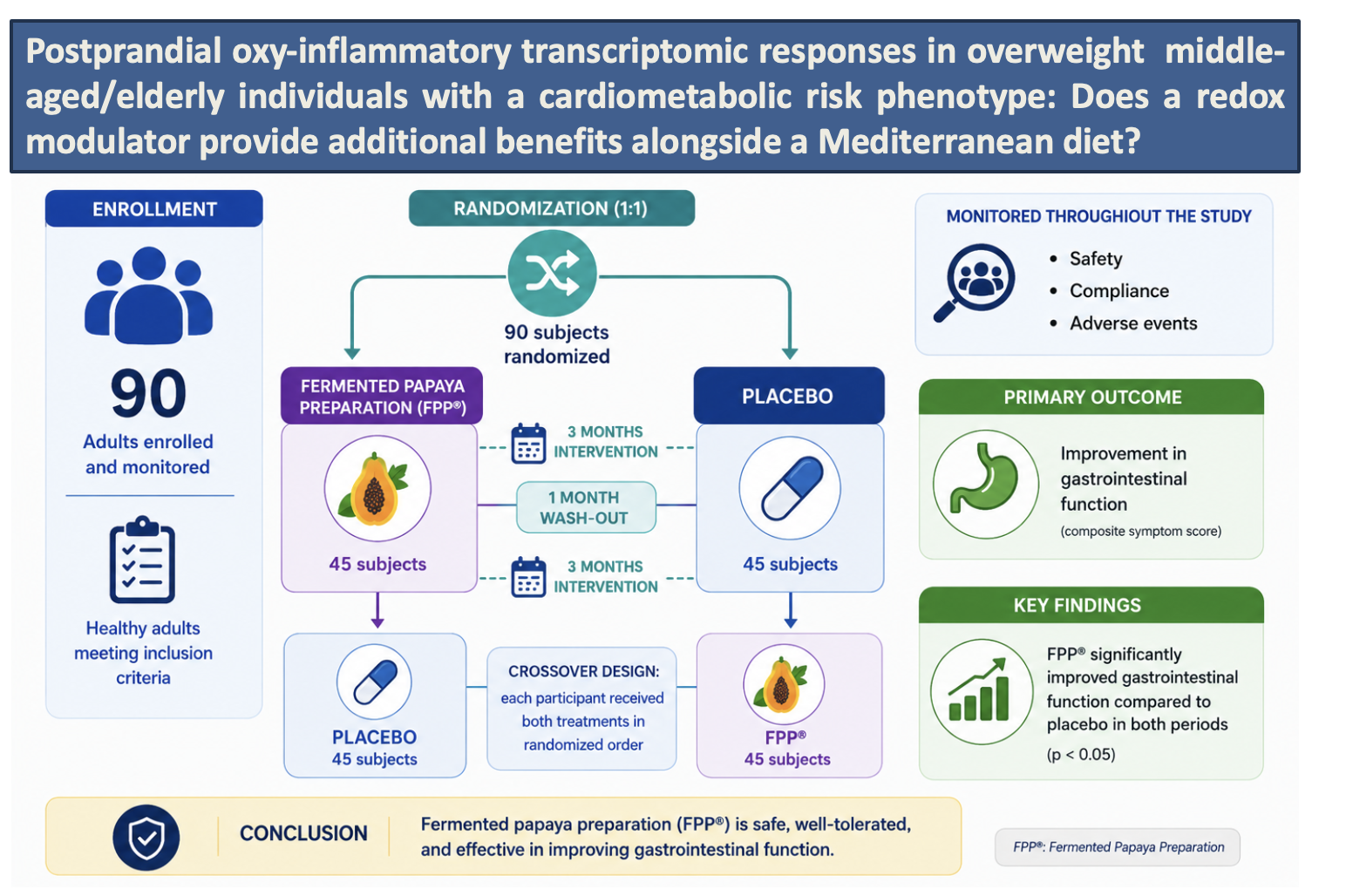
Objective: This study aimed to assess both intra- and extracellular redox status during the postprandial period in middle-aged and older sedentary individuals adhering to a Mediterranean dietary pattern, with or without supplementation using a patented fermented papaya preparation (FPP).
Methods: A total of 90 otherwise healthy participants presenting at least one cardiometabolic risk factor were enrolled. Postprandial assessments were conducted at baseline and after three months. Evaluated parameters included inflammatory biomarkers, adhesion molecules, apoptosis in peripheral blood mononuclear cells, and p53 gene expression.
Results: Compared with the Mediterranean diet alone, three months of FPP supplementation resulted in significant reductions in soluble levels of vascular cell adhesion molecule 1 and intercellular adhesion molecule 1. It also effectively prevented the postprandial increase in Annexin V⁺/DAPI⁺ cells and induced a protective downregulation of p53 expression, particularly within the cytoplasmic compartment. Furthermore, CySS concentrations and the CySS:GSH ratio were significantly reduced, while the decline in GSH levels was attenuated under the FPP-supplemented regimen.
Conclusion: These findings support the potential benefit of dietary interventions, particularly when combined with redox-modulating nutraceuticals, in reducing postprandial oxidative stress and its associated metabolically deleterious effects.
- Hu C, Zhang X, Teng T, Ma ZG, Tang QZ. Cellular Senescence in Cardiovascular Diseases: A Systematic Review. Aging Dis. 2022;13(1):103-128. doi: 10.14336/AD.2021.0927
- Regitz-Zagrosek V, Lehmkuhl E, Mahmoodzadeh S. Gender aspects of the role of the metabolic syndrome as a risk factor for cardiovascular disease. Gend Med. 2007;4 Suppl B:S162-177. doi: 10.1016/s1550-8579(07)80056-8
- Pérez-Castillo IM, Rueda R, Bouzamondo H, et al. Does Lifelong Exercise Counteract Low-Grade Inflammation Associated with Aging? A Systematic Review and Meta-Analysis. Sports Med. 2025;55(3):675-696. doi: 10.1007/s40279-024-02152-8
- Baechle JJ, Chen N, Makhijani P, et al. Chronic inflammation and the hallmarks of aging. Mol Metab. 2023;74:101755. doi: 10.1016/j.molmet.2023.101755
- An aged immune system drives senescence and ageing of solid organs. Nature. 2021;594(7861):100-105. doi: 10.1038/s41586-021-03547-7
- Cisneros B, García-Aguirre I, Unzueta J, et al. Immune system modulation in aging: Molecular mechanisms and therapeutic targets. Front Immunol. 2022;13:1059173. doi: 10.3389/fimmu.2022.1059173
- Xu W, Wong G, Hwang YY, Larbi A. The untwining of immunosenescence and aging. Semin Immunopathol. 2020;42(5):559-572. doi: 10.1007/s00281-020-00824-x
- Lewkiewicz S, Chuang YL, Chou T. A Mathematical Model of the Effects of Aging on Naive T Cell Populations and Diversity. Bull Math Biol. 2019;81(7):2783-2817. doi: 10.1007/s11538-019-00630-z
- Ahmed B, Si H. The Aging of Adipocytes Increases Expression of Pro-Inflammatory Cytokines Chronologically. Metabolites. 2021;11(5):292. doi: 10.3390/metabo11050292
- Huang Z, Chen B, Liu X, et al. Effects of sex and aging on the immune cell landscape as assessed by single-cell transcriptomic analysis. Proc Natl Acad Sci USA. 2021;118(33):e2023216118. doi: 10.1073/pnas.2023216118
- Yanai H, Adachi H, Hakoshima M, Katsuyama H. Postprandial Hyperlipidemia: Its Pathophysiology, Diagnosis, Atherogenesis, and Treatments. Int J Mol Sci. 2023;24(18):13942. doi: 10.3390/ijms241813942
- de Vries MA, Klop B, Eskes SA, et al. The postprandial situation as a pro-inflammatory condition. Clin Investig Arter. 2014;26(4):184-192. doi: 10.1016/j.arteri.2014.02.007
- Le NA. Lipoprotein-associated oxidative stress: a new twist to the postprandial hypothesis. Int J Mol Sci. 2014;16(1):401-419. doi: 10.3390/ijms16010401
- Lacroix S, Rosiers CD, Tardif JC, Nigam A. The role of oxidative stress in postprandial endothelial dysfunction. Nutr Res Rev. 2012;25(2):288-301. doi: 10.1017/S0954422412000182
- Srivastava SP, Kopasz-Gemmen O, Thurman A, et al. The molecular determinants regulating redox signaling in diabetic endothelial cells. Front Pharmacol. 2025;16:1563047. doi: 10.3389/fphar.2025.1563047
- Jones DP. Redefining oxidative stress. Antioxid Redox Signal. 2006;8(9-10):1865-1879. doi: 10.1089/ars.2006.8.1865
- Altıparmak IH, Erkuş ME, Sezen H, et al. The relation of serum thiol levels and thiol/disulphide homeostasis with the severity of coronary artery disease. Kardiol Pol. 2016;74(11):1346-1353. doi: 10.5603/KP.a2016.0085
- Mankowski RT, You L, Buford TW, et al. Higher dose of resveratrol elevated cardiovascular disease risk biomarker levels in overweight older adults - A pilot study. Exp Gerontol. 2020;131:110821. doi: 10.1016/j.exger.2019.110821
- Joris PJ, Plat J, Bakker SJ, Mensink RP. Effects of long-term magnesium supplementation on endothelial function and cardiometabolic risk markers: A randomized controlled trial in overweight/obese adults. Sci Rep. 2017;7(1):106. doi: 10.1038/s41598-017-00205-9
- Pathak S, Kesavan P, Banerjee A, et al. Metabolism of Dietary Polyphenols by Human Gut Microbiota and Their Health Benefits. In: Polyphenols: Mechanisms of Action in Human Health and Disease. Kidlington, UK: Elsevier; 2018:347-359. doi: 10.1016/b978-0-12-813006-3.00025-8
- Ambagaspitiya SS, Appuhamillage GA, Wimalawans VC, et al. Supplementation with Resveratrol and Curcumin Does Not Affect the Inflammatory Response to a High-Fat Meal in Older Adults with Abdominal Obesity: A Randomized, Placebo-Controlled Crossover Trial. J Nutr. 2018;148(3):379-388. doi: 10.1093/jn/nxx072
- Teunissen-Beekman KF, Dopheide J, Geleijnse JM, et al. Dietary proteins improve endothelial function under fasting conditions but not in the postprandial state, with no effects on markers of low-grade inflammation. Br J Nutr. 2015;114(11):1819-1828. doi: 10.1017/S0007114515003530
- Morand C, Dubray C, Milenkovic D, et al. Hesperidin contributes to the vascular protective effects of orange juice: a randomized crossover study in healthy volunteers. Am J Clin Nutr. 2011;93(1):73-80. doi: 10.3945/ajcn.110.004945
- Marotta F, Safran P, Tajiri H, et al. Improvement of hemorheological abnormalities in alcoholics by an oral antioxidant. Hepatogastroenterology. 2001;48(38):511-517.
- Tomella C, Catanzaro R, Illuzzi N, et al. The hidden phenomenon of oxidative stress during treatment of subclinical-mild hypothyroidism: a protective nutraceutical intervention. Rejuvenation Res. 2014;17(2):180-183. doi: 10.1089/rej.2013.1495
- Marotta F, Pavasuthipaisit K, Yoshida C, Albergati F, Marandola P. Relationship between aging and susceptibility of erythrocytes to oxidative damage: in view of nutraceutical interventions. Rejuvenation Res. 2006; 9(2):227-230. doi: 10.1089/rej.2006.9.227
- Marotta, F, Koike K, Lorenzetti A, et al. Regulating redox balance gene expression in healthy individuals by nutraceuticals: a pilot study. Rejuvenation Res. 2010;13(2-3):175-178. doi: 10.1089/rej.2009.0950
- Bertuccelli G, Zerbinati N, Marcellino M, et al. Effect of a quality-controlled fermented nutraceutical on skin aging markers: An antioxidant-control, double-blind study. Exp Ther Med. 2016;11(3):909-916. doi: 10.3892/etm.2016.3011
- Marotta F, Chui DH, Jain S, et al. Effect of a fermented nutraceutical on thioredoxin level and TNF-alpha signalling in cirrhotic patients. J Biol Regul Homeost Agents. 2011;25(1):37-45.
- Jones DP, Liang Y. Measuring the poise of thiol/disulfide couples in vivo. Free Radic Biol Med. 2009;47(10):1329-1338. doi: 10.1016/j.freeradbiomed.2009.08.021
- Guzonjić A, Crevar M, Simić I, et al. Alterations in GSH/GSSG and CyS/CySS redox status in small cell lung cancer patients undergoing chemotherapy. Discov Oncol. 2025;16(1):1445. doi: 10.1007/s12672-025-03251-2
- Bellini A, Nicolò A, Bazzucchi I, Sacchetti M. Effects of Different Exercise Strategies to Improve Postprandial Glycemia in Healthy Individuals. Med Sci Sports Exerc. 2021;53(7):1334. doi: 10.1249/MSS.0000000000002607
- Solomon TPJ, Eves FF, Laye MJ. Targeting Postprandial Hyperglycemia With Physical Activity May Reduce Cardiovascular Disease Risk. But What Should We Do, and When Is the Right Time to Move? Front Cardiovasc Med. 2018;5:99. doi: 10.3389/fcvm.2018.00099
- Henson J, Davies MJ, Bodicoat DH, et al. Breaking Up Prolonged Sitting With Standing or Walking Attenuates the Postprandial Metabolic Response in Postmenopausal Women: A Randomized Acute Study. Diabetes Care. 2016;39(1):130-138. doi: 10.2337/dc15-1240
- Dong Y, Sameni S, Digman MA, Brewer GJ. Reversibility of Age-related Oxidized Free NADH Redox States in Alzheimer’s Disease Neurons by Imposed External Cys/CySS Redox Shifts. Sci Rep. 2019;9(1):11274. doi: 10.1038/s41598-019-47582-x
- Watson WH, Burke TJ, Zelko IN, Torres-González E, Ritzenthaler JD, Roman J. Differential Regulation of the Extracellular Cysteine/Cystine Redox State (EhCySS) by Lung Fibroblasts from Young and Old Mice. Oxid Med Cell Longev. 2016;2016:1561305. doi: 10.1155/2016/1561305
- Dong WC, Guo JL, Xu L, et al. Impact of homocysteine on acute ischemic stroke severity: possible role of aminothiols redox status. BMC Neurol. 2024;24(1):175. doi: 10.1186/s12883-024-03681-5
- Moriarty-Craige SE, Ha KN, Sternberg P Jr, et al. Effects of long-term zinc supplementation on plasma thiol metabolites and redox status in patients with age-related macular degeneration. Am J Ophthalmol. 2007;143(2):206-211. doi: 10.1016/j.ajo.2006.09.056
- Goudev A, Kyurkchiev S, Gergova V, et al. Reduced Concentrations of Soluble Adhesion Molecules after Antioxidant Supplementation in Postmenopausal Women with High Cardiovascular Risk Profiles – A Randomized Double-Blind Study. Cardiology. 2000;94(4):227-232. doi: 10.1159/000047322
- Rallidis LS, Kolomvotsou A, Lekakis J, et al. Short-term effects of Mediterranean-type diet intervention on soluble cellular adhesion molecules in subjects with abdominal obesity. Clin Nutr ESPEN. 2017;17:38-43. doi: 10.1016/j.clnesp.2016.11.002
- Ishinoda Y, Masaki N, Hitomi Y, et al. Effectiveness of the serum ratio of l-cysteine to glutathione for the prediction of cardiovascular events. J Clin Biochem Nutr. 2025;77(2):174-181. doi: 10.3164/jcbn.24-156
- Potere N, Bonaventura A, Abbate A. Novel Therapeutics and Upcoming Clinical Trials Targeting Inflammation in Cardiovascular Diseases. Arter Thromb Vasc Biol. 2024;44(12):2371-2395. doi: 10.1161/ATVBAHA.124.319980
- Miller KN, Li B, Pierce-Hoffman HR, et al. p53 enhances DNA repair and suppresses cytoplasmic chromatin fragments and inflammation in senescent cells. Nat Commun. 2025;16(1):2229. doi: 10.1038/s41467-025-57229-3
- Diekmann C, Huber H, Preuß M, et al. Moderate Postmeal Walking Has No Beneficial Effects Over Resting on Postprandial Lipemia, Glycemia, Insulinemia, and Selected Oxidative and Inflammatory Parameters in Older Adults with a Cardiovascular Disease Risk Phenotype: A Randomized Crossover Trial. J Nutr. 2019;149(11):1930-1941. doi: 10.1093/jn/nxz148
- Catanzaro R, Calabrese F, Occhipinti S, et al. Nonalcoholic fatty liver disease increases risk for gastroesophageal reflux symptoms. Dig Dis Sci. 2014;59(8):1939-1945. doi: 10.1007/s10620-014-3113-7
- Chauhan W, Sj S, Ferdowsi S, Sohel A, Zennadi R. Red blood cell Rpl13a small noncoding nucleolar RNAs guides 2’-O-methylation on peroxidasin messenger RNA promoting venous thrombosis in aging. J Thromb Haemost. 2025. doi: 10.1016/j.jtha.2025.02.036