

MEF2C as a key driver in Epstein–Barr virus-positive diffuse large B-cell lymphoma

Introduction: Epstein–Barr virus (EBV)+ diffuse large B-cell lymphoma (DLBCL) is an aggressive lymphoma with a poor prognosis and complex molecular alterations. The role of ferroptosis in EBV+ DLBCL remains poorly understood.
Objectives: The objective of this study was to identify and validate key ferroptosis-related genes (FRGs) in EBV+ DLBCL by integrating bioinformatics and experimental approaches.
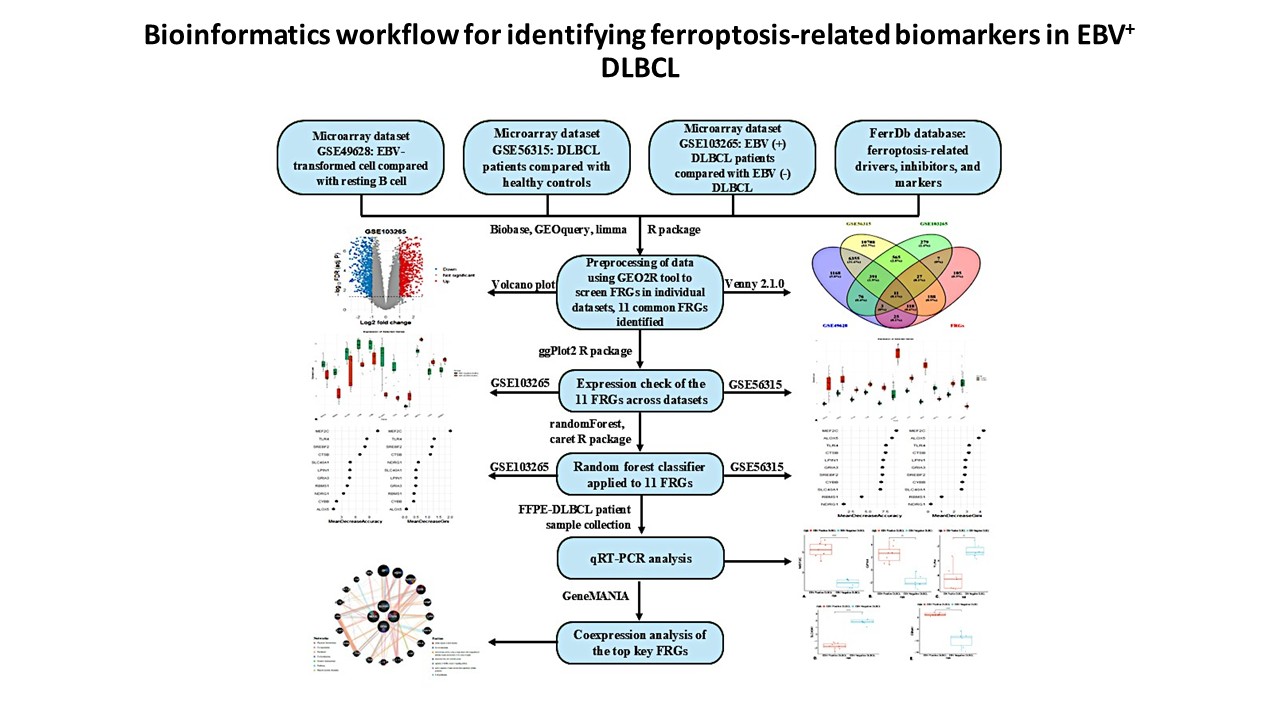
Methods: Gene expression datasets related to EBV and DLBCL were retrieved from the Gene Expression Omnibus (GEO) database, including GSE49628, GSE56315, and GSE103265. Differentially expressed genes (DEGs) were identified using GEO2R with the criteria |log2 fold change| ≥ 1 and adjusted p < 0.05. The DEG lists from the three datasets were intersected with the human FRGs retrieved from FerrDb using Venny 2.0. A random forest classifier was used to classify FRGs in each dataset through the randomForest and caret R packages. Selected genes were evaluated by quantitative real-time polymerase chain reaction (RT-qPCR) in formalin-fixed, paraffin-embedded DLBCL tissues from 13 patients, and further co-expression analysis of the genes was performed using GeneMANIA.
Results: Overlapping FRGs (n = 11) were identified through Venny 2.1.0. Using a random forest classifier, MEF2C was identified as the most important predictive biomarker, along with TLR4 and SLC40A1. Consistent with the expression-analysis results, RT-qPCR showed significantly higher MEF2C and GPX4 expression in EBV+ DLBCL samples, and significantly lower TLR4 and SLC40A1 expression. Co-expression analysis verified the involvement in pathways associated with iron ion homeostasis, inflammatory signaling, and B-cell proliferation.
Conclusion: This study suggests that molecular changes associated with ferroptosis are linked to EBV+ DLBCL and that MEF2C may be a therapeutic target or biomarker.
- Liu Y, Barta SK. Diffuse large B‐cell lymphoma: 2019 update on diagnosis, risk stratification, and treatment. Am J Hematol. 2019;94(5):604-616. doi: 10.1002/ajh.25460
- He MY, Kridel R. Treatment resistance in diffuse large B-cell lymphoma. Leukemia. 2021;35(8):2151-2165. doi: 10.1038/s41375-021-01285-3
- Awasthi P, Ahmad A, Singh NK, Ahmad IZ, Hasan S. Synergistic drug repurposing strategy identifies doxorubicin and paclitaxel as potential combination therapy for diffuse large B-cell lymphoma. Comput Biol Med. 2026;213:111781. doi: 10.1016/J.COMPBIOMED.2026.111781
- Brady G, MacArthur GJ, Farrell PJ. Epstein–Barr virus and Burkitt lymphoma. Postgrad Med J. 2008;84(993):372-377. doi: 10.1136/JCP.2007.047977
- Tsao SW, Tsang CM, Lo KW. Epstein–Barr virus infection and nasopharyngeal carcinoma. Philos Trans R Soc B. 2017;372(1732):20160270. doi: 10.1098/rstb.2016.0270
- Castillo JJ, Beltran BE, Miranda RN, Young KH, Chavez JC, Sotomayor EM. EBV-positive diffuse large B-cell lymphoma, not otherwise specified: 2018 update on diagnosis, risk-stratification and management. Am J Hematol. 2018;93(7):953-962. doi: 10.1002/AJH.25112
- Chabay P. Advances in the Pathogenesis of EBV-Associated Diffuse Large B Cell Lymphoma. Cancers. 2021;13(11):2717. doi: 10.3390/CANCERS13112717
- Ahmed N, Abusalah MAHA, Farzand A, et al. Updates on Epstein–Barr Virus (EBV)-Associated Nasopharyngeal Carcinoma: Emphasis on the Latent Gene Products of EBV. Medicina. 2022;59(1):2. doi: 10.3390/MEDICINA59010002
- Awasthi P, Dwivedi M, Kumar D, Hasan S. Insights into intricacies of the Latent Membrane Protein-1 (LMP-1) in EBV-associated cancers. Life Sci. 2023;313:121261. doi: 10.1016/J.LFS.2022.121261
- Awasthi P, Kohli AS, Dwivedi M, Hasan S. Implications of EBV-Encoded and EBV-Related miRNAs in Tumors. Curr Gene Ther. 2025;25(5):567-585. doi: 10.2174/0115665232327174241211075019
- Wang B, Wang Y, Zhang J, et al. ROS-induced lipid peroxidation modulates cell death outcome: mechanisms behind apoptosis, autophagy, and ferroptosis. Arch Toxicol. 2023;97(6):1439-1451. doi: 10.1007/S00204-023-03476-6
- Piccolo M, Ferraro MG, Iazzetti F, Santamaria R, Irace C. Insight into Iron, Oxidative Stress and Ferroptosis: Therapy Targets for Approaching Anticancer Strategies. Cancers. 2024;16(6):1220. doi: 10.3390/CANCERS16061220
- Liu J, Liu R, Miao J, He A. Ferroptosis in hematological malignancies: molecular mechanisms and therapeutic potential. Cell Oncol. 2025;49(1):10. doi: 10.1007/S13402-025-01142-W
- Maiorino M, Conrad M, Ursini F. GPx4, Lipid Peroxidation, and Cell Death: Discoveries, Rediscoveries, and Open Issues. Antioxid Redox Signal. 2018;29(1):61-74. doi: 10.1089/ars.2017.7115
- Zhang Y, Zou L, Li X, et al. SLC40A1 in iron metabolism, ferroptosis, and disease: A review. WIREs Mech Dis. 2024;16(4). doi: 10.1002/WSBM.1644
- Shen Y, Deng Y, Xie Y, et al. Pan‐cancer analyses of necroptosis, pyroptosis and ferroptosis related genes reveal TLR4 as a potential therapeutic target. J Cell Mol Med. 2025;29(14). doi: 10.1111/jcmm.70742
- Schmitt A, Xu W, Bucher P, et al. Dimethyl fumarate induces ferroptosis and impairs NF-κB/STAT3 signaling in DLBCL. Blood. 2021;138(10):871-884. doi: 10.1182/BLOOD.2020009404
- Liu L, Guo L, Zhang H, et al. Ferroptosis-related gene analysis revealing novel biomarkers and therapeutic targets in diffuse large B-cell lymphoma. Sci Rep. 2025;15(1):38613. doi: 10.1038/s41598-025-22478-1
- Weng J, Chen L, Liu H, Yang XP, Huang L. Ferroptosis Markers Predict the Survival, Immune Infiltration, and Ibrutinib Resistance of Diffuse Large B cell Lymphoma. Inflammation. 2022;45(3):1146-1161. doi: 10.1007/S10753-021-01609-6
- Lin C, Xie S, Wang M, Shen J. PRDX1 knockdown promotes erastin-induced ferroptosis and impedes diffuse large B-cell lymphoma development by inhibiting the MAPK/ERK pathway. BMC Cancer. 2025;25(1):806. doi: 10.1186/S12885-025-14173-1
- Chen X, Hu S, Han Y, et al. Ferroptosis-related STEAP3 acts as predictor and regulator in diffuse large B cell lymphoma through immune infiltration. Clin Exp Med. 2023;23(6):2601-2617. doi: 10.1007/s10238-023-00996-4
- Kotkaranta P, Chan M, Vuolio T, et al. DLBCL cells with ferroptosis morphology can be detected with a deep convolutional neural network. Biomed Pharmacother. 2025;182:117785. doi: 10.1016/J.BIOPHA.2024.117785
- Song X, Zhang W, Yu N, Zhong X. PAQR3 facilitates the ferroptosis of diffuse large B‐cell lymphoma via the regulation of LDLR‐mediated PI3K/AKT pathway. Hematol Oncol. 2023;42(1). doi: 10.1002/hon.3219
- Lu X, Zhang Q, Xie Y. TCFL5 knockdown sensitizes DLBCL to doxorubicin treatment via regulation of GPX4. Cell Signal. 2023;110:110831. doi: 10.1016/J.CELLSIG.2023.110831
- Sun Y, Xu Z, Wang Z, et al. KMT2D upregulates SMG1 via histone methylation to antagonize mTOR and reinforce DLBCL ferroptosis. J Leukoc Biol. 2025;117(7). doi: 10.1093/JLEUKO/QIAF092
- Hagenbrock R, Schmitt A, Labisch J, et al. Identification of ferroptosis-sensitizers for DLBCL treatment. Blood. 2025;146(suppl 1):3303. doi: 10.1182/BLOOD-2025-3303
- Liu Z, Song SY. Genomic and Transcriptomic Approaches Advance the Diagnosis and Prognosis of Neurodegenerative Diseases. Genes. 2025;16(2):135. doi: 10.3390/genes16020135
- Shi K, Lin W, Zhao XM. Identifying Molecular Biomarkers for Diseases with Machine Learning Based on Integrative Omics. IEEE/ACM Trans Comput Biol Bioinform. 2021;18(6):2514-2525. doi: 10.1109/TCBB.2020.2986387
- Kursa MB. Robustness of Random Forest-based gene selection methods. BMC Bioinformatics. 2014;15(1):8. doi: 10.1186/1471-2105-15-8
- Barrett T, Wilhite SE, Ledoux P, et al. NCBI GEO: archive for functional genomics data sets—update. Nucleic Acids Res. 2012;41(D1):D991-D995. doi: 10.1093/NAR/GKS1193
- Hansen KD, Sabunciyan S, Langmead B, et al. Large-scale hypomethylated blocks associated with Epstein-Barr virus–induced B-cell immortalization. Genome Res. 2014;24(2):177-184. doi: 10.1101/GR.157743.113
- García-Barchino MJ, Sarasquete ME, Panizo C, et al. Richter transformation driven by Epstein–Barr virus reactivation during therapy‐related immunosuppression in chronic lymphocytic leukaemia. J Pathol. 2018;245(1):61-73. doi: 10.1002/path.5060
- Dybkær K, Bøgsted M, Falgreen S, et al. Diffuse large B-cell lymphoma classification system that associates normal B-cell subset phenotypes with prognosis. J Clin Oncol. 2015;33(12):1379-1388. doi: 10.1200/JCO.2014.57.7080
- Aubert J, Bar-Hen A, Daudin JJ, Robin S. Determination of the differentially expressed genes in microarray experiments using local FDR. BMC Bioinformatics. 2004;5(1):1-9. doi: 10.1186/1471-2105-5-125
- Zhou N, Bao J. FerrDb: a manually curated resource for regulators and markers of ferroptosis and ferroptosis-disease associations. Database. 2020;2020. doi: 10.1093/DATABASE/BAAA021
- Franz M, Rodriguez H, Lopes C, et al. GeneMANIA update 2018. Nucleic Acids Res. 2018;46(W1):W60-W64. doi: 10.1093/NAR/GKY311
- De Paepe P, De Wolf-Peeters C. Diffuse large B-cell lymphoma: a heterogeneous group of non-Hodgkin lymphomas comprising several distinct clinicopathological entities. Leukemia. 2006;21(1):37-43. doi: 10.1038/sj.leu.2404449
- Li JW, Deng C, Zhou XY, Deng R. The biology and treatment of Epstein-Barr virus-positive diffuse large B cell lymphoma, NOS. Heliyon. 2024;10(1):e23921. doi: 10.1016/j.heliyon.2023.e23921
- Peng F, Liao M, Qin R, et al. Regulated cell death (RCD) in cancer: key pathways and targeted therapies. Signal Transduct Target Ther. 2022;7(1):286. doi: 10.1038/s41392-022-01110-y
- Tong X, Tang R, Xiao M, et al. Targeting cell death pathways for cancer therapy: recent developments in necroptosis, pyroptosis, ferroptosis, and cuproptosis research. J Hematol Oncol. 2022;15(1):174. doi: 10.1186/S13045-022-01392-3
- Su H, Peng C, Liu Y. Regulation of ferroptosis by PI3K/Akt signaling pathway: a promising therapeutic axis in cancer. Front Cell Dev Biol. 2024;12. doi: 10.3389/fcell.2024.1372330
- Li J, Cao F, Yin HL, et al. Ferroptosis: past, present and future. Cell Death Dis. 2020;11(2):88. doi: 10.1038/s41419-020-2298-2
- Pan Y, Li J, Liu H, et al. MEF2C: A Novel Transcription Factor Implicated in Human Malignant Tumors. Curr Top Med Chem. 2025;25. doi: 10.2174/0115680266359306250619210412
- Khiem D, Cyster JG, Schwarz JJ, Black BL. A p38 MAPK-MEF2C pathway regulates B-cell proliferation. Proc Natl Acad Sci USA. 2008;105(44):17067-17072. doi: 10.1073/pnas.0804868105
- Wilker PR, Kohyama M, Sandau MM, et al. Transcription factor Mef2c is required for B cell proliferation and survival after antigen receptor stimulation. Nat Immunol. 2008;9(6):603-612. doi: 10.1038/ni.1609
- Pasqualucci L. The germinal center in the pathogenesis of B cell lymphomas. Hematol Oncol. 2023;41(S1):62-69. doi: 10.1002/hon.3141
- Pasqualucci L, Trifonov V, Fabbri G, et al. Analysis of the coding genome of diffuse large B-cell lymphoma. Nat Genet. 2011;43(9):830-837. doi: 10.1038/ng.892
- Morin RD, Mendez-Lago M, Mungall AJ, et al. Frequent mutation of histone-modifying genes in non-Hodgkin lymphoma. Nature. 2011;476(7360):298-303. doi: 10.1038/nature10351
- Okosun J, Bödör C, Wang J, et al. Integrated genomic analysis identifies recurrent mutations and evolution patterns driving the initiation and progression of follicular lymphoma. Nat Genet. 2014;46(2):176-181. doi: 10.1038/ng.2856
- Ying CY, Dominguez-Sola D, Fabi M, et al. MEF2B mutations lead to deregulated expression of the oncogene BCL6 in diffuse large B cell lymphoma. Nat Immunol. 2013;14(10):1084-1092. doi: 10.1038/ni.2688
- Pasqualucci L, Khiabanian H, Fangazio M, et al. Genetics of Follicular Lymphoma Transformation. Cell Rep. 2014;6(1):130-140. doi: 10.1016/j.celrep.2013.12.027
- Schmitz R, Wright GW, Huang DW, et al. Genetics and Pathogenesis of Diffuse Large B-Cell Lymphoma. N Engl J Med. 2018;378(15):1396-1407. doi: 10.1056/nejmoa1801445
- Chapuy B, Stewart C, Dunford AJ, et al. Molecular subtypes of diffuse large B cell lymphoma are associated with distinct pathogenic mechanisms and outcomes. Nat Med. 2018;24(5):679-690. doi: 10.1038/s41591-018-0016-8
- Forcina GC, Dixon SJ. GPX4 at the Crossroads of Lipid Homeostasis and Ferroptosis. Proteomics. 2019;19(18). doi: 10.1002/pmic.201800311
- Song X, Wang X, Liu Z, Yu Z. Role of GPX4-Mediated Ferroptosis in the Sensitivity of Triple Negative Breast Cancer Cells to Gefitinib. Front Oncol. 2020;10. doi: 10.3389/fonc.2020.597434
- Wei Y, Lv H, Shaikh AB, et al. Directly targeting glutathione peroxidase 4 may be more effective than disrupting glutathione on ferroptosis-based cancer therapy. Biochim Biophys Acta Gen Subj. 2020;1864(4):129539. doi: 10.1016/J.BBAGEN.2020.129539
- Bhowmick S, Banerjee S, Shridhar V, Mondal S. Reprogrammed immuno-metabolic environment of cancer: the driving force of ferroptosis resistance. Mol Cancer. 2025;24(1):161. doi: 10.1186/S12943-025-02337-3
- Shi H, Kokoeva MV, Inouye K, Tzameli I, Yin H, Flier JS. TLR4 links innate immunity and fatty acid–induced insulin resistance. J Clin Invest. 2006;116(11):3015-3025. doi: 10.1172/JCI28898
- He W, Liu Q, Wang L, Chen W, Li N, Cao X. TLR4 signaling promotes immune escape of human lung cancer cells by inducing immunosuppressive cytokines and apoptosis resistance. Mol Immunol. 2007;44(11):2850-2859. doi: 10.1016/J.MOLIMM.2007.01.022
- Li CW, Jheng BR, Chen BS, Zhang L. Investigating genetic-and-epigenetic networks, and the cellular mechanisms occurring in Epstein–Barr virus-infected human B lymphocytes via big data mining and genome-wide two-sided NGS data identification. PLoS One. 2018;13(8):e0202537. doi: 10.1371/JOURNAL.PONE.0202537
- Nakamura H, Takada K. Reactive oxygen species in cancer: Current findings and future directions. Cancer Sci. 2021;112(10):3945-3952. doi: 10.1111/cas.15068
- Jomova K, Alomar SY, Valko R, et al. Interplay of oxidative stress and antioxidant mechanisms in cancer development and progression. Arch Toxicol. 2026;100(1):27-73. doi: 10.1007/S00204-025-04146-5
- Conrad M, Sato H. The oxidative stress-inducible cystine/glutamate antiporter, system x c −: cystine supplier and beyond. Amino Acids. 2012;42(1):231-246. doi: 10.1007/S00726-011-0867-5
- Bayır H, Dixon SJ, Tyurina YY, Kellum JA, Kagan VE. Ferroptotic mechanisms and therapeutic targeting of iron metabolism and lipid peroxidation in the kidney. Nat Rev Nephrol. 2023;19(5):315-336. doi: 10.1038/s41581-023-00689-x
- Auberger P, Favreau C, Savy C, Jacquel A, Robert G. Emerging role of glutathione peroxidase 4 in myeloid cell lineage development and acute myeloid leukemia. Cell Mol Biol Lett. 2024;29(1):98. doi: 10.1186/S11658-024-00613-6
- Wang J, Guo D, Jiang S, Wu W, Gao X. Targeting ferroptosis in cancer: from mechanistic insights to therapeutic approaches. Mol Biomed. 2026;7(1):20. doi: 10.1186/S43556-026-00416-5
- Wang S, Wu Z, Bu X, et al. MEF2C Alleviates Postoperative Cognitive Dysfunction by Repressing Ferroptosis. CNS Neurosci Ther. 2024;30(10):e70066. doi: 10.1111/cns.70066
- Wang C, Jiang S, Zhang L, et al. TAF Family Proteins and MEF2C Are Essential for Epstein-Barr Virus Super-Enhancer Activity. J Virol. 2019;93(16). doi: 10.1128/JVI.00513-19
- Yu T, Xu-Monette ZY, Yu L, Li Y, Young KH. Mechanisms of ferroptosis and targeted therapeutic approaches in lymphoma. Cell Death Dis. 2023;14(11):771. doi: 10.1038/s41419-023-06295-w
- Sun S, Shen J, Jiang J, Wang F, Min J. Targeting ferroptosis opens new avenues for the development of novel therapeutics. Signal Transduct Target Ther. 2023;8(1):372. doi: 10.1038/s41392-023-01606-1
- Shayanmanesh M, Ahmadi SE, Amini A. Ferroptosis in Haematological Malignancies: From Regulatory Networks to Novel Therapeutic Opportunities. J Cell Mol Med. 2025;29(17). doi: 10.1111/jcmm.70790