

Regulation of the DDAH/ADMA/NO axis by miR-193a and miR-939-5p in triple-negative breast cancer

Introduction: Dysregulated nitric oxide (NO) signaling plays a role in the viciousness of triple-negative breast cancer (TNBC). Dimethylarginine dimethylaminohydrolase 1 (DDAH1), which hydrolyzes asymmetric dimethylarginine (ADMA), an endogenously produced inhibitor of nitric oxide synthase (NOS), enhances NO production and promotes tumor vascularization, linking it to tumor progression. However, the roles of DDAH1 and its isoform DDAH2, and their regulation in the DDAH/ADMA/NO axis, remain poorly defined. Given their emerging role in gene regulation, microRNAs (miRNAs) may offer novel approaches for modulating this pathway in TNBC.
Objective: To investigate the regulatory effects of miR-939-5p and miR-193a on the DDAH/ADMA/NO axis in TNBC.
Methods: RNA was extracted from breast cancer (BC) tissues, and MDA-MB-231 TNBC cells were subjected to miRNA mimics. Gene expression was analyzed by quantitative reverse transcription-polymerase chain reaction, ADMA levels were quantified using a competitive enzyme-linked immunosorbent assay, and NO levels were measured with the Griess assay.
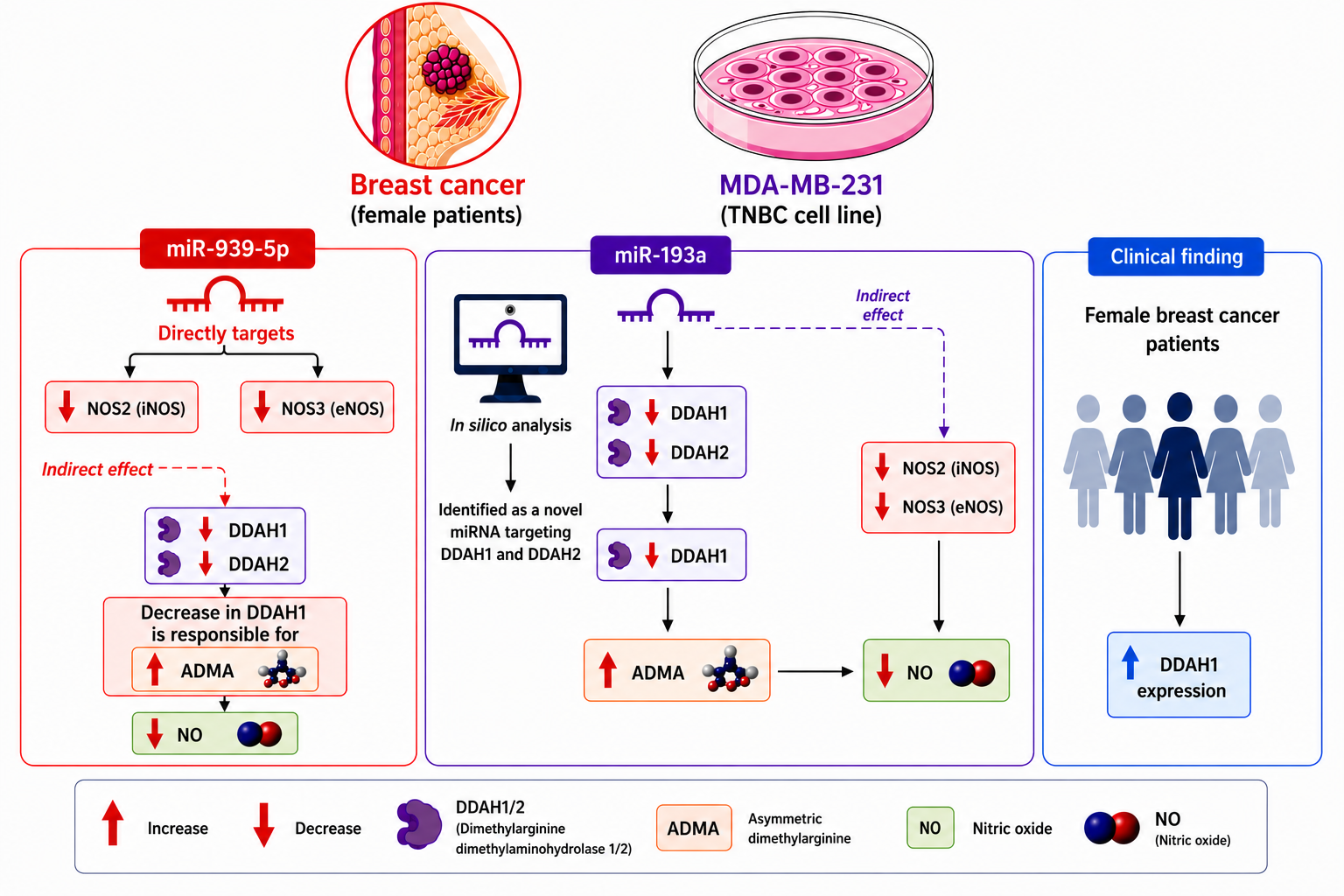
Results: DDAH1, but not DDAH2, expression was elevated in BC samples. Overexpression of either miR-939-5p or miR-193a suppressed DDAH1 and DDAH2 in TNBC cells, elevating ADMA levels and reducing NO bioavailability. In addition, overexpression of miR-193a directly influenced NOS2 and NOS3 transcripts, further suppressing NO synthesis. These dual effects highlight the capacity of miRNAs to regulate NO signaling at multiple levels.
Conclusion: This study highlighted the overexpression of DDAH1 in 20 Egyptian BC patients, a previously underexplored area. Moreover, it provided the first evidence that miR-939-5p and miR-193a modulate the ADMA/NO pathway in TNBC. This was achieved by simultaneously suppressing DDAH1/DDAH2 and NOS enzymes; the miRNAs shifted the balance toward ADMA accumulation and reduced NO signaling. These findings identify miR-939-5p and miR-193a as novel regulators of the DDAH/ADMA/NO axis in TNBC and provide new insights into the molecular mechanisms governing this pathway.
- Bauer KR, Brown M, Cress RD, Parise CA, Caggiano V. Descriptive analysis of estrogen receptor (ER)‐negative, progesterone receptor (PR)‐negative, and HER2-negative invasive breast cancer, the so‐called triple‐negative phenotype: a population‐based study from the California Cancer Registry. Cancer. 2007;109(9):1721-1728. doi: 10.1002/cncr.22618
- Haffty BG, Yang Q, Reiss M, et al. Locoregional relapse and distant metastasis in conservatively managed triple negative early-stage breast cancer. J Clin Oncol. 2006;24(36):5652-5657. doi: 10.1200/JCO.2006.06.5664
- Yin L, Duan JJ, Bian XW, Yu SC. Triple-negative breast cancer molecular subtyping and treatment progress. Breast Cancer Res. 2020;22(1):61. doi: 10.1186/s13058-020-01296-5
- Xiong X, Zheng LW, Ding Y, et al. Breast cancer: pathogenesis and treatments. Signal Transduct Target Ther. 2025;10(1):49. doi: 10.1038/s41392-024-02108-4
- Loibl S, von Minckwitz G, Weber S, et al. Expression of endothelial and inducible nitric oxide synthase in benign and malignant lesions of the breast and measurement of nitric oxide using electron paramagnetic resonance spectroscopy. Cancer. 2002;95(6):1191-1198. doi: 10.1002/cncr.10817
- Ziche M, Morbidelli L. Nitric oxide and angiogenesis. J Neurooncol. 2000;50(1-2):139-148. doi: 10.1023/a:1006431309841
- Tuteja N, Chandra M, Tuteja R, Misra MK. Nitric oxide as a unique bioactive signaling messenger in physiology and pathophysiology. BioMed Res Int. 2004;2004(4):227-237. doi: 10.1155/S1110724304402034
- Abán CE, Accialini PL, Etcheverry T, Leguizamón GF, Martinez NA, Farina MG. Crosstalk between nitric oxide and endocannabinoid signaling pathways in normal and pathological placentation. Front Physiol. 2018;9:1699. doi: 10.3389/fphys.2018.01699
- Choi JY, Lee KM, Noh DY, et al. Genetic polymorphisms of eNOS, hormone receptor status, and survival of breast cancer. Breast Cancer Res Treat. 2006;100(2):213-218. doi: 10.1007/s10549-006-9245-5
- Jin Z, Wang W, Jiang N, et al. Clinical implications of iNOS levels in triple-negative breast cancer responding to neoadjuvant chemotherapy. PLoS ONE. 2015;10(7):e0130286. doi: 10.1371/journal.pone.0130286
- Garrido P, Shalaby A, Walsh EM, et al. Impact of inducible nitric oxide synthase (iNOS) expression on triple negative breast cancer outcome and activation of EGFR and ERK signaling pathways. Oncotarget. 2017;8(46):80568-80588. doi: 10.18632/oncotarget.19631
- Kamm A, Przychodzen P, Kuban-Jankowska A, et al. Nitric oxide and its derivatives in the cancer battlefield. Nitric Oxide. 2019;93:102-114. doi: 10.1016/j.niox.2019.09.005
- Chavez KJ, Garimella SV, Lipkowitz S, Wong JE, Zujewski JA. Triple negative breast cancer cell lines: one tool in the search for better treatment of triple negative breast cancer. Breast Dis. 2011;32(1-2):35-48. doi: 10.3233/BD-2010-030714
- Bode-Böger SM, Scalera F, Kielstein JT, et al. Symmetrical dimethylarginine: a new combined parameter for renal function and extent of coronary artery disease. J Am Soc Nephrol. 2006;17(4):1128-1134. doi: 10.1681/asn.2005101119
- Martens‐Lobenhoffer J, Rodionov RN, Bode‐Böger SM. Probing AGXT2 enzyme activity in mouse tissue by applying stable isotope‐labeled asymmetric dimethyl arginine as substrate. J Mass Spectrom. 2012;47(12):1594-1600. doi: 10.1002/jms.3125
- Rodionov RN, Martens-Lobenhoffer J, Brilloff S, et al. Role of alanine:glyoxylate aminotransferase 2 in metabolism of asymmetric dimethylarginine in the settings of asymmetric dimethylarginine overload and bilateral nephrectomy. Nephrol Dial Transplant. 2014;29(11):2035-2042. doi: 10.1093/ndt/gfu236
- Ramuschkat M, Appelbaum S, Atzler D, et al. ADMA, subclinical changes and atrial fibrillation in the general population. Int J Cardiol. 2016;203:640-646. doi: 10.1016/j.ijcard.2015.05.102
- Ragavan VN, Nair PC, Jarzebska N, et al. A multicentric consortium study demonstrates that dimethylarginine dimethylaminohydrolase 2 is not a dimethylarginine dimethylaminohydrolase. Nat Commun. 2023;14(1):3392. doi: 10.1038/s41467-023-38467-9
- Shiozawa T, Iyama S, Toshima S, et al. Dimethylarginine dimethylaminohydrolase 2 promotes tumor angiogenesis in lung adenocarcinoma. Virchows Arch. 2016;468(2):179-190. doi: 10.1007/s00428-015-1863-z
- Hulin JA, Tommasi S, Elliot D, Hu DG, Lewis BC, Mangoni AA. MiR-193b regulates breast cancer cell migration and vasculogenic mimicry by targeting dimethylarginine dimethylaminohydrolase 1. Sci Rep. 2017;7(1):13996. doi: 10.1038/s41598-017-14454-1
- Reddy KRK, Dasari C, Duscharla D, et al. Dimethylarginine dimethylaminohydrolase-1 (DDAH1) is frequently upregulated in prostate cancer, and its overexpression conveys tumor growth and angiogenesis by metabolizing asymmetric dimethylarginine (ADMA). Angiogenesis. 2018;21(1):79-94. doi: 10.1007/s10456-017-9587-0
- Hulin JA, Tommasi S, Elliot D, Mangoni AA. Small molecule inhibition of DDAH1 significantly attenuates triple negative breast cancer cell vasculogenic mimicry in vitro. Biomed Pharmacother. 2019;111:602-612. doi: 10.1016/j.biopha.2018.12.117
- Mangoni AA, Ceruti T, Frapolli R, et al. Pharmacokinetic Characterization of the DDAH1 Inhibitors ZST316 and ZST152 in Mice Using a HPLC-MS/MS Method. Molecules. 2022;27(3):1017. doi: 10.3390/molecules27031017
- Nafea HM, Youness RA, Abou-Aisha K, Gad MZ. 27P MiR- 939-5p exhibits tumour suppressor activity and immune surveillance manipulation in triple-negative breast cancer. Ann Oncol. 2021;32:S11. doi: 10.1016/j.annonc.2021.01.041
- Nafea H, Youness RA, Abou-Aisha K, Gad MZ. LncRNA HEIH/miR-939-5p interplay modulates triple-negative breast cancer progression through NOS2-induced nitric oxide production. J Cell Physiol. 2021;236(7):5362-5372. doi: 10.1002/jcp.30234
- Gu H, Wang R, Beeraka NM, et al. Global burden and trends of breast cancer: GLOBOCAN 2022 estimates of incidence and mortality in 185 countries. Chin Med J. 2026;139(3):404- 414. doi: 10.1097/CM9.0000000000003921
- Pekarek L, García-Montero C, Casanova-Martin C, Ortega MA, Fraile-Martínez Ó. Beyond molecular classification in metastatic triple-negative breast cancer: toward subtype-guided precision oncology. Int J Mol Sci. 2026;27(11):5040. doi: 10.3390/ijms27115040
- Vedenko A, Panara K, Goldstein G, Ramasamy R, Arora H. Tumor Microenvironment and Nitric Oxide: Concepts and Mechanisms. Adv Exp Med Biol. 2020;1277:143-158. doi: 10.1007/978-3-030-50224-9_10
- Myśliwiec A, Bartusik-Aebisher D, Aebisher D. The Role of Nitric Oxide in Cancer Treatment: Ally or Foe? Molecules. 2025;30(13):2802. doi: 10.3390/molecules30132802
- Nair A, Madhyastha H, Revanasiddappa BC, et al. The role of nitric oxide in inflammation, tumor microenvironment, and cancer therapy. Nitric Oxide. 2026;162:25-34. doi: 10.1016/j.niox.2026.02.005
- Ekmekcioglu S, Ellerhorst J, Smid CM, et al. Inducible nitric oxide synthase and nitrotyrosine in human metastatic melanoma tumors correlate with poor survival. Clin Cancer Res. 2000;6(12):4768-4775.
- Loibl S, Buck A, Strank C, et al. The role of early expression of inducible nitric oxide synthase in human breast cancer. Eur J Cancer. 2005;41(2):265-271. doi: 10.1016/j.ejca.2004.07.010
- Raspollini MR, Amunni G, Villanucci A, et al. Expression of inducible nitric oxide synthase and cyclooxygenase-2 in ovarian cancer: correlation with clinical outcome. Gynecol Oncol. 2004;92(3):806-812. doi: 10.1016/j.ygyno.2003.12.023
- Yang L, Wang Y, Guo L, Wang L, Chen W, Shi B. The Expression and Correlation of iNOS and p53 in Oral Squamous Cell Carcinoma. Biomed Res Int. 2015;2015:637853. doi: 10.1155/2015/637853
- Decker NK, Abdelmoneim SS, Yaqoob U, et al. Nitric oxide regulates tumor cell cross-talk with stromal cells in the tumor microenvironment of the liver. Am J Pathol. 2008;173(4):1002-1012. doi: 10.2353/ajpath.2008.080158
- Jadeski LC, Hum KO, Chakraborty C, Lala PK. Nitric oxide promotes murine mammary tumour growth and metastasis by stimulating tumour cell migration, invasiveness and angiogenesis. Int J Cancer. 2000;86(1):30-39. doi: 10.1002/(SICI)1097-0215(20000401)86:1<30::AID-IJC5>3.0.CO;2-I
- Tanriover N, Ulu MO, Isler C, et al. Neuronal nitric oxide synthase expression in glial tumors: correlation with malignancy and tumor proliferation. Neurol Res. 2008;30(9):940-944. doi: 10.1179/174313208X319099
- MacAllister RJ, Whitley GSJ, Vallance P. Effects of guanidino and uremic compounds on nitric oxide pathways. Kidney Int. 1994;45(3):737-742. doi: 10.1038/ki.1994.98
- Vallance P, Leiper J. Cardiovascular biology of the asymmetric dimethylarginine: dimethylarginine dimethylaminohydrolase pathway. Arterioscler Thromb Vasc Biol. 2004;24(6):1023-1030. doi: 10.1161/01.ATV.0000128897.54893.26
- Moncada S, Palmer RM, Higgs EA. Biosynthesis of nitric oxide from L-arginine: a pathway for the regulation of cell function and communication. Biochem Pharmacol. 1989;38(11):1709-1715. doi: 10.1016/0006-2952(89)90403-6
- Xu W, Liu LZ, Loizidou M, Ahmed M, Charles IG. The role of nitric oxide in cancer. Cell Res. 2002;12(5-6):311-320. doi: 10.1038/sj.cr.7290133
- Michalik KM, You X, Manavski Y, et al. Long noncoding RNA MALAT1 regulates endothelial cell function and vessel growth. Circ Res. 2014;114(9):1389-1397. doi: 10.1161/CIRCRESAHA.114.303265
- Peng Y, Croce CM. The role of MicroRNAs in human cancer. Signal Transduct Target Ther. 2016;1(1):1-9. doi: 10.1038/sigtrans.2015.4
- Otmani K, Lewalle P. Tumor suppressor miRNA in cancer cells and the tumor microenvironment: mechanism of deregulation and clinical implications. Front Oncol. 2021;11:708765. doi: 10.3389/fonc.2021.708765
- Svoronos AA, Engelman DM, Slack FJ. OncomiR or tumor suppressor? The duplicity of microRNAs in cancer. Cancer Res. 2016;76(13):3666-3670. doi: 10.1158/0008-5472.CAN-16-0359
- Anastasiadou E, Boccellato F, Vincenti S, et al. Epstein– Barr virus encoded LMP1 downregulates TCL1 oncogene through miR-29b. Oncogene. 2010;29(9):1316-1328. doi: 10.1038/onc.2009.439
- Pekarsky Y, Croce CM. Is miR-29 an oncogene or tumor suppressor in CLL? Oncotarget. 2010;1(3):224-227. doi: 10.18632/oncotarget.129
- Di Leva G, Piovan C, Gasparini P, et al. Estrogen mediated-activation of miR-191/425 cluster modulates tumorigenicity of breast cancer cells depending on estrogen receptor status. PLoS Genet. 2013;9(3):e1003311. doi: 10.1371/journal.pgen.1003311
- Liu Y, Xu X, Xu X, et al. MicroRNA-193a-3p inhibits cell proliferation in prostate cancer by targeting cyclin D1. Oncol Lett. 2017;14(5):6046-6052. doi: 10.3892/ol.2017.6865
- Fang Z, Li C, Li S. MicroRNA‑193b acts as a tumor suppressor in colon cancer progression via targeting RAB22A. Exp Ther Med. 2019;17(5):3921-3928. doi: 10.3892/etm.2019.7435
- Fares F, Miari R, Azzam N, Shalom RB, Napso T, Ronen O. miRNA-193a acts as a tumor suppressor in human head and neck cancer cells and inhibits tumor development in xenograft mice. Res Sq. Preprint posted online June 10, 2024. doi: 10.21203/rs.3.rs-4310591/v1
- Jammal R, Krowiorz K, Haetscher N, et al. The miRNA- 193 family is a potent tumor-suppressor and a biomarker for poor prognosis in acute myeloid leukemia. Blood. 2016;128(22):1534. doi: 10.1182/blood.V128.22.1534.1534