

Psychometric and clinical utility of the Hospital Anxiety and Depression Scale in cancer patients: A narrative review on the Albanian population

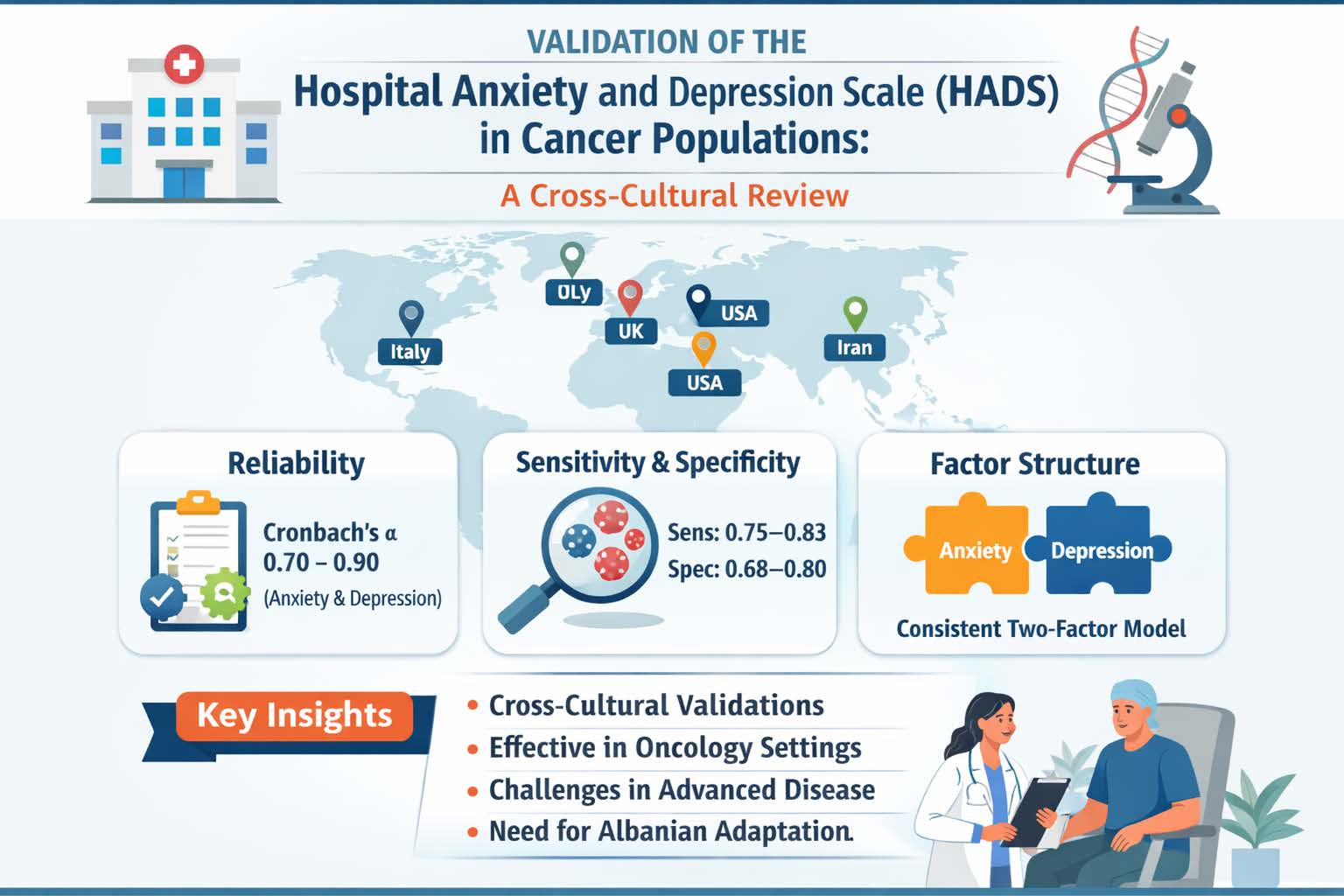
Anxiety and depression are highly prevalent among patients with cancer and negatively affect quality of life, treatment adherence, and clinical outcomes. The Hospital Anxiety and Depression Scale (HADS) is widely used in oncology due to its brevity and limited overlap with somatic symptoms. However, its psychometric performance varies across cultural and clinical settings, requiring context-specific evaluation. This study summarizes and compares evidence regarding the psychometric properties, factor structure, and clinical utility of the HADS in adult patients with cancer, and identifies gaps in cross-cultural validation, particularly the absence of an Albanian version. A narrative review of studies was conducted using major electronic databases. Validation studies, cross-cultural adaptations, systematic reviews, and meta-analyses assessing the HADS in patients with cancer were included. Evidence on reliability, validity, factor structure, and diagnostic performance was synthesized descriptively. Across diverse patient populations with cancer, the HADS demonstrated acceptable to excellent internal consistency, with Cronbach’s α values generally exceeding 0.70 for both subscales. Most studies supported the original two-factor structure, although alternative models were reported in some cultural contexts. Meta-analytic findings indicated moderate to good diagnostic accuracy for detecting clinically significant anxiety and depression. Numerous language adaptations confirmed its international applicability; however, variability in optimal cut-off scores and factor structures was observed. No validated Albanian version for cancer patients was found. The HADS is a reliable and practical screening tool in oncology. The absence of a validated Albanian version highlights the need for culturally adapted psychometric studies to support effective psychosocial screening in Albanian-speaking cancer populations.
- Bray F, Laversanne M, Sung H, et al. Global cancer statistics 2022: GLOBOCAN estimates of incidence and mortality worldwide for 36 cancers in 185 countries. CA A Cancer J Clinicians. 2024;74(3):229-263. doi: 10.3322/caac.21834
- Vaccarella S, Georges D, Bray F, et al. Socioeconomic inequalities in cancer mortality between and within countries in Europe: a population-based study. Lancet Reg Health Eur. 2023;25:100551. doi: 10.1016/j.lanepe.2022.100551
- Riba MB, Donovan KA, Ahmed K, et al. NCCN Guidelines® Insights: Distress Management, Version 2.2023. J Natl Compr Canc Netw. 2023;21(5):450-457. doi: 10.6004/jnccn.2023.0026
- Bakhsh HR, Bin Sheeha B, Tesio L, et al. Validity of the Arabic Version of the PROMIS Anxiety and PROMIS Depression in Cancer Questionnaires: Measuring Depression and Anxiety in Oncologic Patients in Saudi Arabia-A Rasch Analysis Study. J Clin Med. 2025;14(24):8774. doi: 10.3390/jcm14248774
- Prinsen CAC, Mokkink LB, Bouter LM, et al. COSMIN guideline for systematic reviews of patient-reported outcome measures. Qual Life Res. 2018;27(5):1147-1157. doi: 10.1007/s11136-018-1798-3
- Maheu C, Tock WL, Fisher P, et al. Systematic Review of Fear of Cancer Recurrence Patient-Reported Outcome Measures: Evaluating Methodological Quality and Measurement Properties Using the COSMIN Checklist. Healthcare. 2025;13(17):2165. doi: 10.3390/healthcare13172165
- Page MJ, McKenzie JE, Bossuyt PM, et al. Updating guidance for reporting systematic reviews: development of the PRISMA 2020 statement. J Clin Epidemiol. 2021;134:103- 112. doi: 10.1016/j.jclinepi.2021.02.003
- Hansson E, Wessman C, Paganini A. Creating a standard for evaluation of symptoms of depression and anxiety in women undergoing reduction mammaplasty: validation and reliability of HADS. BMC Plast Reconstr Surg. 2025;1(1). doi: 10.1186/s44452-025-00001-9
- Zigmond AS, Snaith RP. The hospital anxiety and depression scale. Acta Psychiatr Scand. 1983;67(6):361-70. doi: 10.1111/j.1600-0447.1983.tb09716.x
- Upadhyay K, Tamrakar RK, Kumar S, et al. Psycho-oncology: Bridging mental health and cancer care in modern medicine. Arch Psychiatr Nurs. 2026;60:152024. doi: 10.1016/j.apnu.2025.152024
- Marano G, Paris I, Traversi G, et al. Modern Personalized Strategies for Breast Cancer Treatment: Bridging Precision Oncology and Psycho-Oncology. J Clin Med. 2026;15(4):1574. doi: 10.3390/jcm15041574
- Perna G, Pinto E, Spiti A, et al. Foundations for a Personalized Psycho-Oncology: The State of the Art. J Pers Med. 2024;14(9):892. doi: 10.3390/jpm14090892
- Hou J, Meng Y, Zhang L, et al. Anxiety in breast cancer research (1982–2024): a bibliometric analysis. Clin Transl Oncol. 2025;28(5):1637-1651. doi: 10.1007/s12094-025-04115-5
- Rodgers J, Martin CR, Morse RC, et al. An investigation into the psychometric properties of the Hospital Anxiety and Depression Scale in patients with breast cancer. Health Qual Life Outcomes. 2005;3(1). doi: 10.1186/1477-7525-3-41
- Saboonchi F, Wennman-Larsen A, Alexanderson K, et al. Examination of the construct validity of the Swedish version of the Hospital Anxiety and Depression Scale in breast cancer patients. Qual Life Res. 2013;22(10):2849-2856. doi: 10.1007/s11136-013-0407-8
- Osborne RH, Elsworth GR, Sprangers MAG, et al. The value of the Hospital Anxiety and Depression Scale for comparing women with early-onset breast cancer with population-based reference women. Qual Life Res. 2004;13(1):191-206. doi: 10.1023/B:QURE.0000015292.56268.e7
- Hajian-Tilaki K, Hajian-Tilaki E. Factor structure and reliability of the Persian version of the Hospital Anxiety and Depression Scale in patients with breast cancer survivors. Health Qual Life Outcomes. 2020;18(1). doi: 10.1186/s12955-020-01429-6
- Annunziata MA, Muzzatti B, Altoè G. Defining Hospital Anxiety and Depression Scale structure by confirmatory factor analysis: a contribution to validation for oncological settings. Ann Oncol. 2011;22(10):2330-2333. doi: 10.1093/annonc/mdq750
- Schellekens MPJ, van den Hurk DGM, Prins JB, et al. The suitability of the Hospital Anxiety and Depression Scale, Distress Thermometer and other instruments to screen for psychiatric disorders in lung cancer patients and their partners. J Affect Disord. 2016;203:176-183. doi: 10.1016/j.jad.2016.05.044
- Lloyd M, Sugden N, Thomas M, et al. The structure of the Hospital Anxiety and Depression Scale: Theoretical and methodological considerations. Br J Psychol. 2023;114(2):457-475.doi: 10.1111/bjop.12637
- Terol-Cantero MC, Cabrera-Perona V, Martín-Aragón M. Revisión de estudios de la Escala de Ansiedad y Depresión Hospitalaria (HAD) en muestras españolas [Hospital Anxiety and Depression Scale (HADS) review in Spanish Sample]. An Psicol. 2015;31(2):494. [In Spanish]. doi: 10.6018/analesps.31.2.172701
- Mitchell AJ, Meader N, Symonds P. Diagnostic validity of the Hospital Anxiety and Depression Scale (HADS) in cancer and palliative settings: A meta-analysis. J Affect Disord. 2010;126(3):335-348. doi: 10.1016/j.jad.2010.01.067
- Vodermaier A, Millman RD. Accuracy of the Hospital Anxiety and Depression Scale as a screening tool in cancer patients: a systematic review and meta-analysis. Support Care Cancer. 2011;19(12):1899-1908. doi: 10.1007/s00520-011-1251-4
- Annunziata MA, Muzzatti B, Bidoli E, et al. Hospital Anxiety and Depression Scale (HADS) accuracy in cancer patients. Support Care Cancer. 2020;28(8):3921-3926. doi: 10.1007/s00520-019-05244-8
- Mitchell AJ, Chan M, Bhatti H, et al Prevalence of depression, anxiety, and adjustment disorder in oncological, haematological, and palliative-care settings: a meta-analysis of 94 interview-based studies. Lancet Oncol. 2011;12(2):160- 174. doi: 10.1016/S1470-2045(11)70002-X
- Franco A, Anees W, Moreira D, et al. Literature reviews: typology and forensic applications. Int J Legal Med. 2025;139(5):2503-2517. doi: 10.1007/s00414-025-03514-1
- Baethge C, Goldbeck-Wood S, Mertens S. SANRA—–a scale for the quality assessment of narrative review articles. Res Integr Peer Rev. 2019;4(1). doi: 10.1186/s41073-019-0064-8
- Rana K, Poudel P, Chimoriya R. Qualitative Methodology in Translational Health Research: Current Practices and Future Directions. Healthcare. 2023;11(19):2665. doi: 10.3390/healthcare11192665
- Theile CM, Beall AL. Narrative Reviews of the Literature: An overview. J Dent Hyg. 2024;98(1):78-82
- Costantini M, Musso M, Viterbori P, et al. Detecting psychological distress in cancer patients: validity of the Italian version of the Hospital Anxiety and Depression Scale. Support Care Cancer. 1999;7(3):121-127. doi: 10.1007/s005200050241
- Mystakidou K, Tsilika E, Parpa E, et al. The Hospital Anxiety and Depression Scale in Greek cancer patients: psychometric analyses and applicability. Support Care Cancer. 2004;12(12):821-825. doi: 10.1007/s00520-004-0698-y
- Nikolovski A, Gamgoum L, Deol A, et al. Psychometric properties of the Hospital Anxiety and Depression Scale (HADS) in individuals with stable chronic obstructive pulmonary disease (COPD): a systematic review. Disabil Rehabil. 2024;46(7):1230-1238. doi: 10.1080/09638288.2023.2182918
- Hyland KA, Hoogland AI, Gonzalez BD, et al. Evaluation of the psychometric and structural properties of the Spanish version of the Hospital Anxiety and Depression Scale in Latina cancer patients. J Pain Symptom Manag. 2019;58(2):289-296.e2. doi: 10.1016/j.jpainsymman.2019.05.003
- Vilela-Estrada AL, Villarreal-Zegarra D, Copez-Lonzoy A, et al. Psychometric properties of the Spanish version of the Hospital Anxiety and Depression Scale in cancer patients. Front Psychol. 2025;15. doi: 10.3389/fpsyg.2024.1497946
- Beaton DE, Bombardier C, Guillemin F, et al. Guidelines for the process of cross-cultural adaptation of self-report measures. Spine. 2000;25(24):3186-3191. doi: 10.1097/00007632-200012150-00014
- Hobbs C, Lewis G, Dowrick C, et al. Comparison between self-administered depression questionnaires and patients’ own views of changes in their mood: a prospective cohort study in primary care. Psychol Med. 2021;51(5):853-860. doi: 10.1017/S0033291719003878
- Pimenta CJ, Bezerra TA, Silva CR, et al. Evidence of validity of the Brazilian version of the Cancer Behavior Inventory - Brief Version. Rev Gaucha Enferm. 2024;45. doi: 10.1590/1983-1447.2024.20230107.en
- Murari J, Sharma I, Atwal SA, et al. Understanding cancer-related pain: pathophysiology, classification, and treatment modalities. Cureus. 2025;17(9). doi: 10.7759/cureus.91395
- Wang M, Han B, Liu Y, et al. Effects of posttraumatic stress symptoms on anxiety and depression in breast cancer patients. BMC Psychol. 2025;14(1). doi: 10.1186/s40359-025-03741-6
- Lloyd-Williams M, Friedman T, Rudd N. An analysis of the validity of the Hospital Anxiety and Depression Scale as a screening tool in patients with advanced metastatic cancer. J Pain Symptom Manag. 2001;22(6):990-996. doi: 10.1016/S0885-3924(01)00358-X
- Galindo O, Benjet C, Juárez García F, et al. ropiedades psicométricas de la Escala Hospitalaria de Ansiedad y Depresión (HADS) en una población de pacientes oncológicos mexicanos [Psychometric properties of the Hospital Anxiety and Depression Scale in a Mexican oncological population]. Salud Ment. 2015;38(4):253-258. [In Spanish] doi: 10.17711/sm.0185-3325.2015.035
- Villoria E, Lara L. Assessment of the Hospital Anxiety and Depression Scale for cancer patients. Rev Med Chil. 2018;146(3):300-307. doi: 10.4067/s0034-98872018000300300
- Li Q, Lin Y, Hu C, et al. Psychometric properties of the Chinese version of the Hospital Anxiety and Depression Scale in cancer patients and their family caregivers. Eur J Oncol Nurs. 2016;25:16-23. doi: 10.1016/j.ejon.2016.09.004
- Yusoff N, Low WY, Yip CH. Psychometric properties of the Malay version of the Hospital Anxiety and Depression Scale: a study of husbands of breast cancer patients in Kuala Lumpur, Malaysia. Asian Pac J Cancer Prev. 2011;12(4):915- 917
- Ramírez Orozco M, Vázquez OG, Bargalló Rocha JE, et al. Propiedades psicométricas de la Escala Hospitalaria de Ansiedad y Depresión (HADS) en sobrevivientes de cáncer de mama mexicanas [Psychometric properties of the Hospital Anxiety and Depression Scale (HADS) in Mexican breast cancer survivors]. Psicol Salud. 2022;32(2):313–324. [In Spanish] doi: 10.25009/pys.v32i2.2752
- Akuratiyage LY, De Silva P, Dissanayake U, et al. Cultural validation of the Sinhala version of the hospital anxiety and depression scale (HADS-S) in Sri Lanka. Sri Lanka J Psychiatry. 2025;16(1):27-33. doi: 10.4038/sljpsyc.v16i1.8616
- Şahin G, Yuksel HC, Acar C, et al. Assessment of the fear of progression in Turkish cancer patients: a validation and reliability study fear of progression questionnaire short form. BMC Psychol. 2025;13(1). doi: 10.1186/s40359-025-02650-y
- Park H, Kim KE, Moon E, et al. Psychometric properties of assessment tools for depression, anxiety, distress, and psychological problems in breast cancer patients: a systematic review. Psychiatry Investig. 2023;20(5):395-407. doi: 10.30773/pi.2022.0316
- Tian X, Li H, Li F, et al. Development and validation of a web-based calculator for determining the risk of psychological distress based on machine learning algorithms: A cross-sectional study of 342 lung cancer patients. Support Care Cancer. 2024;33(1). doi: 10.1007/s00520-024-09127-5
- Maheu C, Singh M, Tock WL, et al. The Cancer and Work Scale (CAWSE): Assessing Return to Work Likelihood and Employment Sustainability After Cancer. Curr Oncol. 2025;32(3):166. doi: 10.3390/curroncol32030166
- Luckett T, Butow PN, King MT, et al. A review and recommendations for optimal outcome measures of anxiety, depression and general distress in studies evaluating psychosocial interventions for adults with cancer. Support Care Cancer. 2010;18(10):1241-1262. doi: 10.1007/s00520-010-0932-8
- Miraglia Raineri A, Lauro Grotto R, Fioravanti G, et al. Assessing psychological needs in female cancer patients: a tailored model. Acta Biomed. 2021;92(S2):e2021005. doi: 10.23750/abm.v92iS2.11284
- Aburub A, Al-Sharman A, Hijazi H. Exploring Factors Associated with Fear of Falling among Women with Breast Cancer: Findings from a Cross-Sectional Study. Asian Pac J Cancer Prev. 2025;26(11):3967-3974. doi: 10.31557/APJCP.2025.26.11.3967
- Horan MR, Sim JA, Krull KR, et al. A Review of Patient- Reported Outcome Measures in Childhood Cancer. Children. 2022;9(10):1497. doi: 10.3390/children9101497
- Perez NB, Sierra PG, Taylor B, et al. Selecting a depression measure for research: A critical examination of five common self-report scales. J Affect Disord. 2026;394:120542. doi: 10.1016/j.jad.2025.120542
- Lemos R, Costa B, Frasquilho D, et al. Cross-cultural adaptation and psychometric evaluation of the perceived ability to cope with trauma scale in Portuguese patients with breast cancer. Front Psychol. 2022;13. doi: 10.3389/fpsyg.2022.800285
- Zhou B, Kang J, Zhao L, et al. Development and validation of a risk prediction model for post-traumatic stress disorder among Chinese breast cancer survivors. Sci Rep. 2025;15(1). doi: 10.1038/s41598-025-92137-y
- Liu X, Shi J, Gu H, et al. Psychological impacts of thyroid cancer diagnosis and treatment-a retrospective study. Front Psychol. 2025;16. doi: 10.3389/fpsyg.2025.1697978
- Knaul FM, Arreola-Ornelas H, Kwete XJ, et al. The evolution of serious health-related suffering from 1990 to 2021: an update to The Lancet Commission on global access to palliative care and pain relief. Lancet Glob Health. 2025;13(3):e422-e436. doi: 10.1016/S2214-109X(24)00476-5
- Bray F, Laversanne M, Sung H, et al. Global cancer statistics 2022: GLOBOCAN estimates of incidence and mortality worldwide for 36 cancers in 185 countries. CA Cancer J Clin. 2024;74(3):229-263. doi: 10.3322/caac.21834
- Liu Y, Zheng Z. Understanding the global cancer statistics 2022: growing cancer burden. Sci China Life Sci. 2024;67(10):2274-2276. doi: 10.1007/s11427-024-2657-y