
Clinical efficacy, safety, and pharmacologic determinants of antimicrobial peptides: A systematic review and meta‑analysis

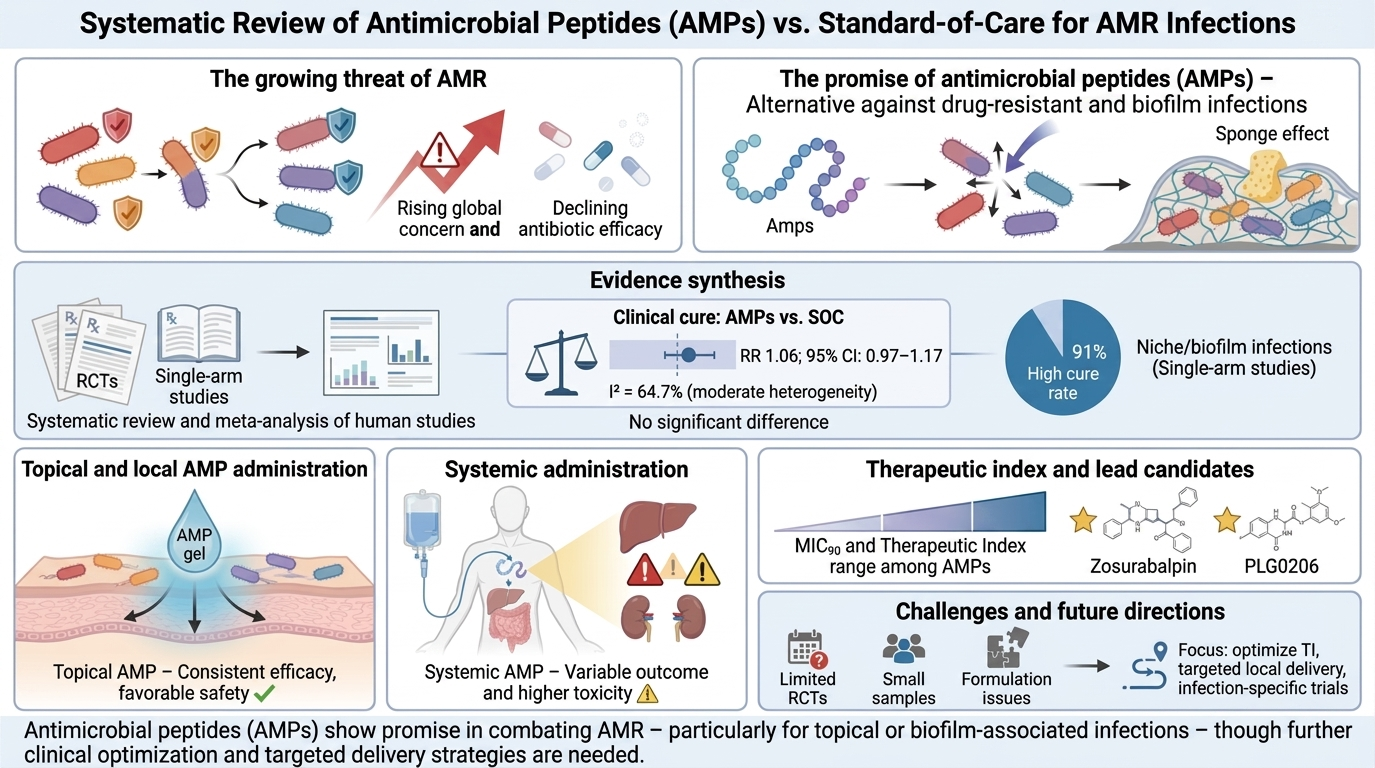
Introduction: Antimicrobial resistance poses an escalating global health threat, driving the need for alternative therapeutic strategies beyond conventional antibiotics. Despite extensive preclinical research, the clinical performance of these agents remains incompletely characterized.
Objective: This systematic review and meta-analysis synthesize and evaluate clinical efficacy, safety, and pharmacologic determinants of antimicrobial peptide therapeutics in human studies, and determine their comparative performance against standard-of-care treatments.
Methods: A comprehensive search of PubMed, Embase, Web of Science, ClinicalTrials.gov, and the World Health Organization International Clinical Trials Registry Platform identified eligible clinical studies published between January 2000 and January 2026. Randomized controlled trials and comparative clinical studies reporting clinical or microbiologic outcomes were included in the quantitative meta-analysis. Early-phase, single-arm, or non-comparative studies were synthesized qualitatively. A random-effects model was used to estimate pooled risk ratios (RRs) for clinical cure, and heterogeneity was assessed using the I2 statistic.
Results: Six comparative clinical studies involving 1,418 participants were included in the meta-analysis. Pooled analysis demonstrated no statistically significant difference in clinical cure between peptide-based therapeutics and standard-of-care treatments (RR 1.06, 95% confidence interval: 0.97–1.17), with moderate heterogeneity (I2 = 64.7%). Early-phase and single-arm studies reported high clinical cure rates, particularly in biofilm-associated or localized infections. Subgroup analyses indicated that topical or locally-administered peptides produced more consistent therapeutic outcomes, whereas systemic administration showed greater variability and was more frequently limited by toxicity.
Conclusion: Antimicrobial peptides demonstrate promising activity in specific clinical contexts, particularly biofilm-related and drug-resistant infections. While current evidence does not show superiority over standard-of-care therapies, early-phase data highlight their potential in niche indications. Future development should prioritize optimizing therapeutic index, improving targeted delivery strategies, and designing infection-specific clinical trials to fully realize the clinical potential of this emerging therapeutic class.
- Spellberg B, Bartlett JG, Gilbert DN. The Future of Antibiotics and Resistance. New Eng J Med. 2013;368(4):299-302. doi: 10.1056/NEJMp1215093
- Zhang Q. Bacteria carrying mobile colistin resistance genes and their control measures, an updated review. Arch Microbiol. 2024;206(12):462. doi: 10.1007/s00203-024-04188-w
- Renwick M, Mossialos E. What are the economic barriers of antibiotic R&D and how can we overcome them? Expert Opin Drug Discov. 2018;13(10):889-892. doi: 10.1080/17460441.2018.1515908
- Gargate N, Laws M, Rahman KM. Current economic and regulatory challenges in developing antibiotics for Gram-negative bacteria. npj Antimicrob Resist. 2025;3(1):50. doi: 10.1038/s44259-025-00123-1
- Ngashangva N, Huidrom S, Devi IS. Antimicrobial peptides: natural templates for next-generation therapeutics against antimicrobial resistance. Front Cell Infect Microbiol. 2026;15. doi: 10.3389/fcimb.2025.1720027
- Hancock REW, Sahl HG. Antimicrobial and host-defense peptides as new anti-infective therapeutic strategies. Nat Biotechnol. 2006;24(12):1551-1557. doi: 10.1038/nbt1267
- Kim SH, Min YH, Park MC. Antimicrobial Peptides: Current Status, Mechanisms of Action, and Strategies to Overcome Therapeutic Limitations. Microorganisms. 2025;13(11):2574. doi: 10.3390/microorganisms13112574
- Siddiqui NA, Houson HA, Kamble NS, et al. Leveraging copper import by yersiniabactin siderophore system for targeted PET imaging of bacteria. JCI Insight. 2021;6(10). doi: 10.1172/jci.insight.144880
- Sahoo K, Meshram S. Biofilm Formation in Chronic Infections: A Comprehensive Review of Pathogenesis, Clinical Implications, and Novel Therapeutic Approaches. Cureus. 2024;16(10):e70629. doi: 10.7759/cureus.70629
- Agüero-Chapin G, Antunes A, Marrero-Ponce Y. A 2026 Update on Computational Approaches to the Discovery and Design of Antimicrobial Peptides. Antibiotics. 2026;15(2). doi: 10.3390/antibiotics15020203
- Xuan J, Feng W, Wang J, et al. Antimicrobial peptides for combating drug-resistant bacterial infections. Drug Resist Updat.. 2023;68:100954. doi: 10.1016/j.drup.2023.100954
- Khanda M, Seal P, Mohan AJ, Arya N, Boda SK. Antimicrobial peptides and their application to combat implant-associated infections – opportunities and challenges. Nanoscale. 2025;17(17):10462-10484. doi: 10.1039/D5NR00953G
- Pennone V, Rosini E, Mascheroni E, et al. Revolutionizing orthopedic healthcare: a systematic review unveiling recombinant antimicrobial peptides. Front Microbiol. 2024;15:1370826. doi: 10.3389/fmicb.2024.1370826
- Pletzer D, Coleman SR, Hancock RE. Anti-biofilm peptides as a new weapon in antimicrobial warfare. Curr Opin Microbiol. 2016;33:35-40. doi: 10.1016/j.mib.2016.05.016
- Mansour SC, Pena OM, Hancock REW. Host defense peptides: front-line immunomodulators. Trends Immunol. 2014;35(9):443-450. doi: 10.1016/j.it.2014.07.004
- Hoffmann-La Roche. A Study to Investigate the Pharmacokinetics of RO7223280 in Critically Ill Participants With Bacterial Infections. ClinicalTrials.gov. 2024. Accessed May 7, 2026. https://clinicaltrials.gov/study/NCT05614895
- Wei Y, Li Y, Li X, et al. Peceleganan Spray for the Treatment of Skin Wound Infections. JAMA Netw Open. 2024;7(6):e2415310. doi: 10.1001/jamanetworkopen.2024.15310
- Page MJ, McKenzie JE, Bossuyt PM, et al. The PRISMA 2020 statement: an updated guideline for reporting systematic reviews. BMJ. 2021:n71. doi: 10.1136/bmj.n71
- Sterne JAC, Savović J, Page MJ, et al. RoB 2: a revised tool for assessing risk of bias in randomised trials. BMJ. 2019:l4898. doi: 10.1136/bmj.l4898
- Sterne JA, Hernán MA, Reeves BC, et al. ROBINS-I: a tool for assessing risk of bias in non-randomised studies of interventions. BMJ. 2016:i4919. doi: 10.1136/bmj.i4919
- Guyatt G, Oxman AD, Akl EA, et al. GRADE guidelines: 1. Introduction—GRADE evidence profiles and summary of findings tables. J Clin Epidemiol. 2011;64(4):383-394. doi: 10.1016/j.jclinepi.2010.04.026
- Cadence Pharmaceuticals. Study of Omiganan 1% Gel in Preventing Catheter Infections/Colonization in Patients With Central Venous Catheters. ClinicalTrials.gov. 2009. Accessed December 26, 2025. https://clinicaltrials.gov/ study/NCT00231153
- Mercer DK, Robertson JC, Miller L, Stewart CS, O’Neil DA. NP213 (Novexatin®): A unique therapy candidate for onychomycosis with a differentiated safety and efficacy profile. Med Mycol. 2020;58(8):1064-1072. doi: 10.1093/mmy/myaa015
- van der Velden WJ, van Iersel TM, Blijlevens NM, Donnelly JP. Safety and tolerability of the antimicrobial peptide human lactoferrin 1-11 (hLF1-11). BMC Med. 2009;7(1):44. doi: 10.1186/1741-7015-7-44
- Fowler VG, Das AF, Lipka-Diamond J, et al. Exebacase in Addition to Standard-of-Care Antibiotics for Staphylococcus aureus Bloodstream Infections and Right-Sided Infective Endocarditis: A Phase 3, Superiority-Design, Placebo- Controlled, Randomized Clinical Trial (DISRUPT). Clin Infect Dis.. 2024;78(6):1473-1481. doi: 10.1093/cid/ciae043
- Sader HS, Dale GE, Rhomberg PR, Flamm RK. Antimicrobial Activity of Murepavadin Tested against Clinical Isolates of Pseudomonas aeruginosa from the United States, Europe, and China. Antimicrob Agents Chemother. 2018;62(7). doi: 10.1128/AAC.00311-18
- Peptilogics. A Phase 1b Open-Label, Dose-Escalating Study to Evaluate the Safety and Tolerability of PLG0206 in Patients Undergoing DAIR for Treatment of a PJI Occurring After Total Knee Arthroplasty. 2025. Accessed December 30, 2025. https://clinicaltrials.gov/study/NCT05137314
- Dad N, Elsawy MA, Humphreys G, Pluen A, Lu JR, McBain AJ. A critical view of antimicrobial peptides: exploring their potential and the barriers to realization. J Appl Microbiol. 2025;136(5). doi: 10.1093/jambio/lxaf087
- Muttenthaler M, King GF, Adams DJ, Alewood PF. Trends in peptide drug discovery. Nat Rev Drug Discov. 2021;20(4):309-325. doi: 10.1038/s41573-020-00135-8
- Mookherjee N, Anderson MA, Haagsman HP, Davidson DJ. Antimicrobial host defence peptides: functions and clinical potential. Nat Rev Drug Discov. 2020;19(5):311-332. doi: 10.1038/s41573-019-0058-8
- Chalekson CP, Neumeister MW, Jaynes J. Treatment of infected wounds with the antimicrobial peptide D2A21. J Trauma. 2003;54(4):770-774. doi: 10.1097/01.TA.0000047047.79701.6D
- Manobala T. Peptide-based strategies for overcoming biofilm-associated infections: a comprehensive review. Crit Rev Microbiol. 2025;51(4):563-580. doi: 10.1080/1040841X.2024.23905