
Protective effects of TianJiangXueshuantongWan on cerebral ischemia–reperfusion injury in rats through the phosphatidylinositol 3-kinase/protein kinase B pathway

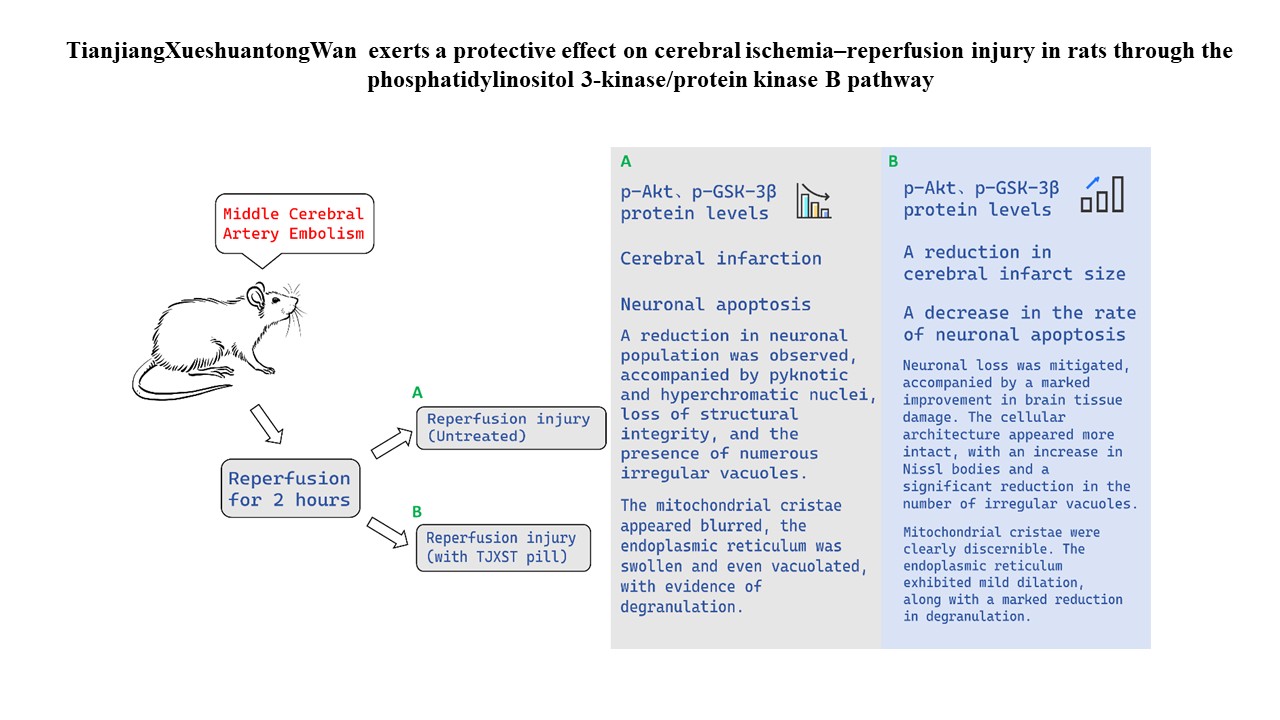
Introduction: In China, TianjiangXueshuantongWan (TJXSTW) is widely used clinically to treat cerebral ischemia–reperfusion (I/R) injury. However, the mechanism of its action remains unclear.
Objective: This study investigates whether TJXSTW protects against I/R injury via the phosphatidylinositol 3-kinase (PI3K)/protein kinase B (Akt) signaling pathway.
Methods: A middle cerebral artery occlusion (MCAO)–reperfusion rat model was established. Rats were assigned to a normal (sham) group, MCAO group, MCAO + LY294002 group, MCAO + TJXSTW group, or MCAO + TJXSTW + LY294002 group. Outcomes assessed included brain infarct volume, tissue damage, neuronal apoptosis, mitochondrial structure, and the expression of PI3K/Akt pathway proteins.
Results: TJXSTW mitigated infarct-related tissue damage, neuronal apoptosis, and mitochondrial injury. These protective effects may be attributed to reduced apoptosis via increased expression of phosphorylated Akt and phosphorylated glycogen synthase kinase-3 beta. The use of PI3K pathway inhibitors attenuated the protective effect of TJXSTW on cerebral I/R injury.
Conclusion: TJXSTW exerts a protective effect against cerebral I/R injury by inhibiting apoptosis through the activation of the PI3K/Akt signaling pathway.
- Donkor ES. Stroke in the 21st Century: A Snapshot of the Burden, Epidemiology, and Quality of Life. Stroke Res Treat. 2018;2018:3238165. doi: 10.1155/2018/3238165
- Katan M, Luft A. Global Burden of Stroke. Semin Neurol. 2018;38(2):208-211. doi: 10.1055/s-0038-1649503
- Feigin VL, Nguyen G, Cercy K, et al. Global, Regional, and Country-Specific Lifetime Risks of Stroke, 1990 and 2016. N Engl J Med. 2018;379(25):2429-2437. doi: 10.1056/NEJMoa1804492
- Gu HQ, Yang X, Wang CJ, et al. Clinical Characteristics, Management, and In-Hospital Outcomes in Patients With Stroke or Transient Ischemic Attack in China. JAMA Netw Open. 2021;4(8):e2120745. doi: 10.1001/jamanetworkopen.2021.20745
- Wang Y, Xu J, Zhao X, et al. Association of hypertension with stroke recurrence depends on ischemic stroke subtype. Stroke. 2013;44(5):1232-1237. doi: 10.1161/STROKEAHA.111.000302
- Pan Y, Li Z, Li J, et al. Residual Risk and Its Risk Factors for Ischemic Stroke with Adherence to Guideline-Based Secondary Stroke Prevention. J Stroke. 2021;23(1):51-60. doi: 10.5853/jos.2020.03391
- Assessment and Intervention of Collateral Circulation in Acute Ischemic Stroke: Chinese Expert Consensus. Chin J Emerg Med. 2022;31(10):1313-1320. doi: 10.3760/cma.j.issn.1671-0282.2022.10.005
- Wang YJ, Li ZX, Gu HQ, et al. China Stroke Statistics 2019: A Report From the National Center for Healthcare Quality Management in Neurological Diseases, China National Clinical Research Center for Neurological Diseases, the Chinese Stroke Association, National Center for Chronic and Non-communicable Disease Control and Prevention, Chinese Center for Disease Control and Prevention and Institute for Global Neuroscience and Stroke Collaborations. Stroke Vasc Neurol. 2020;5(3):211-239. doi: 10.1136/svn-2020-000457
- Wang RX, Shao Y, Yang X, et al. The effect of Tianjiang Xueshuantong Wan pills on ischemia-reperfusion injury after thrombolysis in acute cerebral infarction. Explore. 2023;19(1):48-51. doi: 10.1016/j.explore.2022.02.002
- Nossing C, Ryan KM. 50 years on and still very much alive: ‘Apoptosis: a basic biological phenomenon with wide-ranging implications in tissue kinetics’. Br J Cancer. 2023;128(3):426-431. doi: 10.1038/s41416-022-02020-0
- Liu T, Li X, Zhou X, et al. PI3K/AKT signaling and neuroprotection in ischemic stroke: molecular mechanisms and therapeutic perspectives. Neural Regen Res. 2025;20(10):2758-2775. doi: 10.4103/NRR.NRR-D-24-00568
- Zhang X, Xu M, Che X, Cao X, Li X. Dexmedetomidine reduces myocardial ischemia-reperfusion injury in rats through PI3K/AKT/GSK-3β signaling pathway. Minerva Cardioangiol. 2020;68(1):58-59. doi: 10.23736/S0026-4725.19.05102-8
- Gerace E, Scartabelli T, Pellegrini-Giampietro DE, Landucci E. Tolerance Induced by (S)-3,5-Dihydroxyphenylglycine Postconditioning is Mediated by the PI3K/AKT/GSK3β Signalling Pathway in an In Vitro Model of Cerebral Ischemia. Neuroscience. 2020;433:221-229. doi: 10.1016/j.neuroscience.2019.12.047
- Xie X, Wang F, Ge W, et al. Scutellarin attenuates oxidative stress and neuroinflammation in cerebral ischemia/reperfusion injury through PI3K/AKT-mediated Nrf2 signaling pathways. Eur J Pharmacol. 2023;957:175979. doi: 10.1016/j.ejphar.2023.175979
- Deng RM, Zhou J. The role of PI3K/AKT signaling pathway in myocardial ischemia-reperfusion injury. Int Immunopharmacol. 2023;123:110714. doi: 10.1016/j.intimp.2023.110714
- Shi Q, Cheng Q, Chen C. The Role of Autophagy in the Pathogenesis of Ischemic Stroke. Curr Neuropharmacol. 2021;19(5):629-640. doi: 10.2174/1570159X18666200729101913
- Virani SS, Alonso A, Benjamin EJ, et al. Heart Disease and Stroke Statistics-2020 Update: A Report From the American Heart Association. Circulation. 2020;141(9):e139-e596. doi: 10.1161/CIR.0000000000000757
- Shen L, Gan Q, Yang Y, et al. Mitophagy in Cerebral Ischemia and Ischemia/Reperfusion Injury. Front Aging Neurosci. 2021;13:687246. doi: 10.3389/fnagi.2021.687246
- Zhang M, Liu Q, Meng H, et al. Ischemia-reperfusion injury: molecular mechanisms and therapeutic targets. Signal Transduct Target Ther. 2024;9(1):12. doi: 10.1038/s41392-023-01688-x
- Zhou S, Fang Z, Wang G, Wu S, et al. Gap junctional intercellular communication dysfunction mediates the cognitive impairment induced by cerebral ischemia reperfusion injury: PI3K/AKT pathway involved. Am J Transl Res. 2017;9(12):5442-5451.
- Zhang W, Liu X, Li Q. Protective Effects of Oleuropein Against Cerebral Ischemia/Reperfusion by Inhibiting Neuronal Apoptosis. Med Sci Monit. 2018;24:6587-6598. doi: 10.12659/MSM.912336
- Hur EM, Zhou FQ. GSK3 signaling in neural development. Nat Rev Neurosci. 2010;11(8):539-551. doi: 10.1038/nrn2870
- Xing XS, Liu F, He ZY. AKT regulates β-catenin in a rat model of focal cerebral ischemia-reperfusion injury. Mol Med Rep. 2015;11(4):3122-3128. doi: 10.3892/mmr.2014.3000
- Zhou D, Li Y, Lin L, Zhou L, Igarashi P, Liu Y. Tubule specific ablation of endogenous β-catenin aggravates acute kidney injury in mice. Kidney Int. 2012;82(5):537-547. doi: 10.1038/ki.2012.174
- Kitagawa H, Warita H, Sasaki C, et al. Immunoreactive Akt, PI3-K and ERK protein kinase expression in ischemic rat brain. Neurosci Lett. 1999;274(1):45-48. doi: 10.1016/s0304-3940(99)00676-x
- Li ZR, Yang L, Zhen J, Zhao Y, Lu ZN. Nobiletin protects PC12 cells from ERS-induced apoptosis in OGD/R injury via activation of the PI3K/AKT pathway. Exp Ther Med. 2018;16(2):1470-1476.doi: 10.3892/etm.2018.6330