
Erinacine A regulates autophagy-mediated apoptosis of hepatocellular carcinoma cells through the PI3K/Akt/mTOR/ULK1 signaling pathway

Introduction: Erinacine A is a cancer autophagy inhibitor with proven efficacy in many cancers. However, its therapeutic role in liver cancer remains unknown.
Objective: This study investigates the effect of Erinacine A on autophagy-mediated apoptosis in HepG2 hepatocellular carcinoma cells.
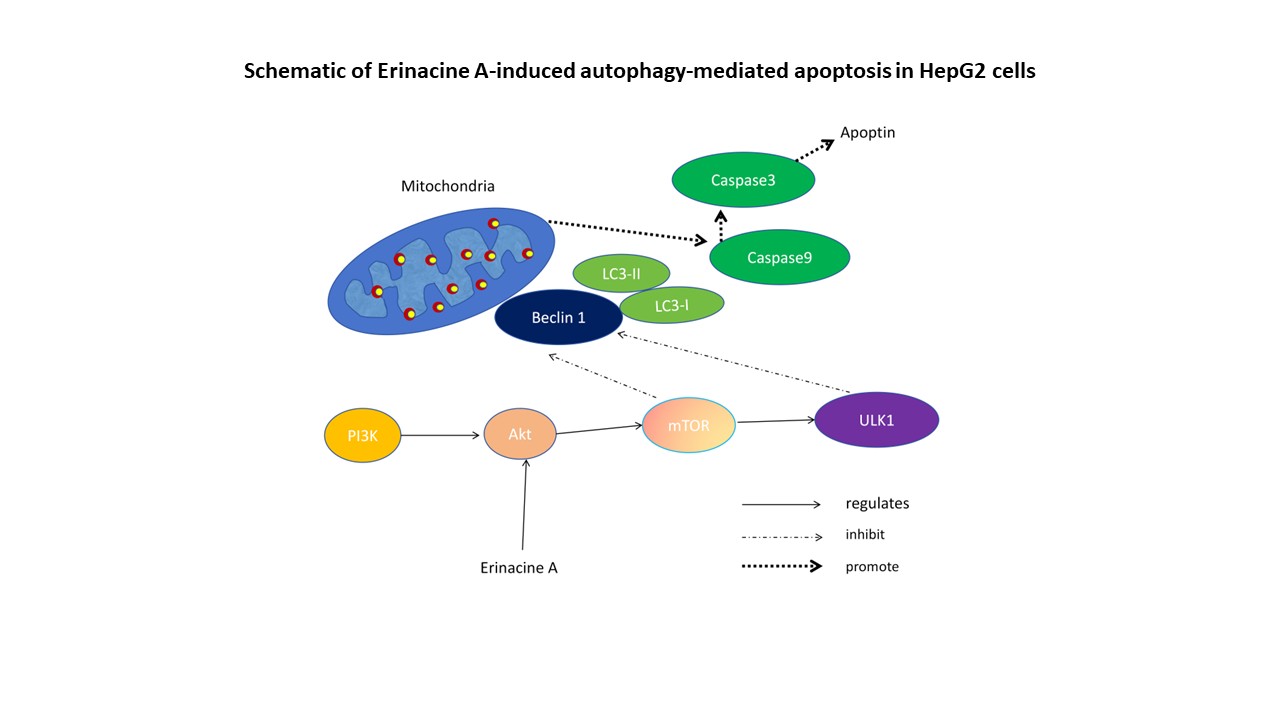
Methods: HepG2 cells were divided into seven treatment groups: (i) NC: untreated cells, (ii) AC: cells treated with Erinacine A, (iii) HEG: cells with hig h protein kinase B (Akt) expression treated with Erinacine A, (iv) HEHAG: cells with high Akt expression treated with Erinacine A with and SC79, (v) LAR: cells treated with Erinacine A and GDC-0068, (vi) GD: cells with stably low Akt expression treated with Erinacine A, and (vii) GFR: cells with stably low Akt expression treated with Erinacine A, Akt, and SC79. Scratch tests, cell invasion tests, and Cell Counting Kit-8 were used to detect cell migration, invasion, and proliferation. Western blot and polymerase chain reaction were performed to assess the phosphoinositide 3-kinase (PI3K)/Akt/mechanistic target of rapamycin (mTOR)/Unc-51-like autophagy activating kinase 1 (ULK1) signaling pathway, as well as protein expression and mRNA levels of apoptosis markers caspase-3 and caspase-9, and the expression of autophagy related proteins Beclin 1, microtubule-associated protein 1 light chain 3 (LC3)-I, and LC3 II.
Results: Cell migration, invasion, and proliferation in AC, HEG, and HEHAG groups were lower compared to the NC group (p < 0.05). In the AC group, LC3-I, LC3-II, and Beclin 1 showed reduced protein expression (p < 0.05), with Beclin 1 in the GFR group exhibiting a further significant reduction (p < 0.01). Protein levels and mRNA expression of caspase-3 and caspase-9 were elevated in the AC group (p <0.01). Phosphorylated PI3K/Akt/mTOR protein and mRNA levels were significantly increased in the AC, HEG, and HEHAG groups (p < 0.05), whereas ULK1 was decreased (p < 0.05). The GFR group showed a reversal of these trends (p < 0.05).
Conclusion: Erinacine A suppresses the proliferation, migration, and invasion of HepG2 cells, likely through the modulation of the PI3K/AKT/mTOR/ULK1 signaling pathway, which in turn inhibits autophagy-mediated apoptosis in these cells.
- Gaidai O, Yan P, Xing Y. Future world cancer death rate prediction. Sci Rep. 2023;13(1):303. doi: 10.1038/s41598-023-27547-x
- Xia C, Dong X, Li H, et al. Cancer statistics in China and United States, 2022: profiles, trends, and determinants. Chin Med J (Engl). 2022;135(5):584-590. doi: 10.1097/CM9.0000000000002108
- Anwanwan D, Singh SK, Singh S, Saikam V, Singh R. Challenges in liver cancer and possible treatment approaches. Biochim Biophys Acta Rev Cancer. 2020;1873(1):188314. doi: 10.1016/j.bbcan.2019.188314
- Benichou E, Seffou B, Topcu S, et al. The transcription factor ChREBP Orchestrates liver carcinogenesis by coordinating the PI3K/AKT signaling and cancer metabolism. Nat Commun. 2024;15(1):1879. doi: 10.1038/s41467-024-46234-7
- Xia C, Dong X, Li H, et al. Cancer statistics in China and United States, 2022: profiles, trends, and determinants. Chin Med J (Engl). 2022;135(5):584-590. doi: 10.1097/CM9.0000000000002108
- Li IC, Lee LY, Chen YJ, et al. Erinacine A-enriched Hericium erinaceus mycelia promotes longevity in Drosophila melanogaster and aged mice. PLoS One. 2019;14(5):e0217226. doi: 10.1371/journal.pone.0217226
- Kuo HC, Kuo YR, Lee KF, et al. A Comparative Proteomic Analysis of Erinacine A’s Inhibition of Gastric Cancer Cell Viability and Invasiveness. Cell Physiol Biochem. 2017;43(1):195-208. doi: 10.1159/000480338
- Prasher P, Sharma M, Sharma AK, et al. Key oncologic pathways inhibited by Erinacine A: A perspective for its development as an anticancer molecule. Biomed Pharmacother. 2023;160:114332. doi: 10.1016/j.biopha.2023.114332
- Huang YM, Fu YS, Chen WL, Lu HC. In Vitro Assessment of 4-Acetyl-Antroquinonol B and Erinacine A in Suppressing Breast Cancer-Induced Osteoclastogenesis. Int J Med Mushrooms. 2024;26(8):41-57. doi: 10.1615/IntJMedMushrooms.2024054321
- Pinter M, Peck-Radosavljevic M. Review article: systemic treatment of hepatocellular carcinoma. Aliment Pharmacol Ther. 2018;48(6):598-609. doi: 10.1111/apt.14913
- Fulda S. Targeting autophagy for the treatment of cancer. Biol Chem. 2018;399(7):673-677. doi: 10.1515/hsz-2018-0108
- Bishop E, Bradshaw TD. Autophagy modulation: a prudent approach in cancer treatment. Cancer Chemother Pharmacol. 2018;82(6):913-922. doi: 10.1007/s00280-018-3676-6
- Debnath J, Gammoh N, Ryan KM. Autophagy and autophagy-related pathways in cancer. Nat Rev Mol Cell Biol. 2023;24(8):560-575. doi: 10.1038/s41580-023-00585-z
- Li X, Huang Q, Wang M, et al. Compound K Inhibits Autophagy-Mediated Apoptosis Through Activation of the PI3K-Akt Signaling Pathway Thus Protecting Against Ischemia/Reperfusion Injury. Cell Physiol Biochem. 2018;47(6):2589-2601. doi: 10.1159/000491655
- Pinter M, Peck-Radosavljevic M. Review article: systemic treatment of hepatocellular carcinoma. Aliment Pharmacol Ther. 2018;48(6):598-609. doi: 10.1111/apt.14913
- Zhang Q, Cao S, Qiu F, Kang N. Incomplete autophagy: Trouble is a friend. Med Res Rev. 2022;42(4):1545-1587. doi: 10.1002/med.21884
- Li YL, Wang TT, Sun YJ, et al. P53-mediated PI3K/AKT/mTOR pathway played a role in PtoxDpt-induced EMT inhibition in liver cancer cell lines. Oxid Med Cell Longev. 2019;2019:2531493. doi: 10.1155/2019/2531493
- Zhuo QY, Chen MX, Wang LL. Betulinic acid induces apoptosis and autophagy in human colon cancer cell SW620 by regulating PI3K/Akt/mTOR signaling pathway. Chin J Exp Tradit Med Form. 2022;28(14):99-106. doi: 10.13422/j.cnki.syfjx.20220921
- Cao QX, Lu WG, Zhou TT, et al. Analgesic-antitumor peptide inhibits angiogenesis by suppressing AKT activation in hepatocellular carcinoma. J Exp Clin Cancer Res. 2018;37(1):325. doi: 10.1186/s13046-018-0988-4
- Zhang Y, Wang LH, Xu N, et al. Erianin suppresses hepatocellular carcinoma cells through down-regulation of PI3K/AKT, p38 and ERK MAPK signaling pathways. Biomed Pharmacother. 2021;143:112215. doi: 10.1016/j.biopha.2021.112215
- Li J, Wang Y, Zhang L, et al. LncRNA SNHG1 promotes hepatocellular carcinoma cell invasion and migration via regulating PI3K/AKT signaling pathway. J Cell Biochem. 2022;123(8):1345-1356. doi: 10.1002/jcb.30289
- Zhang H, Liu Y, Wang F, et al. CCK-8 assay for evaluating the proliferation of hepatocellular carcinoma cells treated with traditional Chinese medicine extracts. J Cell Biochem. 2021;122(5):5890-5898. doi: 10.1002/jcb.30045
- Zhou LJ, Wang YJ, Hu HL, et al. Erinacine Facilitates the Opening of the Mitochondrial Permeability Transition Pore Through the Inhibition of the PI3K/Akt/GSK-3β Signaling Pathway in Human Hepatocellular Carcinoma. Cell Physiol Biochem. 2018;50(3):851-867. doi: 10.1159/000494472
- Lee KC, Lee KF, Tung SY, et al. Induction Apoptosis of Erinacine A in Human Colorectal Cancer Cells Involving the Expression of TNFR, Fas, and Fas Ligand via the JNK/p300/p50 Signaling Pathway With Histone Acetylation. Front Pharmacol. 2019;10:1174. doi: 10.3389/fphar.2019.01174
- Hanada M, Feng J, Hemmings BA. Structure, regulation and function of PKB/AKT--a major therapeutic target. Biochim Biophys Acta. 2004;1697(1-2):3-16. doi: 10.1016/j.bbapap.2003.11.009
- Manning BD, Cantley LC. AKT/PKB signaling: navigating downstream. Cell. 2007;129(7):1261-1274. doi: 10.1016/j.cell.2007.06.009
- Bahrami A, Khazaei M, Shahidsales S, et al. The Therapeutic Potential of PI3K/Akt/mTOR Inhibitors in Breast Cancer: Rational and Progress. J Cell Biochem. 2018;119(1):213-222. doi: 10.1002/jcb.26278
- Cao C, Ren Y, Barnett AS, et al. Increased Ca2+ signaling through CaV1.2 promotes bone formation and prevents estrogen deficiency-induced bone loss. JCI Insight. 2017;2(22):e95842. doi: 10.1172/jci.insight.95842
- Wang ZQ, Cui XP, Hao GP, et al. Aberrant expression of PI3K/AKT signaling is involved in apoptosis resistance of hepatocellular carcinoma. Open Life Sci. 2021;16(1):1037-1044. doi: 10.1515/biol-2021-0105
- Tao S, Xie SJ, Diao LT, et al. RNA-binding protein CCDC137 activates AKT signaling and promotes hepatocellular carcinoma through a novel non-canonical role of DGCR8 in mRNA localization. J Exp Clin Cancer Res. 2023;42(1):194. doi: 10.1186/s13046-023-02749-3
- Shi B, Ma M, Zheng Y, Pan Y, Lin X. mTOR and Beclin1: Two key autophagy-related molecules and their roles in myocardial ischemia/reperfusion injury. J Cell Physiol. 2019;234(8):12562-12568. doi: 10.1002/jcp.28125
- Huang Q, Zhan L, Cao H, et al. Increased mitochondrial fission promotes autophagy and hepatocellular carcinoma cell survival through the ROS-modulated coordinated regulation of the NFKB and TP53 pathways. Autophagy. 2016;12(6):999-1014. doi: 10.1080/15548627.2016.1166318
- Sun Y, Yao X, Zhang QJ, et al. Beclin-1-Dependent Autophagy Protects the Heart During Sepsis. Circulation. 2018;138(20):2247-2262. doi: 10.1161/CIRCULATIONAHA.117.032821
- He Y, Sun MM, Zhang GG, et al. Targeting PI3K/Akt signal transduction for cancer therapy. Signal Transduct Target Ther. 2021;6(1):425. doi: 10.1038/s41392-021-00828-5
- Chen R, Zou J, Zhong X, Li J, Kang R, Tang D. HMGB1 in the interplay between autophagy and apoptosis in cancer. Cancer Lett. 2024;581:216494. doi: 10.1016/j.canlet.2023.216494