
In silico identification of pyrazole, pyrimidine, chalcone, and indolinone derivatives as multi-target lung cancer therapeutics

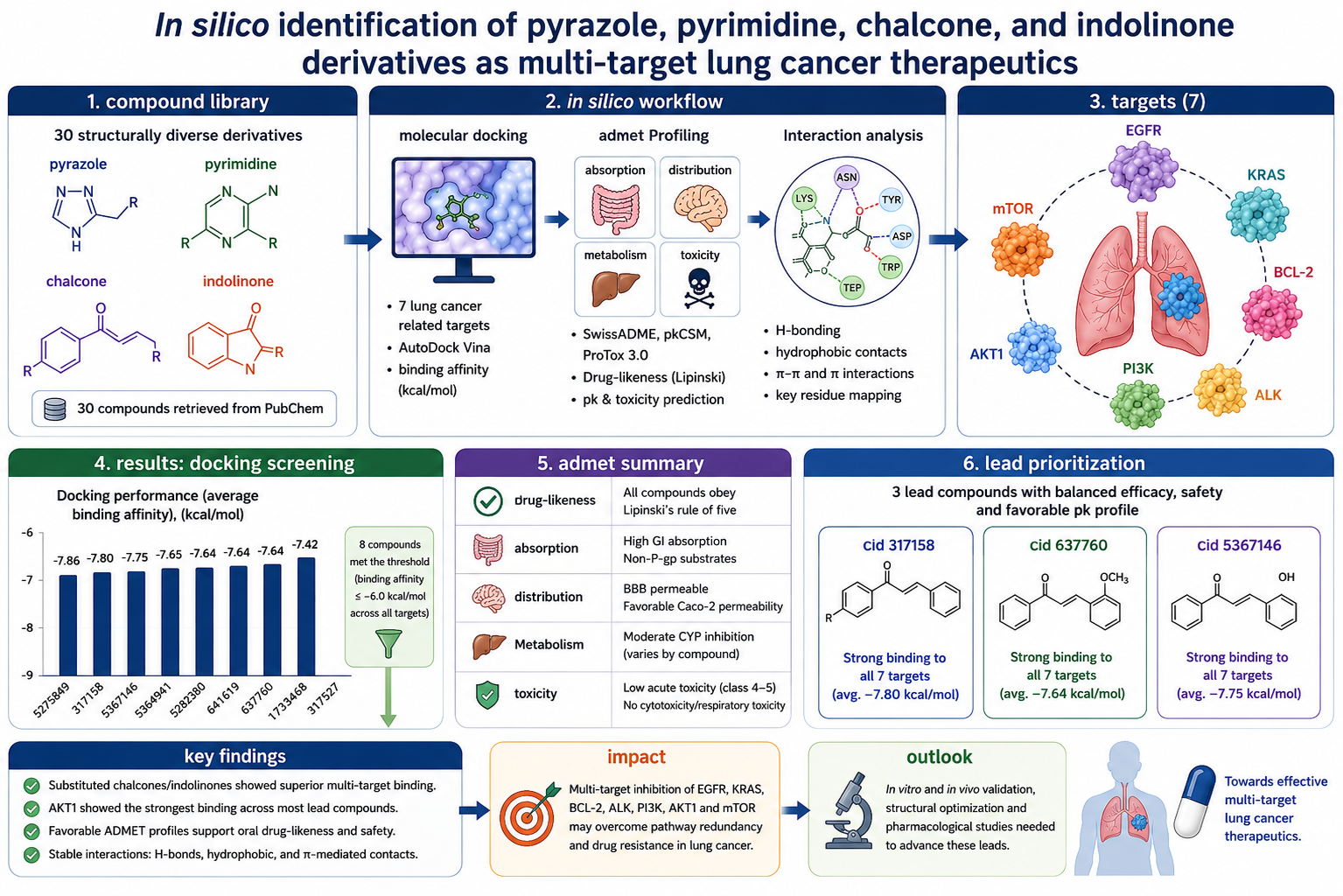
Lung cancer remains a leading cause of cancer-related mortality worldwide, highlighting the need for multi-target therapeutic strategies. In this study, an integrated in silico approach combining molecular docking, pharmacokinetic profiling, and interaction analysis was used to identify potential multi-target inhibitors from a curated virtual library of 30 pyrazole, pyrimidine, chalcone, and indolinone derivatives retrieved from the PubChem database. The compounds were screened against seven lung cancer-related targets (epidermal growth factor receptor [EGFR], Kirsten rat sarcoma viral oncogene homolog, B-cell lymphoma 2, anaplastic lymphoma kinase protein, phosphoinositide 3-kinase, protein kinase B [AKT1], and mechanistic target of rapamycin). Docking results showed clear differences between parent scaffolds and optimized derivatives, with eight compounds exhibiting binding affinities below −6.0 kcal/mol across all targets. Among these, CID 317158, CID 637760, and CID 5367146 showed the most consistent and balanced performance. Absorption, distribution, metabolism, excretion, and toxicity analysis indicated favorable drug-like properties, including compliance with Lipinski’s Rule of Five, high gastrointestinal absorption, and acceptable toxicity profiles. Interaction analysis revealed stable binding across multiple targets, driven by hydrogen bonding, hydrophobic interactions, and π-mediated contacts among key residues, particularly within the EGFR and AKT1 kinase domains. Overall, CID 317158 and CID 637760 emerged as the most promising multi-target candidates, while CID 5367146 also demonstrated strong potential. These findings support the value of multi-target computational screening in early drug discovery and provide a basis for further experimental validation.
- Siegel RL, Miller KD, Jemal A. Cancer statistics, 2019. CA Cancer J Clin. 2019;69(1):7-34. doi: 10.3322/caac.21551
- Sung H, Ferlay J, Siegel RL, et al. Global cancer statistics 2020: GLOBOCAN estimates of incidence and mortality worldwide for 36 cancers in 185 countries. CA Cancer J Clin. 2021;71(3):209-249. doi: 10.3322/caac.21660
- Herbst RS, Morgensztern D, Boshoff C. The biology and management of non-small cell lung cancer. Nature. 2018;553(7689):446-454. doi: 10.1038/nature25183
- Alduais Y, Zhang H, Fan F, Chen J, Chen B. Non-small cell lung cancer (NSCLC): a review of risk factors, diagnosis, and treatment. Medicine. 2023;102(8):e32899. doi: 10.1097/MD.0000000000032899
- Mok TS, Wu YL, Papadimitrakopoulou VA. Osimertinib in EGFR T790M-positive lung cancer. N Engl J Med. 2017;376(20):1993-1994. doi: 10.1056/NEJMc1703339
- Ajmal A, Alkhatabi HA, Alreemi RM, et al. Prospective virtual screening combined with bio-molecular simulation enabled identification of new inhibitors for the KRAS drug target. BMC Chem. 2024;18(1):57. doi: 10.1186/s13065-024-01152-z
- Mukherjee N, Sheetz J, Shellman YG. Targeting the BCL2 family: advances and challenges in BH3 mimetic-based therapies. Int J Mol Sci. 2025;26(20):9859. doi: 10.3390/ijms26209859
- Scaglione IM, Bonato A, Dodi A, et al. Oligoprogression in NSCLC with other actionable oncogenic drivers beyond EGFR and ALK: an emerging entity. Int J Mol Sci. 2026;27(6):2643. doi: 10.3390/ijms27062643
- Singh SR, Bhaskar R, Ghosh S, et al. Exploring the genetic orchestra of cancer: the interplay between oncogenes and tumor-suppressor genes. Cancers. 2025;17(7):1082. doi: 10.3390/cancers17071082
- Dash R, Munni YA, Mitra S, Dash N, Moon IS. Network pharmacology for drug repositioning in anti-Alzheimer’s drug development. In: Roy K, ed. Computational Modeling of Drugs Against Alzheimer’s Disease. Vol 203. New York, NY: Humana; 2023:433-463. doi: 10.1007/978-1-0716-3311-3_15
- Peters JU. Polypharmacology - foe or friend? J Med Chem. 2013;56(22):8955-8971. doi: 10.1021/jm400856t
- Kumar N, Acharya V. Advances in machine intelligence-driven virtual screening approaches for big-data. Med Res Rev. 2024;44(3):939-974. doi: 10.1002/med.21995
- Agamah FE, Mazandu GK, Hassan R, et al. Computational/in silico methods in drug target and lead prediction. Brief Bioinform. 2020;21(5):1663-1675. doi: 10.1093/bib/bbz103
- Wu F, Zhou Y, Li L, et al. Computational approaches in preclinical studies on drug discovery and development. Front Chem. 2020;8:726. doi: 10.3389/fchem.2020.00726
- Adhikari S, Singh M, Sharma P, Arora S. Pyrazolones as potential anticancer scaffold: recent trends and future perspectives. J Appl Pharm Sci. 2021;11(Suppl 1):26-37. doi: 10.7324/JAPS.2021.11s103
- Leite FF, de Sousa NF, de Oliveira BHM, et al. Anticancer activity of chalcones and its derivatives: review and in silico studies. Molecules. 2023;28(10):4009. doi: 10.3390/molecules28104009
- Tylińska B, Wiatrak B, Czyżnikowska Ż, Cieśla-Niechwiadowicz A, Gębarowska E, Janicka-Kłos A. Novel pyrimidine derivatives as potential anticancer agents: synthesis, biological evaluation and molecular docking study. Int J Mol Sci. 2021;22(8):3825. doi: 10.3390/ijms22083825
- Zhirnov VV, Velihina YS, Mitiukhin OP, Brovarets VS. Intrinsic drug potential of oxazolo[5,4-d]pyrimidines and oxazolo[4,5-d]pyrimidines. Chem Biol Drug Des. 2021;98(4):561-581. doi: 10.1111/cbdd.13911
- Vasilev B, Atanasova M. A (comprehensive) review of the application of quantitative structure-activity relationship (QSAR) in the prediction of new compounds with anti-breast cancer activity. Appl Sci. 2025;15(3):1206. doi: 10.3390/app15031206
- Elkhalifa AEO, Banu H, Khan MI, Ashraf SA. Integrated network pharmacology, molecular docking, molecular simulation, and in vitro validation revealed the bioactive components in soy-fermented food products and the underlying mechanistic pathways in lung cancer. Nutrients. 2023;15(18):3949. doi: 10.3390/nu15183949
- O’Boyle NM, Banck M, James CA, Morley C, Vandermeersch T, Hutchison GR. Open Babel: an open chemical toolbox. J Cheminform. 2011;3(1):33. doi: 10.1186/1758-2946-3-33
- Trott O, Olson AJ. AutoDock Vina: improving the speed and accuracy of docking with a new scoring function, efficient optimization, and multithreading. J Comput Chem. 2010;31(2):455-461. doi: 10.1002/jcc.21334
- Eberhardt J, Santos-Martins D, Tillack AF, Forli S. AutoDock Vina 1.2.0: new docking methods, expanded force field, and Python bindings. J Chem Inf Model. 2021;61(8):3891-3898. doi: 10.1021/acs.jcim.1c00203
- Laskowski RA, Hutchinson EG, Michie DA, Wallace AC, Jones ML, Thornton JM. PDBsum: a web-based database of summaries and analyses of all PDB structures. Trends Biochem Sci. 1997;22(12):488-490. doi: 10.1016/S0968-0004(97)01140-7
- BIOVIA, Dassault Systèmes. Discovery Studio Visualizer. Dassault Systèmes; 2025.
- Daina A, Michielin O, Zoete V. SwissADME: a free web tool to evaluate pharmacokinetics, drug-likeness and medicinal chemistry friendliness of small molecules. Sci Rep. 2017;7(1):42717. doi: 10.1038/srep42717
- Pires DE, Blundell TL, Ascher DB. pkCSM: predicting small-molecule pharmacokinetic and toxicity properties using graph-based signatures. J Med Chem. 2015;58(9):4066-4072. doi: 10.1021/acs.jmedchem.5b00104
- Banerjee P, Kemmler E, Dunkel M, Preissner R. ProTox 3.0: a webserver for the prediction of toxicity of chemicals. Nucleic Acids Res. 2024;52(W1):W513-W520. doi: 10.1093/nar/gkae303
- Rothschild SI. Targeted therapies in non-small cell lung cancer—beyond EGFR and ALK. Cancers. 2015;7(2):930-949. doi: 10.3390/cancers7020816
- Cao Z, Zhu J, Chen X, et al. Resistance mechanisms of non-small cell lung cancer and improvement of treatment effects through nanotechnology: a narrative review. J Thorac Dis. 2024;16(11):8039-8052. doi: 10.21037/jtd-24-1078
- Huang L, Fu L. Mechanisms of resistance to EGFR tyrosine kinase inhibitors. Acta Pharm Sin B. 2015;5(5):390-401. doi: 10.1016/j.apsb.2015.07.001
- Koulouris A, Tsagkaris C, Corriero AC, Metro G, Mountzios G. Resistance to TKIs in EGFR-mutated non-small cell lung cancer: from mechanisms to new therapeutic strategies. Cancers. 2022;14(14):3337. doi: 10.3390/cancers14143337
- Antolin AA, Workman P, Mestres J, Al-Lazikani B. Polypharmacology in precision oncology: current applications and future prospects. Curr Pharm Des. 2017;22(46):6935-6945. doi: 10.2174/1381612822666160923115828
- Qiang M, Chen Z, Liu H, et al. Targeting the PI3K/AKT/mTOR pathway in lung cancer: mechanisms and therapeutic targeting. Front Pharmacol. 2025;16:1516583. doi: 10.3389/fphar.2025.1516583
- Sanaei MJ, Razi S, Pourbagheri-Sigaroodi A, Bashash D. The PI3K/Akt/mTOR pathway in lung cancer: oncogenic alterations, therapeutic opportunities, challenges, and a glance at the application of nanoparticles. Transl Oncol. 2022;18:101364. doi: 10.1016/j.tranon.2022.101364
- Guo T, Wu C, Zhang J, et al. Dual blockade of EGFR and PI3K signaling pathways offers a therapeutic strategy for glioblastoma. Cell Commun Signal. 2023;21(1):363. doi: 10.1186/s12964-023-01400-0
- Ceddia S, Landi L, Cappuzzo F. KRAS-mutant non-small-cell lung cancer: from past efforts to future challenges. Int J Mol Sci. 2022;23(16):9391. doi: 10.3390/ijms23169391
- Khan N, Raza U, Ali Zaidi, et al. Drugging the ‘undruggable’ KRAS: breakthroughs, challenges, and opportunities in pancreatic cancer. Cancer Biol Med. 2025;22(7):762-788. doi: 10.20892/j.issn.2095-3941.2025.0122
- Huang L, Guo Z, Wang F, Fu L. KRAS mutation: from undruggable to druggable in cancer. Signal Transduct Target Ther. 2021;6(1):386. doi: 10.1038/s41392-021-00780-4
- Devanahally S, Dubey S. From “undruggable” to tractable: therapeutic advances targeting KRAS G12C-mutant cancers and emerging resistance mechanisms. Cancer Pathog Ther. 2026. doi: 10.1016/j.cpt.2026.02.001
- Akhave NS, Biter AB, Hong DS. Mechanisms of resistance to KRAS G12C-targeted therapy. Cancer Discov. 2021;11(6):1345-1352. doi: 10.1158/2159-8290.CD-20-1616
- Tang D, Kroemer G, Kang R. KRAS-targeted therapies in cancer: novel approaches and overcoming resistance. BMJ Oncol. 2025;4(1):e000946. doi: 10.1136/bmjonc-2025-000946
- Salgia R, Pharaon R, Mambetsariev I, Nam A, Sattler M. The improbable targeted therapy: KRAS as an emerging target in non-small cell lung cancer (NSCLC). Cell Rep Med. 2021;2(1):100186. doi: 10.1016/j.xcrm.2020.100186
- Valentini E, Di Martile M, Brignone M, et al. Bcl-2 family inhibitors sensitize human cancer models to therapy. Cell Death Dis. 2023;14(7). doi: 10.1038/s41419-023-05963-1
- Chen G, Zhou D, Li X, et al. A natural chalcone induces apoptosis in lung cancer cells: 3D-QSAR, docking and an in vivo/vitro assay. Sci Rep. 2017;7(1):10729. doi: 10.1038/s41598-017-11369-9
- Talwelkar SS, Mäyränpää MI, Schüler J, et al. PI3Kβ inhibition enhances ALK-inhibitor sensitivity in ALK-rearranged lung cancer. Mol Oncol. 2023;17(5):747-764. doi: 10.1002/1878-0261.13342
- Long M, Peng S, Wen Q, et al. New advances in understanding the mechanisms and treatment challenges of ALK-targeted therapy resistance in lung cancer. Cancer Drug Resist. 2025;8:43. doi: 10.20517/cdr.2025.122
- Ouyang Y, Li J, Chen X, Fu X, Sun S, Wu Q. Chalcone derivatives: role in anticancer therapy. Biomolecules. 2021;11(6):894. doi: 10.3390/biom11060894
- Liu W, He M, Li Y, Peng Z, Wang G. A review on synthetic chalcone derivatives as tubulin polymerisation inhibitors. J Enzyme Inhib Med Chem. 2022;37(1):9-38. doi: 10.1080/14756366.2021.1976772
- Abdelaal N, Ragheb MA, Hassaneen HM, Elzayat EM, Abdelhamid IA. Design, in silico studies and biological evaluation of novel chalcones tethered triazolo[3,4-a]isoquinoline as EGFR inhibitors targeting resistance in non-small cell lung cancer. Sci Rep. 2024;14(1):26647. doi: 10.1038/s41598-024-76459-x
- Arvanitis CD, Ferraro GB, Jain RK. The blood-brain barrier and blood-tumour barrier in brain tumours and metastases. Nat Rev Cancer. 2020;20(1):26-41. doi: 10.1038/s41568-019-0205-x
- Chen YC, Lin CF, Chiang CL, et al. BBB-penetrant tyrosine kinase inhibitor plus intracranial radiotherapy vs BBB-penetrant TKI alone in Asians with EGFR-mutated lung adenocarcinoma and brain metastases. J Chin Med Assoc. 2025;88(12):933-940. doi: 10.1097/jcma.0000000000001312