
Malnutrition in pediatric oncology critical care: Mechanisms, assessment, and nutrition support

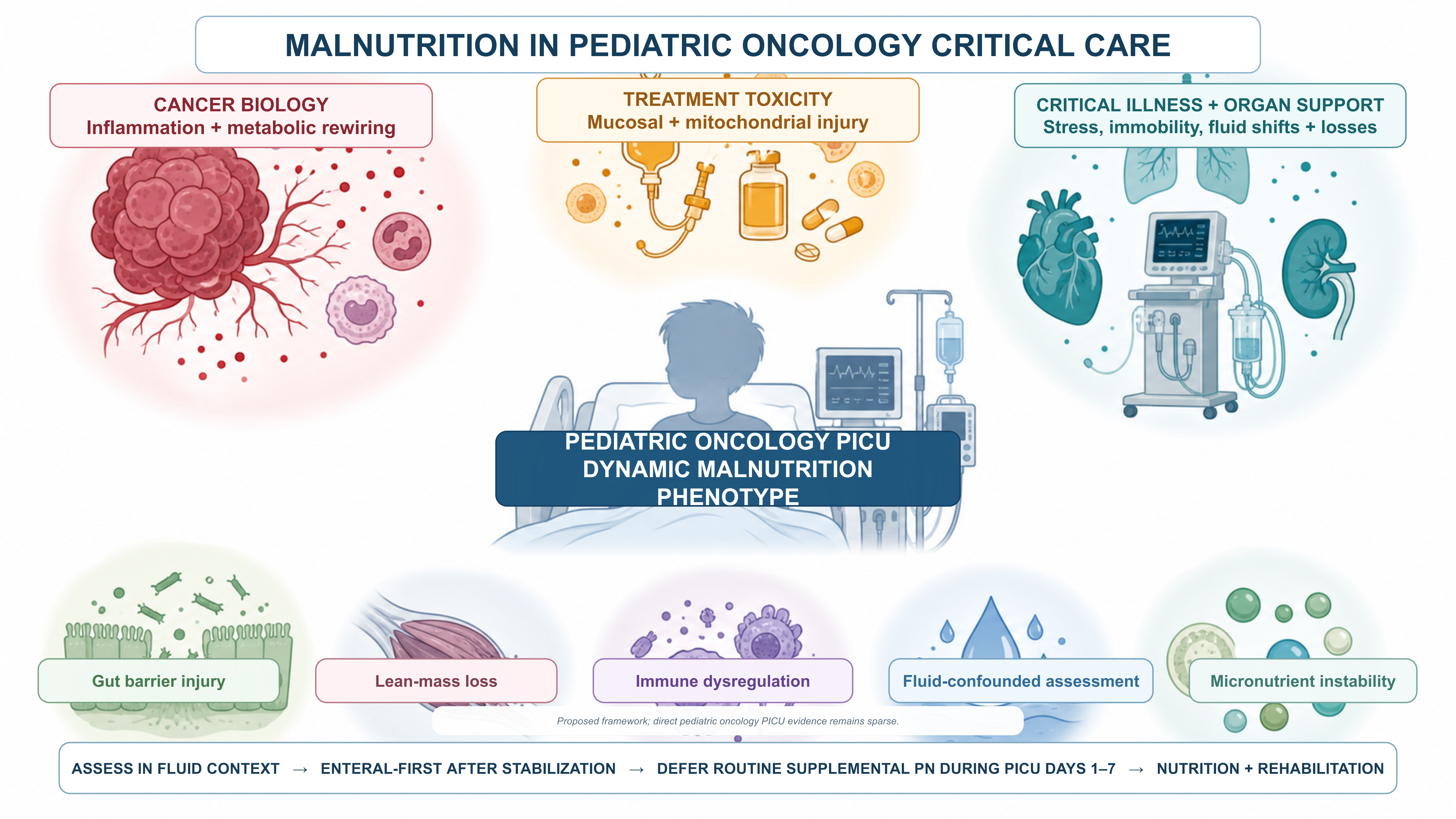
Children with cancer who require pediatric intensive care encounter overlapping metabolic insults from cancer biology, anticancer treatment, and critical illness. These insults may produce a dynamic malnutrition phenotype characterized by impaired intake or absorption, rapid lean-mass loss, micronutrient and electrolyte depletion, and assessment confounded by inflammation and fluid shifts. In this narrative review, we conducted a systematic search on PubMed/MEDLINE through August 11, 2026 and prioritize evidence in the following order: pediatric oncology pediatric intensive care unit (PICU), general PICU, non-critical pediatric oncology or hematopoietic stem-cell transplantation, adult clinical, and preclinical studies. We propose an unvalidated triple-hit model and an evidence-informed decision framework. Serial measured weight should be interpreted with cumulative fluid balance and edema; bioelectrical impedance phase angle and the C-reactive protein-to-albumin ratio are prognostic or risk markers, while muscle ultrasound documents tissue trajectory but does not determine protein requirements. Enteral nutrition is preferred after adequate resuscitation when the gastrointestinal tract is usable. General PICU evidence, including the PEPaNIC trial, supports withholding routine supplemental parenteral nutrition during the first seven days, although applicability to pediatric oncology PICU populations remains unexplored. Universal energy and high-protein targets are not supported; prescriptions should reflect age, illness phase, measured energy expenditure when available, organ function, and refeeding risk. Direct evidence remains sparse, and the proposed framework requires prospective validation.
- Park JA, Cheung NKV. Immunotherapies for Childhood Cancer. Cold Spring Harb Perspect Med. 2025;15(6):a041574. doi: 10.1101/cshperspect.a041574
- Tran TH, Hunger SP. The genomic landscape of pediatric acute lymphoblastic leukemia and precision medicine opportunities. Semin Cancer Biol. 2022;84:144-152. doi: 10.1016/j.semcancer.2020.10.013
- Ness KK, Armstrong GT, Kundu M, Wilson CL, Tchkonia T, Kirkland JL. Frailty in childhood cancer survivors. Cancer. 2015;121(10):1540-1547. doi: 10.1002/cncr.29211
- Podpeskar A, Crazzolara R, Kropshofer G, et al. Recommendations for Nutritional Supplementation in Pediatric Oncology: A Compilation of the Facts. Nutrients. 2023;15(14):3239. doi: 10.3390/nu15143239
- Loeffen EAH, Brinksma A, Miedema KGE, de Bock GH, Tissing WJE. Clinical implications of malnutrition in childhood cancer patients—infections and mortality. Support Care Cancer. 2015;23(1):143-150. doi: 10.1007/s00520-014-2350-9
- Feng S, Cheng L, Lu H, Shen N. Nutritional Status and Clinical Outcomes in Children with Cancer on Admission to Intensive Care Units. Nutr Cancer. 2021;73(1):83-88. doi: 10.1080/01635581.2020.1742361
- Zinter MS, DuBois SG, Spicer A, Matthay K, Sapru A. Pediatric cancer type predicts infection rate, need for critical care intervention, and mortality in the pediatric intensive care unit. Intensive Care Med. 2014;40(10):1536-1544. doi: 10.1007/s00134-014-3389-2
- Sordyl J, Damps M, Skowron-Kandzia K, Baranowska K, Mizia-Malarz A. Clinical characteristics and outcomes of pediatric cancer patients admitted to the intensive care unit during treatment: a retrospective analysis. Oncol Rev. 2026;20. doi: 10.3389/or.2026.1699224
- Lemos PDSM, de Oliveira FLC, Caran EMM. Nutritional status of children and adolescents at diagnosis of hematological and solid malignancies. Rev Bras Hematol Hemoter. 2014;36(6):420-423. doi: 10.1016/j.bjhh.2014.06.001
- Yoruk MA, Durakbasa CU, Timur C, Sahin SS, Taskin EC. Assessment of Nutritional Status and Malnutrition Risk at Diagnosis and Over a 6-Month Treatment Period in Pediatric Oncology Patients With Hematologic Malignancies and Solid Tumors. J Pediatr Hematol Oncol. 2019;41(5):e308-e321. doi: 10.1097/MPH.0000000000001350
- Wösten-van Asperen RM, la Roi-Teeuw HM, van Amstel RB, et al. Distinct clinical phenotypes in paediatric cancer patients with sepsis are associated with different outcomes—an international multicentre retrospective study. eClinicalMedicine. 2023;65:102252. doi: 10.1016/j.eclinm.2023.102252
- Baracos VE, Martin L, Korc M, Guttridge DC, Fearon KCH. Cancer-associated cachexia. Nat Rev Dis Primers. 2018;4(1):17105. doi: 10.1038/nrdp.2017.105
- Argilés JM, López-Soriano FJ, Stemmler B, Busquets S. Cancer-associated cachexia — understanding the tumour macroenvironment and microenvironment to improve management. Nat Rev Clin Oncol. 2023;20(4):250-264. doi: 10.1038/s41571-023-00734-5
- Bozzetti F. Chemotherapy-Induced Sarcopenia. Curr Treat Options Oncol. 2020;21(1):7. doi: 10.1007/s11864-019-0691-9
- Li Y, Dörmann N, Brinschwitz B, et al. SPSB1‐mediated inhibition of TGF‐β receptor‐II impairs myogenesis in inflammation. J Cachexia Sarcopenia Muscle. 2023;14(4):1721-1736. doi: 10.1002/jcsm.13252
- Pedrosa MB, Barbosa S, Vitorino R, Ferreira R, Moreira-Gonçalves D, Santos LL. Chemotherapy-Induced Molecular Changes in Skeletal Muscle. Biomedicines. 2023;11(3):905. doi: 10.3390/biomedicines11030905
- Hulst J, Vangoudoever J, Visser T, Tibboel D, Joosten K. Hormone levels in children during the first week of ICU-admission: Is there an effect of adequate feeding? Clin Nutr. 2006;25(1):154-162. doi: 10.1016/j.clnu.2005.10.006
- Huot JR, Baumfalk D, Resendiz A, Bonetto A, Smuder AJ, Penna F. Targeting Mitochondria and Oxidative Stress in Cancer- and Chemotherapy-Induced Muscle Wasting. Antioxid Redox Signal. 2023;38(4-6):352-370. doi: 10.1089/ars.2022.0149
- Cinausero M, Aprile G, Ermacora P, et al. New Frontiers in the Pathobiology and Treatment of Cancer Regimen-Related Mucosal Injury. Front Pharmacol. 2017;8:354. doi: 10.3389/fphar.2017.00354
- van Vliet MJ, Harmsen HJM, de Bont ESJM, Tissing WJE. The Role of Intestinal Microbiota in the Development and Severity of Chemotherapy-Induced Mucositis. PLoS Pathog. 2010;6(5):e1000879. doi: 10.1371/journal.ppat.1000879
- Theis VS, Sripadam R, Ramani V, Lal S. Chronic Radiation Enteritis. Clin Oncol. 2010;22(1):70-83. doi: 10.1016/j.clon.2009.10.003
- Elad S, Cheng KKF, Lalla RV, et al. MASCC/ISOO clinical practice guidelines for the management of mucositis secondary to cancer therapy. Cancer. 2020;126(19):4423-4431. doi: 10.1002/cncr.33100
- Muratore E, Leardini D, Baccelli F, et al. The emerging role of nutritional support in the supportive care of pediatric patients undergoing hematopoietic stem cell transplantation. Front Nutr. 2023;10:1075778. doi: 10.3389/fnut.2023.1075778
- Vincent M, Assa A, Borrelli O, et al. Intestinal involvement in graft versus host disease in children: An overview by the ESPGHAN Gastroenterology Committee. J Pediatr Gastroenterol Nutr. 2025;81(2):246-255. doi: 10.1002/jpn3.70087
- Jenq RR, Taur Y, Devlin SM, et al. Intestinal Blautia Is Associated with Reduced Death from Graft-versus-Host Disease. Biol Blood Marrow Transplant. 2015;21(8):1373-1383. doi: 10.1016/j.bbmt.2015.04.016
- Lehrnbecher T, Robinson PD, Ammann RA, et al. Guideline for the Management of Fever and Neutropenia in Pediatric Patients With Cancer and Hematopoietic Cell Transplantation Recipients: 2023 Update. J Clin Oncol. 2023;41(9):1774-1785. doi: 10.1200/JCO.22.02224
- Elgarten CW, Li Y, Getz KD, et al. Broad-Spectrum Antibiotics and Risk of Graft-versus-Host Disease in Pediatric Patients Undergoing Transplantation for Acute Leukemia: Association of Carbapenem Use with the Risk of Acute Graft-versus-Host Disease. Transplant Cell Ther. 2021;27(2):177.e1-177.e8. doi: 10.1016/j.jtct.2020.10.012
- Orellana RA, Coss-Bu JA. Metabolic alterations in the critically ill child: a narrative review. Pediatr Med. 2021;4:8-8. doi: 10.21037/pm-20-64
- Tume LN, Valla FV, Joosten K, et al. Nutritional support for children during critical illness: European Society of Pediatric and Neonatal Intensive Care (ESPNIC) metabolism, endocrine and nutrition section position statement and clinical recommendations. Intensive Care Med. 2020;46(3):411-425. doi: 10.1007/s00134-019-05922-5
- von Renesse J, von Kessel MKF, Oehme F, et al. Indirect calorimetry identifies hypermetabolism associated with muscle wasting and increased risk of energy deficit in ICU patients. Crit Care. 2025;29(1):464. doi: 10.1186/s13054-025-05695-y
- Santarelli MD, Davis KA, Stark RJ. Persistent Inflammation, Immunosuppression and Catabolism Syndrome in Pediatric Populations: A Brief Perspective. CPR. 2025;21(4):297-300. doi: 10.2174/0115733963298459240508050319
- Bergmann CB, Beckmann N, Salyer CE, Crisologo PA, Nomellini V, Caldwell CC. Lymphocyte Immunosuppression and Dysfunction Contributing to Persistent Inflammation, Immunosuppression, and Catabolism Syndrome (PICS). Shock. 2021;55(6):723-741. doi: 10.1097/shk.0000000000001675
- Keehn A, O’Brien C, Mazurak V, et al. Epidemiology of Interruptions to Nutrition Support in Critically Ill Children in the Pediatric Intensive Care Unit. JPEN J Parenter Enteral Nutr. 2015;39(2):211-217. doi: 10.1177/0148607113513800
- Hu J, Li H, Wang Z, et al. Impact of enteral nutrition interruption in critically ill children: A systematic review and meta‐analysis. JPEN J Parenter Enteral Nutr. 2026;50(1):13-25. doi: 10.1002/jpen.70021
- Ostermann M. Laboratory assessment of nutritional status in ICU patients. Curr Opin Clin Nutr Metab Care. 2025;28(6):509-514. doi: 10.1097/mco.0000000000001165
- Tekgüç H, özel D, Sanaldi H, Akbaş H, Dursun OU. Prealbumin and Retinol Binding Proteins Are Not Usable for Nutrition Follow-Up in Pediatric Intensive Care Units. Pediatr Gastroenterol Hepatol Nutr. 2018;21(4):321. doi: 10.5223/pghn.2018.21.4.321
- Hasson DC, Demirkol D, Barhight MF, Selewski DT, Gorga SM. Fluid balance and fluid overload in pediatric critical illness: a state-of-the-art review. Intensive Care Med Paediatr Neonatal. 2025;3(1). doi: 10.1007/s44253-025-00099-w
- Lintz VC, Vieira RA, Carioca FDL, et al. Fluid accumulation in critically ill children: a systematic review and meta-analysis. eClinicalMedicine. 2024;74:102714. doi: 10.1016/j.eclinm.2024.102714
- Becker P, Carney LN, Corkins MR, et al. Consensus Statement of the Academy of Nutrition and Dietetics/American Society for Parenteral and Enteral Nutrition. Nutr Clin Pract. 2015;30(1):147-161. doi: 10.1177/0884533614557642
- Moonen HPFX, Van Zanten ARH. Bioelectric impedance analysis for body composition measurement and other potential clinical applications in critical illness. Curr Opin Crit Care. 2021;27(4):344-353. doi: 10.1097/mcc.0000000000000840
- Yang J, Zhang J, Liu J, Liu G, Qian S. Bioelectrical impedance phase angle and the mortality in critically ill children. Front Nutr. 2024;11:1359814. doi: 10.3389/fnut.2024.1359814
- Chang J, Zhang X, Wang W, Liu L. C-reactive protein-to-albumin ratio as a predictor of 28-day mortality in critically ill pediatric patients: a retrospective cohort study. BMC Pediatr. 2025;25(1):864. doi: 10.1186/s12887-025-06261-9
- Mandal A, Swarnkar K, Malik S. C-reactive Protein to Albumin Ratio and Fluid Overload as Predictors of Mortality in Comparison to Pediatric Risk of Mortality (PRISM) III Score in Critically Ill Children in a Tertiary Care Hospital: A Prospective Cohort Study. Cureus. 2026. doi: 10.7759/cureus.102158
- Mohamed SA, Elsawy HM, Bazaraa HM, Ghobashy MH, El Megied MAA. Point of care ultrasonography of quadriceps femoris muscle thickness for assessing nutritional status in critically ill children. Sci Rep. 2025;15(1):16946. doi: 10.1038/s41598-025-01205-w
- Cai Y, Zhang Q, Meng Y, He S, Yang Y. Association of peripheral muscle mass and in-hospital mortality in mechanically ventilated critically ill children: a prospective observational study. Eur J Pediatr. 2026;185(5). doi: 10.1007/s00431-026-06799-5
- de Figueiredo RS, Nogueira RJN, Springer AMM, et al. Sarcopenia in critically ill children: A bedside assessment using point-of-care ultrasound and anthropometry. Clin Nutr. 2021;40(8):4871-4877. doi: 10.1016/j.clnu.2021.07.014
- Stacey LJ, Valla FV, Huang C, et al. The relationship between muscle mass changes and protein or energy intake in critically ill children: A systematic review and meta‐analysis. JPEN J Parenter Enteral Nutr. 2025;49(2):152-164. doi: 10.1002/jpen.2715
- Kangalgil M, Meral B, Tiryaki BRK, Bayram H. Paediatric handgrip reference curves and the relationship between lower handgrip strength and clinical outcomes of hospitalised children. J Paediatr Child Health. 2025;61(2):230-236. doi: 10.1111/jpc.16743
- Fivez T, Kerklaan D, Mesotten D, et al. Early versus Late Parenteral Nutrition in Critically Ill Children. N Engl J Med. 2016;374(12):1111-1122. doi: 10.1056/NEJMoa1514762
- Mehta NM, Skillman HE, Irving SY, et al. Guidelines for the Provision and Assessment of Nutrition Support Therapy in the Pediatric Critically Ill Patient: Society of Critical Care Medicine and American Society for Parenteral and Enteral Nutrition. JPEN J Parenter Enteral Nutr. 2017;41(5):706-742. doi: 10.1177/0148607117711387
- Parshuram GA, Tuira L, Dazo F, El Hariri N, Hulst JM, Mtaweh H. Components of Total Energy Expenditure in Healthy and Critically Ill Children: A Comprehensive Review. Nutrients. 2024;16(16):2581. doi: 10.3390/nu16162581
- da Silva JSV, Seres DS, Sabino K, et al. ASPEN Consensus Recommendations for Refeeding Syndrome. Nutr Clin Pract. 2020;35(2):178-195. doi: 10.1002/ncp.10474
- Chow R, Im JHB, Arends J, et al. Enteral and parenteral nutrition in patients with cancer: complication rates compared—updated systematic review and meta-analysis. BMJ Support Palliat Care. 2025;15(3):281-290. doi: 10.1136/spcare-2024-005244
- Solana MJ, Manrique G, Slocker M, et al. Early vs late enteral nutrition in pediatric intensive care unit: Barriers, benefits, and complications. Nutr Clin Pract. 2023;38(2):442-448. doi: 10.1002/ncp.10922
- van Puffelen E, Hulst JM, Vanhorebeek I, et al. Outcomes of Delaying Parenteral Nutrition for 1 Week vs Initiation Within 24 Hours Among Undernourished Children in Pediatric Intensive Care. JAMA Netw Open. 2018;1(5):e182668. doi: 10.1001/jamanetworkopen.2018.2668
- Budka-Chrzęszczyk A, Szlagatys-Sidorkiewicz A, Bień E, et al. Managing Undernutrition in Pediatric Oncology: A Consensus Statement Developed Using the Delphi Method by the Polish Society for Clinical Nutrition of Children and the Polish Society of Pediatric Oncology and Hematology. Nutrients. 2024;16(9):1327. doi: 10.3390/nu16091327
- Shimizu M, Shimizu A, Takamasu T, Goto H, Taniguchi H. Effectiveness of Nutrition Support Team Intervention in Pediatric Patients with Cancer. J Nutr Sci Vitaminol. 2024;70(4):328-335. doi: 10.3177/jnsv.70.328
- Viani K, Alves J, Damasco-Avila E, et al. Consensus recommendations for the nutritional management of children with cancer in limited resource settings: a report from the International Initiative for Pediatrics and Nutrition. Front Nutr. 2025;12:1605632. doi: 10.3389/fnut.2025.1605632
- Sankaran SS, Dewan P, Malhotra RK, et al. Glutamine Mouthwash for Preventing Methotrexate-Induced Mucositis in Children with Acute Lymphoblastic Leukemia: A Randomized Cross-Over Trial. Indian Pediatr. 2025;62(4):269-275. doi: 10.1007/s13312-025-00042-4
- Aquino VM, Harvey AR, Garvin JH, et al. A double-blind randomized placebo-controlled study of oral glutamine in the prevention of mucositis in children undergoing hematopoietic stem cell transplantation: a pediatric blood and marrow transplant consortium study. Bone Marrow Transplant. 2005;36(7):611-616. doi: 10.1038/sj.bmt.1705084
- van der Meij BS, de Graaf P, Wierdsma NJ, et al. Nutritional support in patients with GVHD of the digestive tract: state of the art. Bone Marrow Transplant. 2013;48(4):474-482. doi: 10.1038/bmt.2012.124
- Liu K, Sharma P, Bartle J, Gilbertson H, Cole T, McCarthy M. Protein intake and requirements in children and adolescents undergoing Hematopoietic Stem Cell Transplant (HSCT): An international benchmarking survey and a scoping review. Clin Nutr ESPEN. 2024;63:274-282. doi: 10.1016/j.clnesp.2024.06.012
- Howard SC, Avagyan A, Workeneh B, Pui CH. Tumour lysis syndrome. Nat Rev Dis Primers. 2024;10(1):58. doi: 10.1038/s41572-024-00542-w
- Weiss SL, Peters MJ, Alhazzani W, et al. Surviving Sepsis Campaign International Guidelines for the Management of Septic Shock and Sepsis-Associated Organ Dysfunction in Children. Pediatr Crit Care Med. 2020;21(2):e52-e106. doi: 10.1097/pcc.0000000000002198
- Weiss SL, Peters MJ, Oczkowski SJW, et al. Surviving Sepsis Campaign International Guidelines for the Management of Sepsis and Septic Shock in Children 2026. Intensive Care Med. 2026;52(5):937-983. doi: 10.1007/s00134-026-08360-2
- Lee AE, Munoz E, Al Dabbous T, Harris E, O’Callaghan M, Raman L. Extracorporeal Life Support Organization Guidelines for the Provision and Assessment of Nutritional Support in the Neonatal and Pediatric ECMO Patient. ASAIO J. 2022;68(7):875-880. doi: 10.1097/MAT.0000000000001767
- Vega MRW, Cerminara D, Desloovere A, et al. Nutritional management of children with acute kidney injury—clinical practice recommendations from the Pediatric Renal Nutrition Taskforce. Pediatr Nephrol. 2023;38(11):3559-3580. doi: 10.1007/s00467-023-05884-3
- Jonckheer J, Vergaelen K, Spapen H, Malbrain MLNG, De Waele E. Modification of Nutrition Therapy During Continuous Renal Replacement Therapy in Critically Ill Pediatric Patients: A Narrative Review and Recommendations. Nutr Clin Pract. 2019;34(1):37-47. doi: 10.1002/ncp.10231
- Demirkol D, Cortina G, Deep A. Micronutrient needs in critically Ill children undergoing continuous renal replacement therapy and protein requirements in acute kidney injury patients. J Pediatr Crit Care. 2024;11(6):268-272. doi: 10.4103/jpcc.jpcc_81_24