
Lactylation: A novel metabolic–epigenetic link in pancreatic cancer

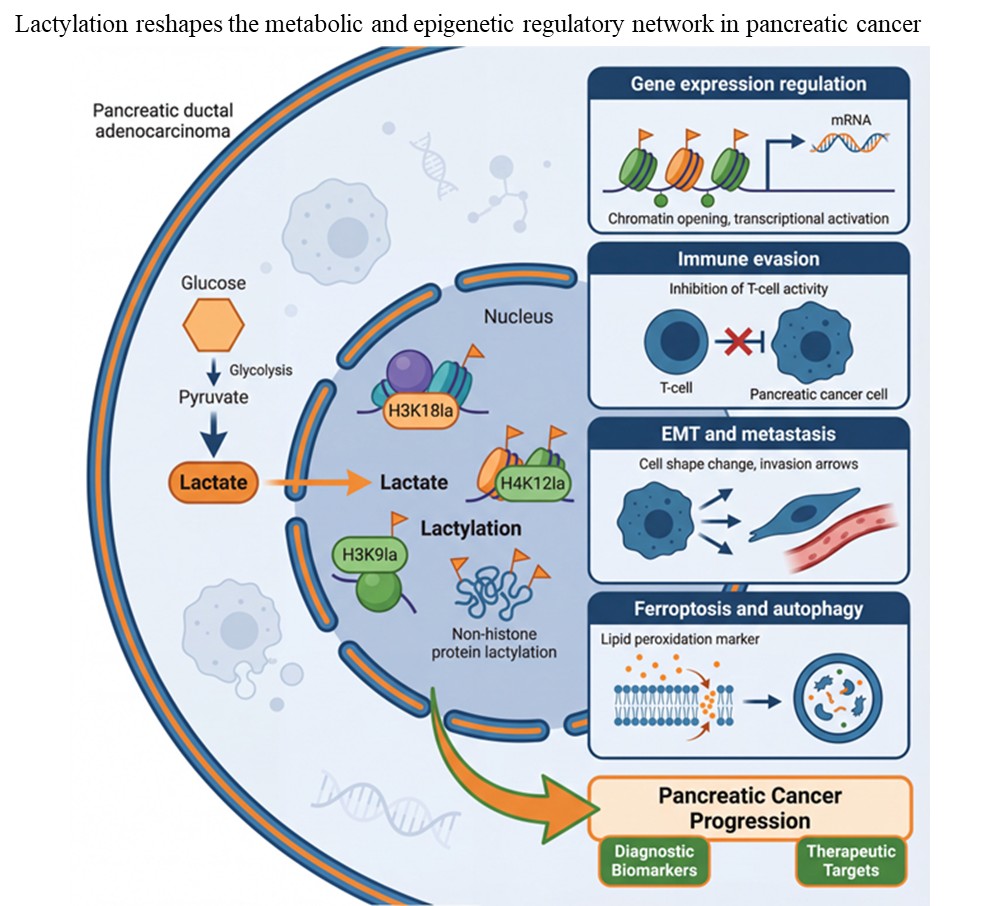
Lactylation, a recently discovered post-translational modification, represents a crucial nexus between cellular metabolism and epigenetic regulation. Driven by the accumulation of lactate, a byproduct of glycolysis, this modification involves the covalent attachment of a lactyl group to lysine residues on both histone and non-histone proteins. Emerging evidence highlights the profound impact of lactylation on various biological processes, including gene expression, cell proliferation, migration, invasion, autophagy, and immune responses, particularly in cancer. This comprehensive review examines the intricate mechanisms governing lactylation, its widespread presence across the proteome, and its specific roles in cancer pathogenesis, with a particular emphasis on pancreatic ductal adenocarcinoma (PDAC). We explore how lactylation at histone H3 lysine 18 (H3K18la), histone H4 lysine 12 (H4K12la), and histone H3 lysine (H3K9la) influences chromatin accessibility and gene transcription, thereby shaping tumor characteristics. Furthermore, we examine the diverse functions of non-histone protein lactylation in regulating metabolic pathways, immune evasion, epithelial–mesenchymal transition, and ferroptosis. The review also discusses the diagnostic and prognostic potential of lactylation markers in PDAC and evaluates the therapeutic implications of targeting lactylation pathways to overcome drug resistance and inhibit tumor progression. By consolidating current knowledge, this review underscores lactylation as a pivotal regulatory layer in cancer biology, offering novel avenues for therapeutic intervention.
- Li X, Yang Y, Zhang B, et al. Lactate metabolism in human health and disease. Sig Transduct Target Ther. 2022;7(1):305. doi: 10.1038/s41392-022-01206-5
- Yang L, Guo D, Wu K, et al. Lactate Metabolism: The String-Puller for the Development of Pancreatic Cancer. Biology. 2025;14(9):1213. doi: 10.3390/biology14091213
- Chen M, Cen K, Song Y, et al. NUSAP1-LDHA-Glycolysis-Lactate feedforward loop promotes Warburg effect and metastasis in pancreatic ductal adenocarcinoma. Cancer Lett. 2023;567:216285. doi: 10.1016/j.canlet.2023.216285
- Sun P, Ma L, Lu Z. Lactylation: Linking the Warburg effect to DNA damage repair. Cell Metab. 2024;36(8):1637-1639. doi: 10.1016/j.cmet.2024.06.015
- Liberti MV, Locasale JW. Histone Lactylation: A New Role for Glucose Metabolism. Trends Biochem Sci. 2020;45(3):179-182. doi: 10.1016/j.tibs.2019.12.004
- Yu, X., Yang J, Xu J, et al. Histone lactylation: from tumor lactate metabolism to epigenetic regulation. Int J Biol Sci. 2024;20(5):1833-1854. doi: 10.7150/ijbs.91492
- Liu R, Wu J, Guo H, et al. Post‐translational modifications of histones: Mechanisms, biological functions, and therapeutic targets. MedComm. 2023;4(3):e292. doi: 10.1002/mco2.292
- Wang T, Ye Z, Li Z, et al. Lactate‐induced protein lactylation: A bridge between epigenetics and metabolic reprogramming in cancer. Cell Prolif. 2023;56(10). doi: 10.1111/cpr.13478
- Izzo LT, Wellen KE. Histone lactylation links metabolism and gene regulation. Nature. 2019;574(7779):492-493. doi: 10.1038/d41586-019-03122-1
- Gao X, Pang C, Fan Z, et al. Regulation of newly identified lysine lactylation in cancer. Cancer Lett. 2024;587:216680. doi: 10.1016/j.canlet.2024.216680
- Dai X, Lv X, Thompson EW, Ostrikov K. Histone lactylation: epigenetic mark of glycolytic switch. Trends Genet. 2022;38(2):124-127. doi: 10.1016/j.tig.2021.09.009
- Wan N, Wang N, Yu S, et al. Cyclic immonium ion of lactyllysine reveals widespread lactylation in the human proteome. Nat Methods. 2022;19(7):854-864. doi: 10.1038/s41592-022-01523-1
- Ren S, Song LN, Zhao R, Tian Y, Wang ZQ. Serum exosomal hsa-let-7f-5p: A potential diagnostic biomarker for metastatic pancreatic cancer detection. World J Gastroenterol. 2025;31(26). doi: 10.3748/wjg.v31.i26.109500
- Ren S, Qian LC, Cao YY, et al. Computed tomography-based radiomics diagnostic approach for differential diagnosis between early- and late-stage pancreatic ductal adenocarcinoma. World J Gastrointest Oncol. 2024;16(4):1256-1267. doi: 10.4251/wjgo.v16.i4.1256
- Ren S, Qin B, Daniels MJ, Zeng L, Tian Y, Wang ZQ. Developing and validating a computed tomography radiomics strategy to predict lymph node metastasis in pancreatic cancer. World J Radiol. 2025;17(8). doi: 10.4329/wjr.v17.i8.109373
- Li T, Hu C, Huang T, et al. Cancer-Associated Fibroblasts Foster a High-Lactate Microenvironment to Drive Perineural Invasion in Pancreatic Cancer. Cancer Res. 2025;85(12):2199-2217. doi: 10.1158/0008-5472.can-24-3173
- Hou J, Guo M, Li Y, Liao Y. Lactylated histone H3K18 as a potential biomarker for the diagnosis and prediction of the severity of pancreatic cancer. Clinics. 2025;80:100544. doi: 10.1016/j.clinsp.2024.100544
- Chen Y, Zhang F, Dai S, et al. Lactate-associated gene MCU promotes the proliferation, migration, and invasion of pancreatic ductal adenocarcinoma. BMC Cancer. 2025;25(1). doi: 10.1186/s12885-025-14319-1
- Wang X, Liu X, Xiao R, et al. Histone lactylation dynamics: Unlocking the triad of metabolism, epigenetics, and immune regulation in metastatic cascade of pancreatic cancer. Cancer Lett. 2024;598:217117. doi: 10.1016/j.canlet.2024.217117
- Gao F, Sun K, Wang S, Zhang X, Bai X. Lactate metabolism reprogramming in PDAC: Potential for tumor therapy. Biochim et Biophys Acta (BBA)-Rev Cancer. 2025;1880(4):189373. doi: 10.1016/j.bbcan.2025.189373
- Sun Y, Chen Y, Peng T. A bioorthogonal chemical reporter for the detection and identification of protein lactylation. Chem Sci. 2022;13(20):6019-6027. doi: 10.1039/d2sc00918h
- Lv H, Dao F, Lin H. DeepKla: An attention mechanism‐based deep neural network for protein lysine lactylation site prediction. iMeta. 2022;1(1). doi: 10.1002/imt2.11
- Zhu R, Ye X, Lu X, et al. ACSS2 acts as a lactyl-CoA synthetase and couples KAT2A to function as a lactyltransferase for histone lactylation and tumor immune evasion. Cell Metab. 2025;37(2):361-376.e7. doi: 10.1016/j.cmet.2024.10.015
- Xie B, Zhang M, Li J, et al. KAT8-catalyzed lactylation promotes eEF1A2-mediated protein synthesis and colorectal carcinogenesis. Proc Natl Acad Sci USA. 2024;121(8). doi: 10.1073/pnas.2314128121
- Tsukihara S, Akiyama Y, Shimada S, et al. Delactylase effects of SIRT1 on a positive feedback loop involving the H19-glycolysis-histone lactylation in gastric cancer. Oncogene. 2024;44(11):724-738. doi: 10.1038/s41388-024-03243-6
- Zou L, Liu Z, Peng L, et al. Delactylation of H3K9 by Sirtuin6 inhibits MGMT transcription and reverses temozolomide resistance in glioblastoma. Int J Biol Macromol. 2025;327:147332. doi: 10.1016/j.ijbiomac.2025.147332
- Moreno-Yruela C, Zhang D, Wei W, et al. Class I histone deacetylases (HDAC1–3) are histone lysine delactylases. Sci Adv. 2022;8(3). doi: 10.1126/sciadv.abi6696
- Gao J, Liu R, Huang K, et al. Dynamic investigation of hypoxia-induced L-lactylation. Proc Natl Acad Sci USA. 2025;122(10). doi: 10.1073/pnas.2404899122
- Duan J, Zhang Y, Li C, et al. Functional characterization of lactate metabolism and its key regulatory genes reveals lactate-mediated modulation of carbon and nitrogen metabolism in Phaeodactylum tricornutum. Microb Cell Fact. 2025;24(1). doi: 10.1186/s12934-025-02779-w
- Kim JY, Jung JH, Lee SJ, Han SS, Hong SH. Glyoxalase 1 as a Therapeutic Target in Cancer and Cancer Stem Cells. Mol Cells. 2022;45(12):869-876. doi: 10.14348/molcells.2022.0109
- Rabbani N, Xue M, Weickert MO, Thornalley PJ. Multiple roles of glyoxalase 1-mediated suppression of methylglyoxal glycation in cancer biology—Involvement in tumour suppression, tumour growth, multidrug resistance and target for chemotherapy. Semin Cancer Biol. 2018;49:83-93. doi: 10.1016/j.semcancer.2017.05.006
- Chaudhry SAA, Shakeel R, Iqbal J. H3K18 lactylation in pancreatic cancer: promising yet unproven ‒ a call for validation. Clinics. 2025;80:100715. doi: 10.1016/j.clinsp.2025.100715
- Ma X, Cheng M, Jia Y, et al. Demethylzeylasteral suppresses the expression of MESP1 by reducing H3K18la level to inhibit the malignant behaviors of pancreatic cancer. Cell Death Discov. 2025;11(1). doi: 10.1038/s41420-025-02603-9
- Ding F, Guo Y, Zhang H, et al. High glucose-induced mitochondrial fission drives pancreatic cancer progression through the H3K18la/TTK/BUB1B signal pathway. Cell Signal. 2025;135:112027. doi: 10.1016/j.cellsig.2025.112027
- Li F, Si W, Xia L, et al. Positive feedback regulation between glycolysis and histone lactylation drives oncogenesis in pancreatic ductal adenocarcinoma. Mol Cancer. 2024;23(1):90. doi: 10.1186/s12943-024-02008-9
- Lu R, Ren L, Fei X, et al. PSMD14‐Mediated LDHA Deubiquitination Upregulates ACLY Expression via H3K18 Lactylation to Promote Lipid Synthesis and Pancreatic Cancer Progression. Adv Sci. 2025;12(44):e05762. doi: 10.1002/advs.202505762
- Wang X, Ying T, Yuan J, et al. BRAFV600E restructures cellular lactylation to promote anaplastic thyroid cancer proliferation. Endocr-Relat Cancer. 2023;30(8). doi: 10.1530/erc-22-0344
- Li J, Ma C, Cao P, et al. A CD147-targeted small-molecule inhibitor potentiates gemcitabine efficacy by triggering ferroptosis in pancreatic ductal adenocarcinoma. Cell Rep Med. 2025;6(8):102292. doi: 10.1016/j.xcrm.2025.102292
- Huang H, Wang S, Xia H, et al. Lactate enhances NMNAT1 lactylation to sustain nuclear NAD+ salvage pathway and promote survival of pancreatic adenocarcinoma cells under glucose-deprived conditions. Cancer Lett. 2024;588:216806. doi: 10.1016/j.canlet.2024.216806
- Chen Y, Yan Q, Ruan S, et al. GCLM lactylation mediated by ACAT2 promotes ferroptosis resistance in KRASG12D-mutant cancer. Cell Rep. 2025;44(6):115774. doi: 10.1016/j.celrep.2025.115774
- Dong W, Huang SX, Qin ML, Pan Z. Mitochondrial alanyl-tRNA synthetase 2 mediates histone lactylation to promote ferroptosis in intestinal ischemia-reperfusion injury. World J Gastrointest Surg. 2025;17(6). doi: 10.4240/wjgs.v17.i6.106777
- Huang Y, Luo G, Peng K, et al. Lactylation stabilizes TFEB to elevate autophagy and lysosomal activity. J Cell Biol. 2024;223(11). doi: 10.1083/jcb.202308099
- Gong T, Han Q, Zhang Y, et al. Matrix stiffness-sensitive LDHA drives autophagy of pancreatic ductal adenocarcinoma via inducing FOXO3 expression and lactylation. Biomater Adv. 2025;177:214401. doi: 10.1016/j.bioadv.2025.214401
- Sun W, Jia M, Feng Y, Cheng X. Lactate is a bridge linking glycolysis and autophagy through lactylation. Autophagy. 2023;19(12):3240-3241. doi: 10.1080/15548627.2023.2246356
- Duan Y, Zhan H, Wang Q, et al. Integrated Lactylome Characterization Reveals the Molecular Dynamics of Protein Regulation in Gastrointestinal Cancers. Adv Sci. 2024;11(35). doi: 10.1002/advs.202400227
- Zhao R, Yi Y, Liu H, et al. RHOF promotes Snail1 lactylation by enhancing PKM2-mediated glycolysis to induce pancreatic cancer cell endothelial–mesenchymal transition. Cancer Metab. 2024;12(1):32. doi: 10.1186/s40170-024-00362-2
- Zhou J, Qiu S, Yang X, et al. Hypoxia‐Induced PRMT1 Lactylation Drives Vimentin Arginine Asymmetric Dimethylation in Tumor Metastasis. Adv Sci. 2025;12(41). doi: 10.1002/advs.202509861
- Chen Q, Yuan H, Bronze MS, Li M. Targeting lactylation and the STAT3/CCL2 axis to overcome immunotherapy resistance in pancreatic ductal adenocarcinoma. J Clin Investig. 2025;135(7). doi: 10.1172/jci191422
- Sun K, Zhang X, Shi J, et al. Elevated protein lactylation promotes immunosuppressive microenvironment and therapeutic resistance in pancreatic ductal adenocarcinoma. J Clin Investig. 2025;135(7). doi: 10.1172/jci187024
- Yang J, Yu X, Xiao M, et al. Histone lactylation-driven feedback loop modulates cholesterol-linked immunosuppression in pancreatic cancer. Gut. 2025;74(11):1859-1872. doi: 10.1136/gutjnl-2024-334361
- Peng T, Sun F, Yang JC, et al. Novel lactylation-related signature to predict prognosis for pancreatic adenocarcinoma. World J Gastroenterol. 2024;30(19):2575-2602. doi: 10.3748/wjg.v30.i19.2575
- Zheng Y, Yang Y, Xiong Q, Ma Y, Zhu Q. Establishment and Verification of a Novel Gene Signature Connecting Hypoxia and Lactylation for Predicting Prognosis and Immunotherapy of Pancreatic Ductal Adenocarcinoma Patients by Integrating Multi-Machine Learning and Single-Cell Analysis. IJMS. 2024;25(20):11143. doi: 10.3390/ijms252011143
- Takata T, Nakamura A, Yasuda H, et al. Pathophysiological Implications of Protein Lactylation in Pancreatic Epithelial Tumors. Acta Histochem Cytochem. 2024;57(2):57-66. doi: 10.1267/ahc.24-00010
- Liu Y, Lin J, Yu Z. Tumor-associated Schwann cell remodeling under metabolic stress via lactate sensing orchestrates pancreatic ductal adenocarcinoma development. Cell Metab. 2025;37(9):1907-1925.e14. doi: 10.1016/j.cmet.2025.07.008
- Lv M, Yang X, Xu C, et al. SIRT4 Promotes Pancreatic Cancer Stemness by Enhancing Histone Lactylation and Epigenetic Reprogramming Stimulated by Calcium Signaling. Adv Sci. 2025;12(20). doi: 10.1002/advs.202412553
- Liu Y, Liu P, Duan S, et al. CTCF enhances pancreatic cancer progression via FLG-AS1-dependent epigenetic regulation and macrophage polarization. Cell Death Differ. 2024;32(4):745-762. doi: 10.1038/s41418-024-01423-1
- Wang Y, Chen J, Wang Y, Zhao J, Zhang J, Wang H. Pharmacologically targeting protein lactylation to overcome cancer drug resistance. Eur J Med Chem. 2025;296:117905. doi: 10.1016/j.ejmech.2025.117905
- Sun Y, Wang H, Cui Z, et al. Lactylation in cancer progression and drug resistance. Drug Resist Updates. 2025;81:101248. doi: 10.1016/j.drup.2025.101248
- Sharma H, Elliott T, Good A, et al. Synthesis, molecular modeling, biological and pharmacokinetic evaluation of hydroxy pyrimidinones and pyrimidinediones as novel LDHA inhibitors. Eur J Med Chem. 2025;300:118156. doi: 10.1016/j.ejmech.2025.118156
- Lin J, Liu G, Chen L, Kwok HF, Lin Y. Targeting lactate-related cell cycle activities for cancer therapy. Semin Cancer Biol. 2022;86:1231-1243. doi: 10.1016/j.semcancer.2022.10.009
- Chen Y, Wu J, Zhai L, et al. Metabolic regulation of homologous recombination repair by MRE11 lactylation. Cell. 2024;187(2):294-311.e21. doi: 10.1016/j.cell.2023.11.022
- Zong Z, Zhang L, Zhou F. Lactylation in Cancer: Advances, Challenges, and Future Perspectives. Cancer Res. 2025;85(17):3192-3195. doi: 10.1158/0008-5472.can-24-4394
- Zhang Q, Luo B, Sun X, et al. Non-histone lysine lactylation: Emerging roles in tumor biology and therapeutic implications. Ageing Res Rev. 2025;112:102875. doi: 10.1016/j.arr.2025.102875
- Xiao S, Zhang S, Sun K, Huang Q, Li Q, Hu C. Lactate and lactylation: molecular insights into histone and non-histone lactylation in tumor progression, tumor immune microenvironment, and therapeutic strategies. Biomark Res. 2025;13(1):134. doi: 10.1186/s40364-025-00849-0
- Zhao Y, Liu W, Deng K, et al. LncRNA BASP1-AS1 drives PCBP2 K115 lactylation to suppress ferroptosis and confer oxaliplatin resistance in gastric cancer. Free Radic Biol Med. 2025;240:717-734. doi: 10.1016/j.freeradbiomed.2025.09.002
- Zhu J, Guo D, Lv H, Liang Z, Song J, Zeng W. Histone lactylation‐mediated up‐regulation of IGF2BP2 enhances ferroptosis resistance via Nrf2 in colorectal cancer. Clinical Translational Med. 2025;15(12):e70551. doi: 10.1002/ctm2.70551
- Lin Z, Zou Y, Zou S, Wen K. Lactylationmediated ferroptosis: A novel mechanism and therapeutic prospects in human diseases (Review). Int J Mol Med. 2025;57(2):1-14. doi: 10.3892/ijmm.2025.5713
- Wu T, Zhao Y, Zhang X, et al. Short‐chain acyl post‐translational modifications in cancers: Mechanisms, roles, and therapeutic implications. Cancer Commun. 2025;45(10):1247-1284. doi: 10.1002/cac2.70048
- Wu G, Fan X, Cheng L, et al. Metabolism-driven posttranslational modifications and immune regulation: Emerging targets for immunotherapy. Sci Adv. 2025;11(37). doi: 10.1126/sciadv.adx6489
- Jia H, Jiang L, Shen X, et al. Post-translational modifications of cancer immune checkpoints: mechanisms and therapeutic strategies. Mol Cancer. 2025;24(1):193. doi: 10.1186/s12943-025-02397-5