
The molecular revolution in colorectal cancer screening: Towards earlier, smarter, and noninvasive detection

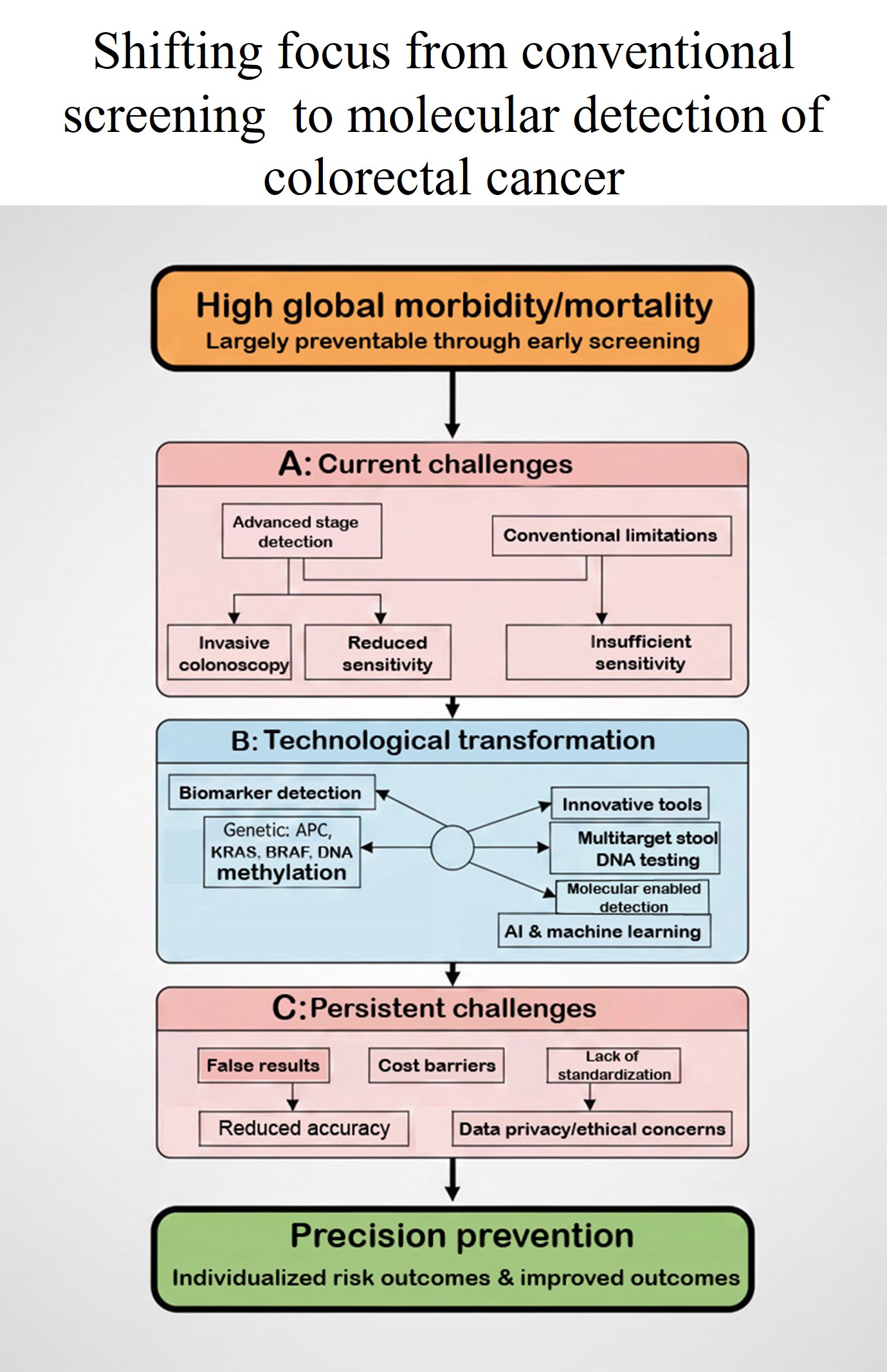
Colorectal cancer (CRC) remains a leading cause of cancer-related morbidity and mortality worldwide, with many cases still diagnosed at advanced stages despite being largely preventable through early screening. Conventional screening approaches, such as colonoscopy and fecal occult blood testing, are effective but limited by invasiveness, low compliance, and suboptimal sensitivity for early-stage disease, underscoring the need for more precise and acceptable alternatives. Recent advances in molecular diagnostics have enabled the detection of cancer-associated genetic and epigenetic alterations, including mutations in APC, KRAS, BRAF, and TP53, as well as microsatellite instability and aberrant DNA methylation, which may be detectable years before clinical manifestation of disease. Emerging technologies such as liquid biopsy and multitarget stool DNA testing are transforming CRC screening by providing minimally invasive approaches with improved diagnostic performance. These advances are further supported by next-generation sequencing, multiplex polymerase chain reaction, artificial intelligence, and machine learning, which enable the identification of complex biomarker patterns that were previously inaccessible. Several molecular assays have already received regulatory approval and show strong clinical utility, particularly in populations less likely to undergo invasive procedures. However, important challenges persist, including false-positive and false-negative results, high cost, lack of standardization, and ethical concerns related to data privacy, particularly in resource-limited settings. As the field advances toward precision prevention, integrating individualized risk profiling with molecular screening strategies may improve diagnostic accuracy and patient outcomes. Ultimately, the success of molecular CRC screening will depend not only on technological innovation but also on ensuring equitable access, affordability, and patient trust. In this perspective, we highlight the molecular revolution in CRC screening, emphasizing how modern technologies have enhanced the speed, accuracy, and uptake of screening strategies. While traditional methods are hindered by limited patient compliance and diagnostic performance, the integration of advanced molecular diagnostics (including liquid biopsies and multitarget DNA testing) is reshaping early detection. Nevertheless, the full potential of this “molecular revolution” will only be realized by addressing barriers related to cost, standardization, and global health equity.
- Qi G, Zhao R, Gao C, et al. Recent advances and challenges in colorectal cancer: From molecular research to treatment. World J Gastroenterol. 2025;31(21):106964. doi: 10.3748/wjg.v31.i21.106964
- Takeda M, Yoshida S, Inoue T, et al. The role of KRAS mutations in colorectal cancer: Biological insights, clinical implications, and future therapeutic perspectives. Cancers. 2025;17(3):428. doi: 10.3390/cancers17030428
- Malapelle U, Angerilli V, Intini R, et al. Detecting BRAF mutations in colorectal cancer in clinical practice: An Italian experts’ position paper. Crit Rev Oncol Hematol. 2025;206(2025):104574. doi: 10.1016/j.critrevonc.2024.104574
- Dang Q, Zuo L, Hu X, et al. Molecular subtypes of colorectal cancer in the era of precision oncology: Current inspirations and future challenges. Cancer Med. 2024;13(14):e70041. doi: 10.1002/cam4.70041
- Calistri D, Rengucci C, Seymour I, Lattuneddu A, Polifemo AM, Monti F, Saragoni L, Amadori D. Mutation analysis of p53, K-ras, and BRAF genes in colorectal cancer progression. J Cell Physiol. 2005;204(2):484-488. doi: 10.1002/jcp.20310
- Cohen J. D, Li L, Wang Y, et al. Detection and localization of surgically resectable cancers with a multi-analyte blood test. Science. 2018;359(6378):926–930. doi: 10.1126/science.aar3247
- Imperiale T. F, Ransohoff D. F, Itzkowitz S. H, et al. Multitarget stool DNA testing for colorectal-cancer screening. New Engl J Med. 2014;370(14):1287–1297. doi: 10.1056/NEJMoa1311194
- Rex D. K, Boland C. R, Dominitz J. A, et al. Colorectal cancer screening: Recommendations for physicians and patients from the U.S. Multi-Society Task Force on Colorectal Cancer. Am J Gastroenterol. 2017;112(7):1016-1030. doi: 10.1038/ajg.2017.189
- Song L, Jia J, Peng X, et al. The performance of the SEPT9 gene methylation assay and a comparison with other CRC screening tests: A meta-analysis. Sci Rep. 2017;7(1):3032. doi: 10.1038/s41598-017-03321-8
- Afolabi H.A, Salleh S.M, Zakaria Z, et al. Molecular characterization of Colorectal cancer (CRC) using next generation sequencing (NGS) in bridging the gap between research and clinical practice: from biomarker discovery to clinical implementation. Discov Oncol. 2025;16,268. doi: 10.1007/s12672-025-01960-2
- Zheng R, Su R, Fan Y, et al. Machine learning-based integrated multiomics characterization of colorectal cancer reveals distinctive metabolic signatures. Anal Chem. 2024;96(21):8772-8781. doi: 10.1021/acs.analchem.4c01171
- Tufail M, Jiang CH, & Li N. Wnt signaling in cancer: from biomarkers to targeted therapies and clinical translation. Mol Cancer. 2025;24:107. doi: 10.1186/s12943-025-02306-w
- Wan J. C. M, Massie C, Garcia-Corbacho J, et al. Liquid biopsies come of age: Towards implementation of circulating tumour DNA. Nat Rev Cancer. 2017;17(4):223-238. doi: 10.1038/nrc.2017.7
- Stecko H, Tsilimigras T.I, Iyer S, et al. Comprehensive assessment of genomic heterogeneity, coalterations, and outcomes of patients with colorectal cancer: An AACR GENIE Project analysis. Surgery. 2025;185:109475. doi: 10.1016/j.surg.2025.109475
- Elbarazi I, Ahmed LA. Alleviating the global burden of cancer through prevention and early detection. Cancer Control. 2025;32. doi: 10.1177/10732748251378666
- Ghoreyshi N, Heidari R, Farhadi A, et al. Next-generation sequencing in cancer diagnosis and treatment: clinical applications and future directions. Discov Oncol. 2025;16:578. doi: 10.1007/s12672-025-01816-9