



Key Laboratory of Precision Prevention and Treatment for Atherosclerotic Diseases of Zhejiang Province, Department of Cardiology, The First Affiliated Hospital of Ningbo University, Ningbo, ChinaBiomechanics; Computational fluid dynamics; Machine learning; Physical informed neural network

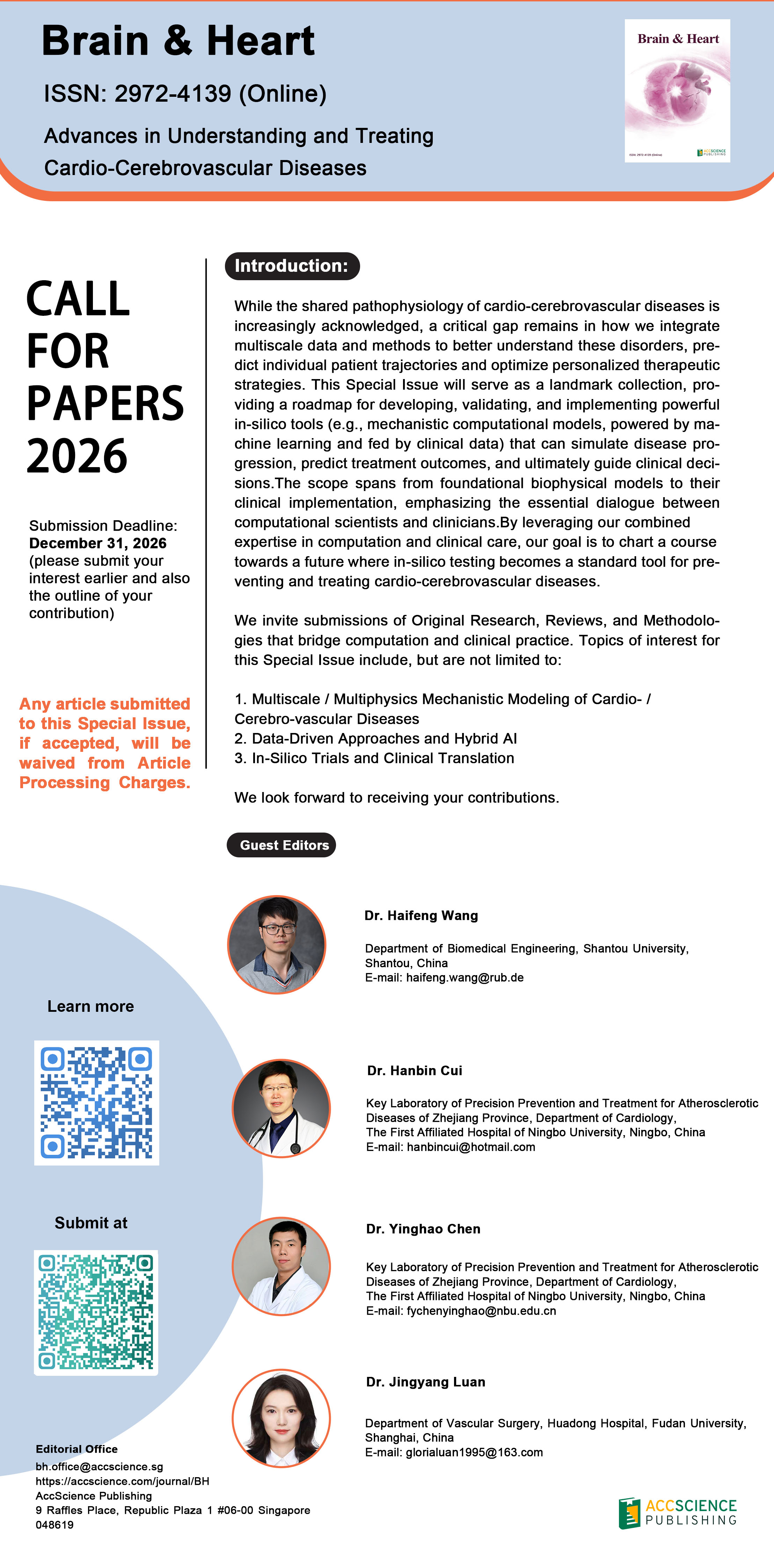
While the shared pathophysiology of cardio-cerebrovascular diseases is increasingly acknowledged, a critical gap remains in how we integrate multiscale data and methods to better understand these disorders, predict individual patient trajectories and optimize personalized therapeutic strategies. This Special Issue will serve as a landmark collection, providing a roadmap for developing, validating, and implementing powerful in-silico tools (e.g., mechanistic computational models, powered by machine learning and fed by clinical data) that can simulate disease progression, predict treatment outcomes, and ultimately guide clinical decisions.The scope spans from foundational biophysical models to their clinical implementation, emphasizing the essential dialogue between computational scientists and clinicians.By leveraging our combined expertise in computation and clinical care, our goal is to chart a course towards a future where in-silico testing becomes a standard tool for preventing and treating cardio-cerebrovascular diseases.
We invite submissions of Original Research, Reviews, and Methodologies that bridge computation and clinical practice. Topics of interest for this Special Issue include, but are not limited to:
- Multiscale / Multiphysics Mechanistic Modeling of Cardio- / Cerebro-vascular Diseases
- Data-Driven Approaches and Hybrid AI
- In-Silico Trials and Clinical Translation
We look forward to receiving your contributions.
Cardiac mechanomedicine: Putting evidence into practice