
Multi-target modulation of the neuroinflammatory network by asiatic acid in ischemic stroke: Integrated network pharmacology, molecular docking, and in vitro validation

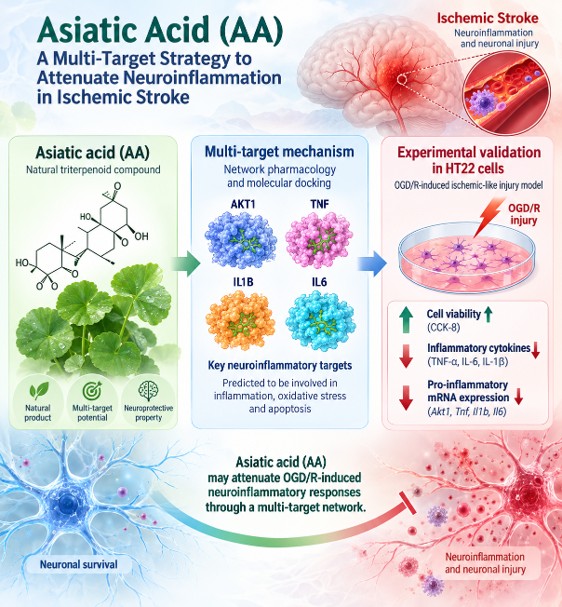
Asiatic acid (AA), a pentacyclic triterpenoid derived from Centella asiatica, has shown neuroprotective and anti-inflammatory activities, but the molecular network underlying its potential effects in ischemic stroke remains incompletely understood. Here, network pharmacology, protein–protein interaction (PPI) analysis, Gene Ontology (GO) and Kyoto Encyclopedia of Genes and Genomes (KEGG) enrichment analyses, molecular docking, and in vitro experiments were integrated to define a multi-target neuroinflammatory framework for AA. A total of 194 AA-associated targets and 2,721 ischemic stroke-associated targets were identified, yielding 96 overlapping targets. PPI analysis prioritized IL-6, TNF, AKT1, and IL-1β as prominent hub candidates, while enrichment analysis linked the shared target network to hypoxia responses, inflammatory regulation, apoptosis, HIF-1 signaling, and TNF-related pathways. Molecular docking predicted structurally plausible interactions between AA and AKT1, TNF, IL-1β, and IL-6. In HT22 cells subjected to oxygen-glucose deprivation/reoxygenation (OGD/R), AA improved cell viability, reduced TNF-α, IL-6, and IL-1β release, and attenuated OGD/R-induced increases in Akt1, Tnf, Il1b, and Il6 mRNA. Collectively, these findings support a hypothesis in which AA modulates an interconnected neuroinflammatory and stress-response network rather than a single molecular target. IL-6, TNF, IL-1β, and AKT1 therefore emerge as experimentally supported candidate nodes for further target-validation studies and, with appropriate in vivo and clinical validation, as potential biomarker candidates. This integrated framework expands the therapeutic rationale for AA in ischemic stroke while defining specific targets and pathways for future mechanistic investigation.
- Li XY, Kong XM, Yang CH, et al. Global, regional, and national burden of ischemic stroke, 1990-2021: an analysis of data from the Global Burden of Disease Study 2021. eClinicalMedicine. 2024;75:102758. doi: 10.1016/j.eclinm.2024.102758
- Iadecola C, Buckwalter MS, Anrather J. Immune responses to stroke: mechanisms, modulation, and therapeutic potential. J Clin Invest. 2020;130(6):2777–2788. doi: 10.1172/JCI135530.
- Boutin H, LeFeuvre RA, Horai R, Asano M, Iwakura Y, Rothwell NJ. Role of IL-1alpha and IL-1beta in ischemic brain damage. J Neurosci. 2001;21(15):5528–5534. doi: 10.1523/JNEUROSCI.21-15-05528.2001
- Madsen PM, Clausen BH, Degn M, et al. Genetic ablation of soluble tumor necrosis factor with preservation of membrane tumor necrosis factor is associated with neuroprotection after focal cerebral ischemia. J Cereb Blood Flow Metab. 2016;36(9):1553–1569. doi: 10.1177/0271678X15610339
- Krishnamurthy RG, Senut MC, Zemke D, et al. Asiatic acid, a pentacyclic triterpene from Centella asiatica, is neuroprotective in a mouse model of focal cerebral ischemia. J Neurosci Res. 2009;87(11):2541–2550. doi: 10.1002/jnr.22071
- Lee KY, Bae ON, Serfozo K, et al. Asiatic acid attenuates infarct volume, mitochondrial dysfunction, and matrix metalloproteinase-9 induction after focal cerebral ischemia. Stroke. 2012;43(6):1632–1638. doi: 10.1161/STROKEAHA.111.639427
- Lee KY, Bae ON, Weinstock S, Kassab M, Majid A. Neuroprotective effect of asiatic acid in rat model of focal embolic stroke. Biol Pharm Bull. 2014;37(8):1397–1401. doi: 10.1248/bpb.b14-00055
- Ye Z, Guo Q, Xia P, Wang N, Wang E, Yuan Y. Sevoflurane postconditioning involves an up-regulation of HIF-1α and HO-1 expression via PI3K/Akt pathway in a rat model of focal cerebral ischemia. Brain Res. 2012;1463:63–74. doi: 10.1016/j.brainres.2012.04.050
- Li J, Tao T, Xu J, Liu Z, Zou Z, Jin M. HIF-1α attenuates neuronal apoptosis by upregulating EPO expression following cerebral ischemia-reperfusion injury in a rat MCAO model. Int J Mol Med. 2020;45(4):1027–1036. doi: 10.3892/ijmm.2020.4480
- Daina A, Michielin O, Zoete V. SwissTargetPrediction: updated data and new features for efficient prediction of protein targets of small molecules. Nucleic Acids Res. 2019;47(W1):W357–W364. doi: 10.1093/nar/gkz382
- Davis AP, Wiegers TC, Sciaky D, et al. Comparative Toxicogenomics Database’s 20th anniversary: update 2025. Nucleic Acids Res. 2025;53(D1):D1328–D1334. doi: 10.1093/nar/gkae883
- Zdrazil B, Felix E, Hunter F, et al. The ChEMBL Database in 2023: a drug discovery platform spanning multiple bioactivity data types and time periods. Nucleic Acids Res. 2024;52(D1):D1180–D1192. doi: 10.1093/nar/gkad1004
- Gallo K, Goede A, Preissner R, Gohlke BO. SuperPred 3.0: drug classification and target prediction—a machine learning approach. Nucleic Acids Res. 2022;50(W1):W726–W731. doi: 10.1093/nar/gkac297
- Safran M, Dalah I, Alexander J, et al. GeneCards Version 3: the human gene integrator. Database. 2010;2010:baq020. doi: 10.1093/database/baq020
- Szklarczyk D, Kirsch R, Koutrouli M, et al. The STRING database in 2023: protein-protein association networks and functional enrichment analyses for any sequenced genome of interest. Nucleic Acids Res. 2023;51(D1):D638–D646. doi: 10.1093/nar/gkac1000
- Shannon P, Markiel A, Ozier O, et al. Cytoscape: a software environment for integrated models of biomolecular interaction networks. Genome Res. 2003;13(11):2498–2504. doi: 10.1101/gr.1239303
- Wu T, Hu E, Xu S, et al. clusterProfiler 4.0: a universal enrichment tool for interpreting omics data. Innovation. 2021;2(3):100141. doi: 10.1016/j.xinn.2021.100141
- Kim S, Chen J, Cheng T, et al. PubChem 2023 update. Nucleic Acids Res. 2023;51(D1):D1373–D1380. doi: 10.1093/nar/gkac956
- Burley SK, Bhikadiya C, Bi C, et al. RCSB Protein Data Bank: powerful new tools for exploring 3D structures of biological macromolecules for basic and applied research and education in fundamental biology, biomedicine, biotechnology, bioengineering and energy sciences. Nucleic Acids Res. 2021;49(D1):D437–D451. doi: 10.1093/nar/gkaa1038
- Eberhardt J, Santos-Martins D, Tillack AF, Forli S. AutoDock Vina 1.2.0: new docking methods, expanded force field, and Python bindings. J Chem Inf Model. 2021;61(8):3891–3898. doi: 10.1021/acs.jcim.1c00203
- Cao Y, Yue X, Jia M, Wang J. Neuroinflammation and anti-inflammatory therapy for ischemic stroke. Heliyon. 2023;9(7):e17986. doi: 10.1016/j.heliyon.2023.e17986
- Wang H, Zhang S, Xie L, Zhong Z, Yan F. Neuroinflammation and peripheral immunity: Focus on ischemic stroke. Int Immunopharmacol. 2023;120:110332. doi: 10.1016/j.intimp.2023.110332
- Zhao P, Lu Y, Wang Z. Naringenin attenuates cerebral ischemia/reperfusion injury by inhibiting oxidative stress and inflammatory response via the activation of SIRT1/FOXO1 signaling pathway in vitro. Acta Cir Bras. 2023;38:e380823. doi: 10.1590/acb380823
- Han Y, Sun Y, Peng S, et al. PI3K/AKT pathway: A potential therapeutic target in cerebral ischemia-reperfusion injury. Eur J Pharmacol. 2025;998:177505. doi: 10.1016/j.ejphar.2025.177505.
- Pantsar T, Poso A. Binding affinity via docking: Fact and fiction. Molecules. 2018;23(8):1899. doi: 10.3390/molecules23081899
- Hopkins AL. Network pharmacology: The next paradigm in drug discovery. Nat Chem Biol. 2008;4(11):682–690. doi: 10.1038/nchembio.118