
Binge eating and obesity as reward–interoception disorders: Neuroendocrine and neuromodulation perspectives

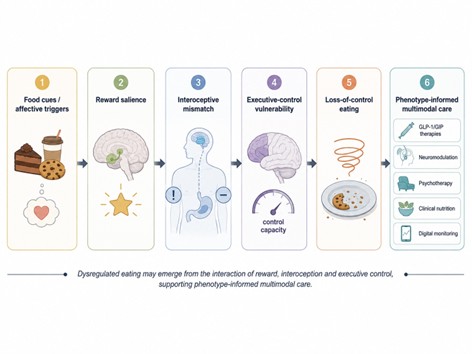
Binge eating disorder and obesity are commonly approached through psychiatric, nutritional or metabolic frameworks, yet their clinical complexity increasingly suggests a deeper neurobiological dysregulation involving reward processing, interoceptive awareness, executive control and brain–body signaling. This Perspective proposes that binge eating and selected obesity phenotypes may be conceptualized as disorders of reward–interoception integration, in which highly salient food cues, dopaminergic motivational drive, altered hunger–satiety perception and impaired prefrontal inhibition may converge to increase vulnerability to loss-of-control eating. Within this framework, the insula, anterior cingulate cortex, salience network, mesolimbic reward circuitry and dorsolateral prefrontal cortex represent key neural nodes linking bodily signals, affective arousal, craving and behavioral regulation. Recent advances in glucagon-like peptide-1 (GLP-1) and glucose-dependent insulinotropic polypeptide/glucagon-like peptide-1 (GIP/GLP-1) receptor agonist therapies further support a brain–body model of ingestive behavior, suggesting that metabolic signals may be associated not only with appetite and satiety, but also with food craving, reward valuation and cue reactivity. In parallel, non-invasive neuromodulation, particularly prefrontal transcranial magnetic stimulation, offers a promising but still investigational strategy to potentially enhance inhibitory control and reduce craving-related vulnerability. The future treatment of binge eating and selected obesity phenotypes may benefit from an integrated neuropsychiatric approach combining incretin-based pharmacotherapy, neuromodulation, psychotherapy, clinical nutrition and digital craving monitoring. Moving beyond exclusively weight-centered models, this Perspective argues for a network-centered understanding of dysregulated eating as a condition of altered communication between reward, body, metabolism and executive control.
- Berridge KC, Ho CY, Richard JM, DiFeliceantonio AG. The tempted brain eats: pleasure and desire circuits in obesity and eating disorders. Brain Res. 2010;1350:43-64. doi: 10.1016/j.brainres.2010.04.003
- Saruco E, Pleger B. A systematic review of obesity and binge eating associated impairment of the cognitive inhibition system. Front Nutr. 2021;8:609012. doi: 10.3389/fnut.2021.609012
- Khalsa SS, Adolphs R, Cameron OG, et al. Interoception and mental health: a roadmap. Biol Psychiatry Cogn Neurosci Neuroimaging. 2018;3(6):501-513. doi: 10.1016/j.bpsc.2017.12.004
- Robinson TE, Berridge KC. The neural basis of drug craving: an incentive-sensitization theory of addiction. Brain Res Brain Res Rev. 1993;18(3):247-291. doi: 10.1016/0165-0173(93)90013-P
- Stice E, Spoor S, Bohon C, Veldhuizen MG, Small DM. Relation of reward from food intake and anticipated food intake to obesity: a functional magnetic resonance imaging study. J Abnorm Psychol. 2008;117(4):924-935. doi: 10.1037/a0013600
- Gearhardt AN, White MA, Masheb RM, Morgan PT, Crosby RD, Grilo CM. An examination of the food addiction construct in obese patients with binge eating disorder. Int J Eat Disord. 2012;45(5):657-663. doi: 10.1002/eat.20957
- Craig AD. How do you feel — now? The anterior insula and human awareness. Nat Rev Neurosci. 2009;10(1):59-70. doi: 10.1038/nrn2555
- Menon V, Uddin LQ. Saliency, switching, attention and control: a network model of insula function. Brain Struct Funct. 2010;214(5-6):655-667. doi: 10.1007/s00429-010-0262-0
- Martin E, Dourish CT, Rotshtein P, Spetter MS, Higgs S. Interoception and disordered eating: a systematic review. Neurosci Biobehav Rev. 2019;107:166-191. doi: 10.1016/j.neubiorev.2019.08.020
- Skibicka KP. The central GLP-1: implications for food and drug reward. Front Neurosci. 2013;7:181. doi: 10.3389/fnins.2013.00181
- Friedrichsen M, Breitschaft A, Tadayon S, Wizert A, Skovgaard D. The effect of semaglutide 2.4 mg once weekly on energy intake, appetite, control of eating, and gastric emptying in adults with obesity. Diabetes Obes Metab. 2021;23(3):754-762. doi: 10.1111/dom.14280
- Aoun L, Almardini S, Saliba F, et al. GLP-1 receptor agonists: a novel pharmacotherapy for binge eating disorder and bulimia nervosa? A systematic review. J Clin Transl Endocrinol. 2024;35:100333. doi: 10.1016/j.jcte.2024.100333
- Martin CK, Redman LM, Ravussin E, et al. Tirzepatide on ingestive behavior in adults with overweight or obesity: a randomized 6-week phase 1 trial. Nat Med. 2025;31:3141-3150. doi: 10.1038/s41591-025-03774-9
- Cavicchioli M, Sarzetto A, Erzegovesi S, Ogliari A. Is repetitive transcranial magnetic stimulation (RTMS) a promising therapeutic intervention for eating disorders and obesity? Clinical considerations based on a meta-analytic review. Clin Neuropsychiatry. 2022;19(5):314-327. doi: 10.36131/cnfioritieditore20220507
- Maranhão MF, Estella N, Cury MEG, Schmidt U, Campbell IC, Claudino AM. Repetitive transcranial magnetic stimulation of the left dorsolateral prefrontal cortex in binge eating disorder: a double-blind randomized controlled trial. Psychol Med. 2025;55:e149. doi: 10.1017/S0033291725000492
- Orrù G, Cesari V, Malloggi E, et al. The effects of transcranial direct current stimulation on food craving and food intake in individuals affected by obesity and overweight: a mini review of the magnitude of the effects. AIMS Neurosci. 2022;9(3):358-372. doi: 10.3934/Neuroscience.2022020
- Grilo CM, Masheb RM, Wilson GT, Gueorguieva R, White MA. Cognitive-behavioral therapy, behavioral weight loss, and sequential treatment for obese patients with binge-eating disorder: a randomized controlled trial. J Consult Clin Psychol. 2011;79(5):675-685. doi: 10.1037/a0025049
- Schaefer LM, Smith KE, Anderson LM, et al. The role of affect in the maintenance of binge-eating disorder: evidence from an ecological momentary assessment study. J Abnorm Psychol. 2020;129(4):387-396. doi: 10.1037/abn0000517
- Kenny PJ. Reward mechanisms in obesity: new insights and future directions. Neuron. 2011;69(4):664-679. doi: 10.1016/j.neuron.2011.02.016
- Pasquale EK, Boyar AM, Boutelle KN. Reward and inhibitory control as mechanisms and treatment targets for binge eating disorder. Curr Psychiatry Rep. 2024;26(11):616-625. doi: 10.1007/s11920-024-01534-z
- Donnelly B, Hay P. Mapping treatment advances in the neurobiology of binge eating disorder: a concept paper. Nutrients. 2024;16(7):1081. doi: 10.3390/nu16071081
- Badulescu S, Tabassum A, Le GH, et al. Glucagon-like peptide 1 agonist and effects on reward behaviour: a systematic review. Physiol Behav. 2024;283:114622. doi: 10.1016/j.physbeh.2024.114622
- Longo P, Bevione F, Lacidogna MC, Lavalle R, Abbate Daga G, Preti A. Neuromodulatory techniques in eating disorders: from electroconvulsive therapy to transcranial magnetic stimulation and beyond: a mixed method systematic meta-review. Psychiatry Res. 2025;344:116346. doi: 10.1016/j.psychres.2024.116346
- Koceva A, Herman R, Janez A, Rakusa M, Jensterle M. Sex- and gender-related differences in obesity: from pathophysiological mechanisms to clinical implications. Int J Mol Sci. 2024;25(13):7342. doi: 10.3390/ijms25137342
- Ahmed F, Arshad MT, Maqsood S, et al. Gut-brain axis in obesity: how dietary patterns influence psychological well-being and metabolic health? Food Sci Nutr. 2025;13(7):e70689. doi: 10.1002/fsn3.70689
- Huwart SJP, Morales-Puerto N, Everard A. Gut microbiota-related neuroinflammation at the crossroad of food reward alterations: implications for eating disorders. Gut. 2025;74(10):1728-1740. doi: 10.1136/gutjnl-2024-333397
- Ziade I, McDermott MM, O’Riordan KJ, Cryan JF, Schneider E. The microbiome and eating disorders: a new framework at the interface of interoception and reward. Neuroscience. 2026;603:264-280. doi: 10.1016/j.neuroscience.2026.03.050