
Anoectochilus roxburghii aqueous extract improves scopolamine-induced cognitive impairment in mice: Associations with gut microbiota and fecal metabolomics

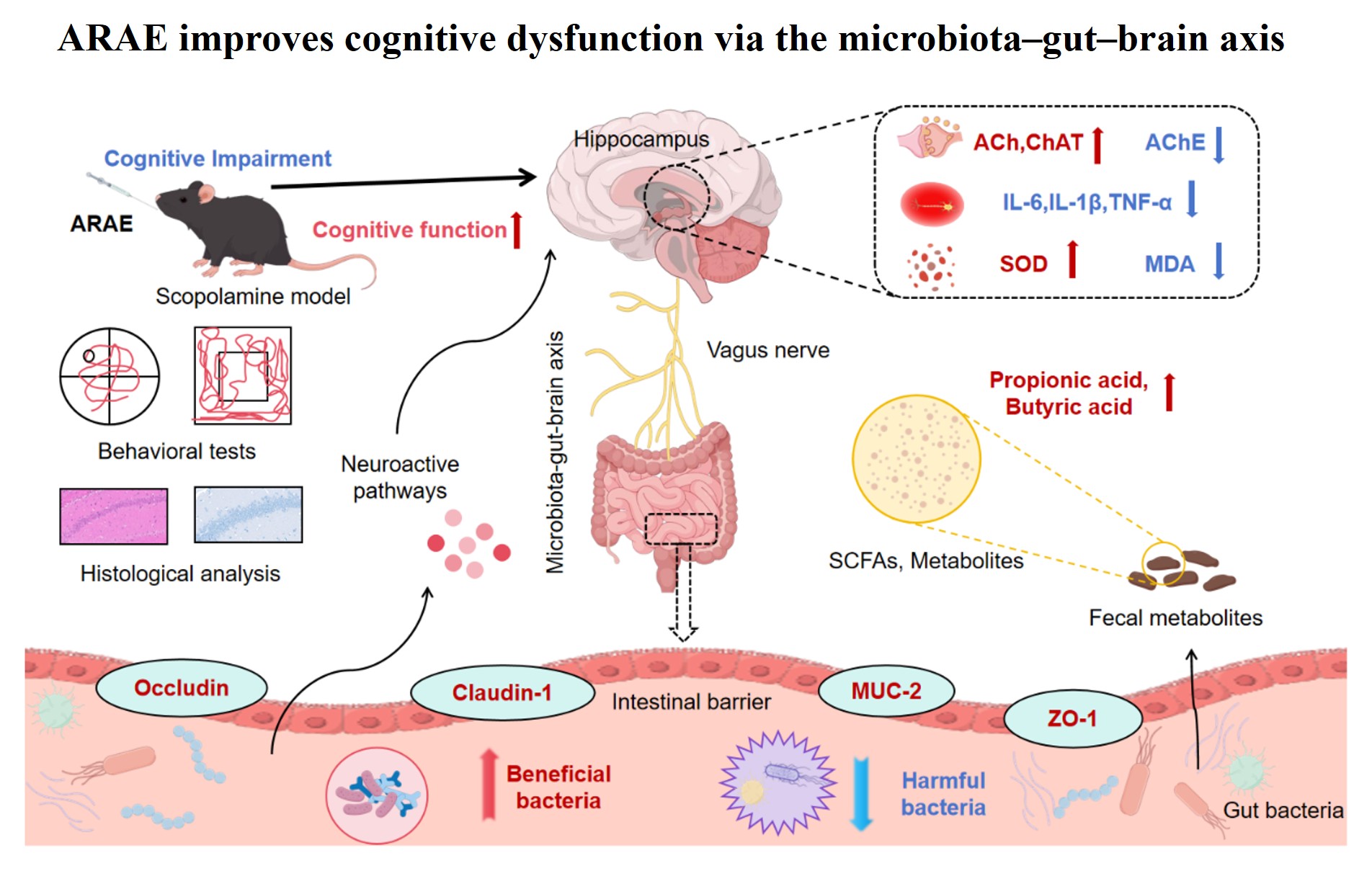
Cognitive dysfunction (CD) associated with cholinergic deficits is a hallmark of Alzheimer’s disease (AD) and related disorders. The natural edible herb Anoectochilus roxburghii has various pharmacological activities, including anti-inflammatory, antioxidant, and neuroprotective effects. However, the underlying mechanism by which A. roxburghii alleviates CD via the microbiota–gut–brain (MGB) axis remains unclear. In this study, a scopolamine-induced CD mouse model was used to evaluate the therapeutic effect of A. roxburghii aqueous extract (ARAE) through behavioral tests, intestinal and brain histopathology, ELISA quantitative assays, gut microbiota sequencing, and metabolomics analysis. ARAE effectively improved cognitive and memory abilities in the mouse model, as demonstrated by significantly reduced escape latency and increased crossings over the target platform in the Morris water maze test. Mechanistic studies elucidated that ARAE effectively reduced the release of inflammatory factors, alleviated oxidative stress, and corrected cholinergic imbalance. Furthermore, ARAE reshaped the gut microbiota and upregulated the expression of tight junction proteins claudin-1, occludin, and zonula occludens-1 (ZO-1), as well as mucin-2 (MUC-2), thereby contributing to the integrity of the intestinal barrier. Meanwhile, ARAE increased the levels of propionic acid and butyric acid, concurrently restoring the disordered host–microbiota co-metabolism by targeting the tryptophan metabolism pathway. In summary, ARAE alleviates scopolamine-induced CD via the MGB axis through anti-inflammatory, antioxidant, cholinergic, and gut barrier-enhancing mechanisms. These findings indicate that A. roxburghii may be a promising candidate for the treatment of CD associated with cholinergic dysfunction and lay a foundation for further research in more comprehensive AD models.
- Zheng Q, Wang X. Alzheimer’s disease: insights into pathology, molecular mechanisms, and therapy. Protein Cell. 2025;16:83-120. doi: 10.1093/procel/pwae026
- Zhang J, Zhang Y, Wang J, Xia Y, Zhang J, Chen L. Recent advances in Alzheimer’s disease: Mechanisms, clinical trials and new drug development strategies. Signal Transduct Target Ther. 2024;9:211. doi: 10.1038/s41392-024-01911-3
- Weller J, Budson A. Current understanding of Alzheimer’s disease diagnosis and treatment. F1000Res. 2018;7:1161. doi: 10.12688/f1000research.14506.1
- Wang B, Pan M, Yang L, et al. Akkermansia muciniphila reduces neuroinflammation and Aβ deposition via tryptophan metabolism in the APP/PS1 mouse model of Alzheimer’s disease. Alzheimers Res Ther. 2026;18:41. doi: 10.1186/s13195-025-01880-x
- Zhang R, Tian M, Wu Y, Yang C, Shi X, Wang S. TLR4/NF-κB signaling-mediated neuroinflammation is associated with gut microbiota dysbiosis in a mouse model of Parkinson’s disease. Front Immunol. 2026;17:1672241. doi: 10.3389/fimmu.2026.1672241
- Loh JS, Mak WQ, Tan LKS, et al. Microbiota-gut-brain axis and its therapeutic applications in neurodegenerative diseases. Signal Transduct Target Ther. 2024;9:37. doi: 10.1038/s41392-024-01743-1
- Yang J, Song X, Yan S, Li Q, Yang W. The gut microbiota influences neurodegenerative diseases through the gut-brain axis: molecular mechanisms and effects on immune function. Front Immunol. 2026;16:1739329. doi: 10.3389/fimmu.2025.1739329
- Zou X, Zhang K, Li X, Zhang Y, Chen L, Li H. Current advances on the phytochemistry, pharmacology, quality control and applications of Anoectochilus roxburghii. Front Pharmacol. 2025;15:1527341. doi: 10.3389/fphar.2024.1527341
- Tian D, Zhong X, Fu L, et al. Therapeutic effect and mechanism of polysaccharides from Anoectochilus Roxburghii (Wall.) Lindl. in diet-induced obesity. Phytomedicine. 2022;99:154031. doi: 10.1016/j.phymed.2022.154031
- Wang L, Chen Q, Zhuang S, et al. Effect of Anoectochilus roxburghii flavonoids extract on H(2)O(2) - Induced oxidative stress in LO2 cells and D-gal induced aging mice model. J Ethnopharmacol. 2020;254:112670. doi: 10.1016/j.jep.2020.112670
- Yan Y, Ye X, Huang C, et al. Anoectochilus roxburghii polysaccharide reduces D-GalN/LPS-induced acute liver injury by regulating the activation of multiple inflammasomes. J Pharm Pharmacol. 2024;76:1212-1224. doi: 10.1093/jpp/rgae077
- Xiao Y, Duan C, Gong P, et al. Kinsenoside from Anoectochilus roxburghii (Wall.) Lindl. suppressed oxidative stress to attenuate aging-related learning and memory impairment via ERK/Nrf2 pathway. J Ethnopharmacol. 2024;319:117152. doi: 10.1016/j.jep.2023.117152
- Zeng Z, Chen C, SiTu Y, et al. Anoectochilus roxburghii flavonoids extract ameliorated the memory decline and reduced neuron apoptosis via modulating SIRT1 signaling pathway in senescent mice. J Ethnopharmacol. 2022;296:115361. doi: 10.1016/j.jep.2022.115361
- Ma Y, Suo J, Sheng S, Chen L. PD-L1 deficiency exacerbates colitis severity by remodeling gut microbiota in inflammatory bowel disease. Front Immunol. 2025;16:1622744. doi: 10.3389/fimmu.2025.1622744
- Alqudah A, Qnais E, Gammoh O, et al. Exploring Scopoletin’s Therapeutic Efficacy in DSS-Induced Ulcerative Colitis: Insights into Inflammatory Pathways, Immune Modulation, and Microbial Dynamics. Inflammation. 2025;48:575-589. doi: 10.1007/s10753-024-02048-9
- Chen Y, Cui W, Li X, Yang H. Interaction Between Commensal Bacteria, Immune Response and the Intestinal Barrier in Inflammatory Bowel Disease. Front Immunol. 2021;12:761981. doi: 10.3389/fimmu.2021.761981
- Brown GC, Heneka MT. The endotoxin hypothesis of Alzheimer’s disease. Mol Neurodegener. 2024;19:30. doi: 10.1186/s13024-024-00722-y
- Mou Y, Du Y, Zhou L, et al. Gut Microbiota Interact With the Brain Through Systemic Chronic Inflammation: Implications on Neuroinflammation, Neurodegeneration, and Aging. Front Immunol. 2022;13:796288. doi: 10.3389/fimmu.2022.796288
- Xue D, Hu X, Li R, et al. Plant-derived bioactive compounds modulate the gut microbiota in Alzheimer’s disease: Metabolite signaling, neuroimmune circuits, and systems-level regulation. Phytomedicine. 2026;153:157919. doi: 10.1016/j.phymed.2026.157919
- Zhao WP, Zhu SQ, Yin ZH, et al. Short-chain fatty acids alleviated fluoride-induced neuroinflammation via the gut-brain axis in rats. Environ Pollut. 2026;390:127503. doi: 10.1016/j.envpol.2025.127503
- Lin W, Ruishi X, Caijiao X, et al. Potential applications and mechanisms of natural products in mucosal-related diseases. Front Immunol. 2025;16:1594224. doi: 10.3389/fimmu.2025.1594224
- Yue F, Zhang J, Xu J, Niu T, Lü X, Liu M. Effects of monosaccharide composition on quantitative analysis of total sugar content by phenol-sulfuric acid method. Front Nutr. 2022;9:963318. doi: 10.3389/fnut.2022.963318
- Saeed N, Khan MR, Shabbir M. Antioxidant activity, total phenolic and total flavonoid contents of whole plant extracts Torilis leptophylla L. BMC Complement Altern Med. 2012;12(1):221. doi: 10.1186/1472-6882-12-221
- Li S, Wang D, Li A, et al. ZuoGui Pill Ameliorates Alzheimer’s Disease-Like Pathology in 3xTg-AD Mice by Targeting Aβ Production, Tau Phosphorylation, Synaptic Loss, and Neuroinflammation. Mol Neurobiol. 2026;63(1):96. doi: 10.1007/s12035-025-05336-z
- Sani SSM, Eidi A, Rajabian A, Hosseini M. Administration of Cilostazol Mitigates Learning and Memory Disturbance in a Rat Model of Amnesia by Modifying Cholinergic Function and Neuroinflammation. Mol Neurobiol. 2026;63:112. doi: 10.1007/s12035-025-05544-7
- Zhang R, Ding N, Feng X, Liao W. The gut microbiome, immune modulation, and cognitive decline: insights on the gut-brain axis. Front Immunol. 2025;16:1529958. doi: 10.3389/fimmu.2025.1529958
- Chen C, Wang GQ, Li DD, Zhang F. Microbiota-gut-brain axis in neurodegenerative diseases: molecular mechanisms and therapeutic targets. Mol Biomed. 2025;6(1):64. doi: 10.1186/s43556-025-00307-1
- Socała K, Doboszewska U, Szopa A, et al. The role of microbiota-gut-brain axis in neuropsychiatric and neurological disorders. Pharmacol Res. 2021;172:105840. doi: 10.1016/j.phrs.2021.105840
- Ji X, Wang J, Lan T, Zhao D, Xu P. Gut microbial metabolites and the brain-gut axis in Alzheimer’s disease: A review. Biomol Biomed. 2025;26(2):240-250. doi: 10.17305/bb.2025.12921
- Luca M, Chattipakorn SC, Sriwichaiin S, Luca A. Cognitive- Behavioural Correlates of Dysbiosis: A Review. Int J Mol Sci. 2020;21(14):4834. doi: 10.3390/ijms21144834
- Wang H, Zhou L, Zheng Q, et al. Kai-xin-san improves cognitive impairment in D-gal and Aβ(25-35) induced ad rats by regulating gut microbiota and reducing neuronal damage. J Ethnopharmacol. 2024;329:118161. doi: 10.1016/j.jep.2024.118161
- Pettersen VK, Steinsland H, Wiker HG. Distinct Metabolic Features of Pathogenic Escherichia coli and Shigella spp. Determined by Label-Free Quantitative Proteomics. Proteomics. 2021;21(2):e2000072. doi: 10.1002/pmic.202000072
- Cheon MJ, Lim SM, Lee NK, et al. Probiotic properties and neuroprotective effects of Lactobacillus buchneri ku200793 isolated from Korean fermented foods. Int J Mol Sci. 2020;21(4):1227. doi: 10.3390/ijms21041227
- Sirin S, Aslim B. Characterization of lactic acid bacteria derived exopolysaccharides for use as a defined neuroprotective agent against amyloid beta1-42-induced apoptosis in SH-SY5Y cells. Sci Rep. 2020;10(1):1-18. doi: 10.1038/s41598-020-65147-1
- He R, Qi P, Shu L, et al. Dysbiosis and extraintestinal cancers. J Exp Clin Cancer Res. 2025;44(1). doi: 10.1186/s13046-025-03313-x
- Du L, Chen J, Yan J, et al. Lingguizhugan decoction ameliorates cognitive impairment in AD-like mice by influencing the microbiome-gut-brain axis mediated by SCFAs. Phytomedicine. 2024;133:155942. doi: 10.1016/j.phymed.2024.155942
- Wang Z, Wang C, Yuan B, et al. Akkermansia muciniphila and its metabolite propionic acid maintains neuronal mitochondrial division and autophagy homeostasis during Alzheimer’s disease pathologic process via GPR41 and GPR43. Microbiome. 2025;13(1):16. doi: 10.1186/s40168-024-02001-w
- Mishra SP, Jain S, Wang B, et al. Abnormalities in microbiota/butyrate/FFAR3 signaling in aging gut impair brain function. JCI Insight. 2024;9(3). doi: 10.1172/jci.insight.168443
- Peng K, Xiao S, Xia S, Li C, Yu H, Yu Q. Butyrate Inhibits the HDAC8/NF-κB Pathway to Enhance Slc26a3 Expression and Improve the Intestinal Epithelial Barrier to Relieve Colitis. J Agric Food Chem. 2024;72(44):24400-24416. doi: 10.1021/acs.jafc.4c04456
- Zhu H, Yang D, Du P, Qian H, Yang Z. 6-Shogaol improves the cognitive and memory declines of natural aging mice by modulating butyrate-producing microbiota and intestinal barrier. Phytomedicine. 2025;148:157381. doi: 10.1016/j.phymed.2025.157381
- Galizzi G, Di Carlo M. Mitochondrial DNA and Inflammation in Alzheimer’s Disease. Curr Issues Mol Biol. 2023;45(11):8586-8606. doi: 10.3390/cimb45110540
- Ramírez-Guerrero S, Guardo-Maya S, Medina-Rincón GJ, Orrego-González EE, Cabezas-Pérez R, González-Reyes RE. Taurine and Astrocytes: A Homeostatic and Neuroprotective Relationship. Front Mol Neurosci. 2022;15:937789. doi: 10.3389/fnmol.2022.937789