

Biomarkers and biosensors in multiple sclerosis: A literature and patent review

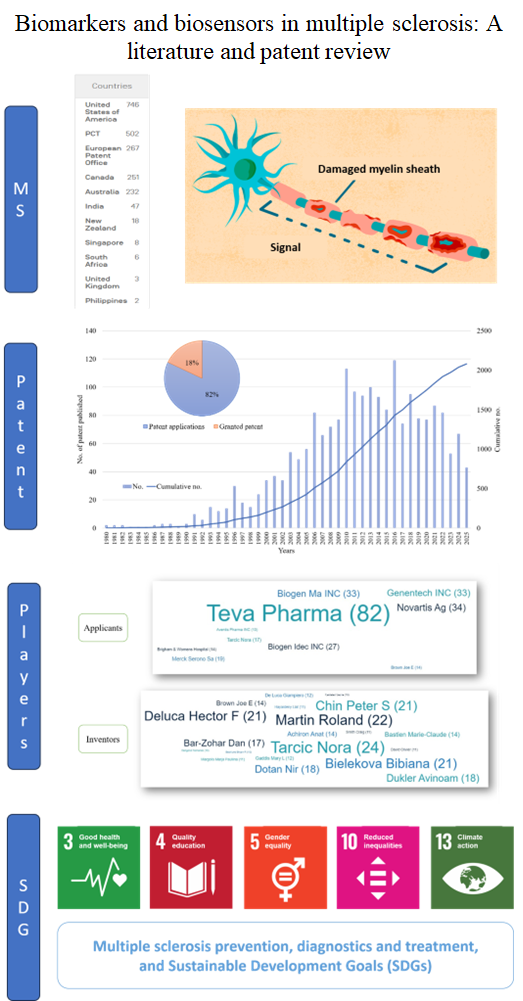
Multiple sclerosis (MS) is a progressive autoimmune disorder that involves damage to the central nervous system. The progressive form of MS currently lacks an effective treatment. Identifying reliable biomarkers for MS is essential for improving diagnosis, tracking disease progression, and assessing treatment outcomes. Recent developments in important biomarker categories are examined in this article, including neurofilament light chain (NfL), a sensitive indication of neurodegeneration and disease status. The integration of artificial intelligence and machine learning is expediting the analysis of complex datasets from genetic and neuroimaging research. Electrochemical nano-biosensors and wearable biosensors are under development to aid in the early detection and treatment of MS. In this article, the second part discusses patent analysis using Patentscope (a patent database from the World Intellectual Property Organization), Google Patents, and Lens.org. It showed that around 2,081 patents have been published globally on MS diagnostics and treatment since 1980. The United States Patent and Trademark Office has observed a record high in patent publications, with 746. These records were followed by the European Patent Office (267), Canada (251), Australia (232), India (47), and others. Furthermore, to understand future trends in biomarker and biosensor technology, the top global players were identified: Teva Pharma Industry Ltd., Novartis AG, Genentech Inc., and Biogen MA Inc. The last part of this review discusses policy interventions for MS diagnosis and treatment that have significant implications for individuals, healthcare systems, and societies in addressing Sustainable Development Goals 3, 4, 5, 10, and 13.
- Anandan S, Maciak K, Breinbauer R, et al. Brain-derived blood biomarkers in multiple sclerosis—current trends and beyond. Front Immunol. 2025;16:1569503. doi: 10.3389/fimmu.2025.1569503
- McDonald WI, Compston A, Edan G, et al. Recommended diagnostic criteria for multiple sclerosis: Guidelines from the international panel on the diagnosis of multiple sclerosis. Ann Neurol. 2001;50(1):121-127. doi: 10.1002/ana.1032
- Schilke ED, Remoli G, Funelli E, et al. Current use of fluid biomarkers as outcome measures in Multiple Sclerosis (MS): a review of ongoing pharmacological clinical trials. Neurol Sci. 2024;45(5):1931-1944. doi: 10.1007/s10072-023-07228-3
- Compston A, Coles A. Multiple sclerosis. Lancet. 2008;372(9648):1502-1517. doi: 10.1016/S0140-6736(08)61620-7
- Glass CK, Saijo K, Winner B, Marchetto MC, Gage FH. Mechanisms Underlying Inflammation in Neurodegeneration. Cell. 2010;140(6):918-934. doi: 10.1016/j.cell.2010.02.016
- Sofroniew MV, Vinters HV. Astrocytes: biology and pathology. Acta Neuropathol. 2010;119(1):7-35. doi: 10.1007/s00401-009-0619-8
- Han MH, Hwang SI, Roy DB, et al. Proteomic analysis of active multiple sclerosis lesions reveals therapeutic targets. Nature. 2008;451(7182):1076-1081. doi: 10.1038/nature06559
- Dillenseger A, Weidemann ML, Trentzsch K, et al. Digital Biomarkers in Multiple Sclerosis. Brain Sci. 2021;11(11):1519. doi: 10.3390/brainsci11111519
- Serin M, Kara P. Demyelination detection in CSF based on electrochemical monitoring of myelin basic protein in comparison between Apta vs. Immuno sensing strategies. Bioelectrochemistry. 2025;161:108834. doi: 10.1016/j.bioelechem.2024.108834
- Krysko KM, Akhbardeh A, Arjona J, et al. Biosensor vital sign detects multiple sclerosis progression. Ann Clin Transl Neurol. 2021;8(1):4-14. doi: 10.1002/acn3.51187
- Can Demirdöğen B. A literature review of biosensors for multiple sclerosis: Towards personalized medicine and point-of-care testing. Mult Scler Relat Disord. 2021;48:102675. doi: 10.1016/j.msard.2020.102675
- Bar-Or A, Nicholas J, Feng J, Sorrell F, Cascione M. Exploring the Clinical Utility of Neurofilament Light Chain Assays in Multiple Sclerosis Management. Neurol Neuroimmunol Neuroinflamm. 2025;12(4):e200427. doi: 10.1212/NXI.0000000000200427
- Ning L, Wang B. Neurofilament light chain in blood as a diagnostic and predictive biomarker for multiple sclerosis: A systematic review and meta-analysis. Sipilä JOT, ed. PLoS ONE. 2022;17(9):e0274565. doi: 10.1371/journal.pone.0274565
- Bjornevik K, Munger KL, Cortese M, et al. Serum Neurofilament Light Chain Levels in Patients With Presymptomatic Multiple Sclerosis. JAMA Neurol. 2020;77(1):58. doi: 10.1001/jamaneurol.2019.3238
- Jaromirska J, Kaczmarski P, Strzelecki D, Sochal M, Białasiewicz P, Gabryelska A. Shedding light on neurofilament involvement in cognitive decline in obstructive sleep apnea and its possible role as a biomarker. Front Psychiatry. 2023;14:1289367. doi: 10.3389/fpsyt.2023.1289367
- Gauthier A, Viel S, Perret M, et al. Comparison of SimoaTM and EllaTM to assess serum neurofilament‐light chain in multiple sclerosis. Ann Clin Transl Neurol. 2021;8(5):1141- 1150. doi: 10.1002/acn3.51355
- Sahoo S, Harper C, Tsui AKY, et al. Serum neurofilament light chain as a biomarker in multiple sclerosis: A cross-sectional observation in real-world clinical practice. Mult Scler Relat Disord. 2025;103:106637.doi: 10.1016/j.msard.2025.106637
- Freedman MS, Abdelhak A, Bhutani MK, et al. The role of serum neurofilament light (sNfL) as a biomarker in multiple sclerosis: insights from a systematic review. J Neurol. 2025;272(6):400. doi: 10.1007/s00415-025-13093-1
- Nicolella V, Fiorenza M, Monteiro I, et al. Clinical utility of the LumipulseTM immunoassay for plasma neurofilament light chain in multiple sclerosis. J Neurol Sci. 2024;463:123115. doi: 10.1016/j.jns.2024.123115
- Ulndreaj A, Sohaei D, Thebault S, et al. Quantitation of neurofilament light chain protein in serum and cerebrospinal fluid from patients with multiple sclerosis using the MSD R-PLEX NfL assay. Diagnosis. 2023;10(3):275-280. doi: 10.1515/dx-2022-0125
- Kuhle J, Kropshofer H, Haering DA, et al. Blood neurofilament light chain as a biomarker of MS disease activity and treatment response. Neurology. 2019;92(10). doi: 10.1212/WNL.0000000000007032
- Sotirchos ES, Fitzgerald KC, Singh CM, et al. Associations of sNfL with clinico‐radiological measures in a large MS population. Ann Clin Transl Neurol. 2023;10(1):84-97. doi: 10.1002/acn3.51704
- Cuello JP, Martínez Ginés ML, Kuhle J, et al. Neurofilament light chain levels in pregnant multiple sclerosis patients: a prospective cohort study. Euro J Neurol. 2019;26(9):1200- 1204. doi: 10.1111/ene.13965
- Højsgaard Chow H, Petersen ER, Olsson A, et al. Age-corrected neurofilament light chain ratio decreases but does not predict relapse in highly active multiple sclerosis patients initiating natalizumab treatment. Mult Scler Relat Disord. 2024;88:105701. doi: 10.1016/j.msard.2024.105701
- Thebault S, Booth RA, Rush CA, MacLean H, Freedman MS. Serum Neurofilament Light Chain Measurement in MS: Hurdles to Clinical Translation. Front Neurosci. 2021;15:654942. doi: 10.3389/fnins.2021.654942
- Kodosaki E, Watkins WJ, Loveless S, et al. Combination protein biomarkers predict multiple sclerosis diagnosis and outcomes. J Neuroinflammation. 2024;21(1):52. doi: 10.1186/s12974-024-03036-4
- Cross AH, Gelfand JM, Thebault S, et al. Emerging Cerebrospinal Fluid Biomarkers of Disease Activity and Progression in Multiple Sclerosis. JAMA Neurol. 2024;81(4):373. doi: 10.1001/jamaneurol.2024.0017
- Di Filippo M, Gaetani L, Centonze D, et al. Fluid biomarkers in multiple sclerosis: from current to future applications. Lancet Reg Health Europe. 2024;44:101009. doi: 10.1016/j.lanepe.2024.101009
- Talaat F, Abdelatty S, Ragaie C, Dahshan A. Chitinase-3- like 1-protein in CSF: a novel biomarker for progression in patients with multiple sclerosis. Neurol Sci. 2023;44(9):3243- 3252. doi: 10.1007/s10072-023-06764-2
- Praet J, Anderhalten L, Comi G, et al. A future of AI-driven personalized care for people with multiple sclerosis. Front Immunol. 2024;15:1446748. doi: 10.3389/fimmu.2024.1446748
- Amin M, Martínez-Heras E, Ontaneda D, Prados Carrasco F. Artificial Intelligence and Multiple Sclerosis. Curr Neurol Neurosci Rep. 2024;24(8):233-243. doi: 10.1007/s11910-024-01354-x
- Yousef H, Malagurski Tortei B, Castiglione F. Predicting multiple sclerosis disease progression and outcomes with machine learning and MRI-based biomarkers: a review. J Neurol. 2024;271(10):6543-6572. doi: 10.1007/s00415-024-12651-3
- Gashi S, Oldrati P, Moebus M, et al. Modeling multiple sclerosis using mobile and wearable sensor data. npj Digit Med. 2024;7(1):64. doi: 10.1038/s41746-024-01025-8
- Arends J, Thijs RD, Gutter T, et al. Multimodal nocturnal seizure detection in a residential care setting: A long-term prospective trial. Neurology. 2018;91(21). doi: 10.1212/WNL.0000000000006545
- Ata N, Zahoor I, Hoda N, et al. Artificial neural network-based prediction of multiple sclerosis using blood-based metabolomics data. Mult Scler Relat Disord. 2024;92:105942. doi: 10.1016/j.msard.2024.105942
- Shull PB, Jirattigalachote W, Hunt MA, Cutkosky MR, Delp SL. Quantified self and human movement: A review on the clinical impact of wearable sensing and feedback for gait analysis and intervention. Gait Posture. 2014;40(1):11-19. doi: 10.1016/j.gaitpost.2014.03.189
- Shariati S, Ghaffarinejad A, Omidinia E. Early detection of multiple sclerosis (MS) as a neurodegenerative disease using electrochemical nano-aptasensor. Microchem J. 2022;178:107358. doi: 10.1016/j.microc.2022.107358
- Zhang Q, Zhao G, Wang S, Song Y, Sun Y. Polymer- Based Electrochemical Sensors for the Diagnosis of Neurodegenerative Diseases. Cell Mol Neurobiol. 2025;45(1):52.doi: 10.1007/s10571-025-01570-0
- Serin M, Kara P. Aptamer-based electrochemical nanobiosensor for research and monitoring of multiple sclerosis in mice models. Bioelectrochemistry. 2024;160:108744. doi: 10.1016/j.bioelechem.2024.108744
- Li W tao, Dong S ying, Chen H, et al. A neurofilament-light chains electrochemical immunosensor expected to reveal the early stage of neurodegenerative diseases. Chem Eng J. 2022;446:136850. doi: 10.1016/j.cej.2022.136850
- Baachaoui S, Mastouri M, Meftah M, Yaacoubi-Loueslati B, Raouafi N. A Magnetoelectrochemical Bioassay for Highly Sensitive Sensing of Point Mutations in Interleukin-6 Gene Using TMB as a Hybridization Intercalation Indicator. Biosensors. 2023;13(2):240. doi: 10.3390/bios13020240
- Deskoulidis E, Petrouli S, Apostolopoulos V, Matsoukas J, Topoglidis E. The Use of Electrochemical Voltammetric Techniques and High-Pressure Liquid Chromatography to Evaluate Conjugation Efficiency of Multiple Sclerosis Peptide-Carrier Conjugates. Brain Sci. 2020;10(9):577. doi: 10.3390/brainsci10090577
- Derkus B, Emregul E, Yucesan C, Cebesoy Emregul K. Myelin basic protein immunosensor for multiple sclerosis detection based upon label-free electrochemical impedance spectroscopy. Biosens Bioelectron. 2013;46:53-60. doi: 10.1016/j.bios.2013.01.060
- Woelfle T, Bourguignon L, Lorscheider J, Kappos L, Naegelin Y, Jutzeler CR. Wearable Sensor Technologies to Assess Motor Functions in People With Multiple Sclerosis: Systematic Scoping Review and Perspective. J Med Internet Res. 2023;25:e44428. doi: 10.2196/44428
- Moebus M, Gashi S, Hilty M, Oldrati P, Holz C. Meaningful digital biomarkers derived from wearable sensors to predict daily fatigue in multiple sclerosis patients and healthy controls. iScience. 2024;27(2):108965. doi: 10.1016/j.isci.2024.108965
- Salis F, Bertuletti S, Bonci T, et al. A multi-sensor wearable system for the assessment of diseased gait in real-world conditions. Front Bioeng Biotechnol. 2023;11:1143248. doi: 10.3389/fbioe.2023.1143248
- Oh J, Capezzuto L, Kriara L, et al. Use of smartphone-based remote assessments of multiple sclerosis in Floodlight Open, a global, prospective, open-access study. Sci Rep. 2024;14(1):122. doi: 10.1038/s41598-023-49299-4
- Jin K, Kosa P, Bielekova B. Smartphone tests quantify lower extremities dysfunction in multiple sclerosis. Front Neurol. 2024;15:1408224. doi: 10.3389/fneur.2024.1408224
- Yousef A, Jonzzon S, Suleiman L, Arjona J, Graves JS. Biosensing in multiple sclerosis. Expert Rev Med Devices. 2017;14(11):901-912. doi: 10.1080/17434440.2017.1388162
- Meldrum D, Kearney H, Hutchinson S, McCarthy S, Quinn G. Wearable sensor and smartphone assisted vestibular physical therapy for multiple sclerosis: usability and outcomes. Front Rehabil Sci. 2024;5:1406926. doi: 10.3389/fresc.2024.1406926
- Li K, Cardoso C, Moctezuma-Ramirez A, Elgalad A, Perin E. Heart Rate Variability Measurement through a Smart Wearable Device: Another Breakthrough for Personal Health Monitoring? Int J Environ Res Public Health. 2023;20(24):7146. doi: 10.3390/ijerph20247146
- Papini AM, König E. Novel diagnostic tools and solutions for multiple sclerosis treatment: a patent review (2009– 2014). Expert Opin Ther Pat. 2015;25(8):873-884. doi: 10.1517/13543776.2015.1043267
- Jadidi-Niaragh F, Mirshafiey A. Therapeutic Approach to Multiple Sclerosis by Novel Oral Drugs. Recent Pat Inflamm Allergy Drug Discov. 2011;5(1):66-80. doi: 10.2174/187221311794474900
- Boyko AN, Davydovskaya MV, Khachanova NV, et al. Clinical recommendations for the use of ocrelizumab in patients with multiple sclerosis. Neurol Neuropsychiatry Psychosom. 2019;11(3):16-25. (Article in Russian). doi: 10.14412/2074-2711-2019-3-16-25
- Polman CH, O’Connor PW, Havrdova E, et al. A Randomized, Placebo-Controlled Trial of Natalizumab for Relapsing Multiple Sclerosis. N Engl J Med. 2006;354(9):899- 910. doi: 10.1056/NEJMoa044397
- Zlokovic BV. The Blood-Brain Barrier in Health and Chronic Neurodegenerative Disorders. Neuron. 2008;57(2):178-201. doi: 10.1016/j.neuron.2008.01.003
- Bhatt TC, Mandaliya VB, Ibrahim M, et al. Multifaceted Microbial Enzyme Nattokinase: A Comprehensive Review on Therapeutics Applications, Production Technologies and Intellectual Property Landscape. Curr Res Biotechnol. 2025;10:100316. doi: 10.1016/j.crbiot.2025.100316
- Bhimani A, Bhatt TC, Ibrahim M, et al. Multidrug-Resistant Pathogens in UTIs: A Concise Review of Epidemiology, Diagnostics, and Patent Landscaping for Precision Healthcare. Diagn Microbiol Infect Dis. 2026;114(2):117125. doi: 10.1016/j.diagmicrobio.2025.117125
- Patel HR, Mandaliya VB. Biocontrol Agents in Agriculture: Patent Landscape, Market Dynamics, and Recommendations for Sustainable Farming. In: Mitra D, De Los Santos Villalobos S, Rani A, Elena Guerra Sierra B, Andjelković S, eds. Bio-Control Agents for Sustainable Agriculture. Singapore: Springer Nature; 2025:463-477. doi: 10.1007/978-981-96-3232-9_19
- Yadav KSR, Mandaliya VB. Nano-Fertilizer for Climate- Smart Agriculture: A Comprehensive Patent Analysis for Sustainable Soil Management Practices. In: Rajput VD, Goel A, Prasad R, Minkina T, eds. Contemporary Suitability of Nanobionics in Agriculture. Nanotechnology in the Life Sciences. Switzerland: Springer Nature; 2025:195-213. doi: 10.1007/978-3-031-82779-2_10
- Yadav V, Mathakia R, Bhatt P, Sharma AK, Soni AK, Mandaliya VB. Case Study: Nanofilters and Their Applications in Water and Wastewater Treatment. In: Mandpe A, Jagwani D, Shah MP, eds. Nanotech Solutions for Industrial Wastewater. Advances in Wastewater Research. Singapore: Springer Nature; 2025:301-340. doi: 10.1007/978-981-96-6879-3_9
- Patel HR, Mathakia R, Mangroliya UC, Mandaliya VB. Sustainable bamboo: Technological innovations and patent insights for a greener future. Adv Bamboo Sci. 2025;10:100127. doi: 10.1016/j.bamboo.2025.100127
- Fasczewski KS, Rothberger SM, Gill DL. Why do they do it? Assessing self-report physical activity behavior and quality of life in individuals with multiple sclerosis. J Health Psychol. 2020;25(7):964-975. doi: 10.1177/1359105317739965
- Allogmanny S, Probst Y. Dietary Modification Combined with Nutrition Education and Counseling for Metabolic Comorbidities in Multiple Sclerosis: Implications for Clinical Practice and Research. Curr Nutr Rep. 2024;13(2):106-112. doi: 10.1007/s13668-024-00538-8
- Metsä-Simola N, Heggebø K, Kjaer Urhoj S, Martikainen P, Einiö E, Östergren O. Neurological conditions and subsequent divorce risk in the Nordic countries: the importance of gender and both spouses’ education. J Epidemiol Community Health. 2024;78(5):326-333. doi: 10.1136/jech-2023-221328
- Amatya B, Khan F, Galea M. Effectiveness of rehabilitation interventions for people with multiple sclerosis - A Cochrane Review summary with commentary. NRE. 2019;45(3):429- 431. doi: 10.3233/NRE-189010
- Michel L. Environmental factors in the development of multiple sclerosis. Revue Neurologique. 2018;174(6):372- 377. doi: 10.1016/j.neurol.2018.03.010
- Moynihan J, Moore H. Endocrine and phototransduction effects in the prevention of multiple sclerosis. Med. Hypotheses. 2011;77(6):1011-1014. doi: 10.1016/j.mehy.2011.08.037
- Rodríguez S. Telemedicina: un facilitador para el acceso a programas de actividad física para pacientes con esclerosis múltiple en Colombia. Neurol Argent. 2024;16(3):153-158. doi: 10.1016/j.neuarg.2024.04.004